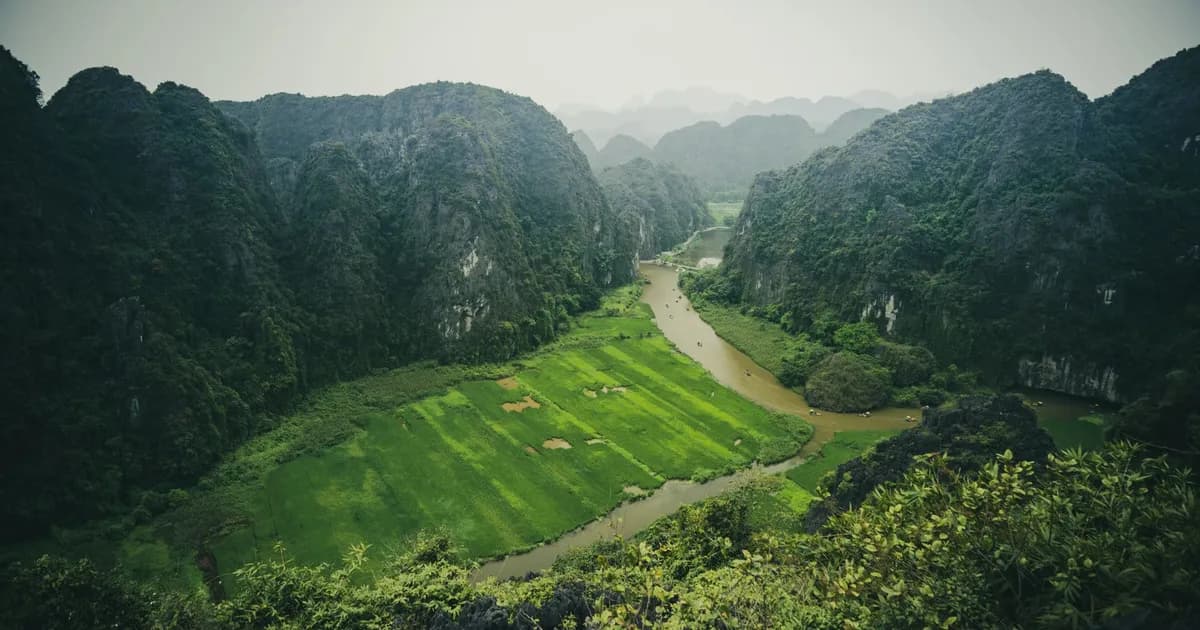

The Ngo Dong River at six in the morning carries almost no sound. A single sampan moves through the mist, its rower working with her feet, the limestone towers above her dissolving into low cloud. The rice paddies on either side are still dark. By nine, this same stretch will hold dozens of boats and the calls of vendors from the bank. But for now, the valley belongs to the people who live in it — and to anyone patient enough to have stayed the night.
Ninh Binh is ninety kilometres south of Hanoi, close enough to reach before lunch and easy to leave by dinner. That proximity is both its advantage and its problem. Most visitors do exactly that: arrive, take a boat, photograph the karst, return. What they miss is harder to schedule. It lives in the hours the tour buses don't cover — the early light, the dusk, the quiet cycling lanes between fish ponds and family shrines. Ninh Binh rewards a different kind of attention. The question is whether you're willing to give it.

A Landscape That Earns Its UNESCO Status
The Trang An Landscape Complex covers 6,172 hectares of flooded karst valleys, cave systems, rice fields, and forest. Inscribed in June 2014, it holds a distinction that matters: it is Vietnam's first and Southeast Asia's only mixed World Heritage property, recognised under both natural and cultural criteria. That dual status is not bureaucratic detail. It is the key to understanding what makes this place unusual.
Most karst landscapes earn their protection for geology alone. Trang An was inscribed because the geology and the human story are inseparable. The limestone massifs here record 250 million years of geological change — from ancient seabed to coastal plain to the tower karst visible today. The caves within them document over 30,000 years of continuous human occupation: tools, animal bones, and human remains from late Pleistocene hunter-gatherers who sheltered here as sea levels rose and fell around them.
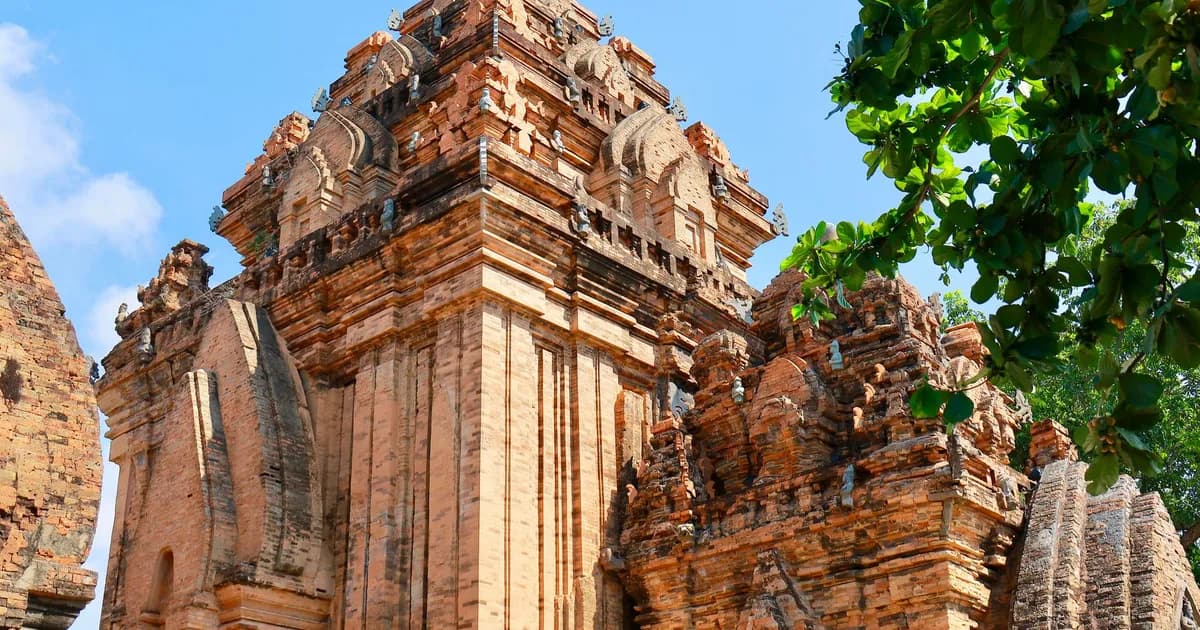
That deep time accumulates into the present. The 10th-century Hoa Lu citadel, capital of the early Vietnamese state of Dai Co Viet from 968 to 1010, was built not on an open delta plain but embedded in karst — the cliffs serving as natural defensive walls for King Dinh Bo Linh's court. The temples that remain, dedicated to Kings Dinh and Le, sit among limestone outcrops seven kilometres from the main Trang An wharf. They are not a detour. They are part of the same long story.
One request. Up to five tailored proposals.
Skip contacting agencies one by one — share your trip once and let up to five trusted Vietnam agencies come to you. Free, with no obligation.
Get my free quotesWhat the Boats Actually Show You
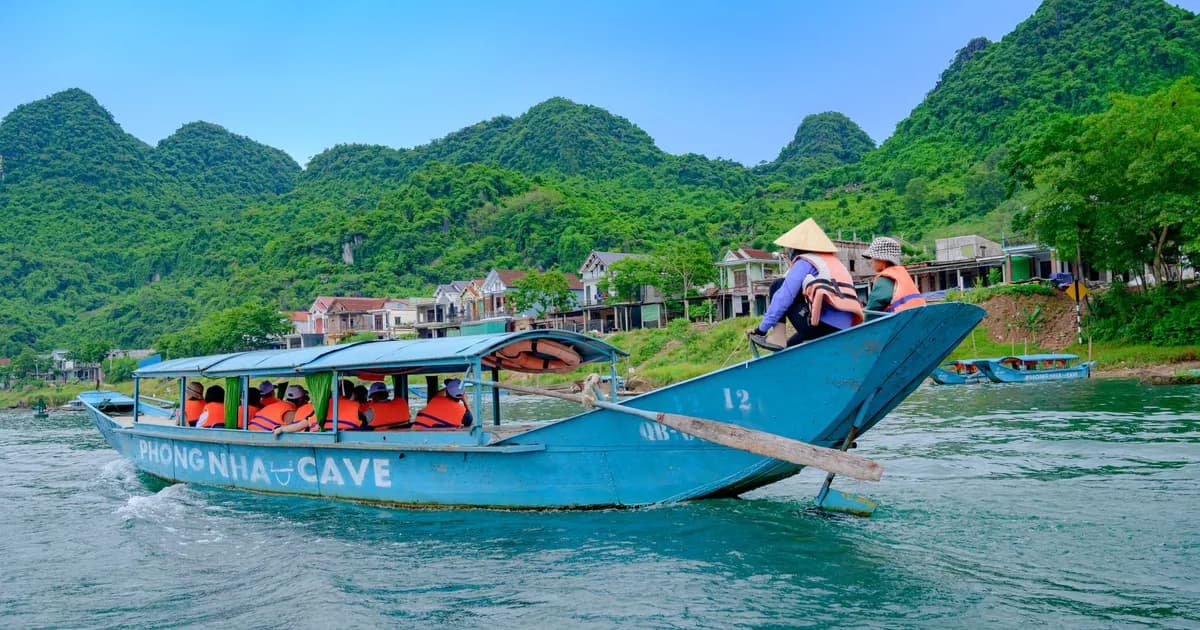
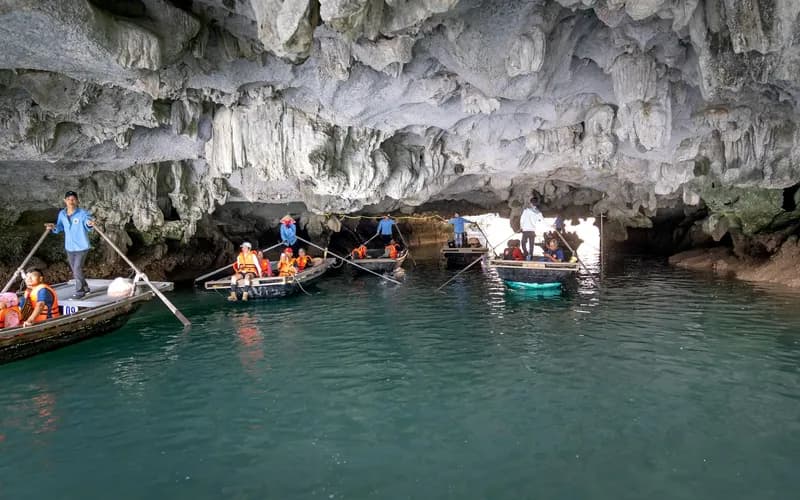
The defining experience of Trang An is the paddled sampan. Inside the core heritage waterways, boats are not motorised — a rule that protects both wildlife and the acoustic character of the valleys. Local rowers, many of them women from nearby villages, work on a rotation managed by the site authority, distributing income across households rather than concentrating it among a few operators.
The technique draws attention: many rowers use their feet on the oars, a regional practice that allows hours of paddling without exhausting the arms. It is efficient and quietly extraordinary to watch. On a rushed day trip, this registers as a curiosity. On a slower visit, it becomes a conversation — about water levels, about children, about whether the rice will be ready before the rains.
Trang An's boat circuits thread through cave tunnels where ceilings drop low enough that passengers must lean back, then open into enclosed valleys ringed by near-vertical cliffs. The Tam Coc section of the complex follows the Ngo Dong River through three natural cave tunnels — Hang Ca, Hang Hai, Hang Ba — flanked by paddies that shift from bright green in May to gold by harvest. These are not the same experience. Trang An's grotto system is more labyrinthine, more temple-dense. Tam Coc is more agricultural, more open. Both deserve a morning of their own.
Bich Dong Pagoda, an 18th-century complex built against a cliff face with shrines at three levels — lower, middle, and upper — is best visited after the last afternoon boats have returned. The incense smoke settles differently when the crowds have gone.
The Buffer Zone Is the Point
UNESCO's cultural landscape designation for Trang An includes a buffer zone of 6,268 hectares — slightly larger than the core — encompassing villages, rice fields, communal houses, and pagodas. This is not peripheral. It is integral to what the site protects: a continuing relationship between people and land, not a preserved ruin.
The best way to understand this is by bicycle. The valley floors between Trang An, Tam Coc, and Hoa Lu are flat, and the concrete lanes threading between them carry almost no traffic before eight in the morning. Loops of five to twenty kilometres are easy to design. Most homestays and small guesthouses in Tam Coc and Trang An villages offer bicycles at low or no cost.
What cycling reveals is the texture of the buffer zone as a lived place. Farmers transplanting rice a few metres from limestone cliffs. Monks collecting alms before the first tour buses arrive. Ducks being driven back from flooded fields at dusk. These are not performances arranged for visitors. They are the agricultural calendar continuing, largely indifferent to the heritage designation surrounding it.
The morning market in Ninh Binh town trades local produce and river fish before the day-trip rhythm begins. The communal houses and pagodas along the cycling routes hold rituals tied to the agricultural year and ancestor worship. These elements are why UNESCO inscribed Trang An under cultural criteria — not because the temples are grand, but because the interactions between people and environment are still ongoing.
Get matched with up to 5 trusted Vietnam agencies
- Free
- No obligation
- Up to 5 agencies
The Tension Worth Understanding
Ninh Binh is being positioned, carefully and officially, as a model for heritage tourism done well. The Trang An management board controls boat numbers and routes. Land-use planning restricts large-scale construction within the core zone and sets guidelines for the buffer zone to protect sightlines. Reforestation projects cover karst slopes. Waste management campaigns target the wharves and waterways.
The UNESCO World Heritage documentation is candid about the pressures: erosion in caves from heavy boat traffic, water quality risks from upstream agriculture, visual intrusion from unchecked construction, and the rapid shift of local livelihoods from farming to tourism services. These are not hypothetical threats. They are the predictable consequences of a landscape that went from regional attraction to international destination within a decade.
For slow travelers, this context shapes practical choices. Staying in a homestay or small ecolodge within an existing village — rather than a large resort built on converted rice land — aligns spending with the settlement patterns the buffer zone is designed to protect. Taking boats early or late, outside peak domestic holidays, reduces pressure on the cave systems. Cycling and walking rather than booking multiple motorised tours lowers noise and carbon footprint while deepening engagement with the agricultural landscape that gives Trang An its cultural value.
None of this requires sacrifice. It requires timing and a willingness to stay long enough for the place to show itself on its own terms.

Who This Place Suits, and When to Come
Ninh Binh is not for travelers who need a checklist confirmed by lunchtime. It is for those who find value in a second morning — when the route is familiar enough to notice what changed overnight, when the rower recognises you, when the pagoda is empty.
Autumn, from September through October, offers the clearest skies and most comfortable temperatures. The rice harvest around Tam Coc in late May and June brings vivid colour and the particular energy of working fields, though the heat is real and the sun reflects hard off the water. December through February is cooler and quieter, with softer light and fewer domestic tourists — though festival season in January and February reverses that calm.
Two nights is the minimum that makes the stay feel like a destination rather than an extension of Hanoi. Three nights allows both valleys, the Hoa Lu temples, a full cycling day, and the kind of unhurried morning that makes the whole province legible. The landscape does not reveal itself quickly. That, in the end, is precisely the point.
Frequently Asked Questions
Is a day trip from Hanoi worth it, or should I stay overnight?
A day trip allows one boat circuit and a brief look at the scenery. It does not allow sunrise on the water, cycling through the buffer zone, or visiting temples outside peak hours. Most travelers who stay at least one night describe the experience as qualitatively different — quieter, more personal, more memorable. Two to three nights is the range that makes Ninh Binh feel like a destination rather than an excursion.
When is the best time to visit Ninh Binh?
Autumn (September–October) is widely considered the most comfortable: moderate temperatures, clear water, and calmer weather. Late May and June bring vivid green rice paddies and lotus blooms but also heat up to 35°C. December through February offers cooler temperatures and softer light, though the Tet period and spring festivals (January–March) bring significant domestic crowds. Avoid major public holidays if you want quieter wharves.
How do I get from Hanoi to Ninh Binh?
The distance is roughly 90–100 kilometres. A limousine van takes 1.5 to 2.5 hours and costs around 150,000–250,000 VND one way. The train runs in approximately 2.5 hours for 100,000–200,000 VND depending on class, arriving at Ninh Binh station about 10–15 minutes by taxi from the main sites. Public buses are cheaper (80,000–100,000 VND) but slower and less comfortable. A private car costs roughly 1,200,000–1,600,000 VND per vehicle.
What do boat tours cost, and how do I avoid crowds on the water?
At Trang An wharf, tickets are commonly around 250,000 VND per person; boats hold four passengers plus the rower. To have a boat to yourself, paying for all four seats (approximately 1,000,000 VND per boat) is the standard approach. Tam Coc tickets run roughly 150,000–195,000 VND per person. Prices should be confirmed on-site, as official tariffs are not centralised in English. To avoid queues and crowded caves, go early — before 8am if possible — or in the late afternoon outside peak holiday periods.
What are the common frustrations travelers encounter?
The main wharves, particularly at Trang An and Tam Coc, can feel heavily commercialised during busy periods. Navigation between the province's spread-out attractions — Trang An, Tam Coc, Hoa Lu, Bich Dong — is awkward without your own transport; public connections are limited. Tipping expectations for boat rowers are socially present but not officially defined, which creates occasional awkwardness. Mid-day summer heat reflecting off water and limestone is genuinely uncomfortable without a hat and sun protection. Arriving with realistic expectations about the busy wharves — and knowing that the quieter experience lies in the hours around them — resolves most of these frustrations before they arise.