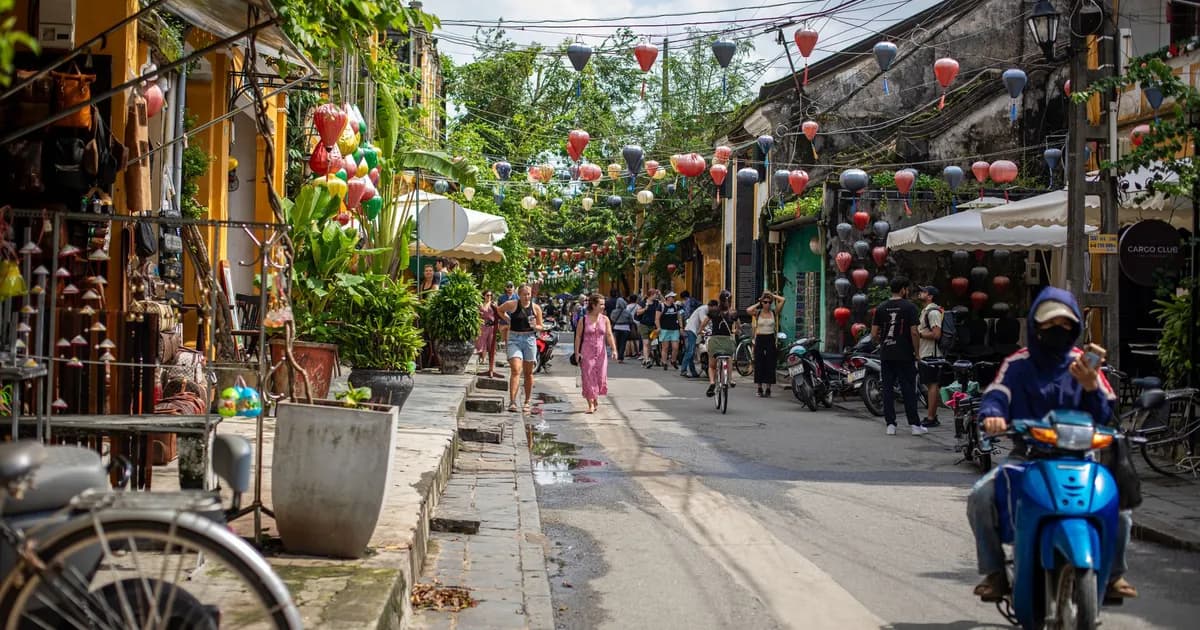
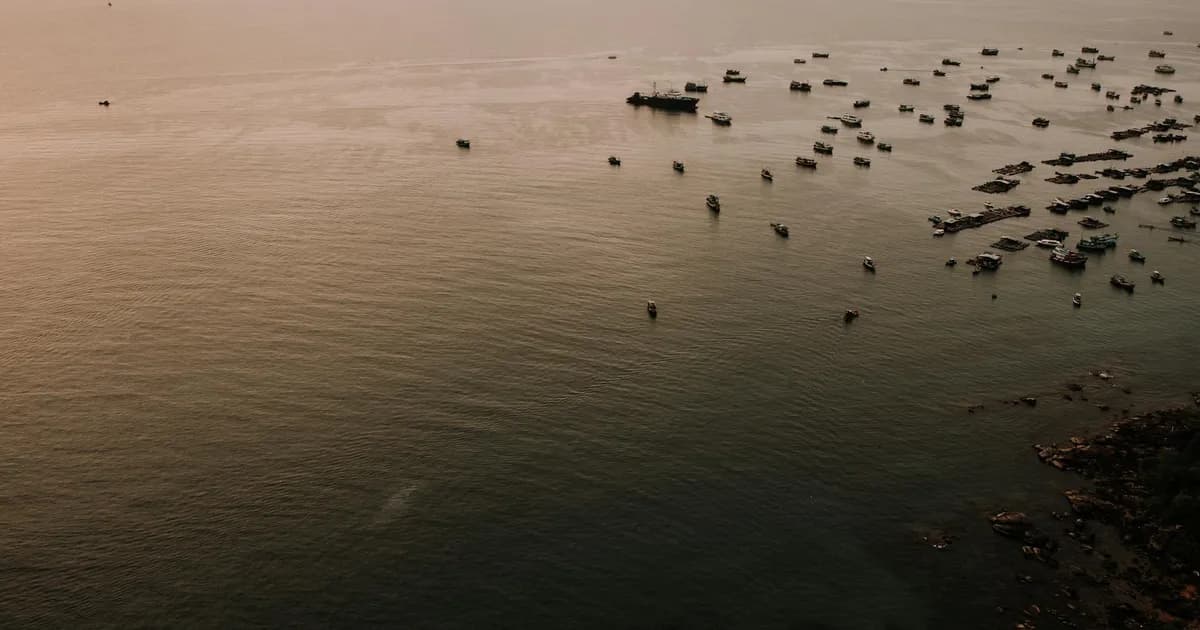

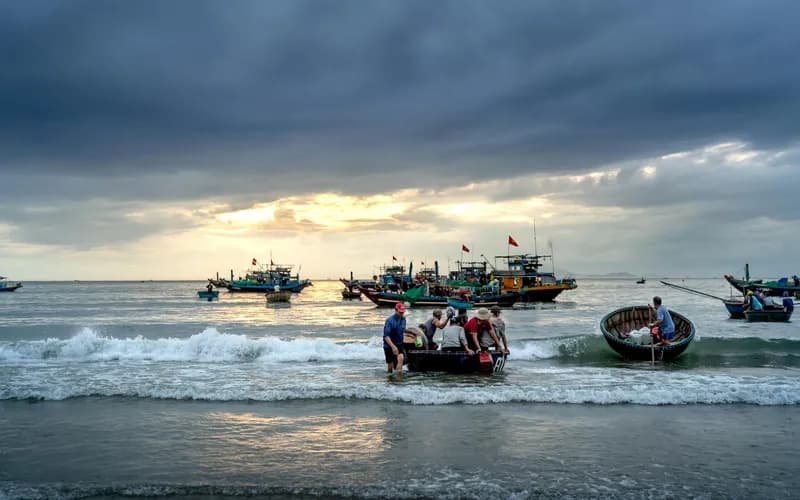
At five in the morning, the coracles are already out. Round-hulled and low in the water, they move through the grey light off Bai Xep with the unhurried confidence of things that have always been here. The fishermen don't look up. The beach behind them is empty except for a few cats and the smell of salt and diesel. This is Quy Nhon before tourism wakes up — and it is, for now, the more honest version of the city.
Quy Nhon is the capital of Bình Định province, on Vietnam's south-central coast, roughly halfway between Da Nang and Nha Trang. It has long beaches, clear offshore water, and a hinterland scattered with 12th-century Cham towers rising from rice fields. It also has a working harbor, a night market that serves locals first, and a cultural identity rooted in martial arts and historical rebellion rather than resort branding. The city is growing — domestic tourism has risen sharply, and international guides are beginning to take notice — but it remains, in 2025, on the right side of a threshold. There is enough infrastructure for a comfortable extended stay. There is not yet enough tourism to dilute what makes it worth staying for.

A Coast Shaped by More Than the Sea
Bình Định was once a heartland of the Champa kingdom, and the evidence is still standing. Tháp Đôi — the Twin Towers — sit inside Quy Nhon city itself, a pair of 12th-century brick structures with curved profiles and carved stone reliefs, set in a small park between ordinary streets. They are not roped off behind ticket queues. You can walk around them slowly, read the stonework, and leave without being photographed by a tour group.
Further into the province, the Bánh Ít towers and other Cham groups stand in rice paddies and on low hilltops, often with no more infrastructure than a dirt path and a caretaker. The transition from tower forecourt to working farmland takes about thirty seconds. That integration — ancient religious architecture absorbed into the texture of rural life — is something Quy Nhon offers that My Son, for all its grandeur, cannot quite replicate.
The region carries other layers too. Bình Định was the birthplace of the Tây Sơn rebellion, the 18th-century uprising that briefly unified a fractured Vietnam. Martial arts schools rooted in that tradition still operate in the province, and demonstrations are accessible to visitors willing to seek them out. This is not a city that wears its history lightly or performs it for cameras. It simply continues.
One request. Up to five tailored proposals.
Skip contacting agencies one by one — share your trip once and let up to five trusted Vietnam agencies come to you. Free, with no obligation.
Get my free quotesThe Beaches, and What They Ask of You
Ky Co and Eo Gió are the images that have begun circulating — pale sand, rocky headlands, water that shifts from green to deep blue depending on the hour. Both sit on the Nhơn Lý peninsula, a short drive or boat ride from the city center. Neither is empty on a Vietnamese public holiday. Both are, on a Tuesday in March, closer to solitude than anything you will find on Nha Trang's main bay.
Eo Gió — the Windy Pass — is less a beach than a series of sea cliffs and coves, best visited at sunrise when the light comes in low and the wind is still manageable. Small cafés have appeared along the walking paths, but the scale remains human. Ky Co has calmer water and a longer stretch of sand; the built-up area concentrates near the main entrance, leaving the flanks quieter.
The other beaches reward a different kind of effort. Bai Xep, south of the city, is a working fishing village with a small bay, simple guesthouses, and the kind of atmosphere that comes from a place not yet organized around visitors. Hon Kho island, reached by boat, has coral and clear water and modest snorkeling services run by local families. Cu Lao Xanh — Blue Island — sits further offshore, with homestays, motorbike loops, and beaches that see few foreign travelers.
None of these places are difficult to reach. Most require a scooter rental or a short boat trip rather than a long journey. But they do require a decision: to leave the city, to allow for some logistical looseness, to spend a day rather than an hour. That is, in a sense, the whole argument for Quy Nhon.
The Food Culture That Anchors a Longer Stay
Quy Nhon's food is not a side note. It is one of the primary reasons to stay longer than a weekend.
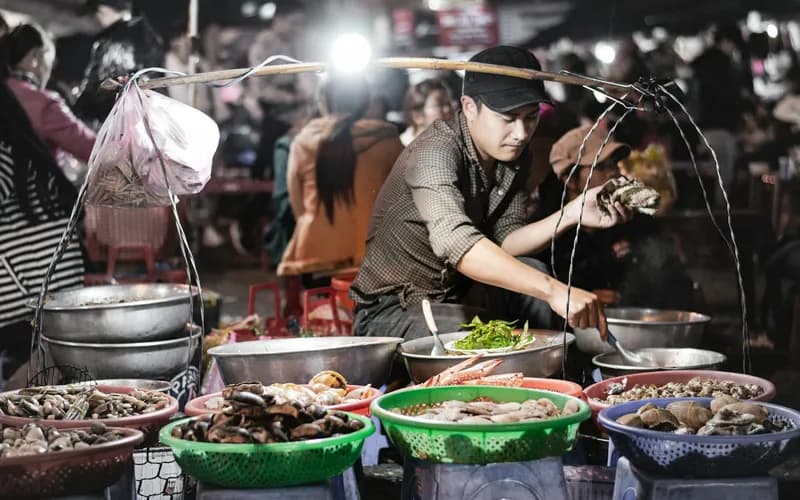
Bánh xèo tôm nhảy — small sizzling rice-flour pancakes filled with fresh shrimp — is a Bình Định specialty tied directly to the fishing economy. The shrimp arrive from the boats; the pancakes are made to order at family stalls that have been doing this for decades. Bún chả cá Quy Nhơn, a fish-cake noodle soup using regional species, is the standard breakfast, eaten at plastic tables on the pavement while the city moves around you.
The night market and the oceanfront food stalls serve a clientele that is overwhelmingly local. Prices reflect that. The seafood is fresh in the way that seafood is fresh when the boats come in a few kilometers away. Sitting at the same stall three mornings in a row, recognizing the cook, being recognized in return — this is the rhythm that slow travel is actually about, and Quy Nhon makes it easy to find.
Get matched with up to 5 trusted Vietnam agencies
- Free
- No obligation
- Up to 5 agencies
Who Quy Nhon Suits, and When to Come
This is not a city for travelers who measure a destination by its rooftop bars or its beach clubs. Nightlife is limited. Western-branded venues are few. The atmosphere after dark is local: families at the seafront, groups at the night market, the occasional café with music. For some travelers, this will register as a gap. For others, it is precisely the point.
Quy Nhon suits travelers who want to use time rather than money to unlock a place. The Cham towers, the offshore islands, the fishing villages, the martial-arts culture — none of it is expensive, but all of it takes days to absorb properly. Itineraries of five to seven days can be filled without repetition. Three days is enough to understand why you should have stayed longer.
The dry season runs roughly from February through October, and this is when the offshore islands are accessible and the water is clear. Storm season — September through December, with the heaviest disruption in October and November — can suspend boat trips for days at a time, making the island beaches effectively unreachable. Come in the dry months, and come with enough time to let the place settle around you.
Accommodation spans the full range: Anantara Quy Nhon Villas and Avani Quy Nhon Resort at the luxury end, midrange sea-view hotels in the city center, and simple guesthouses and hostels in Bai Xep and along the coast. Prices across all categories run below equivalent properties in Da Nang or Phu Quoc. The city is served by Phu Cat Airport, about 30 kilometers out, with daily flights from Hanoi, Ho Chi Minh City, and Da Nang. The Reunification railway line stops at Diêu Trì, 10 kilometers from the center. Overnight buses connect to Nha Trang, Da Nang, and Ho Chi Minh City.
The window that currently exists — enough infrastructure for comfort, not enough tourism to crowd the headlands — will not stay open indefinitely. The guides are already circling. The OTAs are already positioning. The moment to come is the one before the moment everyone agrees it has arrived.
Frequently Asked Questions
When is the best time to visit Quy Nhon?
The dry season, broadly February through October, gives you the most reliable conditions for beaches and island trips. July and August are the hottest months, with temperatures regularly above 30°C, but the water is calm and the offshore islands are fully accessible. Avoid October and November if island visits are a priority — storm season can suspend boat services for extended periods with little warning.
How do I get to Quy Nhon?
Phu Cat Airport (UIH) is the most direct option, with daily flights from Hanoi, Ho Chi Minh City, and Da Nang. The airport is about 30 kilometers from the city center; taxis and transfers are straightforward. Alternatively, the Reunification Express train stops at Diêu Trì station, 10 kilometers out, with onward connections by taxi or local bus. Overnight buses from Nha Trang, Da Nang, and Ho Chi Minh City are a slower but economical option used widely by independent travelers.
How many days should I spend in Quy Nhon?
Five to seven days is the range that allows you to move between the city beaches, the offshore islands, the Cham tower sites in the countryside, and the fishing villages without rushing any of them. Three days is a workable minimum if your time is limited, but it will leave you with a clear sense of what you didn't get to. Quy Nhon is a base, not a stopover.
Is it easy to get around independently?
Yes, with some planning. The city center is navigable by Grab or taxi. For the more appealing beaches — Ky Co, Eo Gió, Bai Xep — a rented scooter gives you the most flexibility and is widely available. Island trips to Hon Kho and Cu Lao Xanh are easiest through local day-tour operators, who handle the boat logistics and typically include lunch and snorkeling gear. Independent travelers comfortable with light logistics will find Quy Nhon very manageable.
What are the costs like compared to other Vietnamese beach cities?
Generally lower. Seafood meals at local stalls and family restaurants are inexpensive by any measure. Resort and hotel rates across all categories tend to run below equivalent properties in Da Nang or Phu Quoc. Day tours to the islands are priced as mid-range excursions rather than premium experiences. The city's food culture is oriented toward local residents, which keeps prices honest.