
There is a moment in every destination's life when the travelers who loved it earliest begin to leave. Not in anger, and not forever — but with a quiet recalibration, a rerouting. Vietnam is in that moment now, and what makes it interesting is that the recalibration is no longer happening at the margins. It has moved to the center of how experienced travelers plan, how operators pitch, and how provincial governments compete for attention. Crowd-avoidance has become a recognized travel value — not a niche preference but a shaping force. The question worth sitting with is not whether this shift is real. It is. The harder question is whether it solves anything, or simply moves the problem somewhere less photographed.
The Icons Are Not Disappearing — They Are Being Edited
Vietnam welcomed 12.6 million international visitors in 2023, surpassing its own target. The government has since set its sights on 17 to 18 million foreign arrivals in 2024, alongside 110 million domestic trips. Those numbers land somewhere. Ha Long Bay absorbed more than seven million domestic tourists alone in 2019. Ninh Binh received roughly 7.2 million visitors in 2023. Hoi An's ancient town core, Sapa's main streets, Tam Coc's boat queues — all carry the visible weight of that volume.
What is shifting is not whether travelers visit these places. Most still do, or plan to. What is shifting is the architecture of the trip around them. Experienced travelers — repeat visitors, long-haul planners, the growing cohort of Vietnamese urbanites designing their own domestic itineraries — are increasingly treating the icons as punctuation rather than substance. A single early-morning hour in Hoi An's old town. One night on a quieter bay. Then, elsewhere.
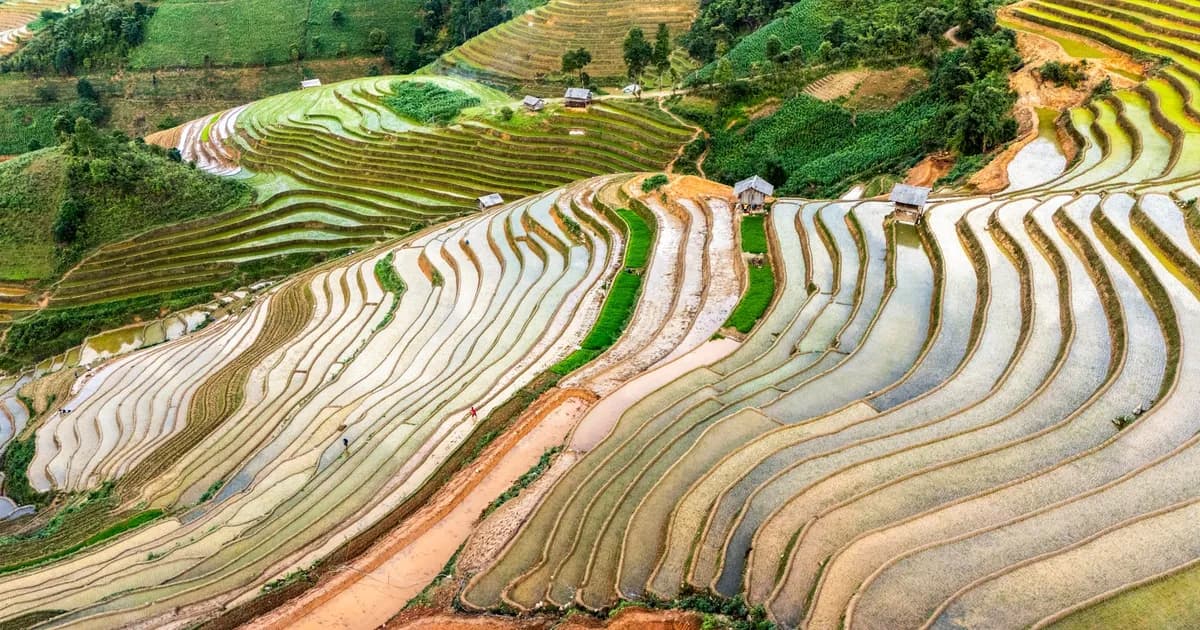
The elsewhere is the story. Vân Long Wetland, west of Ninh Binh city, is now explicitly recommended on forums and in travel media as a calmer alternative to Tràng An and Tam Coc — fewer boats, less noise, the possibility of seeing Delacour's langur on the limestone cliffs. Hoàng Su Phì, in Ha Giang province, is being framed in recent YouTube content as "how Sapa used to feel ten years ago" — terraced rice fields cultivated by Dao and Nùng communities, family homestays, no cable cars. Cam Thanh, just east of Hoi An, offers a version of the coconut waterways that can be quiet or chaotic depending entirely on which dock you choose and who you go with.
These are not random discoveries. They are deliberate substitutions, and that deliberateness is new.
One request. Up to five tailored proposals.
Skip contacting agencies one by one — share your trip once and let up to five trusted Vietnam agencies come to you. Free, with no obligation.
Get my free quotesA Policy Alignment That Is Also a Gamble
Vietnam's national tourism strategy has, for several years, emphasized dispersal — spreading visitors beyond the star attractions into rural provinces, wetland reserves, and highland communities. The logic is sound on paper: reduce pressure on overburdened sites, extend economic benefit to places that have seen little of it, develop a more resilient tourism base. Visa policy has been adjusted to support longer stays, with e-visas now valid for up to 90 days and available to travelers from all countries. Longer stays, the reasoning goes, produce travelers who explore more deeply rather than racing between the same five icons.
Provinces have responded. Ha Giang, Ninh Binh, and Lai Châu are actively courting visitors with community-based tourism frameworks, homestay development guidelines, and heritage designations. Hoàng Su Phì's terraced landscapes carry national heritage status. Vân Long sits within a protected nature reserve with formal restrictions on construction and farming in its core zone.
But the alignment between traveler behavior and government strategy, while real, carries a gamble embedded in it. The institutional capacity that now exists at Vietnam's most famous sites — however imperfect — was built in response to decades of pressure. Quang Ninh has restructured cruise licenses in Ha Long Bay. Hoi An has experimented with crowd management in the ancient town. These mechanisms are slow and incomplete, but they exist. At Vân Long, at Hoàng Su Phì, at Cam Thanh's quieter canals, they largely do not. The IUCN has documented the gap between Vietnam's conservation designations and its on-the-ground enforcement capacity. A protected area label is not the same as a protected area.
The Dispersal Paradox
There is a structural irony at the heart of this trend. The same travel media ecosystem that made Sapa famous, that turned Tam Coc into a conveyor belt, that filled Hoi An's streets with lantern-lit selfies — is now producing the content that sends travelers to Hoàng Su Phì and Vân Long. The mechanism is identical. Only the destination has changed.
Researchers and conservation practitioners working in Vietnam have been direct about this. Dispersal without governance does not reduce tourism pressure — it distributes it into environments with less capacity to absorb it. Secondary sites often lack zoning, carrying-capacity limits, and the benefit-sharing structures that, at their best, give local communities both income and a stake in protecting what draws visitors in the first place. Cam Thanh is already showing the strain: bank erosion from boat congestion, nipa palm damage, waste management problems at the busiest docks. The quieter canals still exist, but they require active effort to find and support.
The emerging consensus among practitioners is that dispersal must be paired with governance — clear limits, community-led models, monitoring that adapts as numbers change. Without that pairing, "hidden gem" is not a description of a place. It is a countdown.
For travelers, this reframes the choice. Selecting Vân Long over Tam Coc is not automatically a responsible act. It depends on which operator you book, how large the group is, whether the income reaches local households, and whether your presence reinforces or resists the extractive patterns now reaching Vietnam's quieter corners. The geography changes. The questions do not.
Get matched with up to 5 trusted Vietnam agencies
- Free
- No obligation
- Up to 5 agencies
What the Shift Actually Reveals
The crowd-avoidance trend is real, measurable, and growing. But it is worth reading it as a symptom before reading it as a solution. What it reveals, most clearly, is that a significant cohort of travelers has developed a more sophisticated relationship with Vietnam — one that values time over ticking, depth over coverage, and experience over evidence. That is genuinely good. It is the instinct that slow travel has always tried to cultivate.
What it does not reveal, on its own, is a path to protecting the places that benefit from that instinct. The traveler who spends three nights in a Hoàng Su Phì homestay, hires a local guide, eats at the family table, and leaves the terraces as they found them — that traveler is part of something worth building. The traveler who arrives because a YouTube video called it "the new Sapa," books through an external aggregator, and moves on in 36 hours is part of a different pattern, regardless of how far they traveled from the tourist trail.

Vietnam's tourism map is being rewritten. The rewriting is happening through individual choices, operator strategies, government policy, and the relentless logic of content sharing. All of those forces are in motion simultaneously, and none of them is fully in control. The destinations that will fare best are those where local communities have enough agency — and enough institutional support — to shape what arrives before it shapes them.
What Is Driving Discovery
Three forces are pushing this redistribution, and they work at different speeds.
The first is repeat visitation. Officials report a rising share of return visitors, particularly from nearby Asian markets and from long-haul travellers who now benefit from longer e-visa validity. Someone on a second or third trip has already done the classic circuit. They are not looking for Ha Long Bay; they are looking for what Ha Long Bay felt like before it became Ha Long Bay, and that search leads reliably to the adjacent alternative.
The second is digital media. Creators have spent two years building content around Quy Nhon's beaches, Pu Luong's terraces and Bai Tu Long's quiet anchorages, almost always with the same framing: go now, before it changes.
The third is the most structural. Vietnamese tourism authorities have started promoting secondary destinations formally, with provinces such as Binh Dinh and Phu Yen appearing at international roadshows. Policy is following the market rather than leading it. For the practical version of the same shift, see our swaps for the classic hubs and the case for Quy Nhon.
Frequently Asked Questions
Is crowd-avoidance in Vietnam a genuine shift or just a travel-media narrative?
It is both, and the distinction matters less than it might seem. The behavior is measurable: itinerary patterns on booking platforms, operator product development, provincial tourism investment, and forum discussions all point in the same direction. But travel media is also accelerating the shift by naming and validating it. The narrative and the behavior are feeding each other, which is precisely why secondary destinations face real pressure even as they are framed as escapes from it.
Does choosing a quieter destination make travel more sustainable?
Not automatically. The sustainability of a visit depends less on the destination's fame than on the conditions of the visit itself — group size, operator practices, length of stay, economic flows, and the governance capacity of the place receiving you. A well-managed day at Tràng An may have less environmental impact than an unregulated overnight at a wetland with no waste infrastructure. Geography is not a proxy for responsibility.
Why are places like Vân Long and Hoàng Su Phì vulnerable despite being protected areas?
Protection designations in Vietnam vary significantly in their enforcement capacity. Legal status establishes what should happen; institutional capacity determines what does. Many secondary sites lack the monitoring systems, zoning enforcement, and community benefit-sharing mechanisms that Vietnam's most famous destinations developed — imperfectly, over time — in response to earlier tourism waves. The designation offers a framework. It does not, on its own, provide the resources or governance to act on it.
What does Vietnam's visa policy change mean for how people travel there?
The extension of e-visa validity to 90 days, available to all nationalities, is designed to attract longer-stay, higher-spend travelers. The logic is that someone with 90 days moves more slowly, explores more provinces, and distributes economic benefit more broadly than someone on a two-week sprint between the five main icons. Whether that logic holds in practice depends on how travelers actually use the time — and whether the secondary destinations they reach have the infrastructure and governance to benefit from the attention.