
The Perfume River at first light carries almost nothing — a fishing skiff, a low mist, the silhouette of Thien Mu Pagoda on its hill. The city has not yet decided to be busy. This is Hue at its most legible: a place whose meaning accumulates in the quiet between monuments, in the steam rising from a bowl of bún bò Huế at a pavement stall, in the long shadow of a citadel wall that has survived dynasty, war, and the slower erosion of forgetting. Hue was Vietnam's imperial capital for nearly a century and a half, and that weight has not lifted. It has simply settled — into the river, the forested hills, the food, the particular unhurried tempo of a city that was once the center of everything and has since learned to hold its history without performing it. For travelers willing to slow down, few places in Southeast Asia offer this quality of depth.
The Imperial City: Grandeur, Ruin, and What Remains
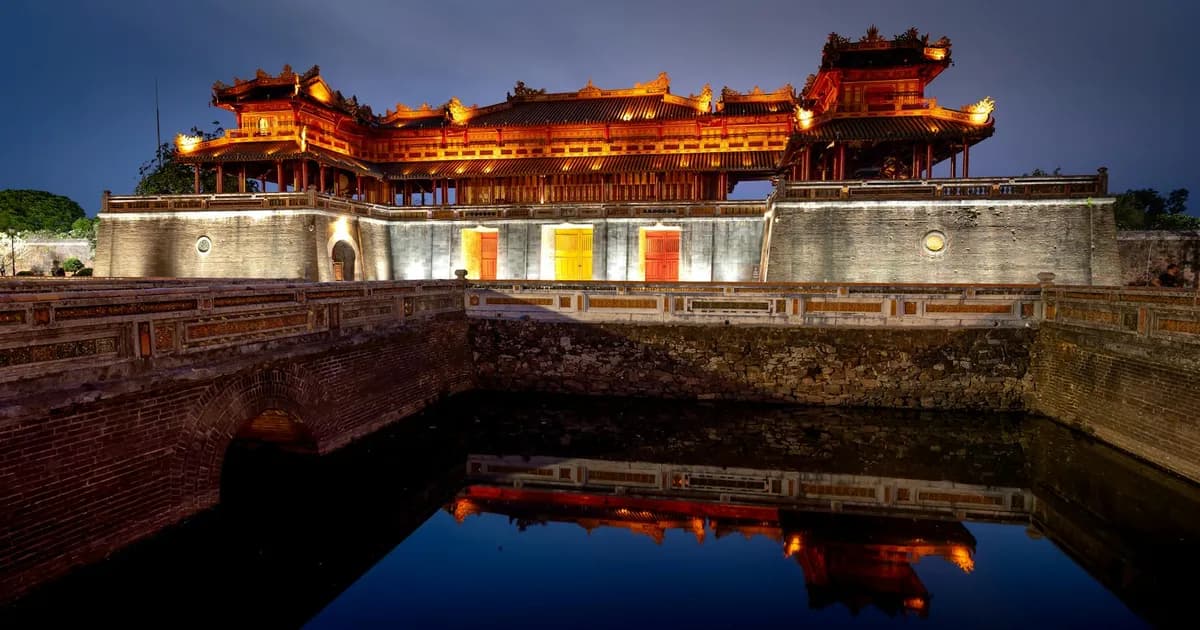
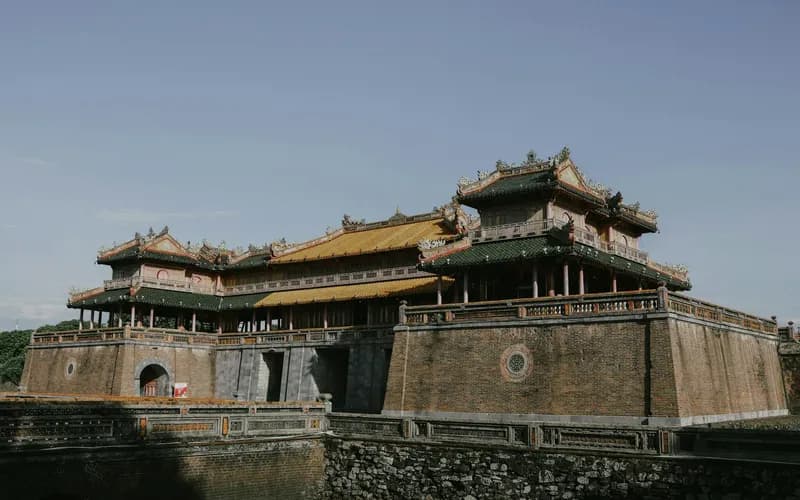
The Complex of Hue Monuments was inscribed as a UNESCO World Heritage Site in 1993, recognized as an outstanding example of an eastern feudal capital — one that integrated geomancy, Confucian planning, and Vietnamese architectural tradition into a coherent landscape shaped by river and mountain. Construction of the Imperial City began in 1804 under Emperor Gia Long and reached its present scale by 1833. At its height, the complex held around 140 structures spread across roughly four kilometers of walled enclosure.
Mid-twentieth-century conflict left deep marks. Sections of the citadel were heavily damaged, and the scars remain visible — not as failure, but as evidence. Restoration has been active since the 1990s, and the work continues today: scaffolding appears around major palatial structures, reconstruction proceeds alongside preservation, and the site is genuinely evolving. Visitors who arrive expecting a fully intact palace may need to recalibrate. What they find instead is something more honest — a layered space where restored grandeur and visible ruin coexist, where the past is neither frozen nor erased.
The Imperial City is also not a museum in the conventional sense. Locals use parts of the grounds as a park. Rituals take place at temple interiors. The site breathes. That quality — of a heritage complex still embedded in daily life — is precisely what distinguishes Hue from more thoroughly curated destinations.
Entrance costs 200,000 VND (around US$8.50) for adults, with reduced rates for children. The citadel opens at 6:30 in summer and 7:00 in winter, closing at 17:30 and 17:00 respectively. Modest dress is mandatory and actively enforced: shoulders and knees covered, no tank tops or short shorts, hats and sunglasses removed inside temple interiors. In Hue's humidity, light linen trousers and a loose long-sleeved shirt are the practical answer.
One request. Up to five tailored proposals.
Skip contacting agencies one by one — share your trip once and let up to five trusted Vietnam agencies come to you. Free, with no obligation.
Get my free quotesThe Tombs and the Hills: A Different Kind of Monument
Beyond the citadel, the Nguyen emperors built their tombs in the forested hills south of the city — each one a distinct architectural statement, each charged with a different personality. Minh Mang's tomb is formal and symmetrical, its lakes and pavilions arranged with Confucian precision. Tu Duc's is more intimate, almost melancholic, built by an emperor who spent years there writing poetry. Khai Dinh's is the outlier: a hillside structure that absorbs French colonial influence into its ornamentation without apology, its interior mosaics dense and theatrical.
These are not sites to rush. Each charges a separate entrance fee from the Imperial City ticket, and each rewards an hour of unhurried attention rather than a twenty-minute loop. The tombs sit in different directions from the city center, so grouping them logically — by location rather than by fame — saves time and allows for the kind of slow transit, by motorbike or bicycle, that lets the landscape register properly.
Thien Mu Pagoda, the seven-tiered tower that has become Hue's most recognizable silhouette, stands on a promontory above the Perfume River. The most considered way to arrive is by boat from the city center — a short journey that frames the pagoda as it was meant to be seen, rising from the water rather than approached from a car park.
The River as Spine
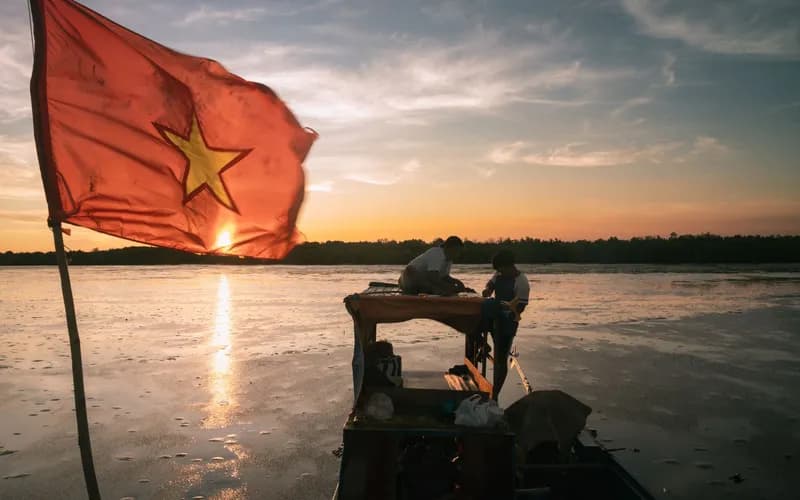
The Perfume River — Sông Hương — is not incidental to Hue. It is structural. The Imperial City stands on the north bank; the commercial city, hotels, and south-bank neighborhoods occupy the other side. Between them, the river carries the logic of the place: Dong Ba Market anchors the north-bank riverfront, opening from four in the morning and running until early evening, its stalls dense with produce, dried goods, and the particular organized chaos of a market that serves a real city rather than a tourist economy.
Evening on the south bank has its own rhythm. Riverside paths fill with locals after dark. Dragon boats offer sunset cruises that are neither kitsch nor perfunctory — the light on the water at dusk is genuinely worth the hour. The river also connects the city to its outlying sites: pagodas, garden houses, and the forested approaches to the tombs all lie along or near its banks, making the waterway a practical as well as symbolic thread through any multi-day itinerary.
For slow travelers, the river offers something rarer than a scenic backdrop. It offers orientation — a fixed point around which the city's layers can be read at whatever pace the day allows.
Get matched with up to 5 trusted Vietnam agencies
- Free
- No obligation
- Up to 5 agencies
The Table: Hue's Culinary Specificity
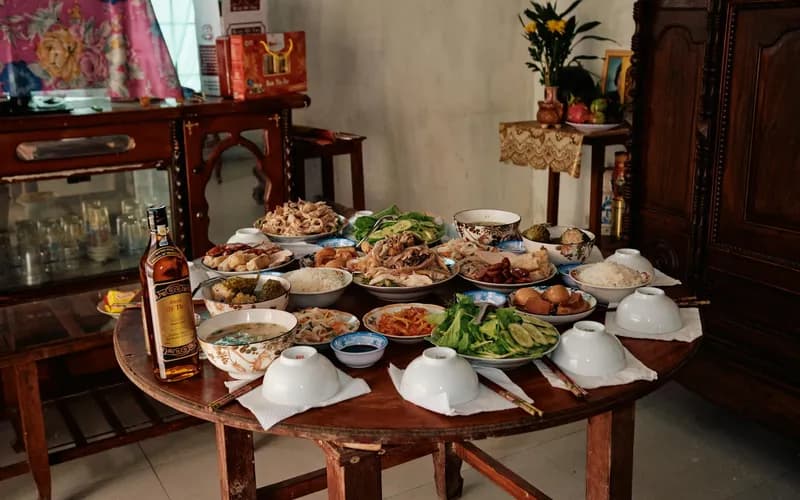
Hue's food culture is inseparable from its imperial history, and it does not travel well. Dishes that appear on menus in Hanoi or Ho Chi Minh City under Hue's name are often approximations — competent, sometimes good, but missing the particular calibration of spice, texture, and proportion that defines the original. This is not chauvinism. It is geography: Hue's cuisine evolved in a specific place, for a specific court, and its most characteristic expressions remain most fully realized there.
Bún bò Huế — the spicy beef noodle soup that is the city's most exported dish — is the entry point, but not the destination. The deeper pleasures are in the bánh: bánh bèo (steamed rice discs with dried shrimp), bánh nậm (flat rice dumplings wrapped in banana leaf), bánh bột lọc (translucent tapioca parcels with shrimp and pork). These are small, precise, and eaten in multiples — a style of grazing that suits the city's pace. Buddhist vegetarian cooking, tied to the pagoda culture along the river, adds another register entirely: elaborate, restrained, and worth seeking out on the first and fifteenth of the lunar month when it is most widely available.
The south-bank neighborhoods around Trương Định and the streets near Dong Ba Market reward an evening of progressive eating — moving between stalls and small restaurants, ordering by instinct, staying longer than planned.
How to Be in Hue: A Practical Frame
Three nights is the minimum for genuine engagement. One full day for the Imperial City — ideally with a return visit at a different hour, when the light and the crowds have shifted. A second day for the tombs and Thien Mu Pagoda, grouped by geography and taken at a pace that allows the forested hills to register as more than a backdrop. A third day for the market, the river, the neighborhoods, and the kind of purposeless wandering that is, in fact, the point.
The rainy season runs from September through December, with October and November carrying the heaviest rainfall and occasional flooding. These months are not impossible — mist on the river has its own atmosphere, and hotel rates drop — but cycling and motorbike excursions become less practical, and some outdoor sites lose their appeal in persistent downpour. February through August offers more reliable conditions for the kind of outdoor, multi-site exploration that Hue rewards.
Hue also sits naturally within a central Vietnam itinerary — between Hoi An and Da Nang to the south, Phong Nha and eventually Hanoi to the north. The temptation is to treat it as a transit point. The better instinct is to reallocate: fewer nights in overtouristed Hoi An, more in a city that has not yet been reshaped around the expectations of its visitors.
Frequently Asked Questions
When is the best time to visit Hue?
February through August offers the most reliable weather for outdoor exploration — visiting tombs, cycling along the river, and making day trips to Bach Ma National Park. October and November bring the heaviest rainfall and occasional flooding, which can disrupt transport and make outdoor sites less accessible. Shoulder months like January and September can work well for travelers who accept some rain in exchange for quieter streets and lower prices.
How do I get to Hue?
Phu Bai International Airport (HUI) connects Hue to Hanoi, Ho Chi Minh City, and other domestic hubs. Flight schedules change frequently, so check current routes close to your travel dates. Hue also sits on the main north-south railway line, and the train journey from Da Nang — crossing the Hai Van Pass — is one of the more scenic rail segments in Vietnam. From Hoi An, most travelers go via Da Nang by road or rail.
How much does it cost to visit the Imperial City and the royal tombs?
Entrance to the Imperial City costs 200,000 VND (around US$8.50) for adults; children aged 7–12 pay 40,000 VND, and children under 7 enter free. The royal tombs — Minh Mang, Tu Duc, Khai Dinh, and others — each charge separate entrance fees, posted at their respective gates. Local tour operators sometimes offer combined packages covering multiple sites in a single day, which can simplify logistics if you plan to visit several tombs.
Is the Imperial City worth visiting given the wartime damage?
Yes — though it helps to arrive with accurate expectations. The site is a mix of restored structures and visible ruins, and active restoration work means scaffolding is sometimes present. Many visitors find this combination more affecting than a pristine reconstruction would be: the damage is part of the history, and the ongoing restoration is part of the story of how Vietnam engages with its imperial past. The scale and atmosphere of the complex remain genuinely impressive.
What are the most common mistakes travelers make in Hue?
The most frequent is not allowing enough time. One day is enough to see the main sites; it is not enough to understand the city. Arriving without modest clothing is another common issue — the dress code at the Imperial City and temple sites is enforced, and being turned away in the heat is an avoidable frustration. Finally, many travelers skip the food culture almost entirely, treating meals as logistics rather than as one of Hue's primary reasons to visit.