
There is a particular kind of travel logic that only becomes visible when something breaks. Vietnam's domestic aviation network has been one of Southeast Asia's great success stories — cheap, frequent, connecting a long country that would otherwise take days to traverse. But when Vietnam's civil aviation authority confirmed in late March 2026 that fuel shortages linked to Middle East supply disruptions would force Vietnam Airlines to suspend 23 domestic flights per week from April 1, something shifted. Not dramatically. Not irreversibly. But enough to make a certain kind of traveler look again at the train.
That traveler was already inclined to look. The slow-travel current has been building for years among time-flexible visitors — Europeans on extended sabbaticals, remote workers threading through Southeast Asia, domestic millennials rediscovering a country their parents crossed by rail. What the aviation disruption did was not create this tendency. It accelerated it. It gave the train a practical argument to sit alongside the aesthetic one. And in doing so, it raised a more interesting question: is Vietnam's north-south rail corridor finally being taken seriously as a travel experience in its own right, rather than a fallback for people who missed their flight?
The Aviation Pressure Is Real, Even If the Rail Revival Is Still Emerging
Vietnam's aviation market has been scaling at a pace that leaves little room for error. Airports handled 83.5 million passengers in 2025, a 10.7 percent increase year-on-year, with projections pointing toward 95 million in 2026. The country operates 22 airports with a combined designed capacity of roughly 96 million passengers annually. At that margin, a fuel-supply shock does not need to be catastrophic to be disruptive. It just needs to be inconvenient enough, often enough, to change how flexible travelers plan.
The April 2026 cuts were concentrated on routes from Ho Chi Minh City, and major trunk routes were maintained. But the signal matters more than the scale. When an aviation authority cites Jet A-1 shortages as the reason for pulling scheduled services, and when airlines simultaneously prepare fuel surcharges on international routes, the message to the traveler is clear: the budget-aviation model that has defined regional mobility for a decade is not as frictionless as it appeared.
For slow travelers, this is less a crisis than a confirmation. Rail was always there. It just needed the right conditions to feel like a choice rather than a compromise.
One request. Up to five tailored proposals.
Skip contacting agencies one by one — share your trip once and let up to five trusted Vietnam agencies come to you. Free, with no obligation.
Get my free quotesWhat the Train Actually Offers
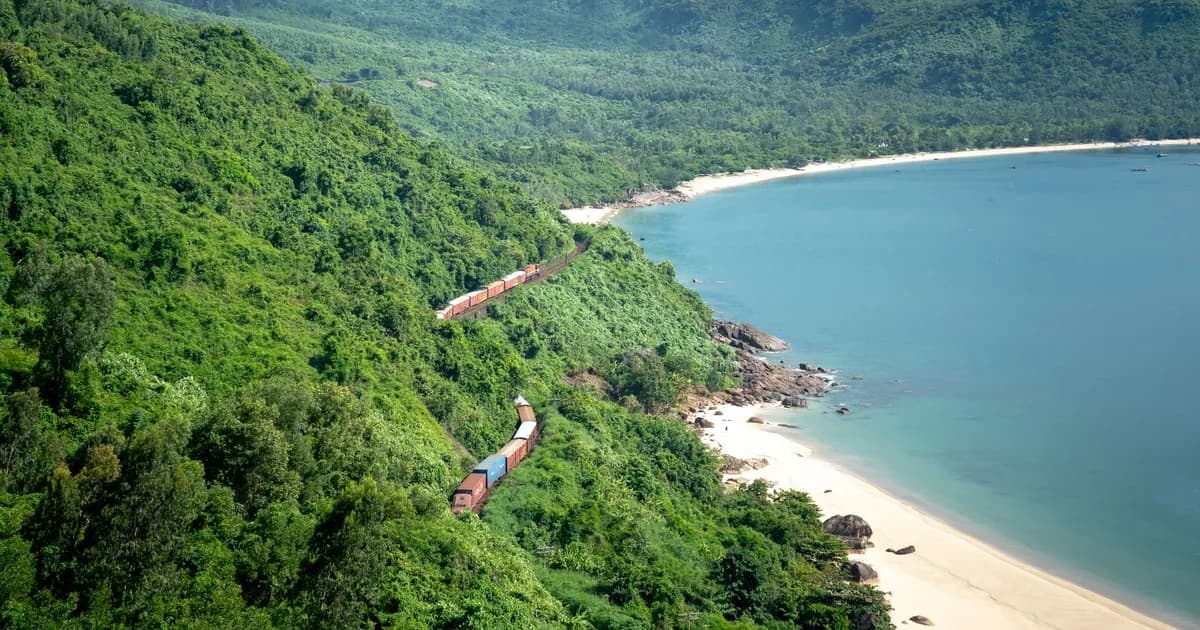
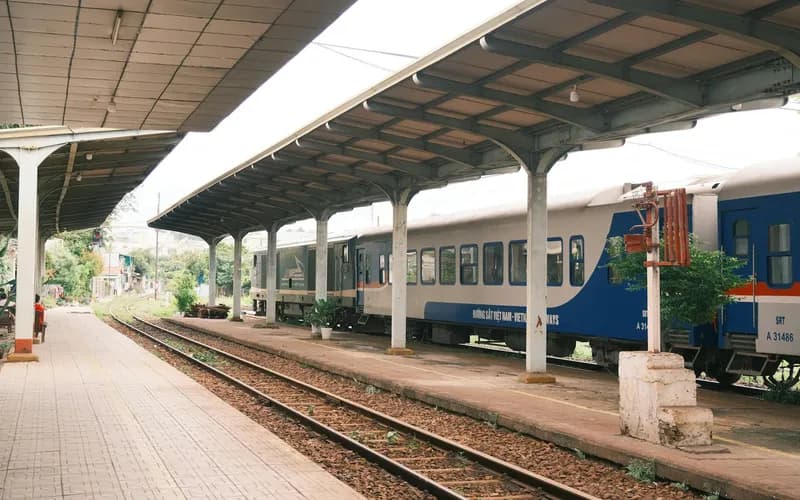
The north-south rail corridor is one of the more quietly compelling journeys in Southeast Asia. It runs close to 1,700 kilometers from Hanoi to Ho Chi Minh City, tracing the coast through Da Nang, Hue, Nha Trang, and a sequence of smaller stations that no domestic flight schedule has ever bothered to serve. The journey in full takes roughly 30 to 35 hours depending on the service. That number, which sounds like a deterrent, is precisely the point.
Slow travel is not about tolerating duration. It is about using duration differently. A sleeper berth on the Reunification Express between Hanoi and Hue is six hours of coastline, mountain pass, and the particular quality of Vietnamese dusk light over rice paddies — none of which is available from 35,000 feet. The train also arrives in the center of cities, not at airports that require an hour of transfer on either end. For a traveler spending three weeks rather than three days, the calculus changes entirely.
The more interesting development — still emerging rather than fully documented — is the hybrid itinerary: train for the coastal spine, coach or private transfer for the off-mainline towns that give Vietnam much of its texture. Hoi An has no train station. Neither does Mui Ne, or the Central Highlands towns around Dalat. But both are reachable by combining rail with a short road leg. Operators are beginning to build itineraries around this logic, though the category is still more travel-industry instinct than established product.

Flight-Shaming Is Not the Story. Practicality Is.
It would be easy — and wrong — to frame this moment as Vietnam's travelers suddenly developing an environmental conscience. The global flight-shaming conversation has had real cultural traction in parts of Northern Europe, but it has not been the primary driver of transport choices in Southeast Asia, where the budget airline transformed access to travel for hundreds of millions of people. Moralizing about aviation in this context misreads the room.
What is actually happening is more pragmatic. A segment of travelers — not all travelers, not even most travelers — is discovering that the train is competitive on its own terms when flights become unreliable or expensive. That segment tends to be time-flexible, experience-oriented, and already skeptical of the itinerary-as-checklist model that budget aviation enables. For them, the fuel disruption is not a crisis. It is permission.
The distinction matters because it shapes what kind of rail revival, if any, Vietnam is actually experiencing. This is not a mass migration from planes to trains. It is a recalibration among a specific traveler profile — one that slow-travel publications, boutique operators, and the more thoughtful corners of the tourism industry are well-positioned to serve.
Get matched with up to 5 trusted Vietnam agencies
- Free
- No obligation
- Up to 5 agencies
Vietnam as a Slow-Travel Corridor: Conditions vs. Commitment
The honest assessment is that Vietnam has the conditions for a credible slow-travel corridor without yet having the institutional commitment to one. The rail infrastructure exists. The scenery along the coastal route is genuinely exceptional. The country's length — over 1,600 kilometers from north to south — rewards travelers who move through it gradually rather than hopping between airport cities.
What is missing is the layer of curation that turns a transport network into a travel experience. Reliable sleeper upgrades, curated station-to-guesthouse transfers, itineraries that treat the train as the organizing logic rather than the connecting tissue — these exist in fragments, offered by individual operators rather than as a coherent category. Vietnam Railways itself has not yet positioned its product with the kind of narrative that, say, Japan's rail network or the European Interrail system has built over decades.
That gap is also an opportunity. The travelers who are already choosing the train — and the operators beginning to build around them — are defining what Vietnamese slow travel looks like before the category has a name. Aviation pressure is accelerating that process. Whether it produces something lasting depends on whether the industry meets the moment with genuine product development or simply waits for fuel prices to stabilize and returns to the default.
Frequently Asked Questions
Is the shift toward rail travel in Vietnam a genuine trend or just a response to a temporary disruption?
Honestly, both. The aviation fuel shortage that prompted Vietnam Airlines to cut 23 weekly domestic flights in April 2026 is a specific, time-limited event. But it is landing on top of a longer-running current: a segment of travelers who were already drawn to slower, more considered itineraries. Disruptions do not create trends — they reveal and accelerate ones that were already forming.
Does choosing the train in Vietnam actually reduce environmental impact compared to flying?
Generally, yes — rail produces significantly lower carbon emissions per passenger-kilometer than domestic aviation. But Unrush would caution against making this the primary argument for the train. The more durable case is experiential: the journey itself is richer, the destinations reachable are more varied, and the pace allows for a different quality of attention. Environmental benefit is real, but it works best as a secondary consideration rather than the headline.
Can rail realistically replace flights for most Vietnam itineraries?
For the coastal trunk — Hanoi to Da Nang, Da Nang to Ho Chi Minh City — rail is a genuine alternative for travelers with time. For off-mainline destinations like Hoi An, Dalat, or the Mekong Delta, a hybrid approach combining train with road transport is the practical answer. Rail cannot replace aviation wholesale, but it can anchor an itinerary in a way that makes the overall journey more coherent and less dependent on flight schedules.
What does the aviation disruption mean for travelers who have already booked domestic flights in Vietnam?
The April 2026 cuts were described as temporary and concentrated on specific Ho Chi Minh City routes, with major trunk services maintained. That said, when fuel supply is constrained, operational changes can happen quickly. Travelers with fixed itineraries should build buffer time between connecting segments and monitor rebooking policies. Those with flexibility might find this a natural moment to reconsider whether a train leg serves their route as well or better.