
Con Dao Islands: Vietnam's Eco-Luxury Archipelago on Its Own Terms
The beach at Bay Canh Island is dark by design. Rangers work by dim red light, moving quietly around a female green sea turtle who has hauled herself above the tide line to nest. She weighs perhaps a hundred kilograms. She has been doing this, on this island, for longer than the resort on the main shore has existed. The small group of visitors watching her — no more than a handful, booked weeks in advance — stands at a respectful distance and says nothing. This is Con Dao at its most essential: a place where the natural world still sets the terms.
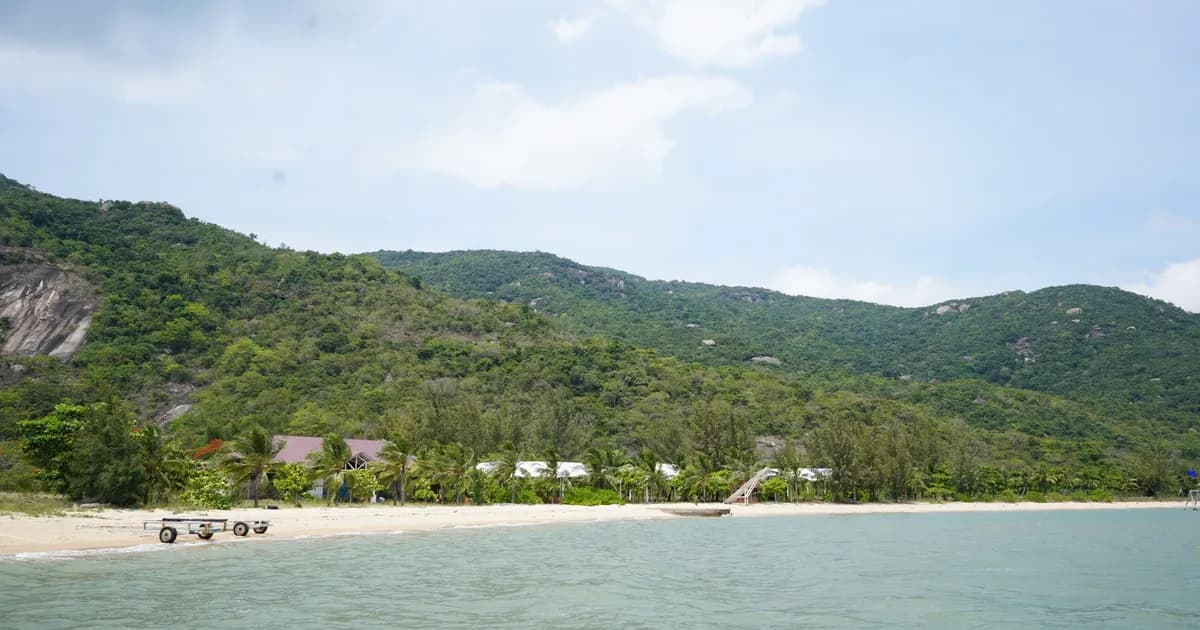
Con Dao is an archipelago of 16 mountainous islands and islets off Vietnam's southeastern coast, about 230 kilometres from Ho Chi Minh City. Most of it is national park. Most of the surrounding sea is a marine protected area. The main island, Côn Sơn, holds a small town, a colonial-era prison complex that is now a memorial site, and a handful of carefully positioned resorts. There is no casino strip, no tower block skyline, no jet-ski concession on every beach. That restraint is not accidental. It is the result of conservation status, geography, and planning controls that have, so far, held.

The Ecology That Earns the Journey
The ASEAN Centre for Biodiversity designates Con Dao's marine protected area as Vietnam's most important sea turtle nesting site (https://www.aseanbiodiversity.org/asean-heritage-parks/con-dao-marine-protected-area/), and the numbers behind that designation are serious. In a single recorded season, park rangers documented 750 nesting females, relocated nearly 2,400 nests, and managed the incubation of more than 227,000 eggs. Hundreds of thousands of hatchlings have been released under controlled conditions. Vietnam's national tourism board notes that Condé Nast Traveler named Vietnam among the world's top seven destinations for sea turtle release experiences, with Con Dao's programme cited as the primary reason.
The marine environment extends well beyond turtles. The reefs here are described by ASEAN as among the most pristine in Vietnam. Dugongs feed in the shallows. Indo-Pacific finless porpoises and Irrawaddy dolphins move through the surrounding waters. More than 66 marine species listed in the IUCN Red List or Vietnam's Red Data Book have been recorded in the protected area. On land, primary forest covers the steep interior hills, regulating water supply and preventing erosion — services that matter as much to the island's residents as to its visitors.
Conservation success here is real, but it is also fragile. A programme case study notes that park managers face ongoing shortages in human and financial resources, with threats from poaching, marine pollution, and storm damage continuing to press against the gains. The ASEAN Centre for Biodiversity recognises the Con Dao National Park Authority as one of the best park management boards in Vietnam — which is genuine praise, and also a reminder that even well-run protected areas operate under pressure.
One request. Up to five tailored proposals.
Skip contacting agencies one by one — share your trip once and let up to five trusted Vietnam agencies come to you. Free, with no obligation.
Get my free quotesA History That Cannot Be Separated from the Landscape
Con Dao's identity is not only ecological. For more than a century, the islands served as a prison colony — first under French colonial administration, then under successive wartime governments. The tiger cages, the isolation cells, the mass graves at Hang Duong Cemetery: these are not background details. They are the reason many Vietnamese visitors come here at all.
For domestic travellers, Con Dao functions as a pilgrimage site as much as a beach destination. The cemeteries are tended with care. Incense burns at the graves of political prisoners. Families arrive not for the reefs but for the dead. A foreign visitor who arrives expecting only a tropical island and encounters this dimension of the place may feel briefly disoriented. That disorientation is worth sitting with. It is part of what Con Dao is.
The prison buildings and memorial sites are preserved and open to visitors. Appropriate dress and quiet behaviour are expected — the same standards you would apply at any war memorial. Photography of mourners is intrusive. The combination of natural sanctuary and site of national trauma is unusual, and it gives Con Dao a gravity that purely recreational islands rarely carry.
The Eco-Luxury Question
Six Senses Con Dao is the resort most associated with the island's upscale positioning. It sits on a private beach where green sea turtles nest each season. When a female lays eggs on the resort's shoreline, staff relocate the clutch to a protected hatchery. Guests may be invited to observe under supervision. The experience is framed as eco-luxury: high comfort, conservation messaging, and genuine wildlife access mediated by trained staff.
This model — controlled, expensive, conservation-aligned — is not the only way to stay on Con Dao, but it is the most visible internationally. Smaller guesthouses and mini-hotels in Côn Sơn town offer a more local experience at a fraction of the price. Neither option involves the kind of resort sprawl that has reshaped Phu Quoc. The island's accommodation stock is simply too small, and the park boundary too close, for that kind of growth to have taken hold.
The honest question for any traveller considering an eco-luxury stay is whether the premium translates into genuine conservation benefit. At Con Dao, the answer is more credible than at many comparable destinations. WWF Vietnam's satellite-tagging programme, launched from the island, has tracked turtle movements across regional waters. The national park authority has a documented record of nest management and hatchling release. The infrastructure for responsible wildlife tourism exists and functions. That does not mean every operator meets the same standard — it means the framework is there, and choosing providers who work within it matters.
Get matched with up to 5 trusted Vietnam agencies
- Free
- No obligation
- Up to 5 agencies
How to Visit Without Eroding What You Came For
The nesting season runs broadly from April through October, with some sources extending the window from mid-March to late October. Turtle tours are limited in capacity and should be booked well in advance, particularly for the Bay Canh Island night excursions. The rules are clear: minimal artificial light, no loud noise, no touching the animals unless directed by trained staff. These are not suggestions. They are the conditions under which the programme operates, and operators who ignore them are not worth booking.
For divers and snorkellers, the reefs reward patience and good timing. Visibility varies with weather and season; local dive operators are the best source of current conditions. The reefs are a conservation asset, not a backdrop, and the same principle applies underwater as on the nesting beaches: the experience is better when the wildlife is undisturbed.
The island is quiet by design. There is one small town. Restaurants are modest in number. Nightlife is not a feature. Travellers who arrive expecting a curated resort island with abundant dining options and evening entertainment will find Con Dao underwhelming. Travellers who arrive with time, patience, and genuine interest in what the island actually offers — the forest trails, the memorial sites, the reefs, the turtles — will find it more than sufficient.
Five days is a reasonable minimum. Three days is enough to feel the place but not enough to understand it. The journey from Ho Chi Minh City involves a domestic flight, usually with a connection, and the schedule is subject to weather. Build in flexibility. The island will not apologise for the effort required to reach it.

Frequently Asked Questions
When is the best time to visit Con Dao?
The answer depends on what you are coming for. The sea turtle nesting season runs from approximately mid-March through late October, with peak activity between May and September. This is also the period when some weather disruption is possible, particularly from August onward. For diving, the calmer months between March and June tend to offer better visibility. The dry season, roughly November through April, brings more settled conditions overall but falls outside the main turtle window. Most travellers find that April through June offers the best balance: nesting season is active, seas are generally calm, and the island is not at its most crowded.
How do I get to Con Dao from Ho Chi Minh City?
The standard route is by domestic flight. Vietnam Airlines, Bamboo Airways, and Vietravel Airlines have operated services to Con Dao Airport on Côn Sơn Island, with flight times of around 45 minutes to an hour. Direct flights from Ho Chi Minh City are available; connections from Hanoi or other cities typically route through Ho Chi Minh City. Schedules and availability change seasonally, so confirm current routes with airlines before booking. A high-speed ferry service from Vung Tau also operates, covering roughly 185 kilometres; crossing times and seasonal availability should be checked with operators closer to travel dates, as rough seas can affect schedules.
How much does it cost to visit Con Dao?
Accommodation ranges from local guesthouses in Côn Sơn town — typically modest in price by Vietnamese standards — to eco-luxury villas at properties like Six Senses Con Dao, which sit at the upper end of the country's resort market. Turtle nesting tours and hatchling release experiences are priced at a premium relative to standard Vietnam tour costs, reflecting their limited capacity and conservation management. National park entry fees and boat permits apply for excursions to outer islands; current rates are published by the park authority and change periodically. Budget travellers can visit Con Dao meaningfully; the island's most important experiences — the memorial sites, the beaches, the forest trails — do not require a luxury resort.
What are the most common mistakes visitors make?
Underestimating the travel time and booking too few nights is the most frequent. The island rewards slow attention, and many of its highlight experiences — night turtle tours, multi-site diving, historical visits — are spread across days and contingent on conditions. Arriving without advance bookings for turtle tours is another common error; places are limited and fill quickly during peak season. A subtler mistake is treating the prison sites and cemeteries as scenic stops rather than active memorial spaces. They are places of mourning for many Vietnamese visitors, and that deserves recognition.
Is Con Dao suitable for families with children?
It can be, with the right expectations. The turtle hatchling release tours are genuinely moving experiences for older children, and the beaches are calm and safe in settled weather. The prison and memorial sites are sobering and may require careful framing for younger visitors. The island has limited children's entertainment infrastructure — no water parks, no organised kids' clubs outside the major resorts. Families who travel slowly and are comfortable with nature-focused itineraries tend to find it rewarding. Those expecting a resort-style family holiday with abundant activities may find the pace too quiet.