
Laos rewards the slow traveler more than almost anywhere else in Southeast Asia. It is a country of one great river, high green mountains, and towns where the day still turns on the temple bell and the market. There is no rush here, and no reason to manufacture one. This guide walks you through Laos region by region and month by month, so you can choose where to go, when to go, and — most importantly — how much to leave out.
First, the Mindset: Why Laos Is Different
Laos is landlocked, mountainous, and thinly populated, and it moves at its own pace. The roads are winding, the distances feel longer than the map suggests, and the joy of the place lies in staying put long enough for it to reveal itself: a second morning watching the alms procession in Luang Prabang, an extra day drifting between islands in the south, an unplanned afternoon on a guesthouse balcony above the Mekong.
The single most important decision you will make is how many places to visit — and the answer is almost always fewer than you think. A common mistake is to try to cover the whole country in ten days; the mountains and the slow transport punish it. Laos is a country to go deep in, not wide. This guide is organised to help you choose a region or two and give them the time they deserve. For what it all costs, pair this with our Laos budget guide.
One request. Up to five tailored proposals.
Skip contacting agencies one by one — share your trip once and let up to five trusted Laos agencies come to you. Free, with no obligation.
Get my free quotesWhen to Go: Laos Season by Season
Laos has three broad seasons, and they shape the country's character as much as its regions do.
Cool and dry (November to February) — the classic window
This is the peak season, and for good reason. Days are warm and clear, nights are cool — genuinely cold in the northern mountains, where a jacket is essential after dark — and the humidity drops away. Rivers are still high enough for boats, the countryside is green from the recent rains, and the skies are blue. It is the best time for trekking in the north, cruising the Mekong, and enjoying Luang Prabang at its most beautiful. The trade-off is that this is when prices and crowds peak, especially around the Western New Year and Lao holidays, so book trains and better hotels ahead.
Hot (March to May) — the quiet, hazy, festive shoulder
Temperatures climb steadily, peaking in April, which is also when agricultural burning blankets the north in haze — Luang Prabang and the mountains can be smoky, and views suffer. It is the low season, with fewer crowds and softer prices. But April also brings Pi Mai (Lao New Year), the country's biggest and most joyful festival, a three-day nationwide water fight and blessing that is worth planning a trip around if you don't mind the heat. The south and the river valleys are hot but the burning is less severe there.
Green and wet (June to October) — lush, dramatic, and underrated
The southwest monsoon brings afternoon downpours rather than all-day rain, and the country turns spectacularly green. Waterfalls thunder, rice paddies glow, the Mekong swells, and the crowds thin to almost nothing. This is a wonderful and often overlooked time to visit, especially the first half. The trade-offs are real — some remote roads and treks become difficult or impassable, and river levels can affect boat schedules — but for lush landscapes, low prices, and solitude, the green season is a slow traveler's secret. Kuang Si Falls and the Bolaven Plateau are at their most magnificent.
In short: November to February for the classic experience and trekking; the green season for lush scenery, low prices and quiet; April if you want to be immersed in Pi Mai. Our budget guide has more on how season affects costs.
The North: Mountains, Rivers, and the Heart of Laos
Northern Laos is, for many travelers, the reason to come — a landscape of jagged limestone mountains, ethnic-minority villages, and slow brown rivers, anchored by the country's most beloved town.
Luang Prabang — the essential first stop
A UNESCO World Heritage town at the meeting of the Mekong and Nam Khan rivers, Luang Prabang is the soul of Laos: gilded temples, French-colonial shophouses, saffron-robed monks, and a pace so gentle it recalibrates you within a day. Spend your mornings watching the dawn alms-giving (respectfully, from a distance), your afternoons at the turquoise Kuang Si Falls or climbing Mount Phousi, and your evenings at the excellent night market. It deserves at least three or four days — more if you let it slow you down, which it will. This is where most Laos itineraries begin.
Nong Khiaw and Muang Ngoi — the river-valley idyll
A few hours north, the small town of Nong Khiaw sits beneath dramatic limestone cliffs on the Nam Ou river, and just upstream, reachable only by boat, tiny Muang Ngoi is one of the most peaceful places in the country. This is the north at its best: viewpoint hikes, village walks, kayaking, and long unhurried afternoons watching the river go by. If Luang Prabang is the culture, this is the calm — and it is where slow travel in Laos truly comes into its own.
Vang Vieng — reinvented, and better for it
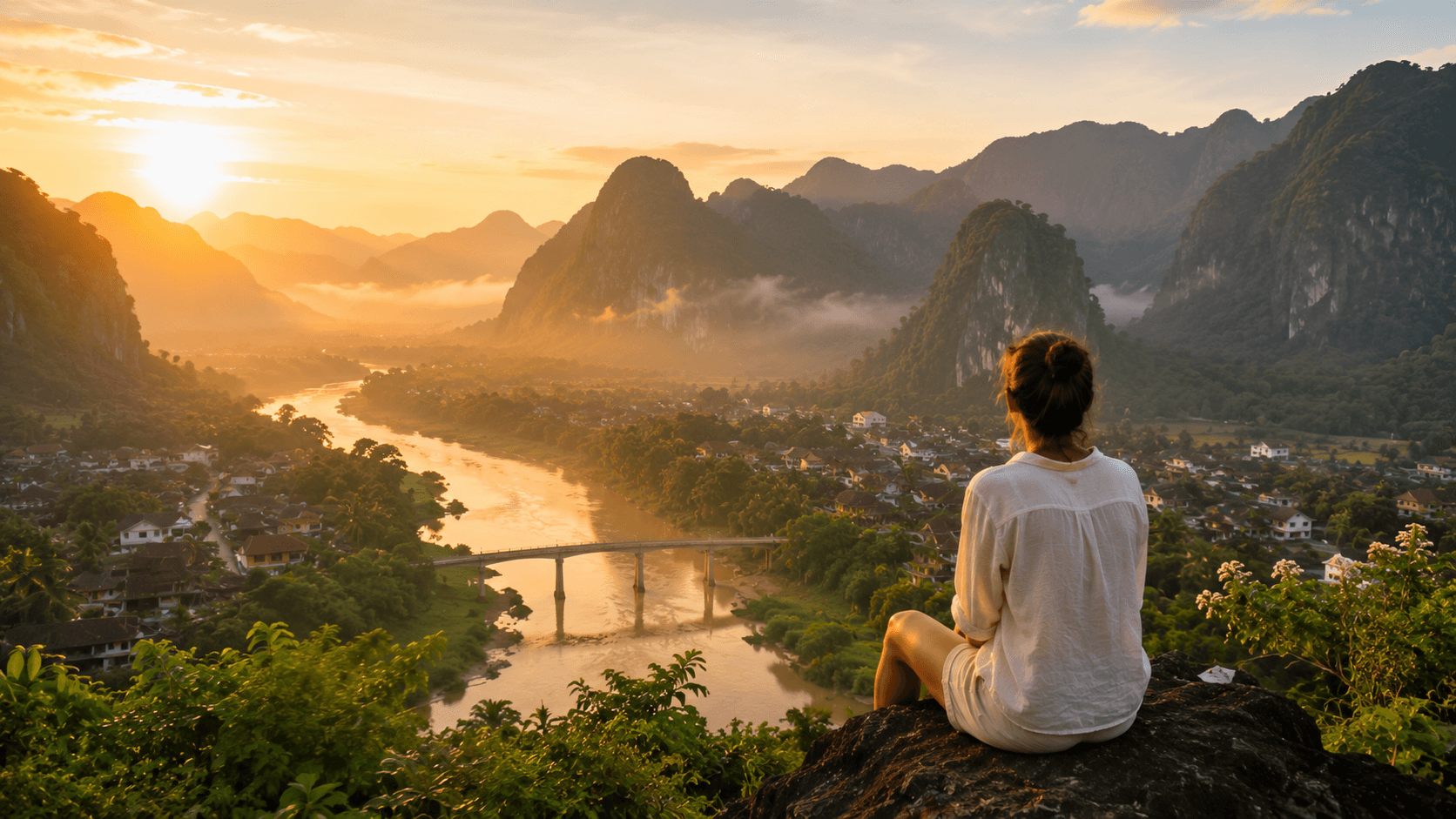
Once notorious for its party-tubing, Vang Vieng has grown up into an outdoor-adventure town set among some of the most photogenic karst scenery in Asia. Hot-air balloons drift over the mountains at dawn, and the days are for kayaking, caving, cycling through rice fields, and swimming in blue lagoons. It sits conveniently on the railway between Vientiane and Luang Prabang, making it an easy and rewarding stop.
Luang Namtha, Phongsali and the far north — for trekkers
For serious trekking and authentic ethnic-minority homestays, the far north around Luang Namtha (and the Nam Ha protected area) and remote Phongsali offers some of the best community-based trekking in Southeast Asia — multi-day walks through forest and hill-tribe villages, staying overnight with families. This is deep, rewarding, off-the-beaten-path travel for those with time.
The Mekong slow boat
Many travelers enter or leave the north via the classic two-day slow boat between Huay Xai (on the Thai border) and Luang Prabang, overnighting in Pakbeng. It is slow travel in its purest form — a drift past riverside villages and forest — and one of the region's signature journeys.
Get matched with up to 5 trusted Laos agencies
- Free
- No obligation
- Up to 5 agencies
The Centre: The Capital and the Loop
Central Laos is often passed through rather than lingered in, but it holds the capital and one of the country's great adventures.
Vientiane — the low-key capital
Southeast Asia's most laid-back capital sits on a bend of the Mekong facing Thailand. Vientiane is less a sightseeing checklist than an easy, walkable place to ease into Laos: golden Pha That Luang, the Patuxai victory monument, riverside temples, French-café culture, and the sobering, essential COPE Centre, which tells the story of the country's unexploded-ordnance legacy. A day or two is plenty for most, but it is a gentle, pleasant one.
The Thakhek Loop and Konglor Cave
For the adventurous, the Thakhek Loop — a multi-day motorbike circuit through central Laos's karst country — is a highlight, culminating in the astonishing Konglor Cave, a seven-kilometre river tunnel you travel through by longtail boat, emerging into a hidden valley. It is one of Laos's most jaw-dropping and underrated experiences.
The South: The Mekong Slows and Spreads
Southern Laos has a different rhythm again — hotter, flatter, more languid, and gloriously unhurried. Many travelers who make it here wish they'd allowed more time.
The Bolaven Plateau — coffee, waterfalls, and cool air
Rising above the southern plains, the Bolaven Plateau is cool, green, and laced with spectacular waterfalls and coffee plantations — Laos's coffee heartland. A loop by motorbike (out of Pakse) past thundering falls like Tad Fane and Tad Yuang, coffee farms, and ethnic villages is one of the south's great journeys, and a wonderful slow-travel circuit.
Champasak and Wat Phou
The sleepy riverside town of Champasak is the gateway to Wat Phou, a hauntingly beautiful pre-Angkorian Khmer temple complex set against a mountainside — a UNESCO site, far quieter than its famous Cambodian cousins, and all the more atmospheric for it.
The 4000 Islands (Si Phan Don) — where the journey ends
Where the Mekong braids into a maze of channels and islands just above the Cambodian border, the 4000 Islands are the spiritual home of doing nothing. On Don Det, Don Khon and Don Khong, you cycle past rice paddies and colonial ruins, watch for rare Irrawaddy dolphins, visit the powerful Khone Phapheng and Li Phi waterfalls, and swing in a hammock over the river as the sun goes down. It is the perfect, unhurried end to a Laos journey.
How to Put It Together: Suggested Slow Routes
The art of a Laos itinerary is subtraction. Here are four unhurried routes, scaled to time.
One week — the northern classic
Fly into Luang Prabang (3–4 nights), take the railway or bus to Vang Vieng (2 nights), then continue to Vientiane (1–2 nights) to fly out. A gentle, rewarding first taste of Laos with minimal transit, all along the railway corridor.
Ten days — north in depth
Luang Prabang (3 nights) → Nong Khiaw and Muang Ngoi (3 nights of river calm) → back to Luang Prabang or on to Vang Vieng (2 nights) → Vientiane (1–2 nights). This is the north done properly, with real time in the river valleys.
Two weeks — north and south
Combine the ten-day north with a flight from Vientiane to Pakse, then the Bolaven Plateau loop (2–3 nights) and the 4000 Islands (2–3 nights) to finish. This is the fullest picture of Laos without rushing — bookended by the country's two most magical regions.
Two-plus weeks — the deep slow trip
Add the Mekong slow boat in via Huay Xai at the start, or a far-north trek from Luang Namtha, or the Thakhek Loop in the centre. With this much time, you can travel Laos the way it wants to be traveled — slowly, and with room for the unplanned.
For help turning any of these into a real, bookable trip, our plan-your-journey page and our certified local agencies are the place to start — local partners are especially valuable in Laos, where the best experiences are remote and the logistics are slow.
Combining Laos With Its Neighbours
Laos sits at the heart of mainland Southeast Asia, and it slots naturally into a longer regional journey. The most popular overland connection is with Thailand: the Mekong slow boat from Huay Xai begins right at the Thai border, and there are easy crossings near Chiang Rai and at the Friendship Bridge by Vientiane. In the south, the 4000 Islands are a short hop from the Cambodian border, making a Laos-to-Cambodia overland route (ending near the temples of Angkor) a classic and logical journey. To the east, border crossings link Laos with Vietnam, and the new railway reaches the Chinese frontier. For slow travelers, these overland links are a gift — they let you feel the transitions between countries rather than skipping over them by plane, and they turn Laos from a standalone destination into the serene, green heart of a wider Indochina adventure. If you're weighing which country to pair it with, our destination guides for each neighbour can help you decide.
Choosing Your Base: Town, River, or Mountain
Part of planning Laos well is deciding what kind of place you want to wake up in. Town bases like Luang Prabang and Vientiane put temples, restaurants, and easy logistics at your doorstep — ideal for a first trip and for travelers who value comfort and culture. River bases like Nong Khiaw, Muang Ngoi, and the 4000 Islands trade nightlife and choice for something rarer: the sound of water, slow mornings, and a genuine sense of remoteness. Mountain and adventure bases like Vang Vieng, Luang Namtha, and the Bolaven Plateau put activity front and centre — trekking, kayaking, caving, cycling, and motorbike loops. Most rewarding trips mix at least two of these registers: a few cultured days in Luang Prabang followed by river calm in Nong Khiaw, or Vientiane's cafés bookending a Bolaven coffee loop. Deciding your balance of town, river, and mountain before you book makes the whole itinerary fall into place — and it's exactly the kind of shaping a good local partner can help with.
Getting Around Between Regions
Laos's geography makes internal transport a real consideration. The game-changing Laos–China Railway now links Vientiane, Vang Vieng and Luang Prabang in a couple of hours each — book ahead, as seats sell out. Beyond the railway corridor, buses and minivans connect everywhere else, slowly, on winding mountain roads. Domestic flights (Lao Airlines) make the long north–south jump — for instance Vientiane or Luang Prabang to Pakse — practical when time is short. And the rivers remain both transport and experience, from the Huay Xai slow boat to the longtails of the Nam Ou and the Konglor tunnel. Our budget guide breaks down the costs of each.
Festivals: Timing Your Trip Around the Calendar
Laos is deeply Buddhist and its festivals are woven into daily life, so timing a trip to catch one adds a rich extra layer.
The biggest is Pi Mai (Lao New Year) in mid-April, a three-day nationwide celebration of water-throwing, temple visits, and blessing. Luang Prabang hosts the most elaborate version, with processions, sand stupas on the riverbank, and an infectious, joyful chaos. It coincides with the hottest, haziest time of year, so it is a trade-off — but a memorable one.
In the green season, Boun Khao Phansa marks the start of Buddhist Lent (around July), and later Boun Awk Phansa (October) ends it with candle-lit processions and, in some towns, colourful boat races on the Mekong. Vientiane's That Luang Festival in November, around the full moon, is a spectacular religious fair at the country's most sacred stupa, and a wonderful way to open the cool season. Luang Prabang's own festivals throughout the year fill its streets with candlelight and music. If your dates are flexible, checking the Buddhist lunar calendar before you book can turn a good trip into an unforgettable one.
A Taste of Each Region
Food is one of the quiet pleasures of travelling Laos slowly, and it changes as you move. In the north, look for khao soi (the Lao version — a rich noodle soup topped with a savoury pork-and-tomato sauce, quite different from the Thai dish of the same name), fresh river fish, and the smoky flavours of highland cooking. Luang Prabang has its own specialities, including or lam (a hearty herbal stew) and river-weed crisps (khai pen) served with jaew bong, a sweet-spicy chilli paste. Everywhere, the constants are sticky rice, eaten by hand from a woven basket, and larb, the national minced-meat salad. In the south, the Bolaven Plateau's coffee is some of Asia's best, grown in volcanic soil and worth seeking out at source. Pairing your route with our sense of where to eat well is easy — the rule across the country is to follow the busy local restaurants and night markets, where the food is freshest and the value unbeatable.
Practical Tips for Moving Slowly
A few pieces of practical wisdom make a slow Laos trip smoother. Build in buffer days — transport delays are normal, and a rigid schedule is the enemy of the country's rhythm. Book the railway in advance, especially in peak season, and remember stations are outside town centres. Carry cash, as Laos is largely a cash economy and ATMs are scarce outside main towns; our budget guide covers the details. Dress respectfully at temples (covered shoulders and knees) and observe the alms-giving from a distance without intruding. Learn a few words of Lao — sabaidee (hello) and khop chai (thank you) go a long way and are warmly received. And pack for range: the northern mountains get genuinely cold at night in the cool season, while the southern lowlands stay hot year-round.
Travelling Responsibly in Laos
Laos is one of the least-developed countries in the region, and the choices travelers make have real weight here. Staying in locally owned guesthouses, eating at local restaurants, hiring local guides, and choosing community-based treks in the north keeps tourism income where it does the most good. Be thoughtful around the alms-giving ceremony in Luang Prabang — watch quietly from across the street, don't use flash, and don't buy sticky rice to offer unless you understand the ritual. Laos also carries the legacy of being one of the most heavily bombed countries in history; unexploded ordnance remains a danger in some rural areas, so stick to marked paths when trekking, and consider a visit to the COPE Centre in Vientiane to understand this history. Choosing operators with genuine community relationships — like those in our certified network — turns a holiday into something that leaves a place better than it found it.
The Slow Traveler''s Bottom Line
Laos is not a country to conquer; it is a country to settle into. The travelers who love it most are the ones who picked one or two regions, stayed longer than they planned, and let the river set the pace. Choose the north for mountains, culture and rivers; add the south for coffee, ruins and islands; and time your trip for the cool dry season or the lush, quiet green season depending on what you value. Then leave gaps in the plan — because in Laos, the gaps are where the best days happen.
This is the essence of the slow travel philosophy: fewer places, more time, deeper experience. Nowhere in Southeast Asia repays it better than Laos.
Frequently Asked Questions
What is the best time to visit Laos?
The cool dry season from November to February is the classic window — clear skies, comfortable days, ideal for trekking and river travel — but also the busiest and priciest. The green season (June to October) is lush, quiet and inexpensive, with dramatic waterfalls, though some remote roads get difficult. April is hot and hazy but brings the wonderful Pi Mai (Lao New Year) festival.
How many days do you need in Laos?
A week covers the northern classic (Luang Prabang, Vang Vieng, Vientiane); ten days lets you add the river valleys of Nong Khiaw and Muang Ngoi; two weeks allows both the north and the southern highlights (Bolaven Plateau and the 4000 Islands). Because transport is slow, it's better to see fewer places well than to rush.
Should I visit northern or southern Laos?
The north (Luang Prabang, the mountains, the rivers, the trekking) is the classic and most-visited region and the best choice for a first trip. The south (Bolaven Plateau, Wat Phou, the 4000 Islands) is hotter, flatter, quieter and wonderfully languid. With two weeks you can do both; with less time, choose the north.
Is the Laos–China Railway worth using?
Yes — it has transformed travel along the Vientiane–Vang Vieng–Luang Prabang corridor, turning long mountain bus rides into short, comfortable, inexpensive train journeys. Book ahead with your passport, as seats sell out, and allow for a short transfer since stations sit outside the towns.
Where should I go for trekking in Laos?
The far north around Luang Namtha (Nam Ha protected area) and remote Phongsali offer the best multi-day community-based treks with village homestays. Nong Khiaw has excellent shorter viewpoint hikes, and the Thakhek Loop and Bolaven Plateau in the centre and south offer motorbike-based adventure.
What is the 4000 Islands and is it worth visiting?
Si Phan Don (the 4000 Islands) is where the Mekong braids into a maze of islands near the Cambodian border. It's the country's most relaxed spot — cycling, colonial ruins, waterfalls, and rare Irrawaddy dolphins — and a perfect, unhurried end to a southern Laos trip, especially if you're continuing into Cambodia.
Do I need to book a trip through an agency, or can I do it independently?
Laos is very doable independently, especially the northern railway corridor. But the country''s best experiences — remote treks with village homestays, the Bolaven and Thakhek loops, well-timed river journeys — are run by small local operators, and information can be patchy. A good local agency saves time, secures scarce train seats and local rates, and unlocks access you''d struggle to arrange alone, which is why local partners add real value here. Many slow travelers do a hybrid: book the harder-to-arrange segments locally and keep the rest flexible.
Ready to plan? Start with our Laos budget guide, browse all our Laos travel guides, and build your route on the plan-your-journey page with our network of certified local agencies.