Renting a Motorbike in Thailand in 2026: Licences, Insurance and Police Checkpoints
A rented scooter is, for many travellers, the freedom of Thailand in physical form: the coast road, the mountain loop, the noodle stall you would never have found on foot. It is also the single most common way travellers get hurt or land themselves in an expensive legal mess. The rules in 2026 are not complicated, but they are widely ignored, and the gap between "everyone does it" and "it is legal" is where the trouble lives. This is the honest, practical version of what you need to ride within the law and stay insured.
Can foreign tourists legally ride in Thailand?
Yes, but only with the right paperwork, and most travellers who rent do not have it. To ride a motorbike or scooter legally in Thailand as a non-ASEAN tourist, you need a valid motorcycle licence from your home country plus an International Driving Permit (IDP) that specifically covers motorcycles. A great many people rent with nothing more than a passport and a car licence, and the rental shops will hand over the keys anyway. That does not make it legal, and it has real consequences the moment something goes wrong.
The shop's willingness to rent is not a measure of legality. Rental businesses are not enforcing licensing law; they are renting bikes. The responsibility, and the liability, sits entirely with you. Understanding entry and travel rules more broadly, as we cover in our 2026 Thailand entry rules guide, is part of the same mindset: know the rules that apply to you before you arrive.
One request. Up to five tailored proposals.
Skip contacting agencies one by one — share your trip once and let up to five trusted Thailand agencies come to you. Free, with no obligation.
Get my free quotesThe licence and IDP rules for 2026
The core requirement is a combination, not a single document. You need your original home-country driving licence with a motorcycle entitlement, and an IDP that carries the motorcycle category, usually shown as category "A". This is the detail that catches people out: a car-only IDP does not cover a scooter, even a small one. If your home licence does not include motorcycles, an IDP cannot add that entitlement, and you are not legally permitted to ride here regardless of engine size.
The IDP itself is only a translation of your national licence, not a licence in its own right. That means you must always carry both together: the IDP and the original licence it translates. Presenting one without the other at a checkpoint is treated as riding without a valid permit. Arrange the IDP in your home country before you travel, because it cannot be issued once you are already in Thailand.
Which IDP you need: 1949 versus 1968
There are two international conventions behind IDPs, and in 2026 the distinction matters more than it used to. Thailand ratified the 1968 Vienna Convention in 2020, and the 1968-style IDP is valid in Thailand for up to three years, compared with just one year for the older 1949-style permit. If you are travelling for an extended period, or you simply want the longest-lasting document, request the 1968 IDP where your country issues both. Either way, check the validity dates carefully; an expired IDP is treated as no IDP at all.
For long-stay slow travellers in particular, the longer-lived 1968 permit removes a recurring administrative headache. It is a small piece of preparation that pays for itself the first time you are waved into a checkpoint.
Get matched with up to 5 trusted Thailand agencies
- Free
- No obligation
- Up to 5 agencies
Police checkpoints and fines
Roadside checkpoints are a routine part of riding in tourist areas. They are especially common in and around Phuket, Krabi, Pattaya and Chiang Mai, and they are set up precisely where rental scooters are thickest. Officers check for a valid licence and IDP, a helmet, and registration. If you cannot produce a valid licence and IDP, expect a fine, typically in the range of 500 to 2,000 baht, issued as a ticket you pay on the spot or at a nearby police station.
A fine is the mild outcome. In some cases the bike can be detained, and you are left arranging its recovery. More importantly, being unlicensed at the moment of a stop is the same status you will hold at the moment of an accident, and that is where the cost stops being a few hundred baht. Riding through the Mae Hong Son loop or any popular route does not exempt you from checks; if anything the well-travelled roads are the most patrolled.
Insurance: the part that really matters
This is the section to read twice. If you ride without the licence and IDP that Thai law requires, your travel insurance will very often refuse to pay a medical or liability claim arising from a motorbike accident. Policies routinely exclude cover when you were not legally entitled to operate the vehicle. Given that serious motorbike injuries in Thailand can run to hundreds of thousands of baht in hospital bills, and that repatriation costs far more, this is not a technicality. It is the difference between an insured accident and financial catastrophe.
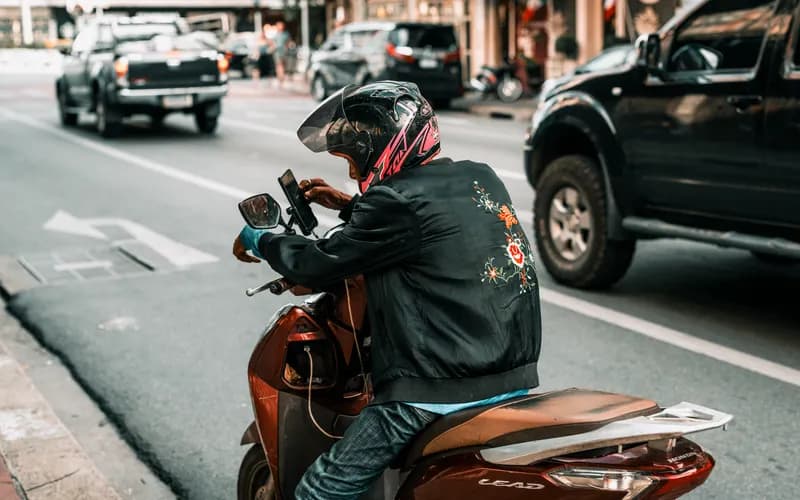
The "insurance" a rental shop mentions is usually just the compulsory minimal third-party cover attached to the bike, which does little for your own injuries or for serious damage. Do not confuse it with real cover. Before you rent, confirm in writing that your own travel policy covers motorcycle riding, that it covers the engine size you intend to rent, and that it requires a valid licence, which you then make sure you hold. Skipping any one of those steps quietly voids the protection you are counting on.
Helmets, deposits and the paperwork trap
Helmets are legally required for rider and passenger, and helmet checks are a common reason for being stopped. Wear one that fits and fasten it; the cheap shop helmet is better than the fine, and far better than the alternative. Beyond the law, a helmet is the single most effective thing you can do to survive a spill.
On deposits, a widespread practice is for shops to ask for your passport as security. Avoid it. Your passport is the one document you cannot afford to have held hostage in a dispute over a scratch, and losing access to it can derail your whole trip. Offer a cash deposit or a photocopy instead, and if a shop insists on the passport, walk to the next one. Before riding off, photograph every existing scratch and dent, film a slow walk-around, and keep the images; the classic scam is a damage charge at return for marks that were already there.
Renting responsibly: choosing a bike and shop
Match the bike to your experience, not your ambition. A small automatic scooter is plenty for town errands and flat coastal roads; mountain routes and long distances call for a larger, better-maintained machine and a rider who knows how to use it. Check the brakes, tyres, lights and horn before you accept the bike, and reject anything with bald tyres or a soft brake lever. A reputable shop will not mind; a careless one is a warning in itself.
If riding is not really your skill, there is no shame in the alternative. Songthaews, buses, grab cars and local drivers reach almost everywhere a scooter does, and a good local operator can arrange transport that removes the risk entirely. Our travel agencies directory lists specialists who can build a trip that does not depend on you riding.
Riding safely on Thai roads
Thailand's roads are among the more dangerous in the region, and rented scooters feature heavily in the statistics. Ride defensively, assume you are invisible to other traffic, avoid riding at night and after drinking, and give yourself far more room than you would at home. Sand, gravel, sudden rain and oncoming vehicles overtaking blind are the everyday hazards. None of this should stop a competent, licensed rider from enjoying one of travel's real pleasures, but it should be met with respect rather than the casual bravado the rental culture encourages. This is exactly the kind of considered, unhurried approach our slow travel charter argues for.
It also helps to plan your riding days deliberately: shorter distances than you think, an early start to avoid afternoon storms and fading light, and a real rest when concentration flags. Fatigue on an unfamiliar bike, on unfamiliar roads, in unfamiliar heat, is an underrated hazard. Treat the ride itself as part of the experience to be savoured, not a transfer to be rushed, and both your safety and your enjoyment improve at once.
What to do next
- Before you leave home, get an IDP that covers motorcycles (category A), ideally the 1968 version, and pack it with your original licence.
- Confirm your travel insurance covers motorcycle riding at the engine size you plan to rent, and that you hold the licence it requires.
- At the shop, inspect the bike, photograph existing damage, refuse to hand over your passport, and take a helmet that fits.
- Carry your licence and IDP every time you ride, and expect checkpoints in tourist areas.
- If riding is not for you, plan an itinerary around buses, songthaews and local drivers using our plan your journey page.
Frequently Asked Questions
Do I really need an International Driving Permit to rent a scooter in Thailand?
Yes. To ride legally as a non-ASEAN tourist you need your home motorcycle licence plus an IDP that covers motorcycles. Rental shops will often rent without checking, but that does not make riding legal, and being unlicensed can void your insurance and bring a fine at a checkpoint.
Does a car licence or car IDP cover a motorbike?
No. A car entitlement, whether on your home licence or your IDP, does not permit you to ride a motorcycle or scooter, regardless of how small the engine is. You need a motorcycle entitlement on your home licence and the motorcycle category on your IDP.
How much is the fine for riding without a licence?
Checkpoint fines for lacking a valid licence and IDP typically fall between 500 and 2,000 baht, paid as a ticket. The bike may also be detained. The far greater risk is that an accident while unlicensed can leave your travel insurance refusing to pay medical or liability costs.
Should I leave my passport as a deposit?
No. Offer a cash deposit or a photocopy instead. Handing over your passport gives a shop leverage in any dispute over damage and risks leaving you without your most important document. If a shop insists on holding the passport, rent elsewhere.
Which IDP should I get, the 1949 or 1968 version?
Where your country issues both, choose the 1968 Vienna Convention IDP: since Thailand ratified that convention it is recognised here for up to three years, against one year for the 1949 permit. Always check the validity dates, and carry the IDP together with your original national licence.
Keep reading
More from the ground · Thailand