Mae Hong Son Loop: Northern Thailand's Great Slow Mountain Circuit
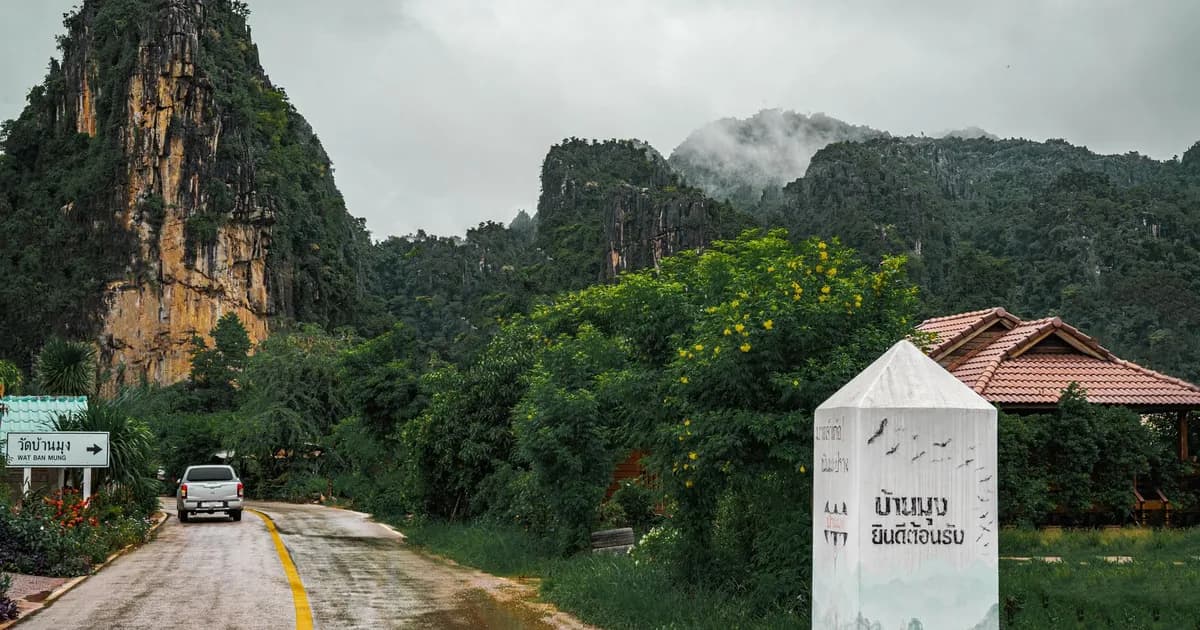
Some roads are made for covering distance. The Mae Hong Son Loop is made for the opposite. This 600-kilometre mountain circuit through the far northwest of Thailand climbs over more than a thousand hairpin bends, and every one of them is an argument for slowing down. Rush it and you will remember only nausea and fog. Give it a week and it becomes one of the most rewarding slow journeys in Southeast Asia: Shan temples, misty valleys, hot springs, hill-tribe villages and towns where the traffic is water buffalo, not tour buses.
The loop, and why it rewards slowing down
The classic route runs from Chiang Mai in a rough circle: north to Pai, west to Mae Hong Son town, south through Khun Yuam to Mae Sariang, then back east to Chiang Mai. You can ride it clockwise or anticlockwise, and the towns are the same either way. What changes with direction is only the order of the climbs.
The mistake most travellers make is treating the loop as a three-day dash. The road demands respect: 1,864 curves by the most-quoted count, long stretches without fuel, and mountain weather that turns from sun to cloud in minutes. Budget four to seven days and the loop stops being an endurance test and starts being a set of places you actually get to know. Our slow traveller's guide to Thailand makes the same case for the whole country: fewer stops, longer stays.
One request. Up to five tailored proposals.
Skip contacting agencies one by one — share your trip once and let up to five trusted Thailand agencies come to you. Free, with no obligation.
Get my free quotesChiang Mai to Pai: the first climb
The first leg is the most notorious. The 762 curves between Chiang Mai and Pai are painted proudly on t-shirts sold in every Pai night market, and they are no joke in a minivan on a full stomach. The road corkscrews up through the Mae Taeng valley and over forested ridges before dropping into Pai's wide, green basin. Take the anti-nausea tablets seriously, sit near the front, and stop at the viewpoints rather than pushing straight through.
If you want to slow the descent into the mountains even further, the misty valley of Chiang Dao sits just north of Chiang Mai and makes a natural first pause before the loop proper begins.
Pai without the party reputation
Pai has a reputation as a backpacker party town, and in high season the walking street can feel like it. But that is a thin layer over something gentler. Rent a bicycle and within ten minutes you are among rice fields, bamboo bridges and hot springs. The Pam Bok waterfall, the Chinese village of Santichon, the sunrise at Yun Lai viewpoint, the lazy loop out to the land-split farm where a family gives you hibiscus juice and roselle wine for a donation: these are the reasons to stay three nights, not one.
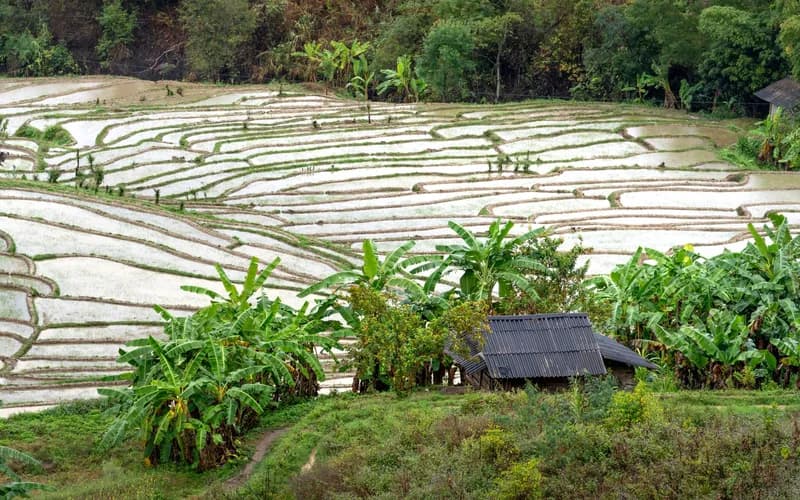
Pai in the cool season, roughly November to February, is genuinely cold at dawn and thick with mist that burns off by mid-morning. It is also busiest then. Come in the green season and you trade some certainty about the weather for near-empty guesthouses and hillsides that are impossibly green.
Get matched with up to 5 trusted Thailand agencies
- Free
- No obligation
- Up to 5 agencies
Over the mountains to Mae Hong Son
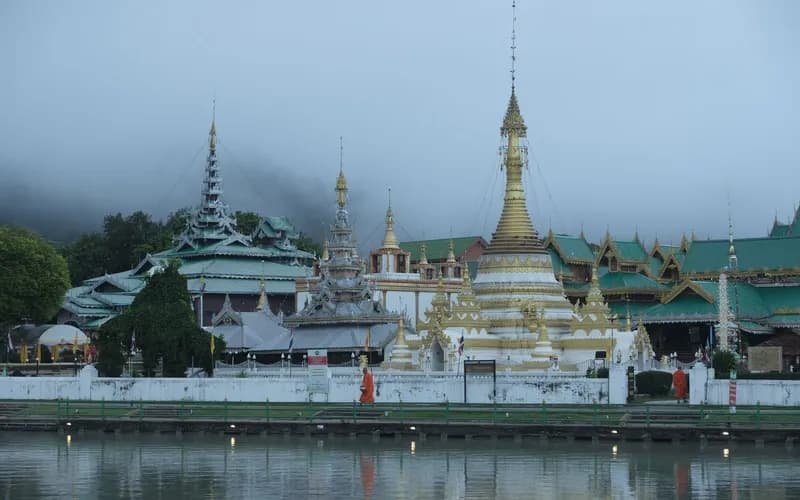
West of Pai the road empties out. This is the part of the loop where you feel how remote the province is. Mae Hong Son town sits at the bottom of a valley hard against the Myanmar border, and its culture reflects that: this is Shan country, and the golden Burmese-style chedis of Wat Chong Kham and Wat Chong Klang reflected in Nong Jong Kham lake are the emblem of the town. Climb to Wat Phra That Doi Kong Mu at dusk for the view over the valley as the mist settles in.
Mae Hong Son rewards the traveller who books a few nights and does very little. Morning markets, a soak at the Pha Bong hot springs, a day trip to the Su Tong Pae bamboo bridge that crosses the rice paddies to a forest monastery, an honest conversation with a guesthouse owner about the Shan New Year. This is the kind of place our northern Thailand off-the-beaten-path guide is built around.
Mae Sariang: the loop's quietest corner
If Mae Hong Son is quiet, Mae Sariang is quieter still. Tucked between mountains and the Yuam River on the southern arc of the loop, it sees a fraction of the visitors, and that is precisely its appeal. There is little to "do" in the checklist sense. You walk the riverfront at dusk, eat at a family restaurant, watch the longtail boats, and let a slow town be slow.
From Mae Sariang the road bends back east toward Chiang Mai through Hot and Chom Thong, closing the circle. Travellers with more time sometimes push further off the loop entirely, toward the equally quiet valleys of Nan province on the other side of the north, but that is a separate journey.
How long to give it
Three days is the minimum and, frankly, a waste. Four to five days is comfortable and lets each of the three main towns breathe. A week turns the loop into a genuine slow-travel experience, with room for a village homestay, a weather day, and the unplanned detours that are the whole point. There is no prize for finishing early.
A useful way to think about pacing is to anchor two or three nights in each of the main towns and let the driving days fall between them, rather than sleeping somewhere different every night. Mountain driving is tiring, and a run of single-night stops leaves you packing and unpacking instead of exploring. Anchoring also means you are in one place long enough to eat at the same noodle stall twice, to be recognised, and to hear about the waterfall or viewpoint that never makes it into a guidebook. If a place grabs you, the beauty of a loose plan is that you can simply stay another night; if it does not, you move on without regret. That flexibility is worth more on this route than any fixed schedule, because the weather and the road will rearrange your plans anyway.
Getting around: bus, car or motorbike
You do not need a motorbike to ride the loop, whatever the t-shirts imply. Public buses and songthaews connect all four towns daily, and they are cheap, safe and social. A rented car gives you flexibility and shelter from the rain. The motorbike is the romantic option and the most dangerous one: mountain roads, gravel, sudden fog and other people's driving send travellers to Chiang Mai hospitals every week. If you do ride, do it legally and insured. We cover exactly what that means in 2026 in our guide to renting a motorbike in Thailand.
The culture of the hills
The Mae Hong Son valley is one of the most ethnically varied corners of Thailand, and that is a large part of what makes it worth slowing for. Shan communities give the towns their Burmese-tinted temples and their food; Karen, Lahu, Lisu and Hmong villages sit in the folds of the surrounding mountains. Some of these villages welcome respectful visitors and homestays; others do not, and the difference matters. Go through a community-based operator or a guesthouse with real local ties rather than turning up unannounced, and treat a homestay as being a guest in someone's home rather than a photo opportunity. The reward is the kind of unhurried, human exchange that a checklist itinerary never delivers.
One community you may be steered toward is the Kayan "long-neck" village near Mae Hong Son. This one deserves honest thought: some settlements function mainly as paid viewing attractions, and the ethics are genuinely debated. If you visit, choose an arrangement where the income clearly reaches the families and where you can talk with people rather than simply photograph them.
Food and where to stay
Northern Thai food changes character up here. Alongside the familiar khao soi you will find Shan dishes: fermented soybean, tea-leaf salads, and simple noodle soups eaten at plastic tables in the morning market. Eat where the locals eat, early, and you will spend little and eat well. For a fuller picture of the regional kitchens, our guide to Thai food maps the differences region by region.
Accommodation ranges from riverside bamboo bungalows to a handful of genuinely lovely boutique places, and it is inexpensive by Thai standards outside the Pai peak. In high season the best-value guesthouses in Pai and Mae Hong Son fill first, so book those two ahead and stay flexible elsewhere.
What to do next
- Decide your direction and pace first: block out five to seven days and resist the urge to compress it.
- Choose your season honestly. Cool and dry (November to February) for clear mountain views and cold dawns; green season for empty guesthouses and lush hills.
- Pick your transport: buses if you want it simple and low-risk, a car for weather-proof flexibility, a motorbike only if you are experienced, licensed and insured.
- Pre-book the first night in Pai and the first in Mae Hong Son in high season; leave the rest loose.
- Read up on itineraries and timing on our plan your journey page and build in at least one day with nothing scheduled.
Frequently Asked Questions
How many days do you need for the Mae Hong Son Loop?
Four to seven days is the sweet spot. Three is possible but leaves you spending most of your time on the road rather than in the towns. A week lets you add a homestay, a rest day and unhurried detours, which is where the loop is at its best.
Can you do the loop without a motorbike?
Yes. Public buses and songthaews link Chiang Mai, Pai, Mae Hong Son and Mae Sariang every day, and they are inexpensive and reliable. A rented car is the most comfortable option if you want to stop where you like without exposure to mountain-road risk.
Which direction should I ride, clockwise or anticlockwise?
It makes little practical difference. Anticlockwise (Chiang Mai to Pai first) gets the most famous, twistiest stretch out of the way early. Clockwise saves Pai for last. The towns and roads are identical either way.
When is the best time to travel the loop?
The cool, dry season from November to February gives the clearest views and coldest mornings, but also the biggest crowds in Pai. The green season is wetter and misty but far quieter and greener; landslides can occasionally affect mountain roads, so check conditions locally.
Is the loop suitable for nervous or first-time riders?
Honestly, no. The gradients, hairpins, gravel and mountain weather make it a demanding ride even for experienced motorcyclists. Nervous or first-time riders are far better served by the bus or a car, and will enjoy the scenery more for not white-knuckling every bend.