
Cambodia is one of the most affordable destinations in Southeast Asia — but the single most useful thing to understand before you go is that "cheap" and "good value" are not the same thing. This guide breaks down exactly what a trip to Cambodia costs in 2026, tier by tier, including the one big fixed cost most budgets forget — the Angkor pass — and shows you how to spend in a way that buys depth rather than just distance.
The Honest Answer: What Cambodia Costs in 2026
Cambodia remains genuinely inexpensive. Accommodation, food, and local transport cost less here than in neighbouring Thailand or Vietnam, and a careful traveler can live very well on very little. What sets Cambodia apart on the budgeting side is not the daily spend — which is low — but a handful of fixed costs that sit on top of it: the Angkor pass, the visa, and international flights. Plan for those separately and the rest of the country is remarkably forgiving on the wallet.
Here is the realistic daily spend per person in 2026, excluding international flights, the visa, and the Angkor pass (all covered below):
| Travel style | Daily budget (per person) | What it buys |
|---|---|---|
| Shoestring / backpacker | $25–35 | Hostel dorm or basic guesthouse, street food and local restaurants, buses and shared transport, the occasional paid activity |
| Mid-range / slow travel | $60–90 | Private room in a guesthouse or comfortable hotel, a mix of local and Western dining, tuk-tuks and some private transfers, guided experiences |
| Premium | $150–300+ | Boutique and luxury hotels, private drivers and guides, fine dining, signature experiences such as ethical elephant sanctuaries and island eco-lodges |
These bands are deliberately wide because costs vary across the country. Siem Reap and Phnom Penh sit at the higher end; Battambang, the northeastern highlands, and the smaller coastal towns sit lower. A dollar simply goes further in a Battambang guesthouse than in a Siem Reap boutique hotel near Pub Street.
A useful rule of thumb: most independent travelers who want comfort without extravagance — private rooms, a daily guided experience or two, the occasional splurge — land between $55 and $80 a day, all in (before the fixed costs). That figure is the spine of this guide.
One request. Up to five tailored proposals.
Skip contacting agencies one by one — share your trip once and let up to five trusted Cambodia agencies come to you. Free, with no obligation.
Get my free quotesA Note on Currency: The Dollar Economy
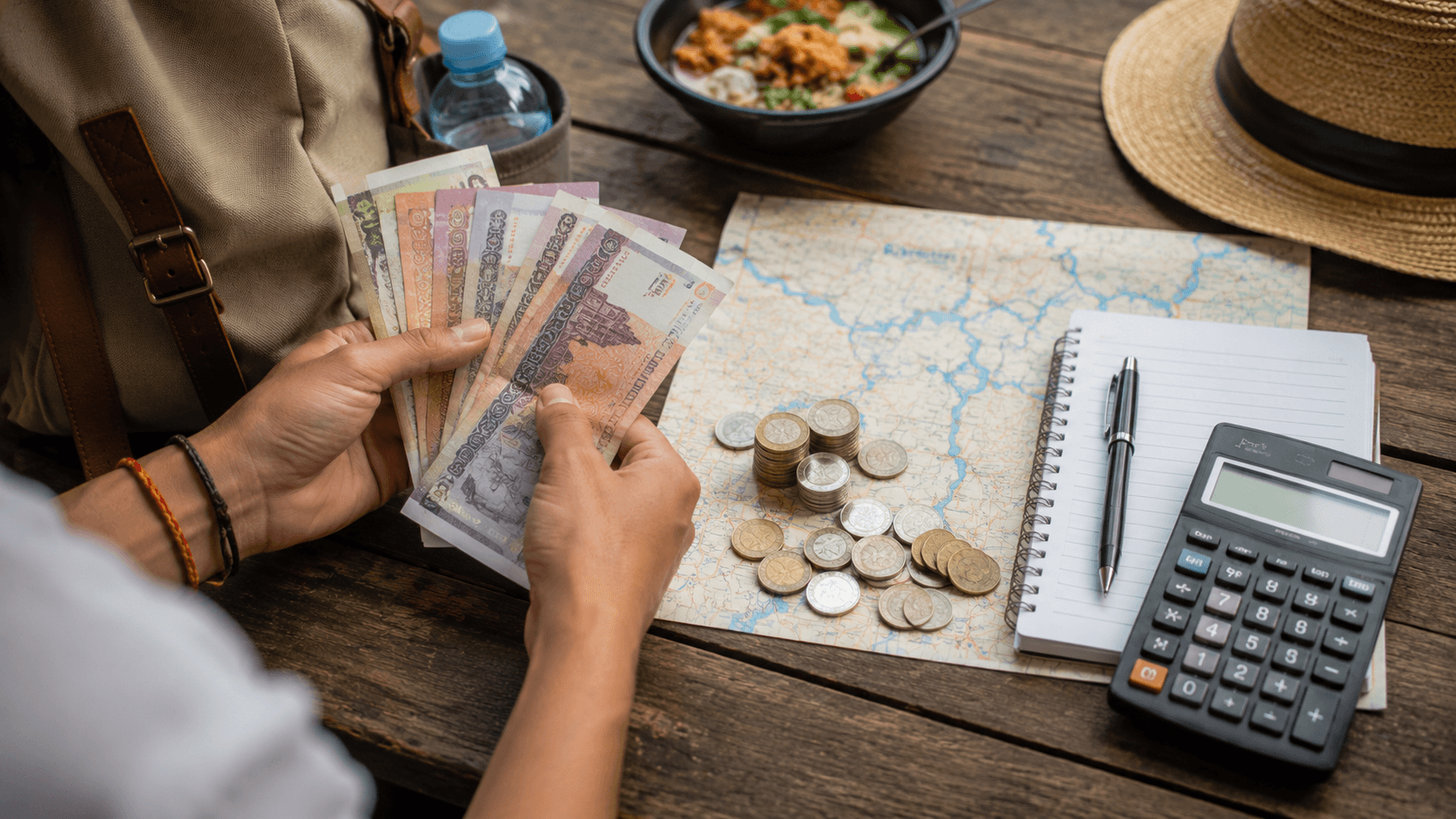
This is the first thing that surprises visitors, and it matters for budgeting. Cambodia runs on the US dollar. Prices are quoted in dollars, hotels and restaurants bill in dollars, and ATMs dispense dollars. The Cambodian riel (KHR) trades at a stable ~4,100 to the US dollar and functions mostly as small change: anything under a dollar comes back to you in riel, so a $3.50 meal paid with a $5 note returns roughly 6,000 riel.
A few practical consequences. Carry clean, undamaged dollar bills — torn or heavily marked notes are often refused. Keep a stack of small denominations ($1, $5), because vendors frequently cannot break a $50 or $100. ATMs are widespread in cities and tourist towns but typically charge a $4–6 withdrawal fee per transaction, so withdraw larger amounts less often. In remote areas — the northeastern highlands, smaller islands — cash is essential and ATMs are scarce, so stock up before you go. Cards are accepted in mid-range and upmarket hotels and restaurants in Phnom Penh and Siem Reap, but Cambodia remains a largely cash economy once you step off the main track.
Getting In: Visas and Entry Costs
Most visitors need a tourist visa, and it is inexpensive and straightforward. The e-visa costs around $30 (plus a small processing fee) and is applied for online before travel through the official government portal; it is typically issued within three business days and grants a 30-day stay. A visa on arrival is also available at major airports and land borders for a similar fee, but requires cash in clean dollars and a passport photo, and lines can be slow — the e-visa is the smoother option.
The tourist visa can usually be extended once, by 30 days, through a travel agent or immigration office. As always, use only the official e-visa portal: lookalike third-party sites charge inflated fees for the same service.
International airfare is the single largest variable and sits outside any daily budget. Cambodia's main gateways are Phnom Penh and the newer Siem Reap–Angkor International Airport, with many travelers also arriving overland from Thailand or Vietnam, or on a regional hop from Bangkok, Ho Chi Minh City, or Singapore. Booking a few months ahead and travelling outside the December–January peak makes the biggest difference to the fare.
Get matched with up to 5 trusted Cambodia agencies
- Free
- No obligation
- Up to 5 agencies
The Angkor Pass: Cambodia's One Big Fixed Cost
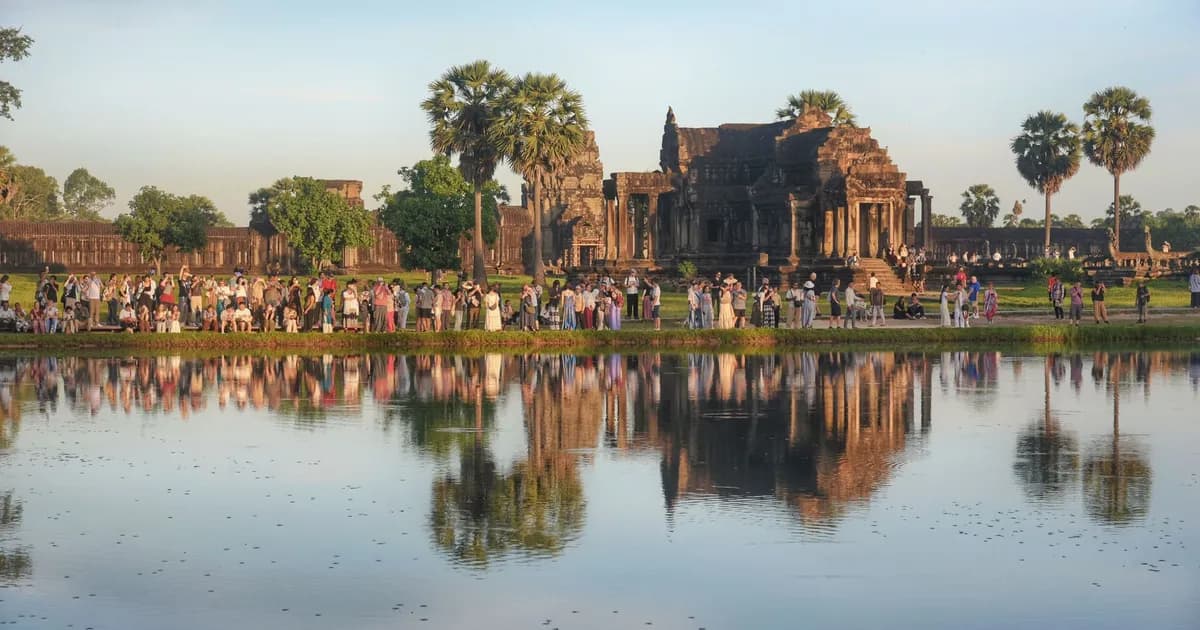
If there is one line that catches budget travelers off guard, it is this. Entry to the Angkor Archaeological Park is not included in any general sightseeing budget, and it is significant by Cambodian standards. The official Angkor passes in 2026 are:
- 1-day pass: $37
- 3-day pass: $62 (valid on any 3 days within a 10-day window)
- 7-day pass: $72 (valid on any 7 days within a 30-day window)
Children under 12 enter free with a passport. The pass covers more than 100 temples across the park — Angkor Wat, the Bayon, Ta Prohm, and far beyond — but a few outlying sites are separate: Beng Mealea ($10) and the Koh Ker complex ($15).
The budgeting insight here is about value per day. A single day at Angkor at $37 is a poor deal — the park is vast and a one-day blitz is exhausting and shallow. The 3-day pass at $62 works out to roughly $20 a day and is the sweet spot for most slow travelers: it lets you start at dawn, rest through the brutal midday heat, return for sunset, and actually absorb the place rather than racing it. This is a clear case where spending a little more buys a great deal more — exactly the philosophy behind our slow travel guide to Cambodia.
Where to Sleep: Accommodation by Tier
Accommodation is where Cambodia's value is most visible, and where the slow-travel approach pays off most directly. Choosing locally owned guesthouses and small family hotels over international chains is rarely a compromise — it is frequently the better experience, with home-cooked breakfasts, owners who become informal guides, and money that stays in the community.
- Hostel dorm bed: $5–12 per night. Clean, social, and widely available in Phnom Penh, Siem Reap, Kampot, and the islands.
- Basic guesthouse or budget hotel, private room: $12–25 per night, often with air conditioning, Wi-Fi, and sometimes a pool at the upper end. Frequently the sweet spot for slow travelers.
- Comfortable mid-range hotel with pool and good service: $30–60 per night — and in Cambodia this tier buys a genuinely lovely stay.
- Boutique and design hotels: $60–120, plentiful in Siem Reap and Phnom Penh.
- Luxury resorts and 5-star hotels: $150–400+ per night, rising well beyond that for signature properties and island eco-resorts.
A practical insight: in Cambodia, the jump from a $15 guesthouse to a $45 boutique hotel buys a genuinely different experience, but the jump from $45 to $150 often buys diminishing returns outside the true luxury tier. For most travelers, the comfortable mid-range bracket — where $40–60 secures a pool, air conditioning, and warm service — is where value and comfort intersect most generously.
Eating Well for Almost Nothing
Food is where Cambodia's value borders on the absurd, and where spending more rarely means eating better. Khmer cuisine is subtle and distinctive — less fiery than Thai food, built on fish, fresh herbs, lime, and fermented depth — and its greatest dishes are everyday ones.
- Street food and market meals: $1.50–3. A bowl of kuy teav (noodle soup) for breakfast, a plate of rice with grilled pork, or num pang (the Cambodian baguette sandwich) cost a dollar or two.
- Local restaurant dish: $3–6 — including the national dish, fish amok, a fragrant coconut curry steamed in banana leaf, and lok lak, stir-fried beef with a lime-pepper dip.
- Mid-range restaurant with table service: $6–12 per main.
- Western and upscale dining (Siem Reap, Phnom Penh): $12–30+ per person — good, but rarely better value than the Khmer food it sits above.
- Local draught beer: often $0.50–1 during happy hour; a fresh fruit shake $1–1.50; Khmer coffee a dollar or two.
A traveler eating predominantly at local restaurants and markets can eat extremely well on $8–15 a day. The counterintuitive truth, exactly as elsewhere in the region: the more you spend trying to "upgrade" your eating in Cambodia, the further you often drift from the best of it. Seek out the busy local spot over the empty tourist terrace.
Getting Around: The Real Cost of Movement
How you move shapes both your budget and the texture of your trip, and Cambodia offers a clear ladder of options.
Tuk-tuks and ride-hailing
In towns, the tuk-tuk is the workhorse. Short hops of 1–3 km run $1–2, medium trips $2–3, and longer cross-town rides $3–5. Always agree the fare before you set off, or use the PassApp / Grab apps, which fix the price in advance and remove the haggling — app-based tuk-tuks are often cheaper than the street rate. For temple days, hiring a tuk-tuk and driver for the whole day at Angkor costs $30–50, split easily between two or three people.
Buses and minivans
The budget backbone for getting between cities. Comfortable long-distance buses connect Phnom Penh, Siem Reap, Battambang, Kampot, and Sihanoukville, with fares typically $8–15 depending on distance and operator. Faster (and pricier) express vans cover the same routes; sleeper buses run the longer overnight legs. Roads have improved markedly, though journeys can still be slow.
Boats
In the wet season and early dry season, river and lake boats are an atmospheric option — the Siem Reap–Battambang boat through the Tonlé Sap, or the Mekong run. They cost more than the bus and run only when water levels allow, but the journey itself is part of the trip.
Domestic flights
A few internal routes exist (Phnom Penh–Siem Reap, and to Sihanoukville), running roughly $40–90 one way. They save time on the longer hops but skip the country in between — their weakness for a slow traveler.
For most one-to-two-week trips, a sensible mix is buses or vans for the intercity legs, tuk-tuks and ride-hailing within towns, and a day-hired driver for temple days and rural exploration.
Tours, Activities, and Entrance Fees
This is the most variable line in any Cambodia budget. Some representative 2026 prices, beyond the Angkor pass already covered:
- Phnom Penh's historical sites: the Royal Palace ~$10; the Tuol Sleng (S-21) Genocide Museum ~$5; the Choeung Ek Killing Fields ~$6 including an excellent audio guide. These are sobering and essential to understanding modern Cambodia.
- A licensed Angkor guide for the day: $35–50 on top of your pass and transport — money well spent for the history and context.
- Tonlé Sap floating-village trips: $20–35, depending on the village and whether you go independently or on a tour.
- Ethical elephant sanctuary in Mondulkiri: $50–90 for a full day of observation (choose genuine sanctuaries over riding camps).
- Cooking classes, kayaking in Kampot, countryside cycling: $15–40.
- Battambang's bamboo train and circus (Phare): a few dollars to ~$18 for the acclaimed circus.
A theme worth noticing: in Cambodia, the experiences that cost more are usually the ones with built-in expertise, conservation, or genuine community benefit — a knowledgeable guide, a real sanctuary, a social-enterprise circus. That is value of a different kind, and worth understanding before you judge a price tag.
Three Costed Itineraries: What Two Weeks Actually Looks Like
Numbers are easier to trust when they add up to a real trip. Here are three 14-day itineraries, costed per person, excluding international flights but including the $30 visa and a $62 three-day Angkor pass.
The shoestring slow traveler — ~$650–800 for two weeks
Hostels and basic guesthouses ($12/night average = $168), street food and local restaurants ($12/day = $168), buses between cities and shared tuk-tuks ($90 total), the $30 visa, the $62 Angkor pass, plus entrances and a couple of activities ($120), SIM and incidentals ($60). Total around $700, or roughly $50 a day all in. Entirely achievable for a traveler comfortable with dorms, buses, and DIY planning.
The mid-range slow traveler — ~$1,300–1,700 for two weeks
This is the sweet spot for most Unrush travelers. Comfortable guesthouses and mid-range hotels ($50/night = $700), a mix of local and Western dining ($25/day = $350), a day-hired Angkor driver and guide plus private transfers and vans ($250), the $30 visa and $62 Angkor pass, guided experiences including a Tonlé Sap trip and a cooking class ($200), SIM and incidentals ($90). Total around $1,650, or roughly $100–120 a day — comfortable, immersive, and still excellent value.
The premium traveler — $3,500+ for two weeks
Boutique and luxury hotels ($170/night = $2,380), fine dining and curated meals ($55/day = $770), private drivers and guides throughout ($1,000+), signature experiences such as an ethical elephant day, a private Angkor sunrise, and an island eco-lodge stay ($800+). Total $5,000+, or $350–400+ a day, depending on how far the luxury tier is pushed.
The striking thing about these three trips is not the gap between them — it is how good the middle one is. The mid-range slow traveler sees, eats, and understands more of Cambodia than the premium traveler shuttling between resorts, at roughly a third of the cost.
Where Your Money Goes Furthest
Costs vary across Cambodia, and routing accordingly is one of the simplest ways to stretch a budget without sacrificing anything.
The cheapest regions are the ones off the main Phnom Penh–Siem Reap corridor: Battambang, with its colonial streets and arts scene; the northeastern highlands of Mondulkiri and Ratanakiri; and the quieter southern towns like Kampot and Kep. Here a guesthouse, three local meals, and a day of exploring can come in well under $30 all in. The most expensive are tourist-heavy Siem Reap (around the temples and Pub Street) and central Phnom Penh, plus the islands — Koh Rong and Koh Rong Sanloem — where everything has to be brought over by boat and prices rise accordingly.
This maps neatly onto the slow-travel philosophy. The places that reward staying longer — Battambang's countryside, Kampot's river, the highland forests — are also, conveniently, the places where your money goes furthest. Choosing a few unhurried days in Kampot over an extra night near Pub Street is both cheaper and richer.
Hidden Costs and Money Traps to Avoid
A realistic budget accounts not just for what things cost, but for where travelers reliably overpay.
Damaged or large dollar bills. Torn, marked, or pre-2013 US notes are routinely refused, and few vendors can break $50 or $100. Arrive with clean, small bills and you avoid a surprisingly common headache.
ATM fees. The $4–6 per-withdrawal charge adds up fast. Withdraw larger amounts less often, and carry enough cash before heading to the highlands or islands, where machines are scarce.
Tuk-tuk and "closed temple" overcharging. Always agree a tuk-tuk fare first or use an app. Around Angkor and Phnom Penh, be wary of drivers who insist a site is closed and offer an alternative — it usually ends at a shop paying commission.
Border-crossing scams. Overland crossings from Thailand (notably Poipet) are notorious for "processing fees" and inflated visa prices. Use the official e-visa, know the correct $30 fee, and decline extras.
The one-day Angkor mistake. Paying $37 to rush Angkor in a single exhausting day is the worst value in Cambodian travel. The 3-day pass costs less per day and transforms the experience.
Sihanoukville. Once a backpacker beach town, it has been heavily redeveloped around casinos and is now poor value and charmless for most travelers; the islands and Kampot/Kep are far better uses of a coastal budget.
How to Get More Value Without Going Cheap
The most important idea in this guide is also the simplest: in Cambodia, value and cost are not the same axis. The cheapest trip and the best-value trip are rarely the same trip — and neither is the most expensive one.
Getting more from your money here is less about spending less and more about spending well:
Stay longer in fewer places. Every relocation costs money — transport, a day of transit, the friction of arriving somewhere new. Three or four nights in one base lowers your per-day cost and deepens the experience. Speed is expensive in every sense.
Buy the 3-day Angkor pass, not the 1-day. It is cheaper per day and incomparably better. Build your Siem Reap stay around it.
Travel in the green season or shoulder months. Prices drop 30–50% outside the December–February peak, the landscape is at its most beautiful, and the crowds thin. Our guide to where to go and when in Cambodia shows how to time this well.
Eat where locals eat. The single highest-value habit in Cambodia — it costs less and tastes better.
Spend on a few things that genuinely matter. A licensed Angkor guide, an ethical elephant day in Mondulkiri, a knowledgeable local driver — the experiences with real expertise or conservation behind them are worth their price. Skip the filler; fund the things that change how you remember the trip.
This is the heart of the slow-travel argument: it is not a more expensive way to see Cambodia, nor a cheaper one. It is a better-value one. For the full philosophy, see our slow travel charter.
The Value of a Good Local Partner
There is a point in planning a Cambodia trip where doing everything yourself stops saving money and starts costing it — in time, in mistakes, in overpriced bookings, and in missed experiences you never knew to ask for. Distances are real, the highlands and islands take planning, and the quality of guides and operators varies enormously.
A knowledgeable local agency does not simply add a markup. The best ones save you money by routing intelligently, booking at local rates, steering you away from commission-driven traps, and concentrating your budget on the experiences that actually matter — the right Angkor guide, a genuine sanctuary, a well-timed Tonlé Sap visit. They turn a good-value trip into an exceptional one. The agencies in our certified network are selected precisely for this: a slow-travel philosophy, genuine community relationships, and quality over volume.
When you are ready to translate a budget into an actual itinerary, our plan-your-journey page is the place to start.
Frequently Asked Questions
How much does a two-week trip to Cambodia cost in 2026?
Excluding international flights but including the visa and a 3-day Angkor pass, expect around $650–800 for a shoestring trip, $1,300–1,700 for a comfortable mid-range slow-travel trip, and $5,000+ for a premium trip. Most independent travelers seeking comfort without extravagance spend roughly $55–80 a day before fixed costs.
Is Cambodia cheaper than Thailand or Vietnam?
Generally yes, for accommodation, food, and local transport — Cambodia is among the most affordable countries in the region. The main offsetting cost is the Angkor pass ($37–72), which has no equivalent in Thailand or Vietnam, plus the $30 visa.
Do I use US dollars or Cambodian riel?
Both, but the US dollar is the de facto currency: prices are quoted in dollars and ATMs dispense dollars. Riel is used as small change for amounts under a dollar. Carry clean, small-denomination dollar bills, as damaged or large notes are often refused.
How much is the Angkor pass in 2026?
$37 for one day, $62 for three days (valid within a 10-day window), and $72 for seven days (valid within a 30-day window). Children under 12 are free. The 3-day pass is the best value for most visitors. Beng Mealea and Koh Ker temples are ticketed separately.
How much should I budget for food per day?
A traveler eating mainly at markets and local restaurants can eat very well on $8–15 a day. Adding Western and mid-range restaurant meals brings it to $20–35. Khmer street food is both the cheapest and often the best option.
What is the cheapest way to travel Cambodia?
Stay in guesthouses and hostels, eat at local restaurants and markets, take buses between cities and app-based tuk-tuks within them, buy the 3-day Angkor pass rather than multiple single days, and travel in the green season. A careful backpacker can travel well on $25–35 a day plus fixed costs.
When is Cambodia most expensive to visit?
The cool, dry peak season from December to February brings the highest accommodation prices and the biggest crowds, especially in Siem Reap. The green season (May–October) can be 30–50% cheaper. Domestic travel also spikes around Khmer New Year in April and the November Water Festival.
Does a local travel agency save money or add cost?
A good one saves money on balance — through local rates, intelligent routing, and by steering you away from overpriced or commission-driven options — while also improving the quality of the trip. The value lies in expertise and access, not just booking convenience.
Ready to turn a budget into a real journey? Explore our Cambodia travel guides, see when to go in our where-to-go-and-when guide, and start building a route on our plan-your-journey page with our network of certified local agencies.