
Most people come to Cambodia for Angkor and leave having seen almost nothing else — which is a shame, because the temples are the beginning of the country, not the whole of it. This guide maps Cambodia region by region, explains its two simple seasons and the great lake that drives them, and shows you how to sequence a trip that goes far deeper than a two-day temple stop.
Cambodia Is Bigger Than Angkor
It is easy to treat Cambodia as a single sight with a country attached. Fly into Siem Reap, spend two days at the temples, fly out — that is the trip a great many visitors take, and it barely scratches the surface. Beyond Angkor lies a riverine capital with a heavy and important history, a vast inland sea that breathes with the seasons, forested highlands home to elephants and ethnic-minority communities, French-colonial towns, and a quiet southern coast strung with islands.
The travelers who have the best time in Cambodia are not the ones who tick off Angkor fastest. They are the ones who understand the shape of the country — its regions, its rhythm, its one defining season — and who give it enough time to reveal itself. That is also the heart of slow travel: going deeper into fewer places, and letting the country set the pace rather than racing a checklist across it.
One request. Up to five tailored proposals.
Skip contacting agencies one by one — share your trip once and let up to five trusted Cambodia agencies come to you. Free, with no obligation.
Get my free quotesCambodia's Regions, Briefly
Before timing, geography. Cambodia is compact compared with its neighbours — you can cross it in a day or two — but it divides into clear regions, each with its own character and its own reasons to linger.
The central plains: Phnom Penh and the great rivers
The heart of the country, where the Mekong, the Bassac, and the Tonlé Sap rivers meet at Phnom Penh. The capital rewards more time than most give it: the gilded Royal Palace and Silver Pagoda, long riverside evenings, a serious and fast-improving food and café scene, and the sobering, essential history of the Tuol Sleng (S-21) museum and the Choeung Ek Killing Fields — without which modern Cambodia cannot be understood. Many travelers rush Phnom Penh in a day; it deserves two or three.
The northwest: temples and Battambang
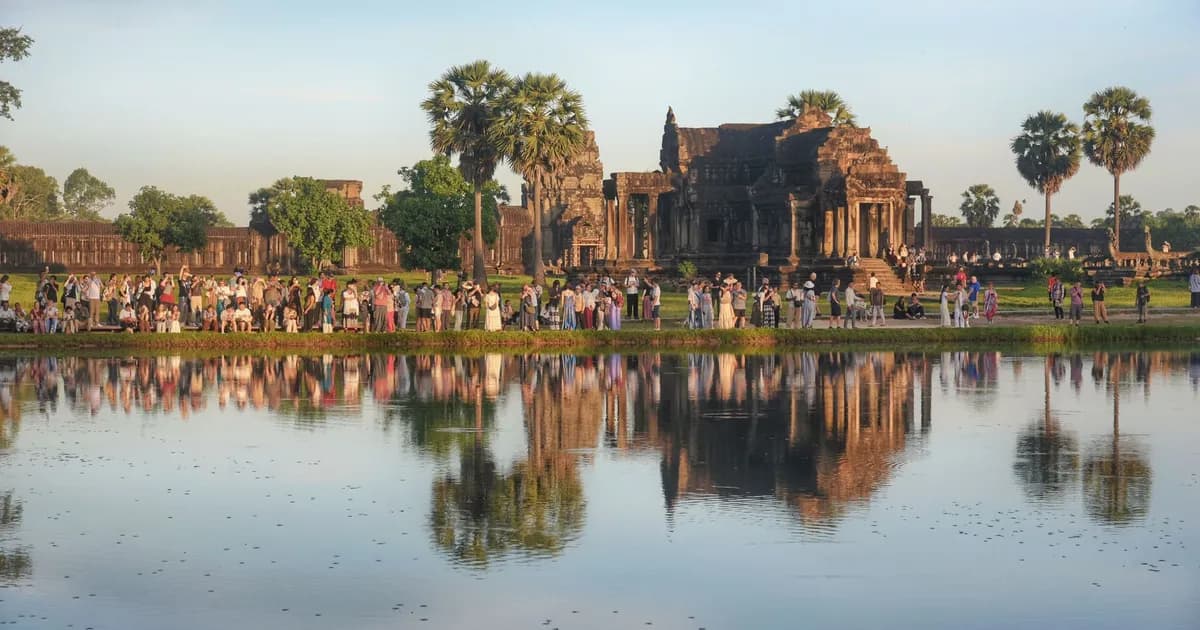
This is the tourist heartland, and rightly so. Siem Reap is the base for the Angkor Archaeological Park — more than a thousand years of Khmer Empire architecture, from the sunrise silhouette of Angkor Wat to the serene stone faces of the Bayon and the jungle-throttled ruins of Ta Prohm. A few hours south, Battambang offers a gentler counterpoint that most temple visitors skip: French-colonial streets, a celebrated arts and circus scene, the novelty of the bamboo train, and an easy countryside of rice fields, brick kilns, and small working temples.
The Tonlé Sap: the beating heart
Southeast Asia's largest freshwater lake sits at Cambodia's centre, and it is far more than scenery — it shapes the country's food, work, and seasons (more below). Its floating and stilted villages, such as Kampong Phluk and Mechrey, and the internationally important bird sanctuary of Prek Toal, are among the most distinctive experiences in the country, and a world away from the temples a short drive north.
The northeastern highlands
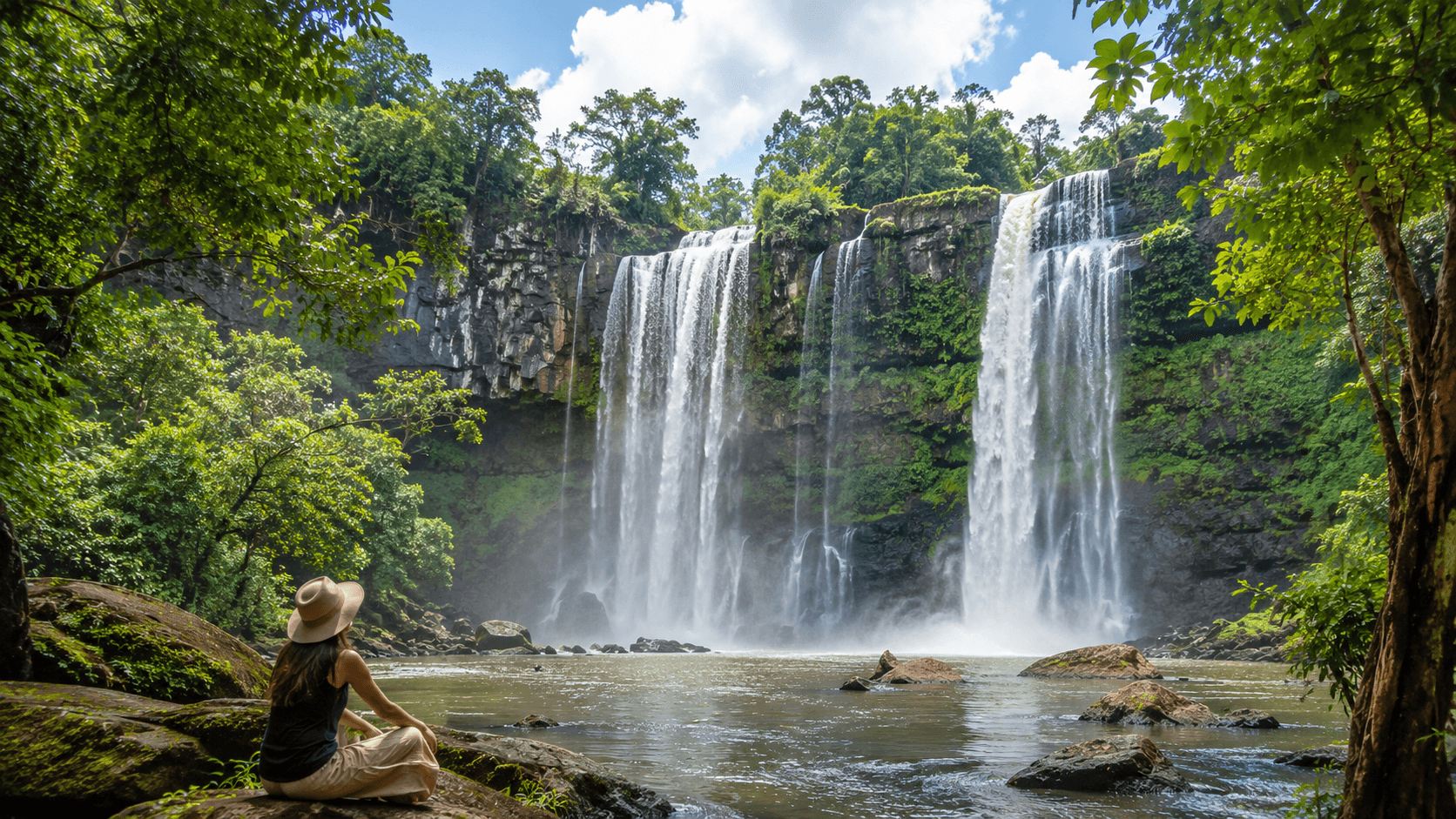
The forested provinces of Mondulkiri and Ratanakiri are Cambodia's wild, cool, and least-visited corner. This is the country of ethical elephant sanctuaries, jungle waterfalls, ethnic-minority communities whose traditions differ markedly from the lowland Khmer, and the serene crater lake of Yeak Laom. It takes real effort to reach — long road journeys from Phnom Penh — and that effort is exactly why it stays quiet and rewarding.
The south coast and islands
Cambodia's coastline is its laid-back south. Kampot, with its pepper plantations and dreamy colonial riverfront, and neighbouring Kep, famous for its crab market, are slow-travel favourites built for unhurried days. Offshore, Koh Rong and the quieter Koh Rong Sanloem offer the white-sand-and-clear-water island escape, while the Cardamom Mountains to the west hold one of Southeast Asia's great remaining rainforests and a growing community-based ecotourism scene. (One honest exception: Sihanoukville, the main coastal city, has been heavily redeveloped around casinos and holds little charm for most travelers — pass through it to the islands rather than lingering.)
When to Go: The Two Seasons
Cambodia's weather is refreshingly simple compared with its neighbours: a single tropical monsoon splits the year into two seasons. There are no opposing coasts to reconcile, as in Thailand — just one nationwide rhythm, with regional shadings.
The cool dry season (November–February)
The headline best time, and for good reason: dry, sunny, and relatively cool, with temperatures around 25–28°C and pleasant evenings, especially in Siem Reap and the highlands. This is peak season — the busiest and most expensive, with Angkor at its fullest — but the conditions are excellent everywhere, including the coast and islands. Book ahead for December and January, when both prices and crowds peak.
The hot dry season (March–May)
Temperatures climb steadily, and by April the country is genuinely hot — regularly above 38°C, with heavy humidity. It is the least comfortable window for temple-walking or trekking, though the seas stay calm and prices ease before the rains arrive. If you travel now, start at dawn, rest through the midday heat, drink constantly, and lean your itinerary toward the coast and islands where a sea breeze helps.
The green season (June–October)
The "low" season, and the most misunderstood. Rain in Cambodia usually arrives as a heavy afternoon downpour, not an all-day washout — mornings are often clear and bright. The landscape turns a brilliant green, the rice paddies fill, waterfalls thunder, the Tonlé Sap swells to its dramatic fullest, prices drop 30–50%, and the crowds thin to almost nothing at the temples. For a slow traveler who values space and value over guaranteed sun, much of the green season is not just manageable but genuinely rewarding. Late October in particular is a sweet spot: the rains are easing, the country is still lush, the lake is high, and prices and crowds remain low.
Get matched with up to 5 trusted Cambodia agencies
- Free
- No obligation
- Up to 5 agencies
The Tonlé Sap Factor
No other feature shapes Cambodia like its great lake, and understanding it helps you time a trip. The Tonlé Sap is connected to the Mekong by a single river — and that river reverses direction with the seasons. In the wet season, the swollen Mekong pushes water back up into the lake, swelling it to several times its dry-season size and flooding the surrounding forests; in the dry season, the flow reverses again and the lake drains back toward the sea. This annual pulse feeds one of the most productive freshwater fisheries on earth, deposits the silt that makes the central plains fertile, and underpins Cambodian life — which is why its reversal is celebrated with a national festival.
For travelers, the practical takeaway: the floating villages and flooded forests are at their most spectacular from the late wet season into the early dry season (roughly September to December), when water levels are high and boats can glide among the treetops. In the deep dry season the lake shrinks dramatically, boats are confined to channels, and some villages sit high and dry on their stilts above cracked mud. If the Tonlé Sap is a priority, time it for the higher-water months.
Angkor: How to Time the Temples
Even within Siem Reap, timing matters — both the season and the hour. The temples are at their most comfortable in the cool dry season, but also their most crowded, especially at the famous Angkor Wat sunrise, when hundreds gather at the reflecting pools. The green season trades crowds for atmosphere: moss-green stones, dramatic monsoon skies, glistening carvings, and far fewer people, with the trade-off of afternoon rain and the odd slippery staircase.
The bigger timing lever is within the day and across days. Angkor is vast — far larger than most expect — and a single day is a poor way to see it. With a multi-day approach you can start before dawn, explore in the cool early hours, retreat through the punishing midday heat, and return for the softer, golden late-afternoon light when the tour buses have gone. A good local guide transforms the experience from pretty stones into a thousand years of legible history. Our Cambodia budget guide explains why the 3-day pass is both better value and a far better experience than the one-day rush.
The Coast and Islands: A Different Rhythm
The south follows the same two-season pattern but feels it more sharply at sea. The best beach and island weather runs November to April, when the water is calm and clear and ferries run reliably. From June to October, the coast sees heavier rain and rougher seas, and boat crossings to Koh Rong and Koh Rong Sanloem can be choppy or occasionally cancelled — build in a buffer day for any island-dependent plan in the green season, and never schedule a same-day island-to-airport connection for a critical flight. Kampot and Kep, being riverside and mainland, are far more forgiving year-round and make a lovely slow base whatever the season — which is part of why they suit the slow-travel approach so well.
Getting Around: How the Regions Connect
How you move between regions shapes the rhythm of a Cambodian trip as much as where you go. The core triangle — Phnom Penh, Siem Reap, and the southern coast — is well served by comfortable buses and express vans on roads that have improved markedly in recent years, though journeys are still measured in hours rather than minutes (Phnom Penh to Siem Reap is roughly five to six hours by road). A short domestic flight links the two main cities for those tight on time, but it skips the countryside that is half the point.
The highlands are the exception: Mondulkiri and Ratanakiri sit at the end of long road journeys from Phnom Penh, which is precisely why they stay quiet — and why they reward a slower, longer commitment rather than a flying visit. The Tonlé Sap also offers a scenic alternative to the road in the wetter months, with boats running between Siem Reap and Battambang or down toward Phnom Penh when water levels allow. The practical lesson for sequencing: cluster regions that connect easily, give the harder-to-reach corners the time they demand, and resist the temptation to bounce across the country to tick boxes.
Festivals Worth Timing a Trip Around
Cambodia's festival calendar can be a reason to choose your dates — or to book well ahead, since the big ones move millions of domestic travelers.
- Khmer New Year (Choul Chnam Thmey), 14–16 April 2026. The most important holiday of the year. Cambodians return to their home villages, pagodas fill, and there is water-splashing and games in the streets. Many businesses close and domestic transport is packed — a wonderful cultural window if you embrace it, but one to plan around for the closures.
- Pchum Ben (Ancestors' Day), late September / early October 2026. A deeply important 15-day Buddhist festival honouring ancestors up to seven generations back, when families bring offerings to pagodas before dawn. Quietly moving, and a fascinating time to witness everyday devotion — Battambang's hilltop pagodas are especially atmospheric.
- Water Festival (Bon Om Touk), 23–25 November 2026. The spectacular celebration of the Tonlé Sap's reversal, with longboat races on the Phnom Penh riverfront, illuminated floats, lantern releases, and huge, joyful crowds. The capital is packed and electric; book accommodation far ahead.
Conveniently, the November Water Festival lands right at the start of the cool dry season and the high-water Tonlé Sap window — one of the best moments of the year to be in the country, if you can handle the crowds in the capital.
How to Sequence a Trip
The goal of a well-planned Cambodia trip is to chase the conditions rather than fight them — and, in the slow-travel spirit, to resist the urge to cram.
A first trip that doesn't rush (cool season, Nov–Feb)
A classic, unhurried two-week shape: a few days in Phnom Penh for the history, river, and food; overland to Siem Reap for several slow days at Angkor on a 3-day pass, plus a Tonlé Sap village and a day trip to Battambang; then south to Kampot and Kep to wind down, with an optional island finish on Koh Rong Sanloem. Three or four bases, not eight — each long enough to settle into and find your regular coffee spot.
Adding the wild side
With more time or on a second visit, trade one leg for the northeastern highlands — Mondulkiri for an ethical elephant sanctuary and forest walks, or Ratanakiri for crater lakes and waterfalls. These take longer to reach and reward a slower pace; pair them with the dry season, when highland roads are at their easiest.
The green-season strategy
In the rains, lean on Phnom Penh, Siem Reap, Battambang, and the riverside south, all of which handle the wet season well, and time the Tonlé Sap for its high-water glory. Save the islands for a dry-season trip, or accept the buffer days they require. You will trade guaranteed sun for lower prices, deep green landscapes, and a country largely to yourself.
A Country Still Healing: Travelling Thoughtfully
Cambodia's recent history is unusually present for visitors, and travelling well here means travelling with awareness. The Khmer Rouge period of the late 1970s remains within living memory, and sites such as Tuol Sleng and Choeung Ek are not attractions but memorials — places to visit quietly and respectfully. That same history is part of why responsible, community-minded travel matters so much here: tourism that keeps money in local hands, supports genuine conservation in the highlands and Cardamoms, and respects the dignity of the communities you visit makes a real difference in a country still rebuilding. Choosing locally owned guesthouses, ethical sanctuaries over riding camps, and operators who employ and pay local guides fairly is not just good ethics — it deepens the trip. This is the thinking behind our slow travel charter.
Region by Region: Where to Slow Down
Timing tells you when; the slow-travel question is where to stay long enough to understand.
In Phnom Penh, give the capital two or three days rather than treating it as a transit point — its history, riverfront, and food reward the time. In Siem Reap, build the stay around a 3-day Angkor pass and add Battambang for a gentler, more local counterpoint that most temple visitors miss entirely.
In the northeast, simply going at all puts you off the circuit — Mondulkiri and Ratanakiri are for travelers who want forest, hill-tribe culture, and almost no other foreigners in sight. On the coast, choose depth over a checklist: a few unhurried days on the river at Kampot, a crab lunch at Kep, and one quiet island rather than a frantic hop between several. In every case, the pattern is the same — the places that reward staying longer are the ones that make the trip.
Don't Try to See It All
The strongest planning advice for Cambodia is also the simplest: don't try to see it all in one trip. The country tempts visitors into a frantic loop — Phnom Penh, Angkor, the highlands, the coast, the islands — compressed into ten exhausting days. The result is a blur of road transfers and a thin experience of everywhere.
A better approach is to pick two or three regions and give each the time to reveal itself. Phnom Penh and the temples. The temples, Battambang, and the lake. The capital and the southern coast. Every relocation costs a half-day of travel, a chunk of budget, and the friction of starting over somewhere new. Staying longer in fewer places is cheaper, calmer, and — counterintuitively — leaves you feeling like you saw more, because you actually understood what you saw. This is the core of the slow-travel argument.
Planning With a Local Partner
Cambodia rewards independent travel, but the seams between regions — the long highland drives, the seasonal lake levels, the festival closures, the island ferry timetables — are exactly where good local knowledge saves a trip from itself. Knowing that your highland leg belongs in the dry season, that the Tonlé Sap is best at high water, or that Khmer New Year will close half the country for three days is the difference between a smooth trip and a frustrating one.
A knowledgeable local agency builds these judgements in by default, routing your time around the conditions and concentrating it on the places worth slowing down for — the right Angkor guide, a genuine elephant sanctuary, a well-timed lake visit. The agencies in our certified network are chosen for exactly this: a slow-travel philosophy and a real understanding of when and where Cambodia is at its best. When you are ready to turn timing into a route, our plan-your-journey page is the place to begin.
Frequently Asked Questions
What is the best time to visit Cambodia?
The cool dry season, November to February, offers the most comfortable weather nationwide — dry, sunny, and around 25–28°C — and is ideal for Angkor, the highlands, and the coast alike. It is also the busiest and most expensive period. The green season (June–October) is cheaper, lusher, and quieter, with short afternoon rains rather than all-day washouts.
Is Cambodia just Angkor, or is there more?
Far more. Beyond the temples lie Phnom Penh's river and history, the Tonlé Sap lake and its floating villages, the forested highlands of Mondulkiri and Ratanakiri, French-colonial Battambang, and a quiet southern coast with islands. Angkor is the start of Cambodia, not the whole of it.
How many days do you need in Cambodia?
Two weeks lets you combine Phnom Penh, Angkor and Siem Reap, and the southern coast at a comfortable pace, with time for the Tonlé Sap. With one week, focus on just Phnom Penh and Siem Reap, or Siem Reap and the south — trying to see everything in a week leaves you mostly in transit.
When are the Tonlé Sap floating villages best?
From the late wet season into the early dry season, roughly September to December, when water levels are high and the lake is at its fullest. In the deep dry season the lake shrinks and boat access is more limited.
How do you get between regions in Cambodia?
Comfortable buses and express vans connect the main triangle of Phnom Penh, Siem Reap, and the southern coast on improved roads (Phnom Penh–Siem Reap is about five to six hours). A domestic flight links the two main cities. The northeastern highlands sit at the end of longer road journeys, and seasonal boats cross the Tonlé Sap when water is high.
How many regions should I include in one trip?
Two or three for a typical two-week trip. Cambodia's distances and road conditions mean that trying to see everything leaves you spending your holiday in transit. Choosing fewer regions and staying longer is cheaper, less tiring, and more rewarding.
Should I avoid the rainy season?
Not necessarily. Many slow travelers prefer it: rain usually falls as short afternoon downpours, the landscape is at its greenest, the Tonlé Sap is at its most dramatic, and prices drop sharply. The main trade-offs are rougher seas for the islands and the occasional disrupted boat crossing.
When are Cambodia's biggest festivals in 2026?
Khmer New Year is 14–16 April; Pchum Ben (Ancestors' Day) falls in late September / early October; and the Water Festival (Bon Om Touk) is 23–25 November in Phnom Penh. Book accommodation well ahead for all of them, and expect closures and packed domestic transport around Khmer New Year.
Ready to match your dates to the right regions? Explore our Cambodia travel guides, cost out the trip with our budget guide, and start building a route on our plan-your-journey page with our network of certified local agencies.