
Laos is already one of Southeast Asia's least-visited countries — and beyond its handful of famous towns lies a Laos almost no one sees. This is a nation of remote river villages reachable only by longtail boat, cave systems that once sheltered a revolution, wild plateaus and forgotten valleys where the tourist trail simply runs out. For the slow traveler willing to trade convenience for wonder, these places are the whole point. Here are the hidden corners of Laos worth the extra effort, and why they reward it.
Why Go Off the Beaten Path in Laos
Most visitors to Laos see a well-worn triangle: Luang Prabang, Vang Vieng, and the 4000 Islands, often in a rushed loop. It is a beautiful introduction — but it is only the surface. Laos's real magic lives in the places the itineraries skip, where roads turn to red dust, where a village has no Wi-Fi and no menu, and where you may be the only foreigner for miles. Going off the beaten path here is not about ticking off obscure sights; it is about arriving somewhere slow enough, and remote enough, that the country can finally slow you down.
The rewards are real: authentic encounters, dramatic and untouched landscapes, prices even lower than the already-cheap norm, and the deep satisfaction of travel that feels earned. The trade-offs are equally real — long, bumpy journeys, basic facilities, patchy connectivity, and the need for patience and flexibility. It helps to reframe what "off the beaten path" means in a country this quiet. Laos receives a small fraction of the visitors of Thailand or Vietnam, so even its headline sights feel calm by regional standards — which means going further here is less about escaping crowds (there rarely are any) and more about reaching the places where the culture is most intact, the landscapes most dramatic, and the sense of discovery most complete. It is a country almost purpose-built for the slow, curious traveller who would rather understand one remote valley than photograph ten famous ones. This is travel for the curious and the unhurried. For the practical side of costs and logistics, pair this with our Laos budget guide, and for how it fits the wider map, our where-to-go-and-when guide.
One request. Up to five tailored proposals.
Skip contacting agencies one by one — share your trip once and let up to five trusted Laos agencies come to you. Free, with no obligation.
Get my free quotesNong Khiaw and Muang Ngoi: The River-Valley North
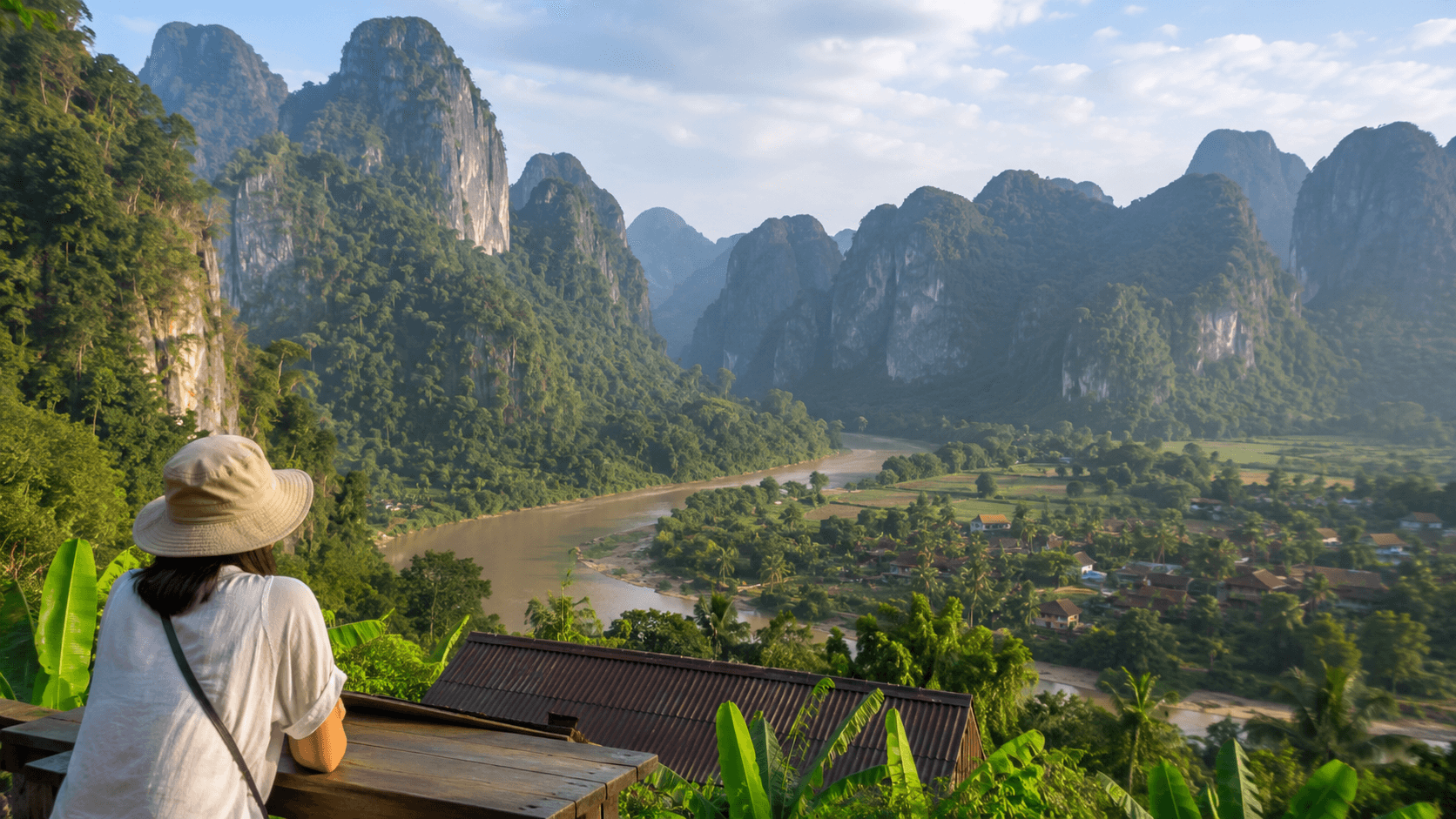
Only a few hours from Luang Prabang but a world away in pace, Nong Khiaw sits beneath towering limestone karsts on the Nam Ou river, and it is fast becoming the north's most beloved slow-travel base. The famous viewpoint hikes — above all the climb to Pha Daeng Peak — deliver some of the most breathtaking panoramas in Laos, a sea of jagged green mountains and winding river. Below, life moves at the speed of the current.
From Nong Khiaw, a short boat ride upstream brings you to tiny Muang Ngoi, a village accessible only by river, with no through-road, where the days are for hammock-swinging, cave visits, village walks to Ban Na, and watching the mist lift off the river at dawn. It is one of the most peaceful places in Southeast Asia, and precisely the kind of spot that rewards staying three nights instead of one.
Phongsali: The Far, Far North
Tucked into the mountainous corner where Laos meets China, Phongsali is one of the country's most remote and least-visited provinces — and one of its most rewarding for intrepid travelers. This is deep hill-tribe country, home to Akha and other ethnic groups whose traditional way of life continues largely unchanged. The reason to make the long journey here is the community-based trekking: multi-day walks between villages, staying overnight in Akha homes, guided by locals who share their culture, forests, and food. It is among the most authentic ethnic-minority experiences in Southeast Asia, precisely because so few make the effort to reach it. Cool, misty, and far from any crowd, Phongsali is the far edge of the map.
Get matched with up to 5 trusted Laos agencies
- Free
- No obligation
- Up to 5 agencies
Luang Namtha and the Nam Ha Protected Area
In the northwest, Luang Namtha is the gateway to the Nam Ha National Protected Area, one of Laos's conservation success stories and a pioneer of community-based ecotourism in the region. Treks here — one to three days through pristine forest, staying in Khmu, Akha, and Lanten villages — were designed from the start to channel income to local communities and fund conservation. It is trekking with a conscience and a genuine sense of wilderness: gibbons calling in the canopy, remote villages, and jungle rivers. For travelers who want their off-the-beaten-path adventure to leave a positive mark, Nam Ha is a model. Luang Namtha town itself is a relaxed base with a good night market and easy bicycle rides out to nearby villages and stupas, and it sits on the overland route between Luang Prabang and the Thai and Chinese borders, making it a natural stop for anyone travelling slowly through the far northwest rather than flying over it.
The Thakhek Loop and Konglor Cave
In central Laos, largely bypassed by the northern circuit, lies one of the country's great adventures: the Thakhek Loop, a three-to-four-day motorbike circuit through a landscape of soaring karst, blue lagoons, caves, and rural villages. It is a rite of passage for adventurous travelers, and gloriously free of crowds.
The loop's crowning glory is Konglor Cave (Tham Kong Lor), an astonishing seven-and-a-half-kilometre river tunnel bored clean through a mountain. You board a longtail boat and travel through the pitch-black cavern — the roof soaring invisibly overhead, the boatman navigating by torchlight — before emerging, blinking, into a hidden jungle valley on the far side. It is one of the most jaw-dropping and least-known natural wonders in Southeast Asia, and reason enough on its own to venture into central Laos.
The Plain of Jars and Phonsavan
On the high, windswept plateau of Xieng Khouang province, scattered across the landscape near Phonsavan, sit thousands of enormous ancient stone jars — some over two thousand years old, their purpose still debated by archaeologists (funerary urns is the leading theory). The Plain of Jars, now a UNESCO World Heritage Site, is one of Southeast Asia's most enigmatic and haunting archaeological landscapes, and it sees a fraction of the visitors its mystery deserves.
The region carries a heavier history too: Xieng Khouang was among the most heavily bombed areas on earth during the Secret War, and cleared paths at the jar sites are marked to keep visitors safe from unexploded ordnance — a sobering reminder woven into the landscape. Phonsavan is remote and little-visited, and all the more atmospheric for it.
Vieng Xai: The Cave City of a Hidden War
Deep in the northeast, in Houaphanh province near the Vietnamese border, the Vieng Xai Caves are among the most extraordinary and least-visited historical sites in Laos. During the Secret War, an entire hidden society — thousands of people, including the revolutionary leadership — lived inside a network of limestone caves to survive years of relentless bombing, complete with hospitals, schools, shops, a theatre, and government offices carved into the rock. Today an excellent audio-guided tour leads you through this remarkable underground world. Far off any tourist trail, Vieng Xai is a profound and moving window into a chapter of history most travelers never learn about.
The Bolaven Plateau's Hidden Corners
The Bolaven Plateau in the south is known for its coffee and its waterfalls, but most visitors only skim it. Go deeper — on the longer version of the Bolaven Loop by motorbike, out of Pakse or Tad Lo — and you find a cooler, greener, gentler Laos of coffee villages, ethnic-minority communities in Sekong and Attapeu, and thundering, near-empty waterfalls like Tad Fane, Tad Yuang, and the lovely, laid-back village of Tad Lo, where you can swim beneath the falls and stay in riverside bungalows. The far southern provinces of Sekong and Attapeu, rarely visited, offer some of the wildest and most remote country in Laos for those who really want to disappear.
Si Phan Don Beyond Don Det
The 4000 Islands are on the map, but most travelers cluster on the backpacker island of Don Det. Slip to its quieter neighbours and the magic deepens. Don Khon, connected to Don Det by an old French railway bridge, is more tranquil, with colonial relics, the powerful Li Phi falls, and cycling paths through rice paddies. Larger Don Khong is quieter still, a place of sleepy villages and genuine local life. From here you can take a boat to look for the critically endangered Irrawaddy dolphins in the Mekong near the Cambodian border — one of the last places on earth to see them. Staying on the quieter islands, and lingering, is Si Phan Don at its slow-travel best.
Sainyabuli and Ethical Elephants
Laos was once known as Lane Xang — "the land of a million elephants" — and in Sainyabuli (Xayaboury) province, west of Luang Prabang, that heritage is being protected. This is home to the Elephant Conservation Center, a genuine sanctuary (not a riding camp) focused on conservation, a socialisation herd, and breeding, where visitors can spend a day or several observing and learning about these animals ethically. In a region where elephant tourism is too often exploitative, Sainyabuli stands out as a responsible, rewarding, and off-the-beaten-path alternative — a place to engage with Laos's elephant heritage the right way.
Sekong and Attapeu: The Forgotten Southeast
If the deep Bolaven still feels too travelled, press on into Sekong and Attapeu, Laos's remote southeastern provinces, among the least-visited in the entire country. This is a landscape of rivers, waterfalls, dense forest, and diverse ethnic-minority communities, with almost no tourist infrastructure and virtually no other foreigners. Travel here is genuinely adventurous — rough roads, basic guesthouses, and few English speakers — but for those who reach it, the reward is a Laos utterly untouched by tourism, where daily life unfolds exactly as it has for generations. It is the far frontier of the country's south, and a place for travelers who measure a destination by how few others have been.
Quiet Corners Around the Famous Towns
You do not always have to travel far to leave the crowds behind; even near the well-known towns, quieter alternatives hide in plain sight. Around Luang Prabang, skip the busiest tier at Kuang Si and seek out the lovely Tad Sae falls (seasonal), the weaving and pottery villages across the river, or a slow homestay in the surrounding hills. Near Vang Vieng, rise before the day-trippers to cycle out to the far lagoons and caves, or base yourself in a rice-field guesthouse on the town's quiet edge rather than its centre. Outside Vientiane, the surreal Buddha Park (Xieng Khuan) and the countryside along the Mekong offer easy escapes. These small detours cost little and prove a reassuring point: in Laos, solitude is rarely more than a short ride away.
The Gibbon Experience in Bokeo
In the forested hills of Bokeo province in the far northwest, the celebrated Gibbon Experience is one of Laos's most unforgettable adventures — and a genuine conservation project. Over two or three days, you zip-line through the canopy of the Nam Kan National Park and sleep in some of the world's highest treehouses, reached only by cable, high above the forest floor. At dawn you may hear — and, with luck, glimpse — the black-crested gibbons whose protection the project funds. The income from visitors directly supports anti-poaching and forest conservation, turning an exhilarating experience into a force for good. It is remote, physical, and utterly memorable: the kind of trip travelers talk about for years.
Nam Et-Phou Louey: Laos's Wildlife Frontier
For the truly intrepid, the Nam Et-Phou Louey National Park in the northeast is one of Southeast Asia's most important protected areas and home to Laos's flagship wildlife-watching experience. Its "Nights of the Wild" river safari takes small groups by boat along the Nam Nern river at dusk to spot wildlife by spotlight — sambar deer, civets, and, for the very lucky, signs of the park's elusive big cats and other rare species. Run as a community-based ecotourism venture that funds conservation and pays local villagers, it is a rare chance to experience Laos's wild heart while directly supporting its protection. This is off-the-beaten-path travel at its most purposeful.
Champasak and Wat Phou: The Quiet Khmer Temple
Everyone knows Angkor; almost no one knows its serene, atmospheric Laotian cousin. In the sleepy riverside town of Champasak in the south stands Wat Phou, a pre-Angkorian Khmer temple complex climbing a mountainside above the Mekong plain, a UNESCO World Heritage Site of crumbling sanctuaries, frangipani-lined stairways, and sacred springs. Where the great Cambodian temples heave with visitors, Wat Phou is often near-empty, letting you wander its ancient stones in genuine quiet — a hauntingly beautiful place to feel the weight of history without the crowds. Champasak itself, a strand of faded French-colonial villas along the river, is a lovely, low-key base for a night or two on the way to or from the 4000 Islands.
Sample Off-the-Beaten-Path Routes
To weave these hidden corners into a real trip, a little structure helps. A northern hidden-gems loop might run Luang Prabang → Nong Khiaw → Muang Ngoi → back to Luang Prabang → Luang Namtha or Phongsali for community trekking, ideal for one to two weeks of deep-north immersion. A central adventure route pairs Vientiane or Thakhek with the Thakhek Loop and Konglor Cave, then loops back — a motorbike-focused week for the self-sufficient. A history-and-mystery route links Luang Prabang, the Plain of Jars at Phonsavan, and the Vieng Xai caves in the northeast, a moving journey through Laos's hidden 20th-century past. And a southern slow route flows from Pakse through the Bolaven Plateau and Tad Lo to Champasak and Wat Phou, ending on the quiet islands of Si Phan Don. Each can be lengthened, shortened, or combined; the only rule is to leave more time than you think you need, because in remote Laos the journey is always slower — and better — than the map suggests.
How to Travel These Places Responsibly
The very remoteness that makes these places special also makes them fragile, and the way you travel matters more here than almost anywhere. In small villages and homestays, your presence has real impact: bring patience and humility, dress modestly, ask before photographing people, learn a few words of Lao, and follow your local guide's lead on customs. Choose community-based treks and homestays that channel income directly to villages, and ethical operations like the Sainyabuli sanctuary over exploitative ones. Stick strictly to marked paths in the former war zones around the Plain of Jars and the northeast — unexploded ordnance remains a genuine danger. And spend your money locally, with village guesthouses, local guides, and small operators, so that tourism becomes a reason to protect these places rather than change them. This is the heart of the slow travel philosophy: travel that leaves a place better than it found it.
Making It Happen: Logistics and Local Help
Off-the-beaten-path Laos demands more planning and more patience than the standard circuit. Journeys are long and roads are rough; transport is by local bus, shared songthaew, rented motorbike, or river boat, and schedules are loose. Connectivity is patchy, so download offline maps and carry enough cash, as ATMs vanish once you leave the main towns. Build in generous buffer time, travel in the dry season (November to April) when remote roads are more reliable, and keep your itinerary flexible.
This is also where a good local partner earns its keep. The best remote treks, homestays, and multi-day loops are run by small local operators whose services are hard to find and book from abroad, and a knowledgeable agency can arrange the logistics, secure the right guides, and open doors that independent travelers struggle to find. The agencies in our certified network are chosen precisely for their deep local relationships and slow-travel values, making them ideal for reaching the Laos beyond the guidebook. When you are ready to plan a journey into the country's hidden corners, our plan-your-journey page is the place to begin.
The Reward of Going Further
Every one of these places asks something of you — a long bus ride, a night without hot water, a leap of faith into a village where no one speaks your language. And every one gives back something the famous sights cannot: the feeling of genuine discovery, of a country meeting you halfway, of travel as it used to be. In a region where so much has been smoothed and packaged for visitors, Laos still offers the real thing, if you are willing to go a little further and stay a little longer. That willingness is the whole spirit of slow travel — and nowhere repays it more generously than the hidden corners of Laos.
Frequently Asked Questions
Where are the best off-the-beaten-path places in Laos?
Standouts include Nong Khiaw and river-only Muang Ngoi in the north; remote Phongsali and Luang Namtha for ethnic-minority trekking; the Thakhek Loop and Konglor Cave in the centre; the Plain of Jars near Phonsavan; the Vieng Xai caves in the northeast; the deeper Bolaven Plateau and Tad Lo in the south; and the quieter 4000 Islands of Don Khon and Don Khong.
Is it safe to travel to remote areas of Laos?
Generally yes, with sensible precautions. The main hazards are rough roads, basic medical facilities, and — in former war zones like the Plain of Jars and the northeast — unexploded ordnance, so always stick to marked paths and never wander off-trail in those areas. Travel with reputable local guides, carry cash and offline maps, and build in buffer time for delays.
What is Konglor Cave and how do you visit it?
Konglor (Tham Kong Lor) is a spectacular 7.5-kilometre river cave in central Laos that you travel through by longtail boat, emerging into a hidden valley on the far side. It's the highlight of the Thakhek Loop, a multi-day motorbike circuit, but can also be reached by bus and local transport for those not riding.
When is the best time for off-the-beaten-path travel in Laos?
The dry season, roughly November to April, is best, as remote dirt roads and trekking trails are far more reliable and river levels are good for boats. The green season (June–October) makes some remote roads difficult or impassable, though the landscapes are at their most lush. Avoid the peak burning haze of March–April in the north if views matter.
Do I need a guide or tour for remote Laos?
For multi-day treks and homestays in areas like Phongsali, Luang Namtha, and the deep Bolaven, a local guide is essential — both for safety and access, and because community-based trekking is designed to run through local operators. For places like Nong Khiaw, the Plain of Jars, and the 4000 Islands, independent travel is very doable, though a good local agency smooths the logistics and unlocks the best experiences.
How do I reach Muang Ngoi?
Muang Ngoi has no road access — you get there by boat up the Nam Ou river, usually a short and scenic trip from Nong Khiaw, which is itself a few hours by bus or minivan from Luang Prabang. That river-only access is exactly what keeps it so peaceful and unspoiled.
How much time do I need for off-the-beaten-path Laos?
More than you think. Because remote journeys are slow and connections loose, allow at least two weeks to combine hidden corners with the classic highlights, or dedicate a focused week to a single region such as the deep north or the Thakhek Loop. The golden rule is to build in buffer days and resist over-packing the itinerary — the whole reward of remote Laos comes from lingering, not rushing.
Is off-the-beaten-path Laos suitable for first-time visitors?
It can be, if you're comfortable with basic facilities, long journeys, and a flexible mindset — accessible spots like Nong Khiaw, the Plain of Jars, and the quieter 4000 Islands are great even on a first trip. The truly remote areas (Phongsali, Sekong, Attapeu) suit more experienced or adventurous travelers. A good local partner can tailor the balance of comfort and adventure to your experience level.
Ready to venture further? Explore all our Laos travel guides, see how the hidden corners fit the map in our where-to-go-and-when guide, and start planning with our network of certified local agencies on the plan-your-journey page.