
On 20 June 2026, the cost of leaving Thailand by air went up. Airports of Thailand, the state-linked operator that runs the country's main international gateways, raised the international passenger service charge from 730 baht to 1,120 baht per departing passenger — an increase of 390 baht, or a little over 50 percent.
It is not a large sum in the context of a long-haul ticket. It is, however, part of a broader pattern of rising fixed costs for visiting Thailand that is worth understanding properly, particularly because the way this charge is collected means most travellers will never see it as a separate line item and will simply notice that flights cost more.
Here is what changed, what it funds, who it applies to, and what it does and does not affect.
What changed on 20 June 2026
The passenger service charge, sometimes called the departure tax or airport tax, is a per-passenger fee levied by the airport operator on departing travellers. It has existed for years and has been bundled into ticket prices since Thailand stopped collecting it in cash at the terminal.
The new international rate is 1,120 baht per departing passenger. The previous rate was 730 baht. The adjustment was approved by the Civil Aviation Authority of Thailand on 20 February 2026 and took effect on 20 June 2026. AOT has stated that the revised structure complies with International Civil Aviation Organization standards for airport charges.
The change applies to international departures. It does not alter the charge on domestic flights within Thailand, which remains lower and separate.
One request. Up to five tailored proposals.
Skip contacting agencies one by one — share your trip once and let up to five trusted Thailand agencies come to you. Free, with no obligation.
Get my free quotesWhich airports it applies to
This is the detail most coverage gets wrong. The increase applies to airports operated by AOT, not to every airport in Thailand. Those are:
- Suvarnabhumi (BKK), Bangkok
- Don Mueang (DMK), Bangkok
- Chiang Mai (CNX)
- Mae Fah Luang Chiang Rai (CEI)
- Phuket (HKT)
- Hat Yai (HDY)
In practice, this covers the overwhelming majority of international departures from Thailand, since almost all long-haul and regional flights leave from one of these six. Airports run by the Department of Airports rather than AOT operate under their own charging arrangements.
If you are leaving Thailand overland — by train or bus to Malaysia, Laos or Cambodia — this charge does not apply to you at all. Land departures have never carried the airport passenger service charge, which is one of several quiet arguments for travelling Thailand and its borders by rail rather than by air.
How and when you actually pay it
You almost certainly will not pay this at the airport. The charge is collected by the ticketing airline at the time of issue and remitted onwards, appearing within the taxes and fees component of your fare rather than as a visible item you are asked to hand over.
The timing rule that matters is the ticketing date, not the travel date. Tickets issued from 20 June 2026 onwards carry the new 1,120-baht charge. Tickets issued before that date, at the old 730-baht rate, may be flown as originally ticketed without any additional collection at the airport. If you booked a long-haul flight in early 2026 for travel in December, you are not liable for the difference.
The practical consequences of that rule:
- Do not expect a demand for cash at the gate. There is no counter to queue at.
- Changing or reissuing a ticket may trigger recalculation at the current rate. A voluntary change to an old ticket can pull the new charge in.
- Award and points bookings are generally not exempt. Taxes and carrier charges on redemptions are paid in cash, and this is one of them.
- Infants without a seat are typically not charged; children with a seat generally are. Confirm with your airline.
Get matched with up to 5 trusted Thailand agencies
- Free
- No obligation
- Up to 5 agencies
What the money is for
AOT has been explicit that the increase funds capital investment rather than operating costs, and the scale of what is under construction is genuinely large.
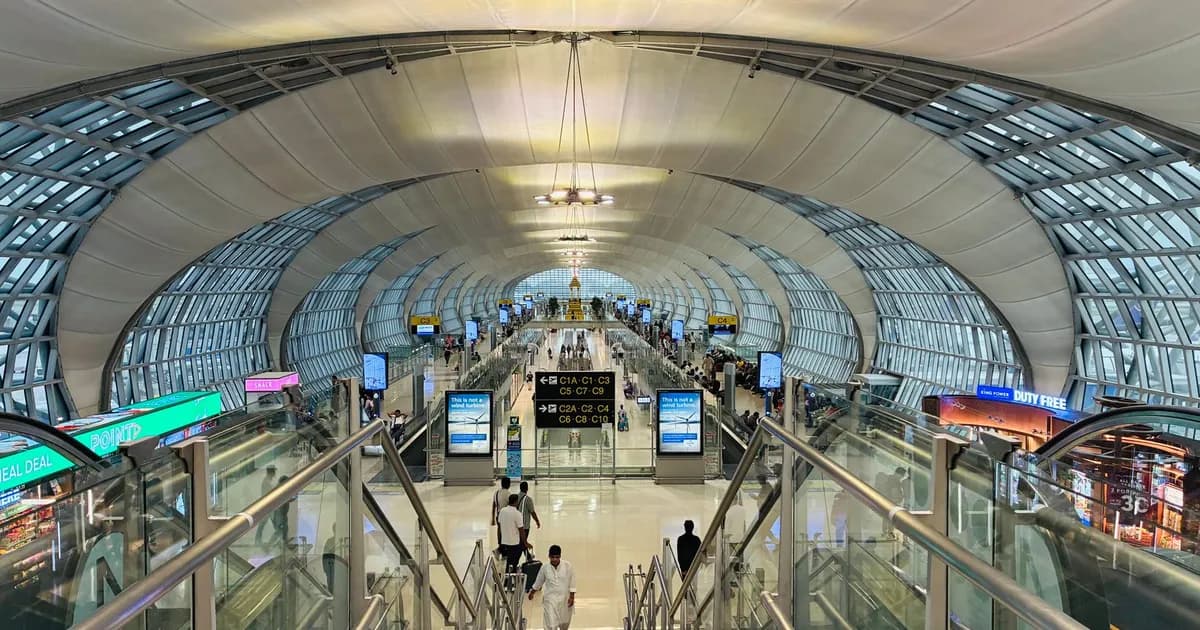
At Suvarnabhumi, the Satellite 1 concourse — 216,000 square metres, 28 contact gates, many sized for widebody aircraft, connected to the main terminal by an underground automated people mover — was built to lift the airport's annual capacity from roughly 45 million passengers to around 60 million and to relieve chronic congestion in the original building. Beyond that, an East Expansion project broke ground in early 2026, intended to take capacity from 65 million towards 80 million passengers with phased openings before the end of the decade.
Don Mueang, Bangkok's second airport and the hub for most low-cost carriers, is being expanded by a further 15 million passengers of annual capacity, targeting around 45 million. AOT has also cited investment in automated Common Use Passenger Processing Systems and upgraded safety technology.
Whether a traveller thinks 390 extra baht is a fair price for that is a matter of judgement. What is not in dispute is that Thailand's main airports have been running well beyond comfortable capacity for several years, and that the passenger experience at peak hours has suffered accordingly. Some of that investment is already visible: automated processing at immigration has expanded significantly, as covered in our piece on Thailand's automated e-gates for foreign visitors.
What it does to your travel budget
For an individual traveller, 390 baht is roughly the price of a decent meal. For a family of four it is around 1,560 baht in additional charges on the outbound leg from Thailand. Neither figure changes a decision about whether to visit.
The reason to pay attention is cumulative. Several fixed costs of a Thai trip have moved upward in the same period:
- The international departure charge, now 1,120 baht per person.
- A proposed tourist arrival fee, discussed at 300 baht for air arrivals and 150 baht at land borders, with officials indicating the final figure could exceed 300 baht once insurance costs are included. Implementation timing has repeatedly shifted, and land and sea collection has been deferred.
- National park entrance fees for foreign visitors, typically between 150 and 500 baht per park per visit, with marine parks such as the Similan and Surin Islands at the top of the range.
- Elevated airfares, following the removal of more than a million scheduled seats from the Thai market between May and July 2026.
None of these individually is significant. Together, on a three-week trip that includes four national parks and a family of three, they add up to a real number. The point is not that Thailand has become expensive — it has not, relative to most alternatives — but that budgeting from figures you remember from a previous trip will leave you short.
What has not changed
It is worth being equally clear about what this announcement does not affect, because a good deal of confusion has circulated.
It is not a visa change. Entry requirements, the visa-exemption period, the Thailand Digital Arrival Card and the various long-stay visa categories are entirely separate matters, governed by immigration authorities rather than the airport operator. Our summary of Thailand's current entry rules, arrival card and fees covers those in detail.
It is not the tourist arrival fee. The 300-baht arrival charge that has been debated for several years is a different mechanism, paid on entry rather than exit, and is not the same as this departure charge. Reporting has frequently conflated the two.
It is not collected in cash. You do not need to keep 1,120 baht aside for the airport. Spend your remaining currency.
It does not apply to domestic flights. Internal flights within Thailand carry a separate, lower charge that was not part of this adjustment.
It does not affect how you apply for a visa. If you need one, the online e-visa process is entirely unchanged by this adjustment.
What to do next
- Check your booking date, not your travel date. Tickets issued before 20 June 2026 were priced at the old rate and are not subject to a top-up.
- Add roughly 1,120 baht per person to any new international ticket you are pricing out of Thailand, and expect it inside the fare rather than as a separate charge.
- Think twice before voluntarily reissuing an older ticket. A change may trigger recalculation at current rates.
- Do not hold back cash for the airport. This charge is not collected at the terminal.
- Budget park fees separately. At 150 to 500 baht per person per park, four parks for two people is a meaningful line in a trip budget.
- If you are crossing to Malaysia, Laos or Cambodia overland, disregard this entirely — it does not apply to land departures.
- Check the current status of the arrival fee close to your travel date, as implementation has been repeatedly deferred.
If you would rather have all of this priced correctly into a single quote before you commit, our plan your journey page sets out how to work with an agency that builds current fees into its costings.
Frequently Asked Questions
How much is Thailand's departure tax in 2026?
The international passenger service charge at AOT-operated airports is 1,120 baht per departing passenger, effective from 20 June 2026, up from 730 baht previously. It is included in the price of your air ticket.
Do I pay the departure fee in cash at the airport?
No. Thailand stopped collecting this charge in cash at the terminal years ago. It is collected by the airline when your ticket is issued and is embedded in the taxes and fees element of your fare.
I booked my flight before June 2026. Do I owe the difference?
Generally no. Tickets issued before 20 June 2026 carry the previous rate and may be flown as ticketed without additional collection. However, if you voluntarily change or reissue that ticket, the fare may be recalculated at current rates.
Does the increase apply at every Thai airport?
No. It applies at the six airports operated by Airports of Thailand: Suvarnabhumi, Don Mueang, Chiang Mai, Mae Fah Luang Chiang Rai, Phuket and Hat Yai. Those handle the vast majority of international departures, but airports run by other authorities set their own charges.
Is this the same as the 300-baht tourist fee?
No, and this is the most common confusion. The 1,120-baht charge is an airport departure fee paid on exit and already in force. The 300-baht tourist arrival fee is a separate proposal collected on entry, whose implementation has been repeatedly delayed and whose final amount may be higher than 300 baht.
Does it apply to children and infants?
Practice varies slightly by airline, but infants travelling without a seat are typically exempt while children occupying a seat are generally charged at the full rate. Confirm with the airline when booking if this matters to your budget.
What if I leave Thailand by land or sea?
The airport passenger service charge applies only to air departures from the relevant airports. Crossing overland into Malaysia, Laos, Cambodia or Myanmar, or leaving by sea, does not incur it. Those crossings have their own separate immigration procedures and occasional local fees.
Will this fee rise again?
AOT has linked the increase to a multi-year capital programme covering the Suvarnabhumi East Expansion, Don Mueang expansion and new processing systems, all of which run to the end of the decade. Further adjustments over that period would not be surprising, but none beyond June 2026 has been announced.