
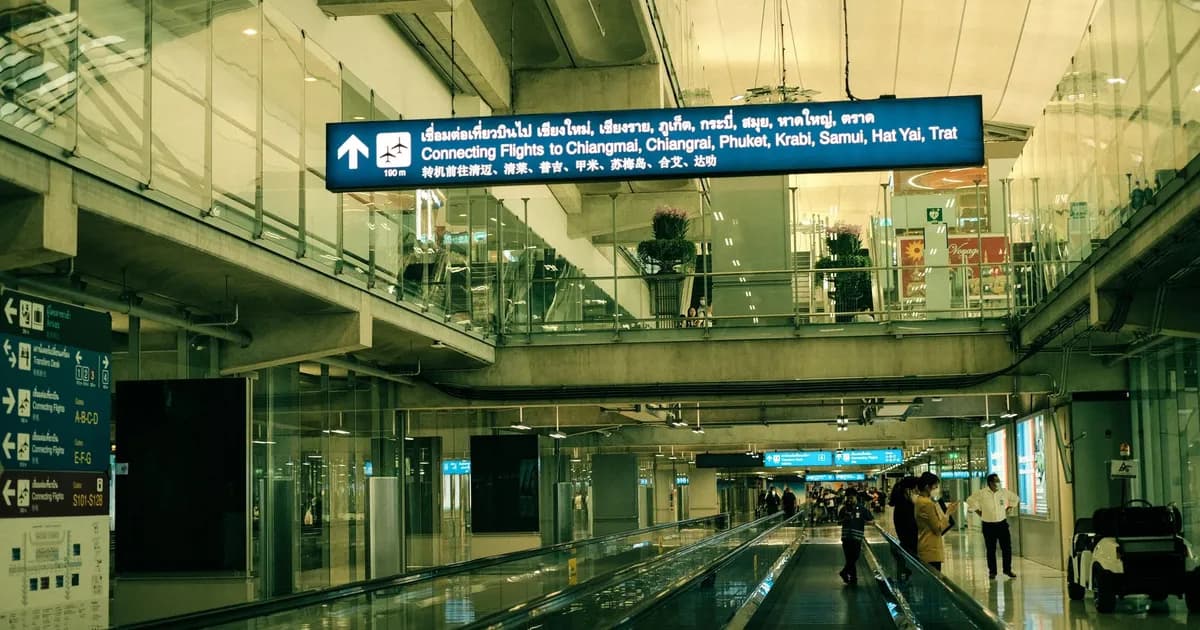

Arriving in Thailand has historically meant one predictable bottleneck: a long, slow-moving immigration queue, however smoothly the flight itself went. As of March 2026, that bottleneck has started to shrink for a growing share of travellers. Automated Border Control e-gates, previously limited mostly to Thai nationals and a narrow band of foreign residents, are now open to many foreign visitors holding biometric passports at five major Thai airports. The gate reads your face, checks it against your passport, and cross-references both against the Thailand Digital Arrival Card you are still required to file before arrival. Get the details right beforehand and the whole process takes under a minute. Get them wrong, and you are redirected to a manned counter exactly as before — so the system rewards preparation more than it rewards showing up and hoping for the best.
What changed, and where
At a glance
- Eligible
- Foreign visitors with a biometric (chip) passport
- Airports
- Suvarnabhumi (BKK), Don Mueang (DMK), Chiang Mai (CNX), Phuket (HKT), Hat Yai (HDY)
- Pre-register
- No e-gate sign-up; TDAC required and must match passport exactly
- Cost
- Free (TDAC filed online within 72 hours of arrival)
- Live since
- March 2026
The expansion of Automated Border Control gates to eligible foreign travellers is now live at Suvarnabhumi Airport (BKK) and Don Mueang Airport (DMK) in Bangkok, along with Chiang Mai (CNX), Phuket (HKT), and Hat Yai (HDY) airports. These five airports together handle the overwhelming majority of international arrivals into the country, which means most travellers flying directly into Thailand from abroad will now encounter the option at their point of entry rather than needing to route through a specific hub to access it. Eligibility depends primarily on holding a biometric passport — the kind with an embedded chip, standard for most modern passports issued by the UK, EU member states, the US, Australia, Canada, and a growing list of other countries — though exact nationality eligibility can shift, so checking current requirements close to your travel date is worth the two minutes it takes.
One request. Up to five tailored proposals.
Skip contacting agencies one by one — share your trip once and let up to five trusted Thailand agencies come to you. Free, with no obligation.
Get my free quotesHow the e-gates actually work
- Step 1Head to the automated gate instead of a manned counter
- Step 2Scan your passport's biometric chip
- Step 3Look at the camera for a live facial-recognition check
- Step 4The gate cross-references your TDAC and scans a QR code when prompted
- Step 5It opens if every detail matches; a mismatch sends you to a staffed counter
The sequence is straightforward but strict about accuracy. On arrival, eligible travellers proceed to the automated gate rather than a manned immigration counter, scan their passport's biometric chip, and undergo a live facial recognition check that compares the traveller standing at the gate against the photo stored on the passport chip. The system then cross-references this against the Thailand Digital Arrival Card submitted before arrival, along with a QR code scan when prompted. Crucially, the gate opens only when the details on your Digital Arrival Card match your passport exactly — name spelling, passport number, and date of birth all need to line up without discrepancy. A mismatch, even a minor typo made while filling out the form on a phone at an airport gate before departure, sends the traveller to a staffed counter for manual processing, which defeats the purpose of using the e-gate at all.
The Thailand Digital Arrival Card remains mandatory
None of this removes the requirement to file a Thailand Digital Arrival Card, or TDAC, which has been mandatory for all foreign arrivals since May 2025 and replaced the old paper TM6 form entirely. The card must be completed online, free of charge, within 72 hours of arrival, and it asks for standard details: passport information, flight details, accommodation address in Thailand, and health declarations. The e-gate system depends entirely on this data being accurate, since it is the record the facial recognition and passport scan are checked against. Filling out the TDAC carefully, ideally the same day you finalise your booking details rather than rushed at an airport gate, is now more consequential than it used to be — under the old manual queue system, a small error might mean a follow-up question from an immigration officer, but under the automated system it means being pulled out of the fast lane entirely.
Get matched with up to 5 trusted Thailand agencies
- Free
- No obligation
- Up to 5 agencies
Why this matters for slow travellers specifically
For travellers planning a longer, unhurried stay in Thailand, arrival logistics rarely feel like the interesting part of a trip, but they set the tone for everything that follows. A traveller stuck for forty minutes in a manual queue after a long-haul flight arrives at their first hotel tired and irritable; a traveller who clears immigration in under a minute has more of that first day intact. This is a small thing on its own, but it fits into a broader pattern in Thailand's 2026 tourism strategy of reducing friction for the kind of visitor who stays longer and spends more deliberately, rather than optimising purely for high-volume, short-stay arrivals. It is a minor detail with an outsized effect on how a long-haul arrival actually feels, particularly for travellers landing after an overnight flight who would otherwise lose the sharpest, most alert part of their first day to a queue. It pairs naturally with other logistical groundwork worth doing before departure — UNRUSH's guide to Thailand's 2026 entry rules, visa requirements, and the tourist fee covers the wider entry picture beyond the e-gates specifically, and is worth reading alongside this one before you travel.
What to prepare before you fly
Getting the fast lane requires a small amount of homework, all of which is easy to do from home well before departure. Confirm your passport is genuinely biometric — check for the small chip symbol on the cover, usually a gold rectangle with rounded corners, though nearly all passports issued in the last decade by major travel markets qualify. File your Thailand Digital Arrival Card within the 72-hour window before arrival, entering your name and passport number exactly as they appear on your passport, with no abbreviations or nicknames. Double-check flight and accommodation details before submitting, since amendments after submission are more limited than corrections made before you hit submit. Keep a screenshot or printout of your TDAC confirmation as a backup, even though the system is digital, in case of a technical issue at the airport. None of this takes more than fifteen minutes, and it is fifteen minutes that can save considerably more time standing in an arrivals hall.
What happens if something does not match
If the e-gate rejects your entry — usually because of a mismatch between your TDAC and passport, or because your specific nationality or passport type is not yet eligible — you are simply redirected to a standard manned immigration counter, exactly the process every traveller used before the e-gates existed. There is no penalty for this beyond the time cost, and immigration staff are used to handling both streams in parallel. It is worth mentioning to the officer if you know the mismatch was a typo in your TDAC, since some minor issues can be corrected on the spot rather than requiring a fresh submission. For a broader sense of how Thailand's digital entry systems have evolved over the past two years, UNRUSH's guide to Thailand's e-visa system in 2026 covers the parallel shift toward online visa applications, which is worth understanding if your nationality requires a visa in addition to the arrival card.
Beyond immigration: the rest of the arrival process
Clearing the e-gate faster only addresses one part of arriving in Thailand, and it is worth planning the rest of that first hour with the same level of preparation. Baggage claim and customs remain unchanged by the e-gate rollout, and at busy periods they can still take longer than the immigration step itself, so a fast e-gate clearance does not guarantee a fast overall arrival. Getting a local SIM or eSIM active before or immediately after landing matters more than ever once immigration itself is quick, since the bottleneck shifts to connectivity — arranging a data plan in advance, covered in UNRUSH's guide to money, SIM cards, and eSIM connectivity in Thailand, lets a traveller move straight from the arrivals hall to a taxi or transfer without a queue at a phone kiosk. It is also worth remembering that domestic connections within Thailand, if your itinerary includes an onward flight to somewhere like Krabi or Koh Samui, still route through standard domestic processing rather than the international e-gate system, so budget the usual buffer for those transfers regardless of how quickly you cleared international arrivals.
What to do next
- Check whether your passport is biometric and confirm current nationality eligibility for e-gates close to your travel date, since the list of eligible passport types continues to expand through 2026.
- File your Thailand Digital Arrival Card within 72 hours of arrival, entering every detail exactly as it appears on your passport.
- Save a screenshot of your TDAC confirmation before you fly, in addition to relying on the digital record.
- Budget the standard immigration queue time as a backup in your arrival-day planning, in case you are redirected to a manned counter.
- Arrive with your passport readily accessible rather than packed away, since the automated gate needs the physical document for the chip scan.
- If connecting onward within Thailand, remember the e-gate expansion currently covers Suvarnabhumi, Don Mueang, Chiang Mai, Phuket, and Hat Yai airports specifically, not every domestic gateway.
Frequently Asked Questions
Which airports currently have the expanded e-gates for foreign visitors?
Suvarnabhumi (BKK) and Don Mueang (DMK) in Bangkok, along with Chiang Mai (CNX), Phuket (HKT), and Hat Yai (HDY), have offered Automated Border Control e-gates to eligible foreign visitors since March 2026.
Do I still need to complete the Thailand Digital Arrival Card if I use an e-gate?
Yes. The TDAC remains mandatory for all foreign arrivals regardless of whether you use an e-gate or a manned counter, and the e-gate system specifically relies on your TDAC data matching your passport to function.
What happens if my passport is not biometric?
You will not be eligible for the automated gates and will proceed through a standard manned immigration counter, exactly as travellers did before the e-gate system existed. There is no additional penalty for this.
How much faster is the e-gate compared to a manned counter?
Reports suggest the automated process can cut arrival wait times by a significant margin during busy periods, though the exact time saved depends heavily on how busy the airport is at the moment you land.
What causes an e-gate to reject a traveller?
The most common cause is a mismatch between the details submitted on the Thailand Digital Arrival Card and the passport being scanned — a misspelled name, incorrect passport number, or wrong date of birth. Facial recognition failures and passport type ineligibility are the other main causes.
Can I fix a TDAC error at the airport?
Minor errors can sometimes be corrected on the spot by immigration staff, particularly obvious typos, but it is far more reliable to double-check every field before you initially submit the form, since corrections after submission are limited.
Is the e-gate system connected to Thailand's other digital entry initiatives?
Yes. It is part of a broader move toward digital immigration processing that includes the Thailand Digital Arrival Card and the online e-visa system, with a further unified digital immigration platform reportedly planned for later in 2026.