
Thailand receives tens of millions of visitors a year, and most of them funnel into the same handful of places — Phuket, Khao San Road, the full-moon beaches, a two-day blur of Chiang Mai. Step even slightly off that track and you find a quieter, cheaper, and frankly better country. This guide maps where to go to escape the crowds, and how to reach those places without losing the plot.
Why "Hidden" Thailand Is the Better Thailand
The crowded parts of Thailand are crowded for a reason — they are genuinely beautiful. But beauty under a thousand selfie sticks is a diminished thing, and the country's overtourism is increasingly concentrated: a small number of islands and streets absorb the bulk of the visitors while vast, lovely regions see almost none.
For a slow traveler, this is an opportunity rather than a problem. The quiet places are not consolation prizes. They are often the best of Thailand — the same turquoise water, the same temples and food and warmth, minus the queues and the markup, plus the thing the headline destinations have mostly lost: a sense that you are somewhere real, lived-in, and unhurried. They also tend to cost noticeably less, which means your budget stretches further exactly where the experience is richer. The trade-off is that they take a little more effort to reach. That effort is the filter that keeps them quiet.
The mountainous north
Nan and Chiang Dao trade Chiang Mai's bustle for rice-field valleys, wooden temples and cave systems — best from November to February, before the burning-season haze. For travelers who want cool-season landscapes and slow scooter days.
Isan, the northeast
The country's least-touristed region, with Lao-influenced food, Mekong river towns and Khmer temples like Phanom Rung. Suits those happy to trade longer distances and thinner transport for a Thailand with almost no other foreigners.
The quiet islands
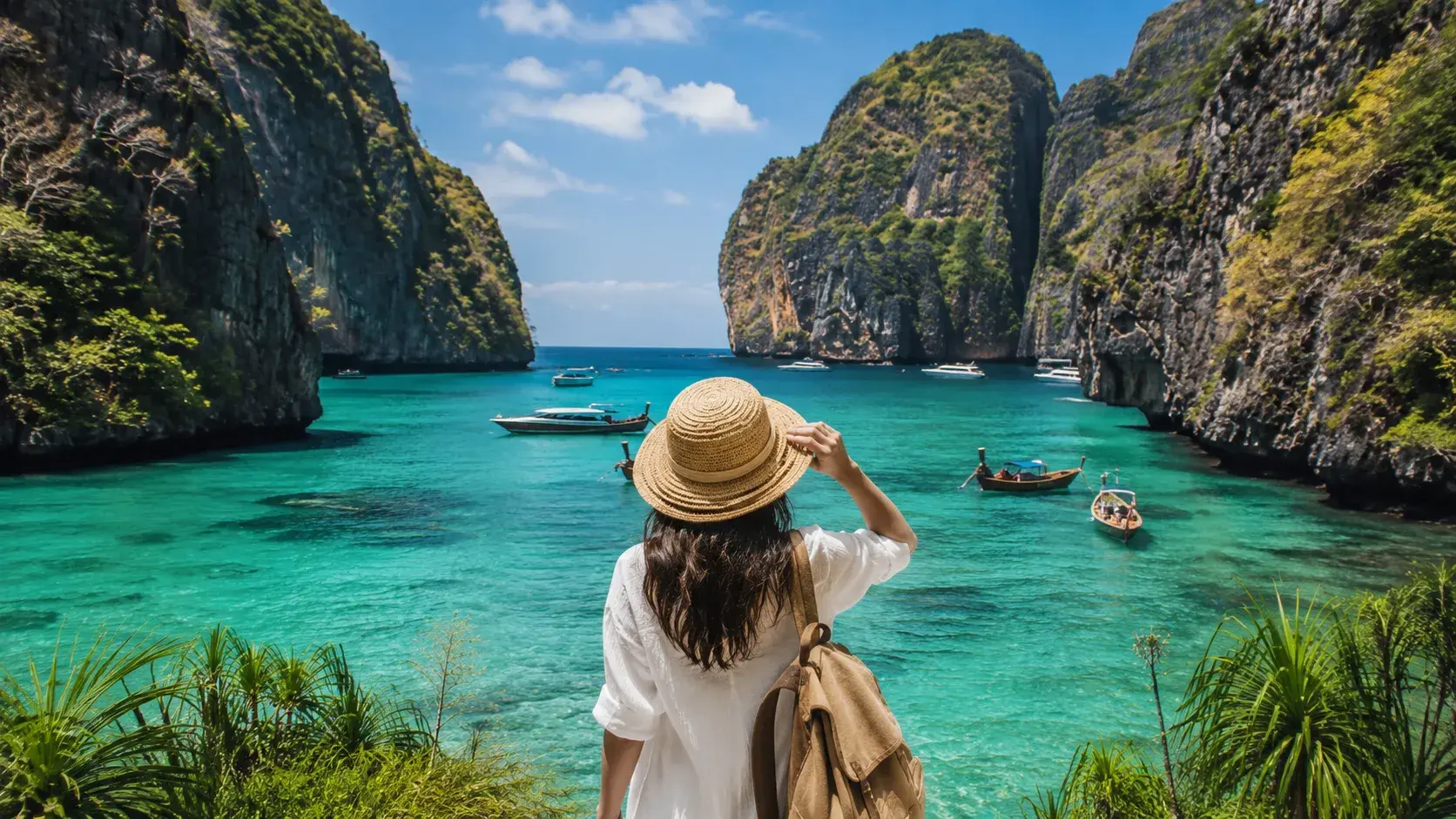
Koh Mak, Koh Kood, Koh Yao Noi and the Trang archipelago keep empty beaches and low-key local development, best December to April. For beach lovers who want turquoise water without the Phuket crowds.
One request. Up to five tailored proposals.
Skip contacting agencies one by one — share your trip once and let up to five trusted Thailand agencies come to you. Free, with no obligation.
Get my free quotesThe North Beyond Chiang Mai
Chiang Mai is the gateway to the north, and worth a few days — but most visitors never go further, which leaves the surrounding region wide open.
Nan
Tucked against the Laos border in a remote eastern valley, Nan is one of the most rewarding slow-travel destinations in the country precisely because it is awkward to reach. Its reward is a gentle landscape of green rice fields, quiet wooden temples — Wat Phumin's 19th-century murals are justly famous — and slow scooter rides through valleys that see a fraction of the north's usual traffic. Nan rewards days, not hours.
Chiang Dao
About 70 kilometres north of Chiang Mai, Chiang Dao sits at the foot of Thailand's third-highest mountain. It offers misty mornings, bright green fields, a vast cave system filled with Buddha images that stretches for kilometres, well-kept natural hot springs, and hill-tribe villages nearby — with almost none of the crowds you find elsewhere in the north. It is one of the easiest off-beat bases to combine with Chiang Mai.
A note on Pai
Once the archetypal hidden valley, Pai has become a victim of its own reputation and is now firmly on the backpacker circuit. It is still pretty, but if solitude is what you are after, Nan and Chiang Dao deliver it far more reliably.
The north is at its best from November to February, when the air is crisp and the valleys fill with morning fog — and, crucially, before the late-February-to-April burning season blankets the region in haze. We cover that timing in detail in our guide to where to go and when in Thailand.
Isan: The Region Almost No One Visits
Thailand's vast northeastern plateau, Isan, is the country's least-touristed region by a wide margin — and the single best place to find a Thailand with almost no other foreigners in sight. It has its own Lao-influenced culture, language, and cuisine (this is the home of som tam and sticky rice), some of the warmest hospitality in the country, and a string of sites that would be mobbed if they were anywhere near a beach.
Nong Khai and the Mekong
A relaxed river town on the Lao border, Nong Khai is built for slow days: cycling along the Mekong, the surreal giant statues of the Sala Keoku sculpture park, and the red-lotus lake that blooms nearby in the cool season. An hour away, the rock formations and ancient shelters of Phu Phra Bat reward a half-day's exploration.
Buriram's Khmer temples
Long before Angkor, this was Khmer territory, and Phanom Rung — an 11th-century sanctuary perched on an extinct volcano — is the finest Khmer monument in Thailand, all the more memorable for the near-total absence of crowds that would swarm an equivalent site elsewhere.
Ubon Ratchathani
A launchpad for Pha Taem National Park, where prehistoric rock paintings overlook the Mekong, and a city known for its festivals and golden temples. Isan's distances are real and public transport thins out beyond the main towns, so this is the region where a little local logistics help — or a rented vehicle — pays off most.
Get matched with up to 5 trusted Thailand agencies
- Free
- No obligation
- Up to 5 agencies
The Quiet Islands
You do not have to give up beaches to escape the island crowds. You just have to skip the famous names.
Koh Mak and Koh Kood
Far out in the east near the Cambodian border, in Trat province, this pair is among the most peaceful in the country. Koh Mak is small, flat, and made for slow exploration — quiet roads, coconut groves, and empty beaches perfect for cycling. Koh Kood is larger and frequently called Thailand's prettiest island, with clear water, secluded beaches, and jungle waterfalls like Khlong Chao. Both are at their best December to April and remain genuinely low-key, with low-rise, locally minded development.
Koh Yao Noi
Sitting in Phang Nga Bay between Phuket and Krabi — surrounded by the region's most famous scenery yet largely bypassed by it — Koh Yao Noi keeps a slow, Muslim-fishing-village rhythm. Limestone views in every direction, a fraction of the visitors, and easy day trips into the bay make it one of the best-value escapes in the south.
The Trang archipelago
South of Krabi, the islands off Trang — Koh Ngai, Koh Mook, Koh Kradan, Koh Libong — stay quiet largely because the airport is on the mainland, an hour from any pier. Koh Mook is famous for its Emerald Cave, reached by swimming 80 metres through a pitch-dark tunnel that opens onto a hidden beach ringed by cliffs. Koh Kradan has powder-white sand, though it fills with day-trippers between roughly 10am and 2pm — the case for staying overnight, when you get the beach to yourself. One honest note: many of the area's reefs were badly bleached in 2024 and the famous Trang dugongs have largely died off or moved on, so come for the beaches and quiet rather than the snorkelling it was once known for.
Inland and Overlooked
Sukhothai
Thailand's first capital, and the more peaceful of its two great ruined cities. Where Ayutthaya is a busy day trip from Bangkok, Sukhothai Historical Park is calm enough to cycle through at dawn among lotus ponds and serene seated Buddhas. It is worth an overnight rather than a rushed visit, and it is at its most magical during the Loy Krathong festival in November, which it claims as its birthplace.
Khao Sok National Park
Inland from the southern coasts lies one of Thailand's great natural surprises: Khao Sok, the largest tract of virgin rainforest in the south, older and more biodiverse than the Amazon, centred on the emerald Cheow Lan Lake with its dramatic limestone cliffs and floating raft houses. A night in a lakeside bungalow, with dawn mist on the water and gibbons calling from the forest, is one of the most memorable experiences in the country — and a world away from the beaches an hour's drive south. The park headquarters charges a 200-baht entry fee.
How to Travel These Places Responsibly
Going off the beaten path comes with a quiet responsibility: these places are quiet partly because they are fragile, and the way you travel determines whether they stay good.
Choose locally owned guesthouses, homestays, and small eco-lodges over outside-owned development — in Nan, on Koh Kood, in Isan, your spending then supports the families and communities preserving these places. Keep development pressure in mind: part of what makes Koh Mak and Koh Yao Noi special is that locals have resisted high-rise tourism, and travelers who respect that rhythm help sustain it. Be honest about ecology, too — the Trang reefs are a reminder that "paradise" is not indestructible. And in Isan especially, where you may be one of very few foreigners around, a little cultural sensitivity and a few words of Thai go a long way.
This is the heart of the slow-travel approach, and the thinking behind our slow travel charter.
How to Get There — and Why a Local Partner Helps
The single reason these places stay quiet is the same reason they take planning: they are harder to reach. Nan and Isan involve long overland legs or regional flights; the Trang islands require coordinating mainland transport with ferry timetables; Khao Sok sits between coasts with its own access quirks; and public transport thins out fast beyond the main towns, especially in the northeast.
This is exactly where local knowledge earns its place. Knowing which island still has space and character, how to chain a flight to a ferry to a homestay, which Isan towns reward a detour, and where a rented vehicle beats waiting for a bus — these are the judgements that turn an ambitious off-beat route from a logistical headache into a smooth, rewarding trip. The agencies in our certified network specialise in exactly this kind of slower, deeper, well-routed travel.
For costs across every tier, see our Thailand budget guide, and when you are ready to build a route, start on our plan-your-journey page.
At a glance
- Getting there
- Long overland legs or regional flights for Nan and Isan; mainland transport plus ferries for the Trang islands.
- Best season
- North and Isan from November to February; eastern and Andaman islands from December to April.
- Avoid
- The north from late February to April, during the burning-season haze.
- Pacing
- Slow — Nan rewards days not hours, and Sukhothai and Khao Sok are worth an overnight.
- Getting around
- Public transport thins out beyond the main towns; a rented vehicle or local partner helps most in Isan.
Frequently Asked Questions
Where can I go in Thailand to avoid crowds?
The northeastern Isan region (Nong Khai, Buriram, Ubon Ratchathani) is the least-touristed part of the country. In the north, Nan and Chiang Dao stay quiet while Chiang Mai and Pai fill up. For beaches, skip Phuket and the full-moon islands in favour of Koh Mak, Koh Kood, Koh Yao Noi, and the Trang archipelago.
Which is the most peaceful island in Thailand?
Koh Mak and Koh Kood, in the far east near Cambodia, are among the most tranquil, with low-key local development and empty beaches. Koh Yao Noi, between Phuket and Krabi, is another standout. The Trang islands stay quiet thanks to their distance from any airport.
Is the Isan region worth visiting?
Yes, if you want a Thailand almost untouched by mass tourism — distinct food and culture, Khmer temples like Phanom Rung, the Mekong river towns, and genuine warmth, often with no other foreigners around. The trade-off is longer distances and thinner public transport, so it rewards a flexible, slower pace.
When is the best time for off-the-beaten-path Thailand?
The cool season, November to February, is ideal for the north (Nan, Chiang Dao) and Isan, with crisp air and clear skies. The eastern and Andaman islands are best December to April. Avoid the north from late February to April during the burning-season haze.
Are these places hard to reach?
Harder than the headline destinations, which is exactly why they stay quiet — long overland legs, regional flights, and ferry connections are often involved. With a little planning, or a good local partner to handle the logistics, they are very accessible.
Can I still find good beaches away from the crowds?
Absolutely. Koh Kood and Koh Mak in the east, Koh Yao Noi in Phang Nga Bay, and the Trang islands all offer beautiful, uncrowded beaches. Be aware that some Trang reefs were bleached in 2024, so go for the sand and quiet rather than world-class snorkelling.
Ready to find the quiet side of Thailand? Explore our Thailand travel guides, see when to go in our where-to-go-and-when guide, and start planning with our network of certified local agencies on the plan-your-journey page.