

The river appears without warning. One moment you are walking a red-dirt track between corn fields, limestone walls rising on both sides; the next, the path dissolves into green water and your guide is already wading in. This is how Tu Lan begins — not with a ticket booth or a viewing platform, but with a river crossing at dawn, chest-deep and cold, headlamp catching the cave mouth ahead.
Tan Hoa is a small farming commune in Quang Binh's Minh Hoa District, roughly 70 kilometres northwest of Phong Nha. It sits in a low valley that floods to twelve metres in a bad October, surrounded by karst peaks that hold more than twenty caves within their limestone. For most of its history, the village was known for precarious agriculture and seasonal hardship. Today it is recognised by the UN World Tourism Organization as one of the world's Best Tourism Villages, a designation that reflects something genuinely unusual: a place where adventure tourism has reduced poverty from 85.7 percent to 2.6 percent in a single decade, without dismantling the landscape that made it worth visiting.
This is not a destination you stumble into. That is precisely the point.

The Caves and What They Ask of You
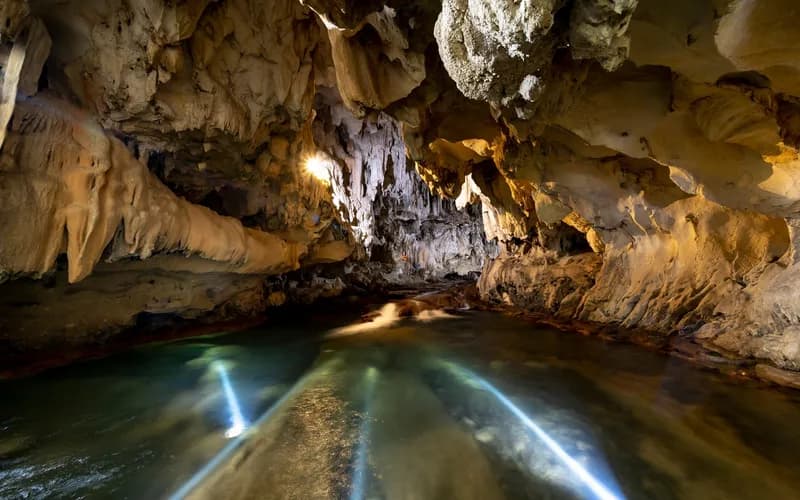
The Tu Lan system is not a single cave but a network — passages, chambers, and underground rivers threaded through the karst over millions of years. Expeditions run from one day to four, and the longer routes earn their length. A typical multi-day itinerary involves jungle trekking, river crossings, swimming through cave passages with a life vest and headlamp, and nights camped on sandbanks inside the mountain. Hang Tien, often paired with Tu Lan on longer routes, offers cathedral-scale dry chambers reached by a harder jungle approach.
Oxalis Adventure, the primary operator, has worked with British speleologists to survey and map the system since the early 2010s. Only a portion of the caves are open to tourism; others remain closed for research or conservation. Group sizes are capped — typically eight to ten guests per departure — and guide-to-guest ratios are designed for safety, not efficiency. All equipment goes in and comes out with the team. Campsites are temporary, set on sandbanks and dismantled after use.
The physical demands are real. Trekking in central Vietnam's humidity, scrambling over wet rock, and swimming short cave passages in darkness requires a baseline of fitness and a genuine comfort with water. Operators classify most multi-day tours as moderate to difficult. Non-swimmers can sometimes be accommodated on less aquatic routes, but the honest answer is that Tu Lan rewards those who come prepared. Travellers who underestimate the combination of heat, mud, and repeated river crossings tend to find the experience harder than expected.
Tours include all meals, camping equipment, safety gear, and transfers from Phong Nha or Dong Hoi. Multi-day expeditions typically cost in the range of US$300–600 per person depending on duration and route — a figure that reflects the staffing, logistics, and conservation infrastructure built into every departure.
One request. Up to five tailored proposals.
Skip contacting agencies one by one — share your trip once and let up to five trusted Vietnam agencies come to you. Free, with no obligation.
Get my free quotesA Village That Learned to Float
Tan Hoa's relationship with water is not metaphorical. The valley floods severely each year, and for generations that flooding meant crop loss, displacement, and debt. The village's response — practical, incremental, and now internationally recognised — was to stop resisting the water and start designing around it.
Locals built floating houses on plastic barrels, tethered to concrete pillars, that rise and fall with the flood rather than fighting it. In 2017, the tourism model was formally adapted to match seasonal river conditions, rerouting or suspending cave expeditions during high-risk periods. By 2022, floating homestays had been developed for visitors, allowing travellers to stay in Tan Hoa even during flood season — paddling between houses, watching the valley transform into a temporary inland sea.
This is climate adaptation made tangible. It is also, quietly, one of the more interesting things a traveller can witness in rural Vietnam: a community that has turned its most dangerous liability into a distinctive experience. The floating homestays are simple — basic private facilities, home-cooked meals, the sound of water against the barrels at night. They are not luxury. They are something more interesting than luxury.
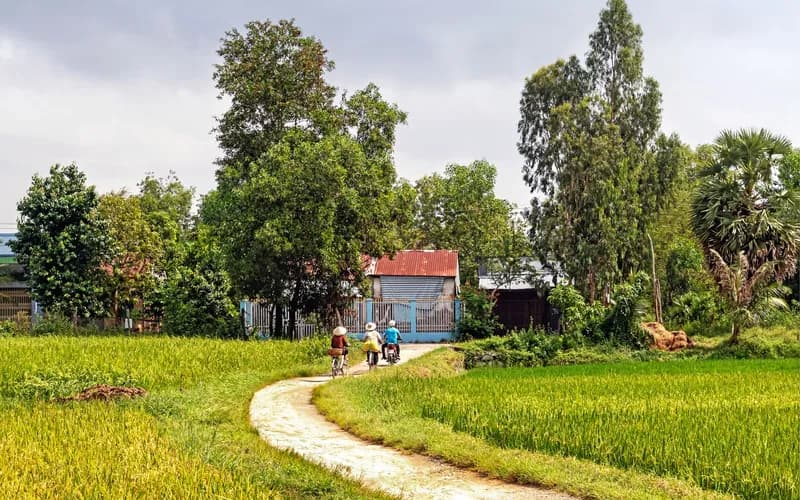
For those visiting outside flood season, Tu Lan Lodge serves as the main base: a rustic eco-lodge set among rice fields, with standard rooms and family bungalows at roughly US$40–80 per night. The village also has scattered homestays at lower price points, small local eateries, and the kind of quiet that becomes noticeable after a few hours.
The Economics of Staying Small
In 2024, approximately 11,000 visitors came to Tan Hoa — around 80 percent of them international. That number sounds modest until you consider what it has produced. Per-capita annual income in the village rose from 4.8 million VND in 2014 to an estimated 36–42 million VND in 2024. More than 130 residents work directly in tourism through Oxalis, as porters, cooks, guides, safety assistants, and homestay hosts. The poverty rate, once among the highest in the province, now sits at 2.6 percent.
The model works because it is deliberately constrained. One main operator. One eco-lodge. Scattered homestays rather than a hotel strip. Group sizes capped at the expedition level. The Oxalis impact report on Tan Hoa describes a village that shifted from logging, hunting, and marginal farming to service roles that monetise conservation rather than deplete it. Government programmes have supported residents in building their own homestays and developing OCOP (One Commune, One Product) goods — local produce, handicrafts — so that community ownership extends beyond wage labour for an external operator.
The inaccessibility is structural to this. The 1.5–2 hour drive from Phong Nha on winding rural roads, the requirement to pre-book multi-day expeditions, the physical commitment involved — these are not inconveniences to be engineered away. They are the filter that keeps daily visitor density low and the experience coherent.
Get matched with up to 5 trusted Vietnam agencies
- Free
- No obligation
- Up to 5 agencies
What to Know Before You Go
Tan Hoa is not a destination for travellers who want flexibility on arrival. The caves require registered guides and permits; independent access is not permitted for safety and conservation reasons. You can stay at the lodge or a homestay and cycle through the fields without a tour, but the cave expedition areas are closed to self-guided visitors. Budget travellers sometimes find this frustrating — the only options are full-service expeditions with safety staff, porters, and equipment built into the cost. That cost reflects genuine infrastructure, not padding.
The village has basic mobile coverage and electricity, but internet speeds are unreliable. There is no nightlife, no café strip, and limited options for special diets beyond what homestay hosts and tour cooks can accommodate. Travellers who arrive expecting the amenities of Phong Nha town will need to recalibrate. Those who arrive expecting a working agricultural village with extraordinary caves nearby will find exactly that.
Spend more than one night. The rhythm of Tan Hoa — early mornings, the sound of farming, the scale of the karst at dusk — takes time to settle into. A cave expedition followed by a day of cycling through corn fields and a meal cooked by your host family is a different kind of travel than most people are used to. It is slower, more specific, and considerably harder to forget.
Frequently Asked Questions
When is the best time to visit Tan Hoa?
The dry season, roughly November through August, offers the most reliable conditions for cave expeditions — stable rivers, clearer water, and easier trekking. December through April is particularly popular and books up quickly. The flood season, typically September to October and sometimes extending into November, brings a different experience: the valley fills with water, cave tours may be limited or rerouted, and the floating homestays come into their own. It is worth visiting then if you are comfortable with potential last-minute itinerary changes and want to see the village in its most distinctive seasonal state.
How do I get to Tan Hoa?
The nearest transport hubs are Dong Hoi, which has a domestic airport and a train station, and Phong Nha town, about 70 kilometres southeast of Tan Hoa. The drive from either point takes roughly 1.5–2 hours on winding rural roads. Public transport to Tan Hoa is limited; most visitors arrive via transfers arranged as part of their cave tour package, or by private hire. If you are booking independently, arrange your transfer in advance — do not assume you can find a taxi on arrival in Phong Nha.
How much does a Tu Lan cave expedition cost?
Multi-day expeditions through Oxalis typically fall in the range of US$300–600 per person, depending on duration and route. This includes all meals, camping equipment, safety gear, guides, porters, and transfers from Phong Nha or Dong Hoi. Accommodation in Tan Hoa itself — at Tu Lan Lodge or local homestays — runs separately if you are staying before or after your tour, at roughly US$40–80 per night for the lodge and less for homestays.
How physically demanding are the tours?
Most multi-day Tu Lan and Hang Tien itineraries are classified as moderate to difficult. They involve jungle trekking, river crossings, rock scrambling, and swimming through cave passages with a life vest. The combination of heat, humidity, mud, and repeated water crossings is more taxing than it sounds on paper. Operators provide helmets, life vests, dry bags, and camping equipment; you should bring solid trekking shoes or robust sandals, quick-drying clothing, and insect protection. Assess your fitness honestly before booking, and flag any concerns about swimming or confined spaces when you enquire.
Is it safe to visit during flood season?
The floating homestays are specifically engineered to rise and fall with floodwaters and are tethered to grounded structures for stability. Tourism activities are only permitted when safety thresholds are met, and the weather-adaptive model exists precisely to avoid exposing visitors to flash-flood risk. Cave expeditions may be shortened, rerouted, or suspended during high-risk periods. If you visit in September or October, build flexibility into your itinerary and follow operator guidance without negotiation.