Phan Rang and the Cham Heartland: Vietnam's Dry Coast, Taken Slowly
Most travellers meet Phan Rang at seventy kilometres an hour, somewhere between Nha Trang and Mui Ne, as a blur of cactus scrub, vineyards and brick towers on a hill. That is a pity, because this stretch of the south-central coast holds the most living Cham culture anywhere in Vietnam, a national park where desert slopes drop straight into coral water, and a rhythm of life set by wind, salt and scarce rain rather than by tour schedules. Give it four or five days instead of a comfort stop, and it becomes one of the most rewarding slow stays on the entire coast.
Why Phan Rang Deserves More Than a Pass-Through
Phan Rang was, until mid-2025, the capital of Ninh Thuan province. Since the administrative merger of 1 July 2025, the old province has been folded into an enlarged Khanh Hoa, so you will now see Phan Rang described as the southern gateway of Khanh Hoa. The change matters for paperwork and signage, much less for the experience: the area still feels distinct from Nha Trang, around a hundred kilometres to the north, and it is far quieter.
What makes it special is continuity. The region is home to the largest Cham community in Vietnam, and here Cham heritage is not only something behind a ticket barrier. Villages still follow Hindu-influenced Balamon and Islamic-influenced Bani traditions, potters still build vessels without a wheel, weavers still work brocade on floor looms, and families still gather at their towers for ceremonies that have run for centuries. If you enjoyed the quieter corners in our guide to off-the-beaten-path Vietnam, Phan Rang is a logical next step: less scenery staged for the camera, more culture for the curious.
The trade-off is honesty about infrastructure. Hotels are simpler than in Nha Trang, English is less widely spoken, and public transport between the sights is thin. That is part of the appeal, but it rewards travellers who plan a little and move slowly.
One request. Up to five tailored proposals.
Skip contacting agencies one by one — share your trip once and let up to five trusted Vietnam agencies come to you. Free, with no obligation.
Get my free quotesA Landscape Shaped by Drought and Wind
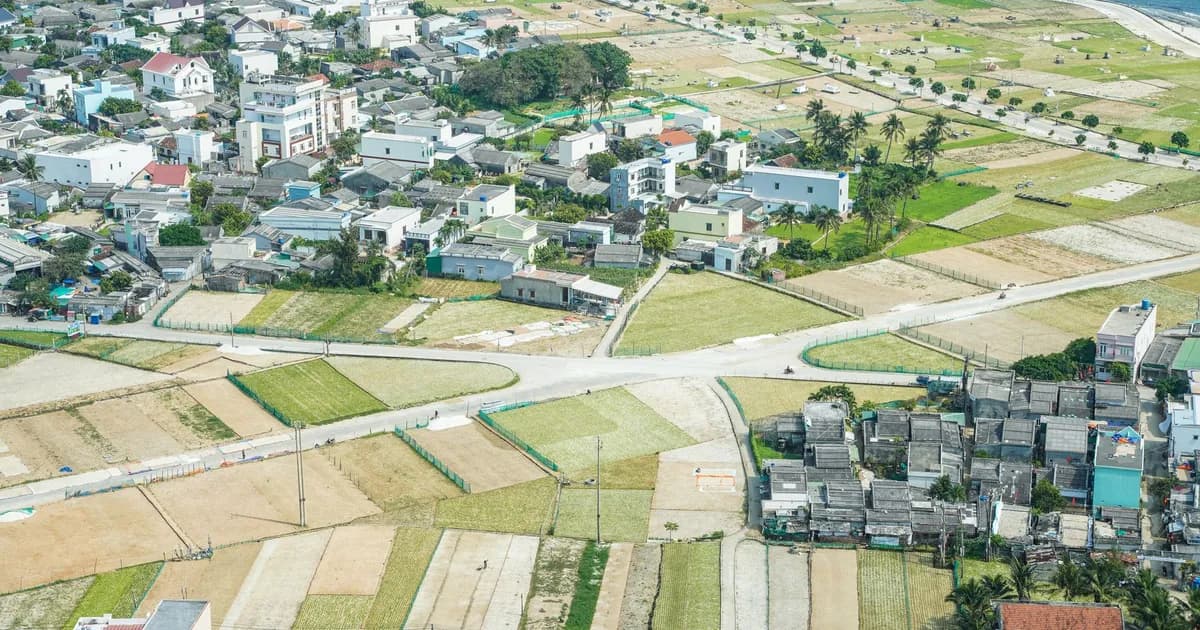
This is one of the driest corners of Vietnam. The mountains to the west cast a rain shadow over the plain around Phan Rang, leaving it parched for much of the year, and the landscape looks more like a Mediterranean hinterland than the green Vietnam of postcards: cactus hedges, thorny scrub, sand dunes near Nam Cuong, sheep and goats grazing on dry hills. Farmers have adapted with grapes, dragon fruit, garlic and salt, and the constant wind that blows off the sea in the dry months has made the coast a quiet favourite with kitesurfers.
For a slow traveller the dryness is a gift. Mornings are clear and cool enough to walk or cycle, afternoons are for shade, cafés and long lunches, and evenings on the beach at Ninh Chu or in a fishing village near Vinh Hy are calm. The light is sharp and golden in a way that makes old brick glow at sunset, and the pace of daily life, dictated by heat and wind, naturally slows your own.
The Cham Towers: Po Klong Garai and Po Ro Me
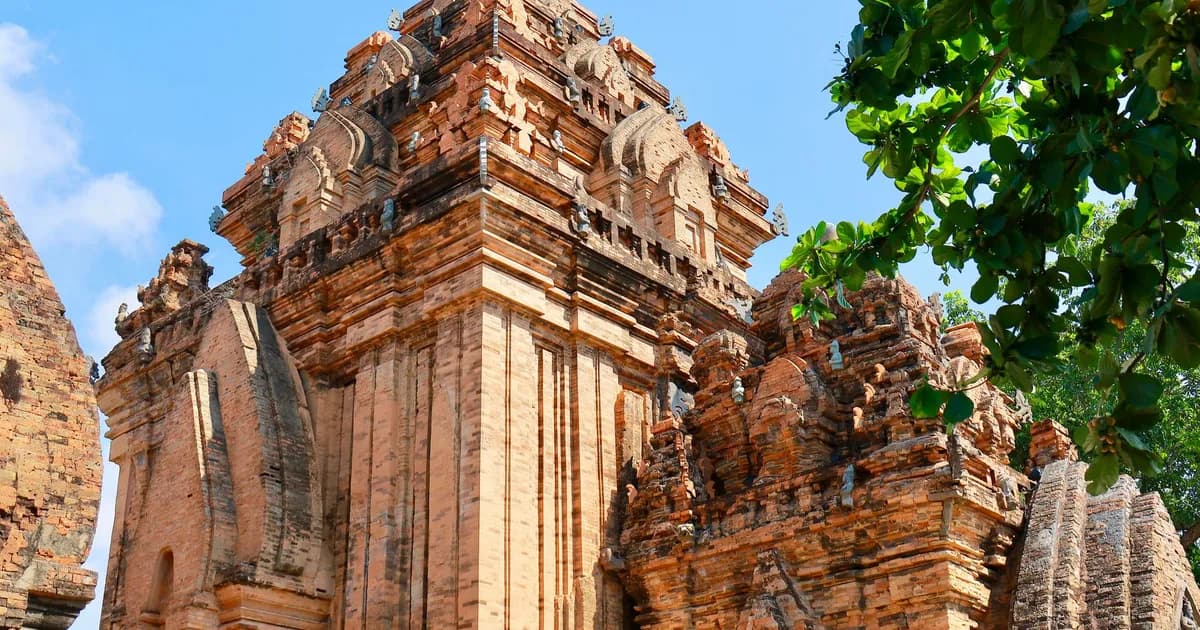
Po Klong Garai sits on Trau Hill on the western edge of Phan Rang, and it is the obvious place to begin. The complex dates from the late 13th and early 14th centuries and is generally credited to King Jaya Simhavarman III, who built it to honour Po Klong Garai, a legendary king remembered for the irrigation works that made this arid plain farmable. Earlier inscriptions on the site suggest he may have restored and expanded an older sanctuary. Three brick structures survive: the main tower, a gate tower and a long building with a saddle-shaped roof. Inside the main sanctuary, a mukhalinga still receives offerings.
Go early. By eight in the morning the light is soft, the brick is warm-toned rather than bleached, and you will often share the hill only with caretakers. Walk slowly around the base to study the carved pilasters and the dancing Shiva above the entrance, then sit on the steps and look west toward the mountains. You are seeing the same irrigated plain the towers were built to bless.
Po Ro Me, roughly 15 kilometres south of the city, is smaller, more remote and more atmospheric. Dedicated to King Po Rome, who ruled in the 17th century, it is among the last towers the Cham ever built. The road there runs through fields and Cham hamlets, which is reason enough to go. Both sites are active places of worship, so dress with shoulders and knees covered, remove shoes where asked and never climb on the structures; our notes on cultural etiquette for temples and village visits apply fully here.
Get matched with up to 5 trusted Vietnam agencies
- Free
- No obligation
- Up to 5 agencies
Bau Truc and My Nghiep: Crafts Made by Hand
About ten kilometres south of Phan Rang, Bau Truc is one of the oldest pottery villages in Southeast Asia still working in the old way. Women potters build pieces entirely by hand, walking backwards around a fixed lump of clay instead of spinning it on a wheel, then shape and polish with shells, bamboo and cloth. Firing is done in the open with straw and wood, which gives the pots their mottled reddish, pink and smoky-grey tones. In November 2022, UNESCO inscribed the art of pottery-making of the Cham people on its List of Intangible Cultural Heritage in Need of Urgent Safeguarding, a recognition that the craft is precious and also fragile: access to raw clay is shrinking, the market is changing, and fewer young people are taking it up.
The best visit is unhurried. Rather than a quick loop past showroom shelves, ask a guide or your host to arrange time with a family workshop, watch a pot being built from start to finish, and buy directly from the maker. Pieces are heavy and breakable, so choose something small or ask about packing. Nearby, the brocade weavers of My Nghiep work on traditional looms; pairing the two villages in one morning gives a fuller picture of Cham domestic crafts than any museum could, and it keeps your money in the households that sustain the skills.
Katê: Timing a Visit Around the Cham New Year
Katê is the most important festival of the Balamon Cham community. It falls on the first day of the seventh month of the Cham calendar, which usually lands in late September or October, and it lasts three days. Ceremonies take place at Po Klong Garai, Po Ro Me and Po Inư Nưgar, followed by gatherings in villages and family homes. The central ritual day at Po Klong Garai includes the procession carrying the deities' garments from the villages up to the tower, the opening of the tower door, the bathing of the statues and their dressing in new robes, all accompanied by Ginang drums and Saranai oboes.
For 2026, published schedules point to October. Exact dates are confirmed locally a few weeks ahead, so check with your accommodation or a local guide before locking in travel. If you come, remember that this is a religious occasion first and a spectacle second. Keep a respectful distance from officiants, ask before photographing people, and avoid standing in the path of the procession. Visiting a village in the following days, when families receive guests at home, is often more meaningful than jostling for a view at the tower.
Nui Chua National Park and Vinh Hy Bay
North-east of Phan Rang, the mountains of Nui Chua fall straight into the sea. Established in 2003 and recognised by UNESCO as a World Biosphere Reserve in 2021, the park protects rare dry forest, coral reefs and some of Vietnam's last sea turtle nesting beaches. Green turtles come ashore to nest roughly between May and October; conservation teams patrol the protected beaches, and any turtle watching should happen only through the park's own programmes, never on your own with a torch.
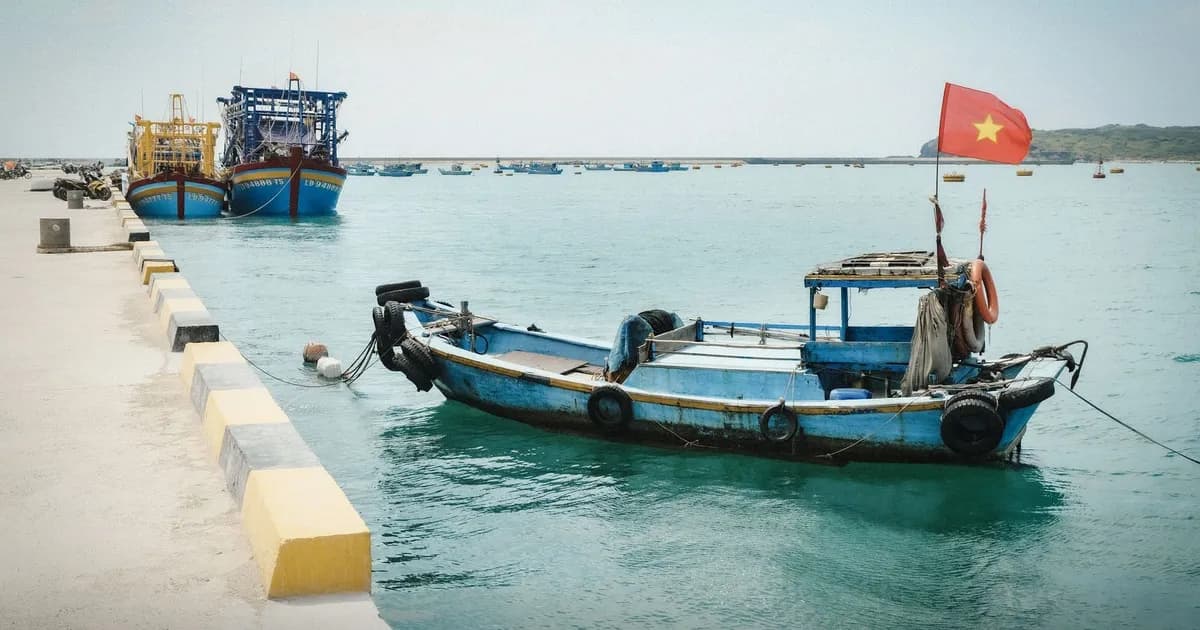
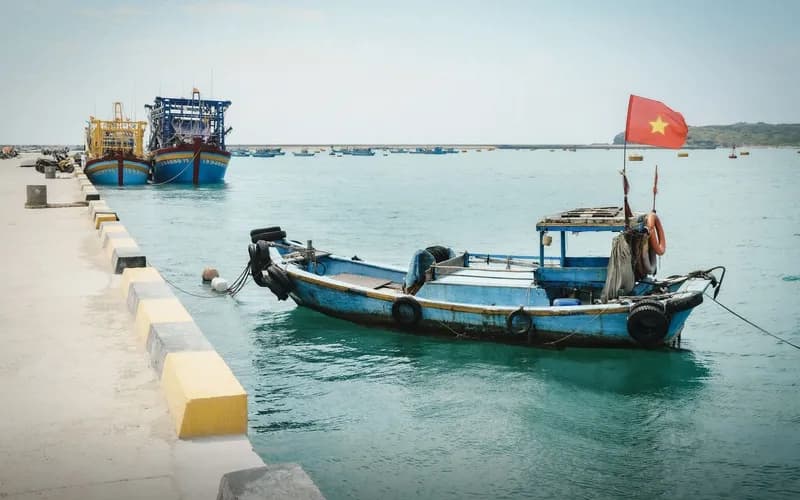
Vinh Hy Bay, about 40 kilometres from the city, shelters a small fishing village enclosed by the park's hills. Glass-bottom boats and snorkelling trips leave from the harbour, but the slower pleasure is simply to stay a night, eat grilled squid by the water and watch the boats return at dawn. The coast road running north from Vinh Hy is one of the most beautiful drives in the country, best done early before the heat builds.
A timely caution: after heavy rain in late September 2026, the park's tourism centre suspended visits, tours and related services at Nui Chua, and at nearby Phuoc Binh National Park, from noon on 23 September until further notice, citing the risk of landslides, falling rocks and flash floods. Trails, streams and ravines here can turn dangerous quickly in the wet months. Check the current status before planning hikes, and treat any closure as final rather than something to negotiate around with an unofficial boatman.
Vineyards, Salt Fields and the Coast Road
Phan Rang's grapes are its most famous produce, and small family vineyards welcome visitors to walk under the trellises and taste fresh grapes, juice, dried fruit or local wine. Keep expectations modest: the wines are a curiosity rather than a revelation, but the vineyards are shady, the families are usually proud to show their work, and buying directly supports them. South of the city, the salt fields around Ca Na shimmer white in the dry season, and the harvest scenes at first light are quietly striking.
Along the coast, Ninh Chu beach is where local families swim in the late afternoon; it is pleasant without being dramatic. The real reason to linger is the chain of coves and fishing villages to the north and south, each with its own early market. If you are building a longer coastal journey, Phan Rang pairs naturally with the unhurried beaches we describe in our piece on Quy Nhon's quiet coast, further north.
Getting There and Getting Around
Phan Rang is easier to reach than its low profile suggests. Thap Cham station sits on the North-South railway, so you can arrive by train from Ho Chi Minh City or Nha Trang and watch the landscape turn from green to ochre through the window; the case for slower rail journeys is one we make in our look at Vietnam's slow rail revival. The nearest airport is Cam Ranh International, roughly 60 kilometres north, with road transfers taking a little over an hour. Sleeper and limousine buses also connect Phan Rang with Ho Chi Minh City, Nha Trang and Da Lat, the last via the scenic Ngoan Muc pass.
Once there, distances are short but spread out. The most comfortable way to link towers, villages and bays is a car with driver for a day or two, or a motorbike taxi for short hops if you are travelling light. Ride-hailing apps work in the city but thin out in rural areas, so arrange return transport before heading to Vinh Hy or Po Ro Me. Cycling is lovely in the early morning on the flat roads south of the city, far less so in the midday heat.
When to Go and What to Watch For
Unusually for Vietnam, this coast is dry for most of the year. Roughly January to August is reliably dry and sunny, with the strongest heat in April and May. The short rainy season arrives late, generally from September or October into December, and can bring heavy downpours, road damage and park closures, as the September 2026 suspensions showed. The windiest months, broadly November to April, are prime time for kitesurfing at the lagoons north of the city.
The sweet spot for culture is late September to October if you want to catch Katê, accepting some risk of rain. For hiking and the coast road, aim for January to April. Summer is hot but calm, and turtle-nesting season adds another reason to visit Nui Chua, through official channels only.
How Long to Stay and Where to Base Yourself
Three nights is the minimum to do the region justice; four or five is better. A natural rhythm is two nights in Phan Rang itself, near Ninh Chu beach, to explore the towers, Bau Truc, My Nghiep and the vineyards at an easy pace, then one or two nights in Vinh Hy or along the coast road, where evenings are quieter and mornings start with the fishing fleet.
Accommodation ranges from simple guesthouses and mid-range beach hotels in Ninh Chu to a handful of resorts on the coast. Book the Katê period early, as domestic visitors and Cham families returning home fill rooms quickly. Eat local: lamb and goat dishes reflect the grazing culture of the dry hills, banh can rice cakes cooked in clay moulds are a Phan Rang breakfast staple, and the seafood in Vinh Hy is excellent and fairly priced if you agree on the weight and price before it is cooked.
What to Do Next
- Decide whether Katê is a priority; if so, watch for the confirmed 2026 dates and book accommodation as soon as they are announced.
- Plan at least three nights, splitting your stay between Phan Rang and the Vinh Hy coast rather than day-tripping from Nha Trang.
- Book a local guide for at least one day at Bau Truc, My Nghiep and Po Ro Me, so you meet makers rather than just shop.
- Check the current status of Nui Chua National Park before planning hikes or turtle programmes, especially from September to December.
- Travel by train to Thap Cham if your schedule allows, and arrange a car with driver for the rural sights.
- Use our plan your journey page to fit Phan Rang into a longer south-central route with Da Lat, Nha Trang or Quy Nhon.
Frequently Asked Questions
Is Phan Rang still in Ninh Thuan province?
Not administratively. Since 1 July 2025, the former Ninh Thuan province has been part of an enlarged Khanh Hoa province. Many signs, maps and locals still use the old name, so you will hear both for some time.
How many days do I need in Phan Rang?
Three nights covers the Cham towers, Bau Truc pottery village and a day at Vinh Hy Bay. Four or five nights lets you add Po Ro Me, the vineyards, the coast road and a slower rhythm of early mornings and long lunches.
When is the Katê festival in 2026?
Katê falls on the first day of the seventh month of the Cham calendar and runs for three days. For 2026, published schedules point to October; confirm the exact dates locally a few weeks ahead, since they follow the Cham calendar.
Can I visit Nui Chua National Park right now?
Visits were suspended from 23 September 2026, until further notice, after heavy rain raised landslide and flash-flood risks. Check with the park or your accommodation for the latest status before planning hikes or snorkelling trips inside the park.
Is Phan Rang a good base for beaches?
It is better for culture than for classic beach holidays. Ninh Chu is pleasant and local, while Vinh Hy and the coves along the coast road are more scenic. Combine the two rather than expecting resort-style beach life.
How do I get there from Nha Trang or Ho Chi Minh City?
Trains stop at Thap Cham station on the North-South line, and buses run from both cities. From Cam Ranh International Airport, a road transfer takes a little over an hour.