
Cambodian food is the great underrated cuisine of Southeast Asia — quieter than Thai, less internationally famous than Vietnamese, and all the more rewarding for it. Khmer cooking is built on subtlety rather than fire: fragrant herb pastes, fermented depth, freshwater fish, and the world-famous pepper of Kampot. This guide maps the dishes, the regional tables, the markets, and exactly where to eat — because the best way to understand Cambodia is to eat your way slowly across it.
Why Khmer Food Is Southeast Asia's Underrated Cuisine
Ask travelers about food in the region and they will name Thai curries and Vietnamese pho long before they mention anything Cambodian. That is not a reflection of quality — it is a quirk of history and exposure. Cambodia has no global restaurant diaspora to speak of, no Michelin Guide (the inspectors cover Bangkok and Vietnam, but not yet Phnom Penh), and decades of upheaval in the late twentieth century that interrupted the country's culinary confidence. What survived, and is now being rediscovered, is a cuisine of real distinction.
Khmer food is defined by balance rather than heat. Where Thai cooking reaches for chilli, Cambodian cooking reaches for aromatics — lemongrass, galangal, turmeric, kaffir lime — and for the deep, savoury funk of fermented fish. It is fresh, herbaceous, gently sour, and quietly complex. And because it has not been flattened for international palates, eating in Cambodia still feels like genuine discovery. The fact that the world has not caught on yet is, for the curious traveler, a gift.
One request. Up to five tailored proposals.
Skip contacting agencies one by one — share your trip once and let up to five trusted Cambodia agencies come to you. Free, with no obligation.
Get my free quotesA Cuisine That Survived
It is impossible to understand Khmer food without a word about its history, because that history is unusually present. Cambodia's culinary traditions stretch back to the Angkorian empire and were refined over centuries in royal kitchens and village homes alike. Then came the Khmer Rouge years of the late 1970s, when the country's food culture — like so much else — was very nearly extinguished: recipes went unwritten, a generation of cooks was lost, and survival cooking replaced refinement.
What you eat in Cambodia today is, in part, a recovery. Older cooks have passed down what they remembered, researchers have reconstructed royal recipes, and a new generation of chefs is rebuilding the cuisine's confidence with evident pride. This is why the social-enterprise restaurants and the modern Khmer kitchens matter beyond the plate — they are part of a living restoration. Eating thoughtfully here is, quietly, a way of taking part in it.
The Flavour Base: Kroeung, Prahok, and Balance
Two ingredients unlock Cambodian cooking. The first is kroeung, a fragrant pounded paste of lemongrass, galangal, turmeric, garlic, shallots, and kaffir lime — the aromatic backbone of countless dishes, made fresh and varying in colour (green, yellow, red) by region and use. The second is prahok, a pungent fermented fish paste that functions as Cambodia's salt and umami in one: an acquired aroma, perhaps, but the soul of authentic Khmer cooking, used in dips, sauces, and simmered dishes. A milder, coconut-rich relative, prahok ktis, served as a dip with raw vegetables, is the gentlest way to meet it.
Around these sit the supporting cast familiar across the region — coconut milk, fish sauce, palm sugar, tamarind, fresh herbs — but the proportions are distinctly Cambodian. The result is food that tilts toward sour, savoury, and aromatic rather than sweet or fiery. Chillies are usually served on the side, to add as you wish, rather than cooked into every dish. Understanding this balance is the key to appreciating why Khmer food tastes like nowhere else: it is a cuisine of fragrance and ferment, not of fire.
Get matched with up to 5 trusted Cambodia agencies
- Free
- No obligation
- Up to 5 agencies
The Dishes That Define Cambodia
A handful of dishes will anchor almost any trip — worth knowing not as a checklist but as a vocabulary.
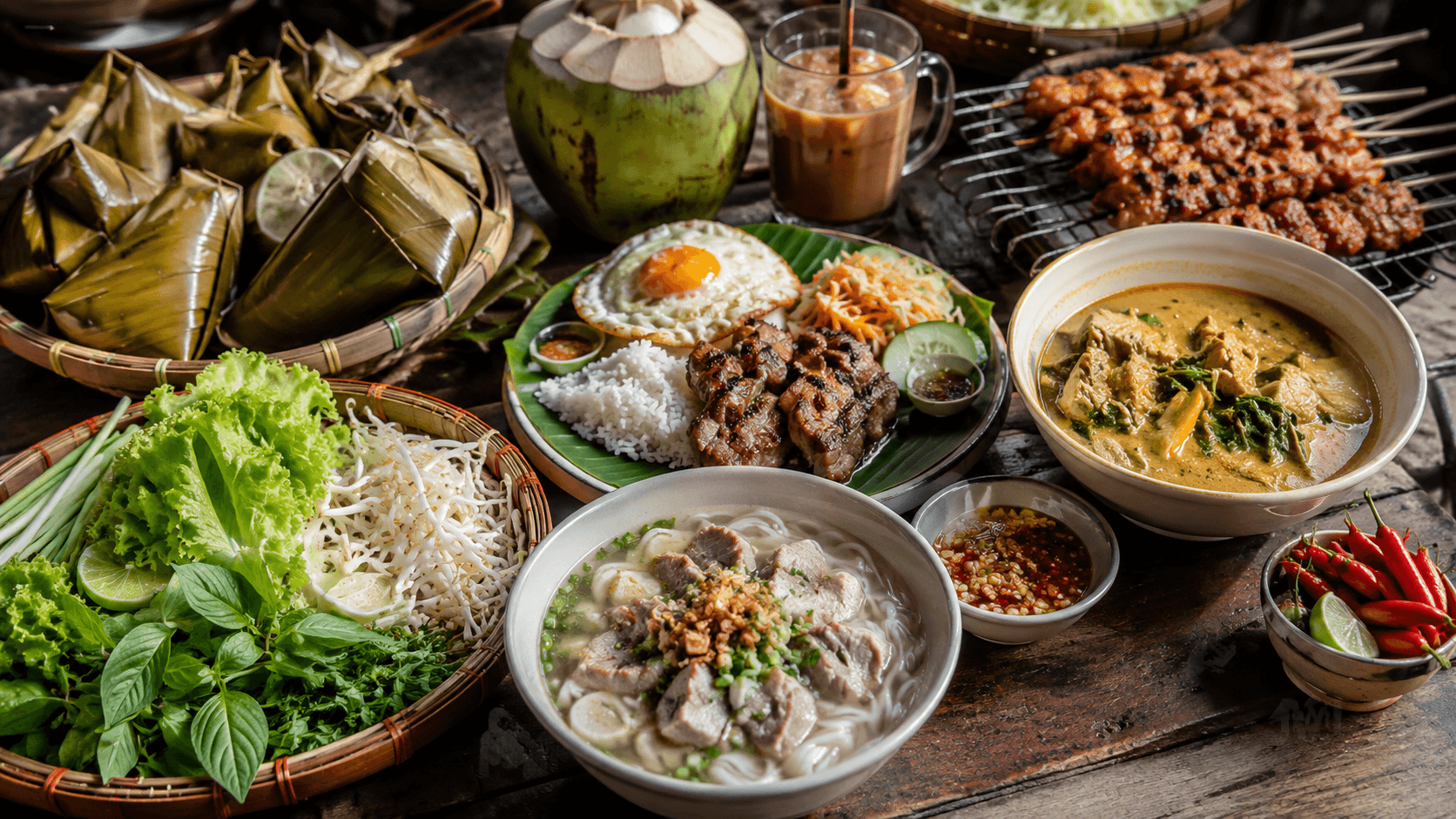
- Fish amok (amok trei) — the national dish: freshwater fish folded with kroeung and coconut cream and steamed in a banana-leaf cup to a soft, mousse-like set. Delicate, fragrant, and unlike any curry elsewhere.
- Beef lok lak — cubes of marinated beef seared and served over rice and salad with a dipping sauce of lime juice and cracked Kampot pepper. Simple, glossy, and beloved.
- Kuy teav — the breakfast of choice: a clear pork or beef noodle soup, customised with herbs, bean sprouts, lime, and chilli at the table.
- Nom banh chok — "Khmer noodles," fermented rice vermicelli drowned in a lemongrass-and-fish gravy and piled with raw herbs and vegetables. A morning street-food classic, often under $1.50.
- Bai sach chrouk — grilled marinated pork over broken rice with pickles and a bowl of broth, the country's beloved breakfast plate.
- Samlor korko — the "national soup," a hearty, slightly bitter medley of vegetables, herbs, and fish or pork thickened with toasted ground rice — peasant cooking at its most soulful.
- Samlor machu — a family of sweet-and-sour soups, tamarind-bright and deeply comforting.
- Char kroeung — anything stir-fried with the aromatic kroeung paste; with chicken, beef, or freshwater snails, it is everyday Khmer cooking at its most fragrant.
- Trey aing — whole grilled fish, eaten with herbs and a tangy dip, a riverside and lakeside staple.
- Num pang — the Cambodian baguette sandwich, a lighter cousin of Vietnam's banh mi, a legacy of the French era.
- Desserts and snacks — num krok (coconut-rice griddle cakes), sweet sticky rice, palm-sugar cakes, and fresh tropical fruit; the sugar palm flavours much of the sweet repertoire.
Kampot Pepper and Kep Crab: A Region on a Plate
If one product has carried Cambodian cuisine onto the world stage, it is Kampot pepper. Grown on the red soils of the southern province and protected by a Geographical Indication, it is prized by chefs worldwide for its floral, complex heat — fresh green peppercorns on the vine are a revelation. A visit to a working pepper farm around Kampot is one of the country's most satisfying food experiences, and the plantations themselves are beautiful.
Just down the coast, the town of Kep is synonymous with one dish: fried crab with fresh green Kampot pepper, eaten at the seaside crab market with the boats unloading the morning's catch a few metres away. It is messy, sweet, peppery, and unforgettable — and a perfect example of how Cambodia's best food is rooted in a specific place. Pairing a Kampot pepper farm with a Kep crab lunch (kdam chaa) is a single day that explains the whole cuisine: terroir, freshness, and a light, aromatic touch.
A Country of Regional Tables
Cambodian food shifts as you move across the country, and following those differences is part of eating it well — it maps onto the regions in our where-to-go-and-when guide.
In the central plains and Phnom Penh, you find the full national repertoire and the most ambitious modern Khmer kitchens, alongside the Chinese-influenced noodle and rice dishes of the capital's streets. Around the Tonlé Sap and the rivers, freshwater fish is king — fresh, dried, grilled, and fermented into prahok — and the lake's annual abundance shapes the whole national diet. On the southern coast, Kampot pepper and Kep crab define a lighter, seafood-led table. In the northeastern highlands, the cooking of the Bunong and other indigenous communities is simpler and forest-influenced, built on grilled meats, foraged herbs, bamboo, and rice wine — even, in season, the famous red tree ants stir-fried with beef. And along the Mekong in Kratie and Stung Treng, river-town food is honest and unfussy. None of this is fancy — but it is deeply tied to place, which is exactly what makes it worth seeking out.
Street Food and Markets: Where to Eat Best
The single highest-value habit in Cambodia is the simplest: eat where Cambodians eat. The country's markets and street corners are its best restaurants. Morning markets serve kuy teav and bai sach chrouk to office workers; evening street stalls grill skewers, fry noodles, and ladle soup; and the night markets of Phnom Penh and Siem Reap gather it all in one place for a few dollars. The covered markets — Phnom Penh's Central Market and Russian Market, Siem Reap's Old Market — have food sections where a pointing finger and a plastic stool deliver some of the best meals of a trip.
A few habits help. Look for the busy stall with the narrow menu — specialism signals quality. Don't fear the lack of English; pointing and smiling works everywhere. Be a little cautious with pre-cut fruit and ice only in the most basic rural settings, but otherwise eat freely — freshly cooked, high-turnover street food is both the cheapest and often the best food in the country. A full street meal with a drink rarely tops a few dollars, a point our Cambodia budget guide explores in detail.
Eating With a Conscience: Social-Enterprise Restaurants
Cambodia has a distinctive and admirable food institution worth seeking out: the training restaurant. Several of the country's most respected kitchens are social enterprises that train disadvantaged young people for careers in hospitality, serving excellent Khmer food while doing genuine good. Romdeng and the Friends group in Phnom Penh, and Marum in Siem Reap, are the best known — elegant, affordable, and deeply worthwhile, with adventurous menus that often include dishes like crispy red tree ants or fish amok done beautifully. Eating at them is a rare case where the ethical choice is also the delicious one, and it sits squarely within the slow-travel idea that how you spend matters as much as what you spend.
Beyond these, a wave of modern Khmer restaurants — Malis and Chanrey Tree among them — is reinterpreting traditional dishes with refinement and pride, plating heritage recipes for a new generation. It is the clearest sign that Cambodian cuisine is rediscovering its confidence and beginning to claim the recognition it has long deserved.
The French Legacy and the Coffee Culture
Cambodia's century under French colonial rule left a light but delicious mark on the table. The baguette lives on as num pang, split and filled with pâté, pickled vegetables, herbs, and chilli for a dollar or two — a perfect street breakfast. Coffee is the other great inheritance: strong, dark, and traditionally sweetened with condensed milk, served hot or, more often in the heat, poured over ice. A modern specialty-coffee scene has taken root in Phnom Penh and Siem Reap, but the roadside iced coffee in a plastic bag remains a daily ritual and one of life's great cheap pleasures. Pastries and flan turn up in city cafés, gentle echoes of the colonial era folded into a thoroughly Cambodian present.
Drinks: Coffee, Sugar Palm, and a Beer Culture
Beyond coffee, Cambodia's everyday drinks are part of the texture of the day. Sugar palm juice and the toddy tapped from palm trees flavour both drinks and sweets across the countryside, and the palm-sugar discs sold by the roadside are a sweet souvenir in themselves. Local draught beer is famously cheap — often well under a dollar during the ubiquitous happy hours — and a cold glass by the river is a Cambodian institution. Sugarcane juice pressed at roadside stalls, fresh fruit shakes, and young coconut round out the refreshments, and in the highlands, home-brewed rice wine is offered as a gesture of welcome. None of it is expensive, and all of it is part of slowing down into the rhythm of the place.
Where to Eat, City by City
Phnom Penh is the capital of the scene — the most ambitious modern Khmer kitchens, the social-enterprise restaurants, riverside dining, and the Chinese-Cambodian street food of the old quarters. Graze the night market and the stalls around the Central and Russian Markets, then book one modern Khmer table to see where the cuisine is heading.
Siem Reap balances temple-day convenience with a genuinely good food scene: classic Khmer at relaxed riverside spots, the social-enterprise Marum, and the lively (if touristy) energy around the Old Market and Pub Street. It is also an easy place to take a cooking class, which is one of the best ways to decode kroeung and amok for yourself — most include a market tour first.
The southern coast — Kampot and Kep — is where you eat with your hands at the crab market, tour a pepper farm, and slow right down over riverside meals. Battambang rewards the curious with an emerging café and arts-driven food culture and excellent, unpretentious local restaurants. And in the highlands and river towns — Mondulkiri, Ratanakiri, Kratie — the pleasure is simpler: grilled meat, foraged herbs, fish straight from the Mekong, and a glass of rice wine with people far from any tourist menu.
How to Eat Cambodia Well
Eating Cambodia well is, in the end, the same as travelling it well: slowly, locally, and with curiosity rather than caution. Order the dish of the place you are in — amok by the Tonlé Sap, crab in Kep, grilled fish on the Mekong, ants in Mondulkiri. Eat at the busy local spot over the empty tourist terrace. Spend a little on one or two standout meals — a modern Khmer tasting menu, a social-enterprise dinner — and let the rest be the cheap, perfect, everyday food that is the real glory of the country. Take a cooking class early in your trip and the whole cuisine opens up: once you can read a plate of amok or a bowl of samlor, every meal afterward makes more sense.
This is the heart of slow travel, and the philosophy behind our slow travel charter. The local agencies in our certified network build food into their itineraries the way Cambodians experience it — by region, by market, and by the company of people who know which stall is worth the detour. When you are ready to turn an appetite into an itinerary, our plan-your-journey page is the place to start.
A Day of Eating in Cambodia
One of the quiet pleasures of Cambodia is how naturally its food structures a day. Breakfast is the great Khmer meal, eaten early and out of the house: a steaming bowl of kuy teav at a market stall, a plate of bai sach chrouk with its little bowl of broth, or nom banh chok ladled from a vendor's basket — washed down with a strong iced coffee in a plastic bag. It is cheap, fast, and the most authentically local moment of the day.
Lunch is rice-led and unfussy: a plate of char kroeung or lok lak, a tamarind-bright samlor machu, or grilled fish with herbs, taken at a roadside bai sach shop or a market food court. The afternoon belongs to refreshment — a fruit shake, fresh sugarcane juice pressed at the kerb, a coconut, or a few num krok griddle cakes from a street cart. Dinner is the social meal: a spread of shared dishes — amok, a stir-fry, a soup, grilled fish — eaten slowly, often riverside, with cold draught beer at happy-hour prices. Eating this way, by the natural rhythm of the day rather than from a restaurant menu, is both the cheapest and the most rewarding way to eat in Cambodia.
Cooking Classes and Food Experiences
Some of the best food memories in Cambodia come from getting closer to how the food is made. A cooking class — widely available in Siem Reap, Phnom Penh, Battambang, and Kampot — usually begins with a market tour, where a guide walks you through kroeung's raw aromatics, the different prahoks, and the herbs and palm sugar that define the cuisine, before you cook an amok or a lok lak yourself. Taken early in a trip, it transforms every meal that follows.
Beyond the classroom, the country offers food experiences rooted firmly in place: touring a Kampot pepper farm and tasting the fresh green peppercorns straight from the vine; the Kep crab market, where lunch is hauled from the sea as you watch; a shared meal in a Tonlé Sap fishing village, where freshwater fish defines everything; and, in the highlands, the offer of home-brewed rice wine and forest-foraged dishes with Bunong hosts. A street-food walk through Phnom Penh's old quarters, ideally with a local guide, ties it all together. These are not add-ons — they are among the most memorable things you can do in Cambodia, and exactly the kind of depth a good local partner builds into a trip.
The Sweet Side: Fruit, Palm Sugar, and Khmer Desserts
Cambodia's sweets are gentle and often overlooked, but worth seeking out. Much of the repertoire is built on palm sugar — tapped from the sugar palms that define the rural skyline and reduced to fragrant, caramel-rich discs — and on coconut and sticky rice. Look for num ansom (sticky-rice cakes wrapped in banana leaf), num krok (the half-sphere coconut-rice griddle cakes), sweet sticky rice with mango or durian in season, and the sweet drinks-cum-desserts of crushed ice, beans, jelly, and syrup sold from glass carts.
Then there is the fruit, which is a pleasure in itself. The seasons bring mango, mangosteen, rambutan, longan, jackfruit, dragon fruit, and the formidable durian — Kampot's durian is especially prized. A bag of cut seasonal fruit with a twist of chilli-salt, bought from a market cart for under a dollar, is one of the small daily joys of travelling here, and a reminder that the best of Cambodian eating is rarely the most expensive.
A Few Words for the Table
Cambodian meals are shared and unhurried, and a little awareness goes a long way. Dishes arrive together, not in courses, and are eaten communally with rice — serve yourself modest amounts and go back rather than piling your plate. A spoon (held in the right hand) and fork are standard for most meals; chopsticks appear mainly with noodle soups. Elders are served and begin first, and it is polite to receive and pass dishes with the right hand. None of this is demanding — Cambodians are warm and forgiving of visitors — but eating the way the table does, slowly and together, is part of the pleasure, and the surest route into the culture behind the food.
Frequently Asked Questions
What food is Cambodia most famous for?
Fish amok (a coconut-and-herb steamed fish curry) is the national dish, alongside beef lok lak, kuy teav noodle soup, nom banh chok ("Khmer noodles"), samlor korko soup, and the celebrated fried crab with Kampot pepper from the southern coast. Khmer food is milder and more herb-forward than Thai cuisine.
Is Cambodian food spicy?
Generally no. Khmer cooking is built on aromatic herb pastes (kroeung), fermented fish (prahok), and balance rather than heat. Chilli is usually served on the side to add as you like, rather than cooked into every dish, which makes the cuisine very approachable.
Is street food safe to eat in Cambodia?
Largely yes — busy stalls with high turnover, where food is cooked fresh in front of you, are often the safest and best option. Choose vendors with long local queues, eat freshly cooked hot food, and be a little more cautious with pre-cut fruit or ice only in the most basic rural settings.
What is Kampot pepper, and why is it famous?
Kampot pepper is a Geographically-Indicated peppercorn grown in southern Cambodia, prized worldwide by chefs for its floral, complex heat. It stars in the signature dish of nearby Kep — fried crab with fresh green Kampot pepper — and a pepper-farm visit is a highlight for food lovers.
Does Cambodia have Michelin-starred restaurants?
No — the Michelin Guide does not yet cover Cambodia (it inspects Thailand and Vietnam in the region). That is part of the appeal: Cambodia's food scene is less commercialised and still feels like genuine discovery, from street stalls to ambitious modern Khmer kitchens.
What should vegetarians know?
Vegetable and tofu dishes are available, but fish sauce and prahok (fermented fish) are widespread, so it is worth asking. Explaining "no meat, no fish" clearly helps, and social-enterprise and modern Khmer restaurants in the cities cater well to vegetarians and vegans.
Are the social-enterprise restaurants worth it?
Very much so. Restaurants like Romdeng and Friends in Phnom Penh and Marum in Siem Reap train disadvantaged young people for hospitality careers while serving excellent Khmer food at fair prices. They are a rare case where the ethical choice is also one of the best meals in town.
How much should I budget for food per day in Cambodia?
Very little for how well you eat. A traveler eating mainly at markets and local restaurants can eat exceptionally well on $8–15 a day; adding modern Khmer or social-enterprise dinners brings it to roughly $20–35. Street food and markets are both the cheapest and often the best option. Our Cambodia budget guide breaks down the full picture.
Ready to taste your way across Cambodia? Explore our Cambodia travel guides, plan around the regions and seasons with our where-to-go-and-when guide, and start building a trip with our network of certified local agencies on the plan-your-journey page.