
Ask anyone who has spent real time in Indonesia what they miss most, and the answer is rarely a beach or a temple. It is a meal. It might be a plate of nasi campur eaten cross-legged at a warung, the smoke of a satay cart drifting down a Balinese lane, or a single spoonful of rendang so deeply spiced it seems to carry the whole history of Sumatra inside it. Indonesian food is not a cuisine you sample from a distance. It is the fastest, warmest, most honest way into the country, and it rewards travelers who slow down enough to eat properly.
This is an archipelago of more than seventeen thousand islands and hundreds of ethnic groups, so there is no single "Indonesian food" any more than there is a single Indonesian person. What holds it together is a shared grammar: rice at the center, a chili sambal on the side, layers of aromatic spice paste built from scratch, and a culture of generosity that turns nearly every meal into an act of hospitality. Learn to read that grammar and the whole country opens up.
This guide walks you through the dishes worth crossing an island for, the regional cuisines that surprise even seasoned visitors, where and how to eat, and how food becomes the clearest window onto Indonesia itself. Take it slowly. That is the whole point.
Rice Is the Soul of the Table
In Indonesian, the word for cooked rice, nasi, is close to the word for a meal itself. To many Indonesians, if you have not eaten rice, you have not really eaten, no matter how full you are. Rice is not a side dish here. It is the sun around which everything else orbits, and understanding that single fact explains most of what arrives on your plate.
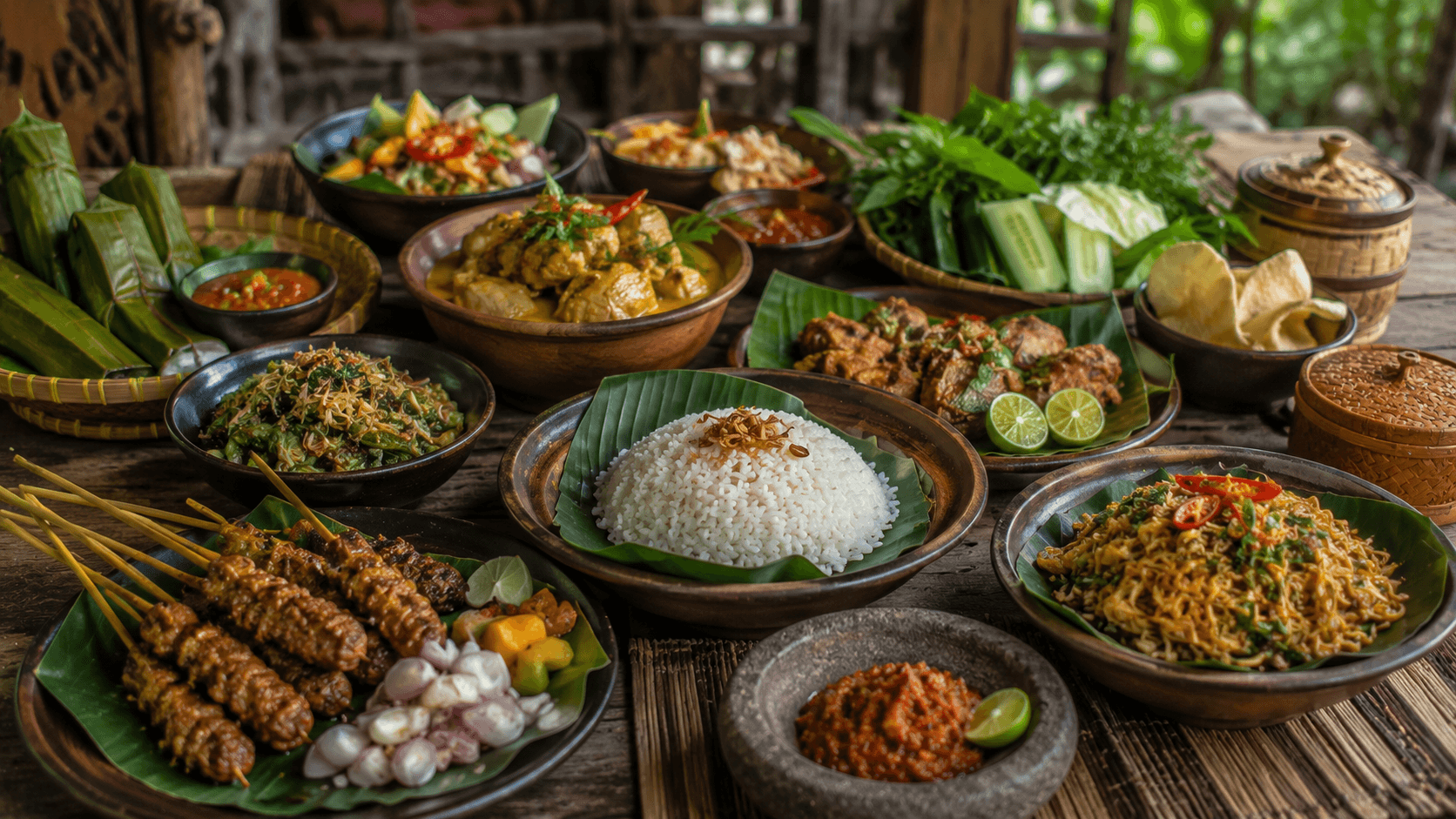
A typical meal is a mound of steamed white rice surrounded by small portions of other things: a piece of fried chicken, a spoon of vegetables, a fried tempeh cutlet, a smear of fiery sambal, perhaps a boiled egg. You are meant to combine them, bite by bite, tempering the heat of the chili with plain rice and mixing textures as you go. This is the logic behind nasi campur, literally "mixed rice," a plate of rice with a personalized selection of small dishes that is arguably the truest expression of everyday Indonesian eating. Every region, every warung, every household has its own version.
Rice also appears transformed. Nasi goreng, Indonesia's beloved fried rice, is built from day-old rice stir-fried with sweet soy sauce (kecap manis), garlic, shallots, chili and a touch of shrimp paste, then crowned with a fried egg and a scatter of crackers. Nasi uduk and nasi lemak-style rice is cooked in coconut milk until rich and fragrant. Lontong and ketupat are rice compressed into dense cakes and cut into cubes, common at celebrations and as a base for saucier dishes. Even breakfast is often rice: many Indonesians happily eat nasi goreng at seven in the morning. If you plan your days around food, it helps to also plan your wider trip well, and our Indonesia trip cost and budget guide shows just how far a food-focused budget stretches here, where a superb warung meal can cost less than a coffee back home.
One request. Up to five tailored proposals.
Skip contacting agencies one by one — share your trip once and let up to five trusted Indonesia agencies come to you. Free, with no obligation.
Get my free quotesThe National Icons
In 2018 the Indonesian government formally named five national dishes, a rare official attempt to draw a line around something so vast. The five are soto, rendang, satay, nasi goreng and gado-gado, and together they make a good starting map for any hungry traveler.
Nasi goreng is the dish most visitors meet first, and for good reason. At its best it is smoky, sweet-savory and deeply satisfying, the kecap manis giving it a dark caramelized edge that sets it apart from other Asian fried rices. Order it from a street cart at night and watch it come together in a single blackened wok in under two minutes.
Satay, or sate, is skewered meat grilled over coconut-husk charcoal and served with a sauce that depends entirely on region. The most famous is sate ayam, chicken satay in a thick peanut sauce, but sate lilit in Bali wraps minced spiced fish or chicken around a lemongrass stalk, and sate Madura from the island of Madura is a benchmark by which many Indonesians judge all others. The smell of a satay grill at dusk is one of the defining sensory memories of the country.
Rendang is the dish that stops travelers in their tracks. Created by the Minangkabau people of West Sumatra, it is beef slow-cooked for hours in coconut milk and a dense paste of chili, galangal, lemongrass, turmeric and other spices until the liquid vanishes entirely and the meat turns dark, dry and almost impossibly tender. The technique, merendang, is really a method of preservation turned into an art form. Rendang has topped global "best food" polls, and one honest bite explains why.
Gado-gado proves the cuisine is not only about meat. It is a salad of blanched vegetables, tofu, tempeh, boiled egg and sometimes potato or lontong, all bound in a warm, rich peanut sauce. "Gado-gado" roughly means "mix-mix," and it is one of the most reliably delicious vegetarian-friendly dishes in the country.
Soto is less a single dish than a whole family of aromatic soups, and it may be the most quietly beloved food in Indonesia. Soto ayam is a golden turmeric chicken broth with noodles, cabbage and a squeeze of lime; soto Betawi from Jakarta is creamy with coconut or milk; soto Madura, coto Makassar and dozens of others carry the flavor of their home regions. A bowl of soto, brightened with sambal and lime, is comfort food raised to a national art.
Beyond the official five sit other everyday icons: mie goreng (fried noodles, nasi goreng's noodle sibling), bakso (springy meatballs in clear broth, an obsession sold from carts nationwide), and nasi campur itself. This is the vocabulary you will use most often, and it will carry you comfortably across the whole archipelago.
Sambal and the Question of Heat
You cannot understand Indonesian food without understanding sambal. It is not a condiment in the polite Western sense; it is a food group. Sambal is a paste of chilies ground with some combination of garlic, shallot, shrimp paste, tomato, lime, palm sugar or tamarind, and there are hundreds of regional versions. A single restaurant may offer several.
Sambal ulek is raw, bright and searingly hot, little more than chilies and salt pounded in a stone mortar. Sambal terasi leans on fermented shrimp paste for a deep, funky savoriness. Sambal matah, a Balinese specialty, is uncooked, made from thinly sliced shallots, lemongrass, chili and lime, and it is so good it has become popular far beyond Bali. Sambal hijau, a green chili sambal, is the classic partner to Padang food.
For visitors, sambal is where honesty matters. Indonesian chili heat is real, and it varies wildly. The safe approach is to ask for sambal on the side (sambal dipisah) and add it gradually, tempering each bite with plain rice. Do not be the traveler who drowns a first plate and then cannot taste the rest of the meal. Heat here is a dial, not a switch, and locals adjust it constantly. Treat it as part of the pleasure rather than a test to be passed.
Get matched with up to 5 trusted Indonesia agencies
- Free
- No obligation
- Up to 5 agencies
Regional Cuisines Worth Crossing an Island For
The real depth of Indonesian food reveals itself the moment you stop treating the country as one place. Each major island, sometimes each city, has its own culinary character, and traveling between them is a form of eating your way through the archipelago. For a sense of how these regions connect on the ground, our slow traveler's guide to where to go and when is a good companion to what follows.
Sumatra and Padang food. West Sumatra gave Indonesia its most famous export: Padang cuisine, or masakan Padang. Named after the Minangkabau city of Padang, it is defined by rich coconut-milk curries (gulai), fiery chili (lado) and, of course, rendang. The Padang restaurant is an institution: you sit down and, without ordering, a waiter stacks a dozen or more small plates across your table, a miniature banquet of rendang, gulai, ayam pop, fried lung, jackfruit curry, boiled greens and sambal hijau. You pay only for what you touch. It is theatrical, generous and utterly Sumatran. Beyond Padang, Sumatran food broadly runs richer and spicier than Javanese, with clear Indian and Middle Eastern influence in its curries and spice blends.
Java and the sweet tooth. Java, the most populous island and the cultural heart of the country, tends toward sweeter, gentler flavors, especially in Central Java around Yogyakarta and Solo. Gudeg, Yogyakarta's signature dish, is young jackfruit stewed for hours in palm sugar and coconut milk until sweet, soft and mahogany-brown. Kecap manis, the thick sweet soy sauce that flavors so much Indonesian cooking, is itself a Javanese invention. East Java leans saltier and more assertive, with dishes like rawon, a dark beef soup blackened by the keluak nut, and rujak cingur, a bracing Surabaya salad.
Bali and the offering table. Bali is the great exception to Indonesia's Muslim-majority norm, and its Hindu culture shapes its food. This is where you eat pork openly and proudly. Babi guling, spit-roasted suckling pig stuffed with turmeric, garlic, lemongrass and chili, is the island's celebratory centerpiece, its crackling skin and spiced meat served with rice and lawar, a spiced mix of vegetables, grated coconut and minced meat. Bebek betutu and ayam betutu, duck or chicken packed with spice paste, wrapped in banana leaves and slow-cooked for hours, are Ubud specialties worth planning a meal around. Balinese food is intensely aromatic thanks to base genep, the island's complete spice paste.
Sulawesi and the fire of Manado. In the far north of Sulawesi, Manadonese cooking is among the spiciest in the country and unafraid of unusual ingredients. Dishes like ayam rica-rica (chicken in a pounded red chili paste), woku (a fragrant herb-and-chili sauce loaded with lemongrass, lime leaf and basil) and tamarind-soured fish soups define the region, which draws on abundant seafood and the volcanic mountains behind it. South Sulawesi, meanwhile, gives us coto Makassar, a rich offal-and-beef soup, and konro, smoky beef ribs. If you want food that pushes past the familiar, Sulawesi delivers, and it pairs naturally with the kind of trip our off-the-beaten-path Indonesia guide describes.
Tempeh, tofu and the humble hero. Across all these regions runs one quiet constant: tempeh. This Javanese invention, fermented soybean cake with a nutty, savory depth, is one of Indonesia's great gifts to world food. Sliced and fried, simmered in sweet tempe orek, or stewed in coconut curry, it is protein at its most affordable and its most delicious. Tofu (tahu) plays a similar everyday role. Do not dismiss them as vegetarian substitutes; here they are the main event.
Street Food and Where to Eat
Some of the best food in Indonesia is cooked a few feet from where you eat it, on the street, for the price of a bus ticket. Learning the different kinds of eating places is the single most useful skill a food traveler can develop here.
A warung is a small, family-run eatery or stall, often little more than a few benches under a roof. Warungs are the backbone of Indonesian eating: unpretentious, cheap and frequently better than any restaurant. A warung nasi or warteg (Warung Tegal) lays out trays of pre-cooked dishes so you can point at what you want and build a plate. This is where you find the real food of a place.
Kaki lima are the mobile street carts, named for the "five feet" of the cart's wheels plus the vendor's legs. They roll through neighborhoods selling one thing done well: bakso, satay, martabak, bubur (rice porridge), es campur. A cart with a long local queue is a near-guaranteed good meal, and the turnover keeps the food fresh.
Rumah makan Padang, the Padang restaurants described above, are found in every Indonesian town and are a reliable, filling, flavor-packed choice when you are traveling and want a lot of food fast.
Pasar malam, night markets, are where a town comes out to eat after dark. Stalls line up selling grilled corn, satay, martabak, fresh juices and every regional snack imaginable, and the atmosphere is as much of a draw as the food. Wandering a pasar malam with no plan, eating small things from many stalls, is one of the quiet joys of slow travel in Indonesia.
A few honest tips on eating well and safely. Busy stalls with high turnover are your friends; freshly cooked, piping-hot food is almost always safe. Drink bottled or properly filtered water and go easy on ice from unknown sources, though reputable places use commercially made ice. Peel your own fruit when you can. Let your stomach adjust in the first days rather than eating the spiciest thing on your first night. These are small habits, not fears, and they let you eat adventurously with confidence. When you are ready to build a trip around this kind of eating, our plan your journey page is the place to start.
Indonesian Coffee and What to Drink
Indonesia is one of the world's great coffee nations, the fourth-largest producer on earth, and its beans have distinct regional personalities well worth seeking out. Sumatran coffee, especially from Aceh and Lake Toba, is famously earthy, full-bodied and low in acidity, with chocolate and herbal notes, thanks partly to the region's traditional wet-hulling process. Java coffee, grown on the island's volcanic highlands, is where the very word "java" as slang for coffee comes from; it is heavy-bodied, spicy and smooth. Toraja coffee from the highlands of South Sulawesi is prized for a robust, aromatic cup with earthy and spicy tones and a hint of sweetness.
The way locals drink it is worth adopting. Traditional kopi tubruk is coffee grounds simply boiled or steeped with sugar, thick and unfiltered, sipped once the grounds settle. In recent years es kopi susu, iced coffee with milk and palm sugar, has swept across urban Indonesia and become the drink of a generation; it is excellent and everywhere. You will also hear about kopi luwak, the notorious "civet coffee" made from beans eaten and passed by the Asian palm civet. It is worth knowing that much of the kopi luwak sold today comes from caged, force-fed civets in poor conditions, and that on both ethical and quality grounds it is best avoided. Indonesia's ordinary coffee is so good that you lose nothing by skipping the gimmick.
Beyond coffee, teh (tea) is served everywhere, usually sweet (teh manis) and often iced. Jamu is Indonesia's traditional herbal tonic, a centuries-old wellness drink made from turmeric, ginger, tamarind and other roots and herbs, sold by roving vendors and increasingly in stylish city cafés; kunyit asam (turmeric-tamarind) and beras kencur are the classic entry points, bracing and genuinely restorative. Fresh fruit juices (jus) are a highlight, from avocado (blended with chocolate syrup) to soursop, mango and dragonfruit. And for those who drink alcohol, Bintang, the ubiquitous local lager, is the beer of Indonesian holidays, best cold with a plate of grilled fish; in Bali you may also encounter arak, a local rice or palm spirit best treated with caution and bought only from reputable sources.
Sweets and Snacks
Indonesian sweets and snacks, collectively jajanan and kue, are a whole delicious world of their own, and they lean toward coconut, palm sugar and rice or cassava flour rather than dairy and wheat. Martabak is the great crowd-pleaser: the sweet version (martabak manis or terang bulan) is a thick, fluffy pancake folded over chocolate, cheese, peanuts and condensed milk, while the savory version is a fried egg-and-scallion parcel. Pisang goreng, fried banana fritters, are the national afternoon snack, sold hot from carts everywhere.
Klepon are green rice-flour balls filled with molten palm sugar and rolled in grated coconut, a small explosion of sweetness. Es campur and es cendol are shaved-ice desserts loaded with jellies, fruit, coconut milk and syrup, perfect against the tropical heat. Kerupuk, the puffed crackers that accompany nearly every meal, are less a snack than a textural necessity; no Indonesian plate feels complete without their crunch. Grazing on these small things between meals is not indulgence here. It is simply how the day is punctuated.
Eating Etiquette and How to Order
Indonesian dining is relaxed and forgiving, but a few customs will make you a more graceful, welcome guest. Most Indonesians eat with a spoon in the right hand and a fork in the left, using the fork to push food onto the spoon; knives are rarely needed since meat is already tender or cut. In many warungs and especially with Padang or Sundanese food, people eat with the right hand only, and doing so with confidence is a genuine sign of respect. The left hand is traditionally considered unclean, so pass and eat with the right.
To order at a warung with a display, simply point; you are not expected to speak fluent Indonesian, and a smile carries you a long way. A few words help enormously: nasi (rice), ayam (chicken), ikan (fish), sapi (beef), sayur (vegetables), pedas (spicy) and tidak pedas or nggak pedas (not spicy). "Enak" means delicious and is always appreciated. Meals are generally not divided into strict courses; dishes arrive as they are ready and are shared from the center of the table. Take a little, leave a little for others, and never be surprised when a host presses you to eat more. Refusing food outright can seem cold, so accept graciously even if only a taste.
Cooking Classes and Food Experiences
If you want to carry Indonesia home with you, take a cooking class. This is one of the most rewarding slow-travel experiences the country offers, and two places do it especially well. Ubud in Bali is the cooking-class capital, where a typical morning begins at a local market learning to identify galangal, turmeric, lemongrass and the components of base genep, followed by hours grinding spice pastes by hand and cooking a full Balinese spread, from sate lilit to lawar to black rice pudding. Yogyakarta in Java offers a gentler, sweeter culinary tradition, with classes that often include a village setting, a market tour and dishes like gudeg and tempeh cooked the traditional way.
Beyond formal classes, the best food experiences are often the simplest: a dawn visit to a pasar (market) to watch the day's ingredients arrive, a coffee-farm tour in the Sumatran or Sulawesi highlands, an evening spent grazing a pasar malam with a local friend. For travelers who want these experiences woven expertly into a wider itinerary, working with a specialist can transform a trip; our vetted Indonesia travel agencies build exactly this kind of food-literate, unhurried journey.
Vegetarian, Vegan and Halal Notes
Indonesia is one of the easier Asian countries for both vegetarian and halal travelers, with a few caveats worth knowing. Because the country is majority Muslim, the overwhelming majority of food outside Bali and Chinese-Indonesian establishments is halal, and pork is uncommon on the mainland. If you keep halal, you are well served almost everywhere; simply be aware that Bali (Hindu), Toraja (Christian) and Chinese-Indonesian kitchens do serve pork.
Vegetarians and vegans have a genuinely rich time here thanks to the central role of tempeh, tofu and vegetables. Gado-gado, pecel (vegetables in peanut sauce), sayur lodeh (vegetable coconut curry), tempeh and tofu dishes and countless vegetable sides make plant-based eating easy and delicious. The two things to watch are terasi (fermented shrimp paste) and small amounts of dried anchovy or shrimp, which find their way into many sambals, soups and even some vegetable dishes as seasoning. Learning to ask "tanpa terasi" (without shrimp paste) and "vegetarian" (widely understood) will smooth your path considerably. Many warungs are happy to build you a rice plate of purely vegetable and soy dishes.
Why Food Is the Best Way to Understand Indonesia
Travel long enough in Indonesia and you realize its food is a map of its history and its people. The Indian and Arab traders who brought curry techniques and spice to Sumatra; the Chinese who introduced noodles, tofu and stir-frying; the Dutch colonial era that scattered rijsttafel and croquettes across the memory of the cuisine; the deep indigenous traditions of each island, expressed in banana-leaf wrapping, coconut, palm sugar and the endless variety of sambal. Every plate carries this history quietly.
Food is also where Indonesian values become visible. The generosity of a Padang table piled high before you have ordered a thing; the patience of rendang cooked down over hours; the communal ease of dishes shared from the center; the pride of a warung owner who has cooked the same perfect dish for thirty years. To eat here attentively, without rushing, is to understand something about the country that no monument can teach you.
That is why food belongs at the center of a slow trip through Indonesia rather than at its edges. Give it real time. Sit longer at the warung. Ask what the vendor recommends. Return to the stall you liked and let them see you come back. The reward is not just better meals but a truer, warmer version of the country, and it is available to anyone willing to slow down and taste it. If you want to shape a whole journey around this spirit of unhurried, meaningful travel, our slow travel charter explains the philosophy behind everything we do.
Frequently Asked Questions
What is the national dish of Indonesia?
Indonesia officially recognizes five national dishes rather than one: soto (aromatic soup), rendang (slow-cooked spiced beef), satay (grilled skewers with peanut sauce), nasi goreng (fried rice) and gado-gado (vegetable salad with peanut dressing). Of these, nasi goreng is the most universally eaten and the dish most visitors encounter first, while rendang is the most internationally celebrated. Together they make an excellent checklist for your first week of eating.
Is Indonesian food very spicy?
It can be, but heat is almost always adjustable. The chili comes mainly from sambal, which is usually served on the side, so you control how much you add. Many core dishes like nasi goreng, satay, gudeg and gado-gado are mild by default. Manadonese (North Sulawesi) and much Padang food are genuinely fiery, so ask for "tidak pedas" or "nggak pedas" (not spicy) or request sambal separately if you are sensitive, and build up gradually.
Is it safe to eat street food in Indonesia?
Yes, with common-sense habits. Choose busy stalls with high turnover and freshly cooked, piping-hot food, which is almost always safe. Be more cautious with pre-cut fruit, ice from unknown sources and dishes that have sat out. Drink bottled or filtered water. Millions of Indonesians eat from warungs and kaki lima carts every day, and street food is often the best food you will find; let your stomach adjust over the first few days rather than diving into the spiciest dish immediately.
What should vegetarians eat in Indonesia?
Indonesia is very friendly to plant-based eaters thanks to tempeh and tofu, which are central to the cuisine rather than afterthoughts. Look for gado-gado, pecel, sayur lodeh, tempeh and tofu dishes, and vegetable-based nasi campur plates. The main things to watch are terasi (shrimp paste) and small amounts of dried anchovy or shrimp used to season sambals and soups; learn to ask "tanpa terasi" (without shrimp paste). Many warungs will happily assemble a purely vegetable and soy rice plate.
Is Indonesian food halal?
Largely, yes. Indonesia is the world's most populous Muslim-majority country, so the vast majority of food, especially outside Bali, is halal and pork is uncommon on the mainland. The clear exceptions are Bali (Hindu culture, where babi guling and other pork dishes are celebrated), Toraja in Sulawesi, and Chinese-Indonesian restaurants, all of which do serve pork. Elsewhere, halal-observant travelers are very well catered for.
What is nasi Padang and how do I order it?
Nasi Padang is the Minangkabau style of eating from West Sumatra, served in Padang restaurants found across the country. In the classic "hidang" style you sit down and the staff cover your table with a dozen or more small plates of rendang, curries, fried chicken, greens and sambal, all without ordering; you eat what you like and pay only for what you touch. In simpler stalls you point at a window display and have a plate assembled. Either way, it is one of the great eating experiences in Indonesia.
What coffee should I try in Indonesia?
Indonesia is a top global coffee producer with distinct regional beans: earthy, full-bodied Sumatran (Aceh, Toba), heavy and spicy Java, and robust, aromatic Toraja from Sulawesi. Try traditional kopi tubruk (thick, unfiltered, boiled with sugar) for the classic experience, or es kopi susu (iced coffee with milk and palm sugar) for the modern café favorite sweeping urban Indonesia. Skip kopi luwak (civet coffee); much of it involves poor animal welfare, and Indonesia's ordinary coffee is outstanding on its own.