

Thailand's national parks have become one of the most confusing line items in a trip budget, largely because three different charges are being discussed in public at the same time and they have almost nothing to do with each other. This is an attempt to separate them cleanly, tell you what you will actually pay at a gate in 2026, and set out the booking and closure rules that will shape your itinerary far more than the money will.
What Changed in 2026
The headline change is that the Department of National Parks, Wildlife and Plant Conservation raised foreigner entrance fees at five parks this year, while leaving prices for Thai citizens untouched. The affected parks are among the most visited in the system, and in each case the foreigner rate roughly doubled from the long-standing 200 baht adult and 100 baht child to 400 baht adult and 200 baht child.
The five are Khao Yai, Khao Laem Ya and Mu Ko Samet, Mu Ko Ang Thong, Hat Nappharat Thara and Mu Ko Phi Phi, and Mu Ko Lanta. Between them they cover a large share of foreign park visits: the Bangkok weekend park, the Rayong island escape, the Ang Thong day trip from Ko Samui, the Phi Phi and Krabi marine zone, and the southern Andaman island chain.
Everything else in the system stayed as it was, which means the majority of Thailand's 130-plus national parks still charge foreigners 100 to 300 baht. Kaeng Krachan, Khao Sok, Doi Inthanon, Erawan and the rest are not part of this increase. The change was announced through official DNP channels rather than as a legislative act, so it can be extended to further parks with relatively little notice. We covered the policy direction behind this in our piece on how conservation priorities are reshaping Thailand's parks.
One request. Up to five tailored proposals.
Skip contacting agencies one by one — share your trip once and let up to five trusted Thailand agencies come to you. Free, with no obligation.
Get my free quotesHat Nappharat Thara, Mu Ko Phi Phi and the 400-Baht Tier
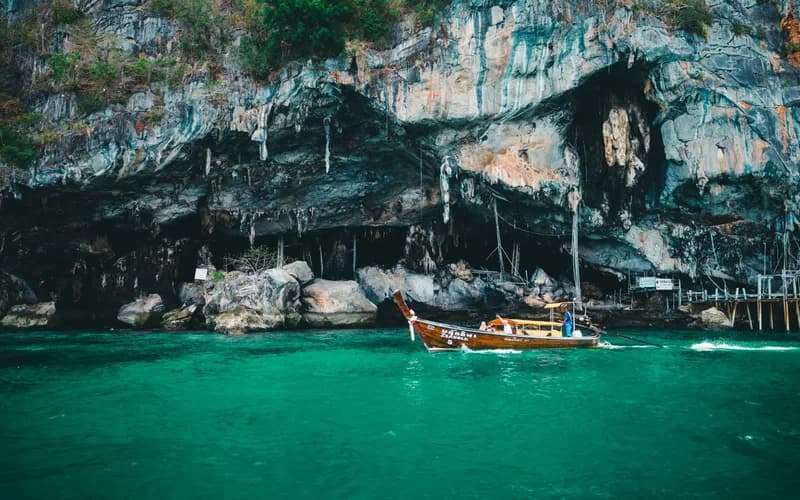
The most consequential of the five for most travellers is Hat Nappharat Thara and Mu Ko Phi Phi in Krabi province, which now charges foreign adults 400 baht and foreign children 200 baht. This is the fee that applies to Maya Bay, to Phi Phi Leh generally, to Railay and Ao Nang's outlying beaches within the park boundary, and to the Bamboo Island and Mosquito Island stops that appear on almost every Phi Phi day tour.
Two practical consequences follow. First, check whether your tour price includes the park fee. A large share of operators quote excluding it and collect cash on the boat, which turns an advertised 1,200-baht trip into a 1,600-baht one. Ask explicitly, and ask in writing.
Second, if your itinerary crosses more than one park zone in a week, the arithmetic adds up faster than it used to. A couple doing an Ang Thong day trip from Samui, a Phi Phi day from Krabi and a Lanta marine park visit is now looking at roughly 2,400 baht in park fees alone. That is not ruinous, but it is worth putting in the budget rather than discovering it at a pier.
The Dual-Pricing Reality
Thailand's national parks operate an openly two-tier pricing system: one rate for Thai citizens, another for foreigners, typically four to ten times higher. Nothing about the 2026 increase changed this principle; it widened the gap.
It is worth understanding rather than being annoyed by. Thai nationals fund the park system through taxation, park budgets are chronically thin, and visitor pressure from international tourism is the single largest source of wear on the most popular sites. Comparable systems exist across the region and in parts of Africa and South America.
The one thing worth knowing is that the Thai rate is available to foreigners holding a Thai work permit, a Thai driving licence or long-stay residence in some parks, at the discretion of the gate. Practice varies enormously between parks and even between shifts. If you qualify, carry the document and ask politely; if you do not, pay the posted rate without arguing. Gate staff do not set the price and have no authority to change it.
Get matched with up to 5 trusted Thailand agencies
- Free
- No obligation
- Up to 5 agencies
The 450-Baht Entry Fee: Approved in Principle, Not Yet Charged
This is the single most misreported item in Thai travel news, so it is worth being precise.
On 14 August 2026, the National Tourism Policy Board approved in principle a flat 450-baht fee for foreign visitors arriving in Thailand. This replaced an earlier proposal of 300 baht for air arrivals and 150 baht for land and sea arrivals with a single rate applying to all modes of entry. A 30-day public consultation followed, and after that the proposal returns to the board and then to Cabinet.
Critically: it is not being collected. There is no 450-baht charge at any Thai border or airport as of now. Even on the fastest plausible path, collection would begin roughly 180 days after publication in the Royal Gazette, which puts realistic implementation in 2027, starting with air arrivals and extending to land and sea entry later.
It is also a completely separate charge from national park entry. Paying a future arrival fee will not get you into Khao Yai. And it is distinct again from the older 300-baht tourist fee that has been proposed, deferred and re-proposed for several years. If you want the wider entry picture, our guide to Thailand's 2026 entry rules, the TDAC and the tourist fee sets out what is actually in force.
Treat any operator or website that claims to collect the 450-baht fee on your behalf as a scam.
Booking, Quotas and the QueQ App
The bigger operational change over recent years has been the move to advance booking and daily caps at the busiest marine parks. The DNP e-ticket system, generally accessed through the QueQ app, is now the standard channel for buying park tickets and reserving quota slots.
How it works in practice:
- You register in the app and enter passport details for each foreign visitor. Names must match travel documents.
- For quota-controlled parks you select a date and a slot; for others you simply buy the entry ticket.
- Tickets for a given day generally need to be secured before the morning cut-off, commonly 8am, and popular dates in high season sell out days ahead.
- The Similan islands run a daily visitor cap of around 3,850 people, which is the tightest and most visible quota in the system.
If you are on an organised day tour, the operator usually handles this and you do nothing. If you are travelling independently, or joining a boat from a small pier, do not assume it has been done for you. The app is functional but not elegant, occasionally rejects foreign payment cards, and is best set up on wifi the night before rather than at a pier with one bar of signal.
Seasonal Closures You Need to Plan Around
Closures will disrupt your plans far more often than fees will, and they are not optional or negotiable.
The Similan and Surin island parks close for the southwest monsoon each year, shutting on 15 May 2026 and reopening in mid-October. This is a full five-month closure and there is no visiting during it, by any boat, at any price. Anyone selling you a Similan trip in July is selling you a trip to somewhere else.
Maya Bay on Ko Phi Phi Leh closes to landings from 1 August to 1 October 2026 for its annual recovery period. Phi Phi day tours continue to run through those months; they simply skip the beach landing and view the bay from the water. This is worth knowing before you book a tour marketed around a photograph you will not be able to take.
Beyond the marine parks, many inland parks close specific trails, waterfalls or camping areas during the wet season or during wildlife breeding periods, and some close entirely for a month or more. Khao Sok, Kaeng Krachan and several northern parks all have partial seasonal restrictions. If a park is central to your plan, check its status directly in the fortnight before you travel rather than relying on a blog. Our guide to Khao Sok and the Cheow Lan lake goes into how the seasons work there specifically.
Free-Entry Days and Other Exceptions
Thailand periodically waives national park, forest park and arboretum entry fees for short promotional windows, usually tied to holidays. Free entry was offered around the New Year period at the start of 2026, and similar waivers have appeared around Songkran and other national occasions in past years.
These are announced with little notice, usually a week or two ahead, through DNP channels. They are pleasant if they coincide with your trip and impossible to plan around. Do not build an itinerary on the expectation of one, and be aware that free days concentrate domestic visitors heavily; a waived fee usually means a much busier park.
Children under three are generally free, and rates for children apply up to around fourteen years depending on the park. Thai students and monks have their own reduced categories.
Are the Parks Still Worth It at the New Price?
At 400 baht, a marine park day is roughly the price of a decent restaurant meal in Bangkok, and for Ang Thong or Similan it is still comfortably worth it. For a two-hour stop at a crowded viewpoint, less obviously so.
The more useful reframing is that the increase makes the case for going deeper rather than wider. One park visited properly over two or three days, with an early start and a night nearby, delivers far more than three parks sampled between boat transfers, and costs the same or less. It also makes non-park coastline more attractive: the quiet Gulf coast around Prachuap Khiri Khan offers empty beaches with no gate and no ticket at all.
What to Carry and How the Gate Actually Works
Bring cash. Many gates still do not take cards reliably, and remote park offices take nothing else. Bring your passport, since foreigner tickets increasingly record passport numbers and quota bookings require them. Keep the paper ticket for the whole visit; rangers check them at trailheads, piers and campsites, not just at the entrance.
Expect a separate small charge for a vehicle, typically 30 to 200 baht depending on type, and separate fees for camping, cabins and some viewpoints. Drones require written permission in advance and are otherwise prohibited in national parks; confiscations do happen.
Finally, tickets are usually valid for a single day and a single park, not for a zone. Re-entering the next morning means paying again unless the park explicitly offers a multi-day pass, which most do not. If your itinerary is complex enough that these details matter, working with one of our vetted Thailand travel agencies removes most of the guesswork.
What to Do Next
- Check whether any of the five reprised parks are on your route, and add 400 baht per adult per park day to your budget.
- Ask every tour operator in writing whether the quoted price includes national park entry fees.
- Install and register the QueQ app before you leave home, and add passport details for everyone travelling.
- Verify closure dates for Similan, Surin and Maya Bay against your travel window before booking flights or boats.
- Carry cash and your passport on every park day, and keep the paper ticket until you leave.
- Ignore any claim that the 450-baht arrival fee is currently being collected, and never pay it to a third party.
- Check the specific park's own status page or Facebook channel in the fortnight before you go, since trail and area closures are announced locally.
Frequently Asked Questions
How much does a Thai national park cost for foreigners in 2026?
Most parks charge foreign adults 100 to 300 baht, with children at half. Five parks now charge 400 baht for adults and 200 baht for children: Khao Yai, Khao Laem Ya and Mu Ko Samet, Mu Ko Ang Thong, Hat Nappharat Thara and Mu Ko Phi Phi, and Mu Ko Lanta. Thai citizens pay considerably less at all of them.
Is the 450-baht tourist fee being charged now?
No. It was approved in principle by the National Tourism Policy Board on 14 August 2026 and then went into public consultation. It still requires further approvals, and collection would begin roughly 180 days after publication in the Royal Gazette, which realistically means 2027 and air arrivals first. Nobody should be charging you for it today.
Is the 450-baht fee the same as the national park fee?
No, and they are not related. Park entry is charged by the Department of National Parks at the gate of each park. The proposed 450-baht fee would be a one-off charge on entering the country, intended to fund tourism infrastructure and insurance. Paying one has no effect on the other.
Do I need to book national park entry in advance?
For most parks, no. For quota-controlled marine parks such as the Similans you do, through the DNP e-ticket system in the QueQ app, with passport details and usually before the morning cut-off. In high season, popular dates sell out several days ahead.
When are the Similan and Surin islands closed?
They closed on 15 May 2026 and reopen in mid-October, a standard five-month monsoon closure repeated every year. No operator can take you there during that window. If a company offers a Similan trip in the closed season, treat that as a reason to book with someone else.
Can I still visit Maya Bay in 2026?
Yes, outside the annual closure. Landings at Maya Bay are suspended from 1 August to 1 October 2026, though Phi Phi day tours continue and view the bay from the boat. Outside those dates, access is subject to the usual 400-baht park fee and to visitor limits at the beach itself.
Why do foreigners pay more than Thai citizens?
Because Thai taxpayers already fund the park system, and international visitors generate a disproportionate share of the pressure on the most popular sites. It is an explicit and publicly posted policy rather than an informal practice, and it is common across the region. Gate staff cannot waive it.
What happens if I arrive without cash?
You may not get in. Card acceptance at park gates is patchy and unreliable outside the largest and most visited entrances, and there are rarely ATMs nearby. Withdraw enough for the whole park day, including vehicle charges and any camping fees, before you set out.