

Thailand's Gulf coast between Hua Hin and Chumphon is one of the few stretches of the country where road, railway and sea stay within sight of each other for hours, and where almost nobody gets off. Prachuap Khiri Khan is long, thin and overwhelmingly domestic: a province Thai families drive to for a weekend of seafood and swimming, and that most foreign itineraries treat as scenery on the way to an island. That is exactly what makes it worth a week.
Where Thailand Narrows to Eleven Kilometres
Prachuap Khiri Khan is the isthmus at its most extreme. At its thinnest, near the provincial capital, only about eleven kilometres separate the Myanmar border from the Gulf of Thailand. You can stand on the hill above town and see the sea on one side and the Tenasserim range on the other, which gives the whole province a compressed, ribbon-like quality. Everything is arranged along a single north-south axis: Highway 4, the southern railway line, and a chain of bays separated by limestone headlands.
The province runs for well over two hundred kilometres and contains almost none of the resort development you find in Hua Hin, sixty kilometres to the north. There are no beach clubs, no ferry piers to famous islands, no dive industry. What there is instead: fishing harbours that still function as fishing harbours, pineapple and coconut plantations inland, a handful of small national parks, and beaches that on a Tuesday in June you may have entirely to yourself.
That emptiness is the appeal and the risk in equal measure, and it is worth being clear-eyed about both before you book five nights.
One request. Up to five tailored proposals.
Skip contacting agencies one by one — share your trip once and let up to five trusted Thailand agencies come to you. Free, with no obligation.
Get my free quotesPrachuap Town: Bay, Hill and 395 Steps
The provincial capital, also called Prachuap Khiri Khan, is a low-rise grid of shophouses wrapped around a shallow crescent bay, Ao Prachuap. It is a working town rather than a resort. The seafront promenade fills up in the late afternoon with joggers, students and food carts; the fishing fleet unloads before dawn; a morning market runs off the main street with the usual excellent, unglamorous breakfast options.
The town's landmark is Khao Chong Krachok, the mirror mountain, a limestone knuckle rising directly behind the seafront. A stairway of 395 steps climbs to Wat Thammikaram at the summit, where the view takes in both bays and, on a clear day, the mountains marking the border. The climb takes fifteen to twenty-five minutes depending on your legs and the heat, and it is best done shortly after sunrise.
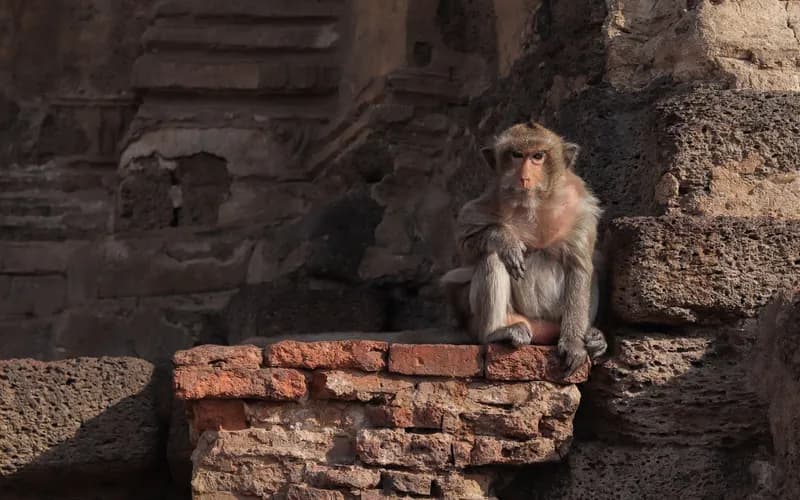
The macaques are not optional. Several hundred of them live on the hill and they are practised opportunists. Carry nothing loose, no plastic bags, no visible food or drink, and do not stop to photograph them at close range. Locals climbing the steps often carry a stick, less to strike than to signal. Treat the monkeys as wildlife with a commercial streak rather than as an attraction and you will be fine.
Prachuap's own bay is not really a swimming beach. The water is shallow, silty and busy with moored boats. For swimming you go a few kilometres south, over the headland, to Ao Manao.
Ao Manao: The Beach Inside an Air Base
Ao Manao is the province's oddest pleasure: a genuinely lovely bay that sits inside the grounds of Wing 5, a Royal Thai Air Force base. It is open to the public. You show identification at the gate, ride in past hangars and married quarters, and arrive at a beach with tidy shade trees, deck chairs, a modest canteen and a swimming area that is patrolled and clean.
The military management explains why it looks the way it does. There is no vendor line, no jet ski touts, no beach bar, no construction site. It closes in the evening. It is also the site of a real piece of history: on 8 December 1941, Japanese forces landed here and were resisted by Thai airmen, police and civilians over a day and a half of fighting. A memorial and small museum on the base commemorate it, and the anniversary is marked in early December each year.
Practically: bring your passport or a copy, dress normally, and accept that photography is fine on the beach and not fine pointed at aircraft or installations. Opening hours can change without notice for exercises or ceremonies, which is a good reminder that this is someone's workplace before it is your beach day. Our guide to the parts of Thailand that avoid the crowds is useful for calibrating expectations here: this is not a resort coast and does not pretend to be.
Get matched with up to 5 trusted Thailand agencies
- Free
- No obligation
- Up to 5 agencies
South to Ban Krut: Palms, Casuarinas and a Golden Buddha
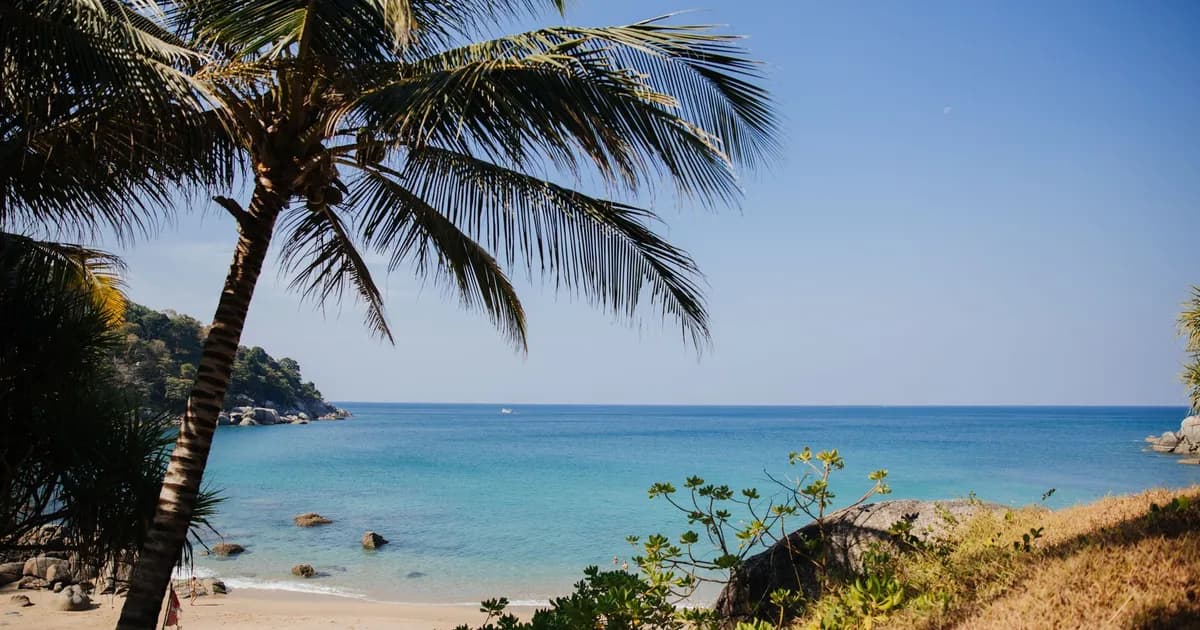
Roughly seventy kilometres south of the provincial capital, Ban Krut is the province's best-known beach among Thais and still almost unknown abroad. It runs for several kilometres, backed by an unbroken line of coconut palms and casuarina trees, with a fishing village at one end and a scatter of small resorts and seafood restaurants along the road behind.
What Ban Krut does not have is more interesting than what it does. There are no jet skis. There are no beach vendors working the sand with sunglasses and sarongs. There are no high-rise hotels, no chain resorts, and no nightlife beyond a few places serving beer until they feel like closing. The sand is broad and firm, the water is generally calm, and the dominant sound in the afternoon is casuarina needles moving in the wind.
At the northern end, Thong Chai hill carries Wat Thang Sai, a temple complex built in the mid-1990s to mark the fiftieth anniversary of King Bhumibol's accession. Nine white pagodas step up the ridge and a large golden Buddha looks out over the coast. The road up is steep but paved, and the view along the beach from the top is the photograph everyone takes home.
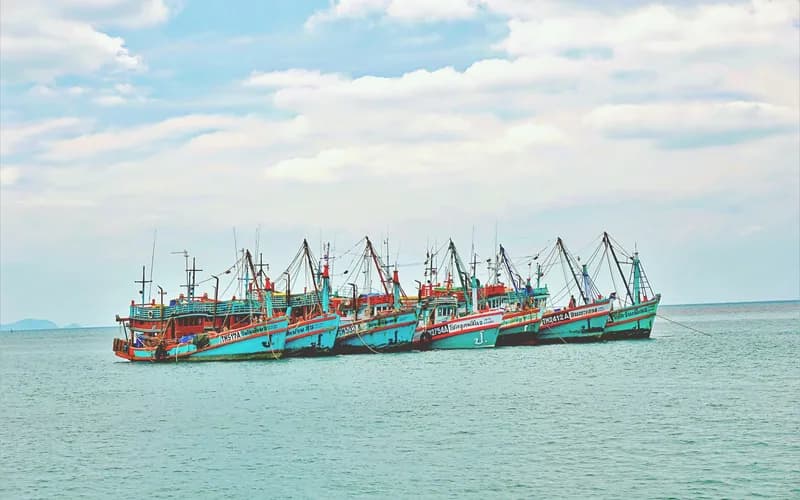
Seafood is the other reason people come. The village landings sell squid, mackerel, crab and prawns at prices that reflect a domestic market rather than a tourist one, and most resorts will cook what you buy or point you at a place that will.
Bang Saphan Yai and the Coast Further South
Continue about eighty kilometres south of Prachuap town and you reach Bang Saphan Yai, roughly a hundred kilometres north of Chumphon and, usefully, a stop on the southern railway line. It is a slightly larger, slightly scruffier version of the same idea: a long bay, a working fishing economy, a small European expatriate community that arrived two decades ago and quietly stayed, and a handful of guesthouses that have been running since before the internet made them findable.
The beaches around Bang Saphan are the sort of places where a good day means a swim, a long lunch and a nap. Offshore, small islands such as Ko Talu and Ko Sing offer respectable snorkelling in the calm months and close during the monsoon. If you want the province at its most unbothered, this is the end to aim for.
Inland, the land rises quickly into forested hills along the Myanmar border, with several small protected areas and waterfalls that run hard in the wet season and disappear in the dry. If you are planning around park access anywhere in the country this year, read our rundown of what national park fees, bookings and closures actually look like in 2026 before you build a day around one.
Getting There, and Why the Train Wins
Prachuap Khiri Khan sits on the main southern railway, which is the single best argument for visiting. Trains from Bangkok take roughly five to six hours to Prachuap town and a little longer to Ban Krut and Bang Saphan Yai. Coming north from Surat Thani or Chumphon, the journey is shorter still. Second-class seats are comfortable, the coast appears on your left going south, and the stations are small enough that you walk out of them straight into the town.
Buses and minivans run from Bangkok's southern terminal and are faster on paper, but the railway drops you closer to where you actually want to be, and the road south of Hua Hin is not a pleasant one. There is no commercial airport in the province worth planning around.
Once you are there, a rented motorbike is the practical way to move between bays, though the distances between Prachuap, Ban Krut and Bang Saphan are long enough that you should treat them as separate bases rather than day trips from one another. Our guide to travelling Thailand by train covers booking windows and class choices in more detail.
When to Go, and the Honest Case Against It
The Gulf coast here is driest and calmest from roughly December to April. February and March are the reliable months: flat water, clear light, warm but not yet punishing. December brings Thai holiday crowds to Ban Krut and Ao Manao, particularly around the 8 December commemorations and New Year, when rooms are booked out and prices rise.
From about May to October the province feels the southwest monsoon indirectly and, later in the year, the edge of the northeast system. Rain tends to come in bursts rather than all day, but it has consequences: run-off makes the water murky and sometimes brown for a day or two after heavy falls, and jellyfish are more common.
The bigger low-season problem is staffing. Many small resorts and restaurants run on skeleton crews or close entirely between May and September. A beach that is pleasantly quiet in February can feel genuinely deserted in June, with three restaurants open, nobody to talk to, and a long dark road back to your room. Some travellers love this. Others find four nights of it more solitude than they bargained for, and it is worth knowing which you are.
Other honest caveats: there is essentially no nightlife, English is limited outside the resorts, ATMs thin out south of Prachuap town, and the swimming, while pleasant, is not the transparent turquoise of the Andaman. Come for the pace, not for the postcard.
Where to Stay and What It Costs
Prachuap town has simple guesthouses and small hotels along and behind the seafront, generally in the 500 to 1,200 baht range, which suits a base for the hill, the market and Ao Manao. Ban Krut is the province's strongest accommodation cluster: garden bungalows and small beachfront resorts, mostly Thai-owned, mostly 900 to 2,500 baht, with a handful of more polished places at the top end. Bang Saphan runs cheaper and rougher.
Book ahead for December, Songkran and any Thai long weekend, and expect a two- or three-night minimum at the better Ban Krut places over holidays. Outside those windows you can usually turn up. If you would rather have someone assemble a route along this coast with train legs and local drivers already sorted, our directory of vetted Thailand travel agencies is the place to start.
What to Do Next
- Pick one base rather than three. Ban Krut for beach time, Prachuap town for markets and the hill, Bang Saphan for maximum quiet.
- Book a second-class seat on a southbound day train from Bangkok and take the coast at eye level.
- Check your dates against Thai school holidays and the 8 December commemorations before you commit to Ban Krut.
- Bring cash. Card acceptance outside the larger resorts is patchy and ATMs are sparse south of the provincial capital.
- Give yourself four nights minimum. The province does not reward a stopover; it rewards a routine.
- If you are travelling in the green season, confirm directly with your accommodation which restaurants are actually open.
Frequently Asked Questions
How many days do you need in Prachuap Khiri Khan?
Four to six nights is the sweet spot. Two nights is enough to see the hill, the market and Ao Manao but not enough to justify the journey. A week lets you split between Prachuap town and Ban Krut without rushing, and leaves room for a rained-out afternoon.
Can foreign visitors really enter Ao Manao inside the air force base?
Yes. The beach is open to the public during daylight hours and foreign visitors are routinely admitted. Bring a passport or photocopy for the checkpoint, keep photography pointed at the sea rather than at aircraft, and be aware that the base can close the area at short notice for exercises or ceremonies.
Is Ban Krut better than Bang Saphan?
They serve different moods. Ban Krut has the longer, prettier beach, the temple on the hill and the better spread of places to sleep and eat. Bang Saphan is quieter, cheaper and less organised, with easier access to offshore snorkelling. If it is your first visit, start with Ban Krut.
What is the swimming like?
Generally calm and shallow, with gentle shelving and few currents on the main beaches. Water clarity is moderate at best and turns murky after heavy rain. This is a comfortable, safe coast to swim on rather than a scenic one, and it is not comparable to the Andaman islands.
Do I need a motorbike?
It helps a great deal. Songthaews and motorbike taxis exist in Prachuap town but thin out quickly elsewhere, and a beach like Ban Krut spreads over several kilometres. If you are not confident riding, choose accommodation with a restaurant and stay put, or arrange a car with a driver through your guesthouse.
Is the province worth visiting in the rainy season?
It can be, if you want solitude and low prices and you are genuinely comfortable with empty. Expect closures, reduced menus, murky water and short heavy showers. If you need things to be open and lively, come between December and April instead.
How does Prachuap compare with Hua Hin?
Hua Hin is a developed resort town with international hotels, golf, malls and a night market built for visitors. Prachuap is a provincial capital with a fishing fleet. If you want restaurants, choice and convenience, stay in Hua Hin. If you want a quieter, more ordinary Thailand and are willing to trade amenities for it, go south.