

For nearly three decades, visiting Tuol Sleng and Choeung Ek was something travellers did quietly and, often, uncertainly. The sites sat outside the official heritage story Cambodia told the world, a story built around Angkor, sandstone and the twelfth century. In July 2025 that changed. UNESCO inscribed three linked places associated with the Khmer Rouge security apparatus on the World Heritage List, and in doing so moved Cambodia's most difficult history from the margins of the visitor experience to its formal centre. A year on, the consequences are becoming visible, and they ask something of anyone travelling here in 2026.
What UNESCO Actually Listed in 2025
The inscription, adopted on 11 July 2025 at the 47th session of the World Heritage Committee in Paris, is titled Cambodian Memorial Sites: From Centres of Repression to Places of Peace and Reflection. It covers three interrelated locations rather than one. The first is the former M-13 prison in Kampong Speu province, a rural site where the Khmer Rouge developed their interrogation methods before taking power. The second is Tuol Sleng Genocide Museum in Phnom Penh, the former S-21, a school converted into the regime's central security centre. The third is the Choeung Ek Genocidal Centre on the city's southern edge, where prisoners from S-21 were taken to be killed.
The three form a chain rather than a set of separate monuments: a place where the system was invented, a place where it was administered, and a place where it ended. That is the argument UNESCO accepted, and it is a more sophisticated framing than most memorial listings receive. It is also Cambodia's fifth World Heritage property, following Angkor in 1992, Preah Vihear in 2008, Sambor Prei Kuk in 2017 and Koh Ker in 2023.
One request. Up to five tailored proposals.
Skip contacting agencies one by one — share your trip once and let up to five trusted Cambodia agencies come to you. Free, with no obligation.
Get my free quotesWhy the Third Site Matters
Most travellers will only ever visit two of the three. M-13, in Tumnup village in Amleang commune, is a rural site without established visitor infrastructure, and it is not currently a practical stop on an ordinary itinerary. Its inclusion is nonetheless the intellectually important part of the listing, because it locates the origin of the machinery outside Phnom Penh and before 1975. That contradicts the comfortable narrative that the violence began with the fall of the capital.
Kaing Guek Eav, known as Duch, ran M-13 before he ran S-21. He was convicted by the Khmer Rouge tribunal and died in custody in 2020. The link between the two prisons is the link between the movement's forest years and its years in power. Once you have absorbed that, a visit to Tuol Sleng reads differently: not as an aberration produced by sudden power, but as an established practice scaled up.
A Different Kind of Heritage Claim
This was Cambodia's first nomination of a modern, non-archaeological site, and among the first anywhere to be submitted specifically as a place associated with recent conflict. World Heritage has long been criticised for treating the twentieth century as somebody else's problem. Cambodia's file argued the opposite case: that the sites of atrocity are heritage precisely because of what they can teach, and that their preservation is a public good rather than a national embarrassment.
The framing matters for travellers. The listing's own subtitle, from centres of repression to places of peace and reflection, sets an expectation about conduct. These are not attractions in the sense that a temple is an attraction. They are places where the descendants of victims still come, and where survivors still work as guides. Reading our charter for slow travel before a Phnom Penh itinerary is a reasonable way to set your own standard for the visit.
Get matched with up to 5 trusted Cambodia agencies
- Free
- No obligation
- Up to 5 agencies
What Has Changed on the Ground
Practically, less than you might expect, and that is intentional. Tuol Sleng remains open daily from 08:00 to 17:00 with foreign adult admission at US$5 and a reduced rate of US$3 for visitors aged ten to eighteen; Cambodian nationals enter free. Choeung Ek opens 07:30 to 17:30 and charges US$6 including a multilingual audio guide. Neither site has been redesigned around its new status, and neither has introduced the queue management or commercial layering that often follows a listing.
What has shifted is emphasis. Interpretation has been strengthened, the sites are increasingly presented as a single connected narrative rather than as two half-day stops, and Cambodian schools and institutions now bring visitors in far greater numbers. Foreign visitors are no longer the primary audience, and the atmosphere reflects that. Expect groups of Cambodian students, expect quiet, and expect to be a guest at somebody else's history rather than the reason the site exists.
The Numbers Behind the Shift
The timing is unusual, because the listing arrived just as Cambodian tourism entered a sharp contraction. Ministry of Tourism figures show roughly 1.54 million international arrivals between January and May 2026, down close to 48 per cent year on year, with the prolonged closure of much of the Thai land border the principal cause. The ministry's own scenarios for the full year range from 4.6 to 4.8 million in the worst case to 6.1 to 6.3 million if the border situation resolves.
Within that reduced total, the composition has changed. China and Vietnam supplied the two largest source markets in early 2026, together accounting for around half of all arrivals. Fewer Western short-break visitors arriving overland from Thailand means the memorial sites are seeing a different mix of people, and a smaller one. For an individual traveller the practical effect is straightforward: 2026 is an unusually quiet year to visit Phnom Penh, and quiet is exactly the condition these places need.
Beyond Phnom Penh: The Wider Memorial Landscape
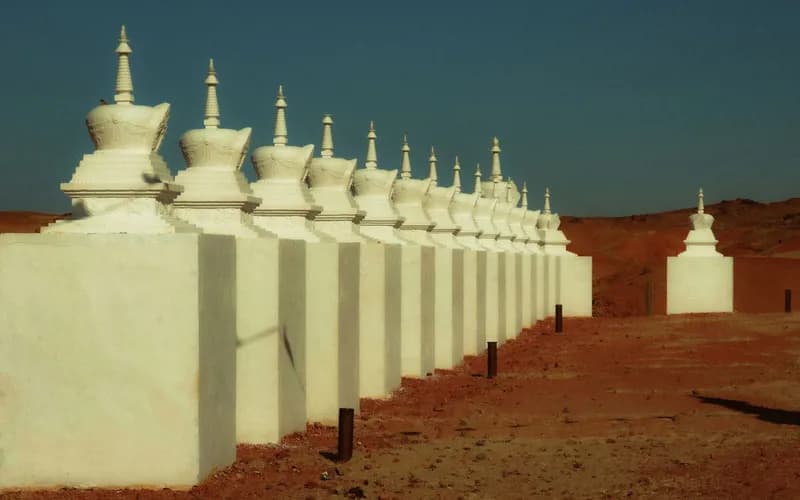
The listing covers three sites, but the Khmer Rouge left between roughly 150 and 196 security centres across the country, and most provinces have a local memorial that receives almost no foreign visitors at all. Many are simply a stupa in a pagoda compound, maintained by monks and by the families of the dead. Some, such as the memorial sites near Battambang and in the north-west, sit close to routes travellers already take.
The right approach to these is restraint. They are not stops to collect, and photographing them requires the same care you would apply at a war grave in your own country. If you are travelling through the north-west anyway, our piece on Battambang and the countryside around it gives the geography that helps you understand where these places sit in ordinary Cambodian life, which is very close by, usually just beyond the rice fields.
How Cambodians Are Reading the Listing
The reaction inside Cambodia has been broadly positive, and for reasons that are not primarily about tourism. Survivors' organisations framed the inscription as recognition: an international acknowledgement that what happened was a documented historical fact rather than a contested claim. In a country where the last tribunal verdicts were delivered only in 2022, and where roughly two thirds of the population was born after 1979, that recognition carries weight in domestic conversations about teaching, remembrance and inheritance.
There is also a generational dimension. Younger Cambodians who grew up with the subject half-spoken at home now encounter it as formal heritage, with the authority that implies. Guides at both Phnom Penh sites increasingly include this shift in their commentary. It is worth listening for, because it is the part of the story that is actually happening now, rather than the part that ended in 1979.
What This Asks of Travellers
Three things, none of them complicated. First, give the sites time and sequence. Tuol Sleng in the morning and Choeung Ek in the afternoon, in that order, is the arrangement that makes narrative sense, and both audio guides are worth the full duration rather than a skim. Second, do not treat the visit as a box to tick between a market and a rooftop bar; leave the rest of the day loose. Third, dress and behave as you would at any place of mourning, with shoulders and knees covered and phones away except for deliberate, respectful photographs.
It is also worth spending the following day somewhere ordinary and alive. Phnom Penh is a functioning capital with river light, morning markets and a strong contemporary arts scene, and seeing it as a city rather than as a site of history is part of an honest visit. Our guide to Phnom Penh at walking pace covers the neighbourhoods that make that possible.
The Risk of Getting It Wrong
The obvious risk of a World Heritage listing is commodification: the tour badge, the aggressive tuk-tuk sales pitch on the riverside, the packaged half-day that pairs S-21 with a shopping stop. That already existed before 2025 and the listing does not remove it. Choosing how you book matters, and the operators that handle these sites well are the ones that brief clients in advance, use trained Cambodian guides and do not bundle the visit with unrelated leisure. Our directory of vetted Cambodian travel agencies is a reasonable starting point.
The subtler risk is treating the past as the whole country. Cambodia in 2026 is a place of expressways, QR payments, a young workforce and a serious cultural revival, and reducing it to four years in the 1970s is its own form of disrespect. The memorial sites earn a day of your attention. They do not earn the framing of your entire trip.
What to Do Next
- Plan Tuol Sleng for the morning and Choeung Ek for the afternoon of the same day, and take both audio guides in full.
- Budget US$5 for Tuol Sleng and US$6 for Choeung Ek, in small US dollar notes, plus transport of roughly US$15 to US$20 for a return tuk-tuk to Choeung Ek.
- Dress conservatively, keep phones silent, and ask before photographing anyone, including staff and other visitors.
- Read a short background text before you go; the visit is far more coherent with the chronology already in your head.
- Do not attempt to visit M-13 in Kampong Speu; it has no visitor infrastructure and no established access arrangements.
- Give the following day to contemporary Phnom Penh rather than stacking another heavy site on top.
Frequently Asked Questions
Did the UNESCO listing change ticket prices or opening hours?
No. As of 2026 Tuol Sleng remains US$5 for foreign adults and opens 08:00 to 17:00, while Choeung Ek is US$6 including the audio guide and opens 07:30 to 17:30. Cambodian nationals continue to enter Tuol Sleng free of charge. The inscription strengthened interpretation and protection rather than the commercial arrangements.
Can I visit the M-13 site in Kampong Speu?
Not in any practical sense. M-13 is a rural location without visitor facilities, signage or an established access programme, and it is included in the listing for its historical role rather than as a destination. Travellers should confine themselves to the two Phnom Penh sites unless a formal visiting arrangement is announced.
Is it appropriate to take photographs?
At both Phnom Penh sites photography is generally permitted, with restrictions posted in specific rooms, but permission is not the same as appropriateness. Photograph deliberately rather than continuously, never photograph other visitors or staff without asking, and do not take portraits of yourself in front of the memorial displays or the mass graves.
How long should I allow for the two sites?
Roughly two to three hours at Tuol Sleng and one and a half to two hours at Choeung Ek, plus around forty minutes of travel each way. That is most of a day. Trying to compress both into a morning is the single most common mistake, and it produces a worse and more superficial visit.
Are the sites suitable for children?
Tuol Sleng advises that the exhibits are not appropriate for visitors aged fourteen and under, and that guidance is sound. Older teenagers can find the visit valuable if they have context beforehand and if an adult is prepared to discuss it afterwards. Choeung Ek is somewhat less graphic but is still a mass grave site.
Will the listing make the sites more crowded?
Not noticeably in 2026. International arrivals to Cambodia fell close to 48 per cent in the first five months of the year, and Phnom Penh is quieter than it has been in a decade. The clearer effect of the inscription has been a rise in Cambodian school and institutional visits, which changes the character of the sites more than the volume.