Renting and Riding a Motorbike in Cambodia in 2026: Licences, Permits and Fines
A motorbike is the best way to see rural Cambodia and the fastest way to ruin a trip. Both statements are true, and the gap between them is almost entirely paperwork. Rental shops in Kampot, Siem Reap and Phnom Penh will hand a scooter to anyone with a passport and forty dollars, and nothing about that transaction tells you whether you are legally entitled to ride it, or whether your insurer will look at your claim. This is what the rules actually say in 2026, what enforcement looks like on the road, and where the expensive traps are.
What the law actually says
The baseline position is straightforward. To ride a motorcycle legally in Cambodia as a visitor you should hold a valid motorcycle licence from your home country and carry an International Driving Permit alongside it. Cambodia recognises both the 1949 and 1968 convention IDPs, so either version issued by your national motoring authority is accepted. The IDP is a translation document, not a licence in itself: it is only valid presented together with the original licence it refers to.
Note the specific wording: a motorcycle licence. A car licence with no motorcycle entitlement does not authorise you to ride a motorbike, and an IDP issued against a car-only licence does not either. This is the single most common gap among travellers who believe they are compliant, and it is the one insurers look for first.
You should also carry your passport, or at minimum a clear photograph of the passport and current visa page, and the rental agreement for the bike.
One request. Up to five tailored proposals.
Skip contacting agencies one by one — share your trip once and let up to five trusted Cambodia agencies come to you. Free, with no obligation.
Get my free quotesThe 125cc question, and why it is the wrong question
You will read, in a great many places, that no licence is required in Cambodia for a motorcycle of 125cc or less. The claim is widely repeated, it appears on rental shop walls, and it is the reason most tourists ride without documents.
Treat it as unreliable guidance rather than a safe harbour, for three reasons. First, accounts of what the exemption covers and whether it still stands vary, and none of the sources repeating it is the Ministry of Public Works and Transport. Second, even where a threshold exists in the traffic code, it has no bearing on your insurance position, which is governed by your policy wording and not by Cambodian law. Third, a roadside conversation about engine displacement is not one you want to be having in Khmer.
The practical conclusion is simple. Carrying a motorcycle licence and an IDP costs very little, takes a few weeks to arrange before you leave, and removes the entire category of problem. Ride a 125cc scooter if you like; carry the documents anyway.
Helmets, lights and the everyday checks
Helmets are compulsory in Cambodia, in cities and outside them, on national roads, in villages and inside national parks. Typical roadside fines reported for riding without one are in the range of five to ten dollars, which is low enough that many riders treat it as a toll rather than a rule. That is a mistake for a different reason: helmet use is the single variable most strongly correlated with surviving a crash on a Cambodian road.
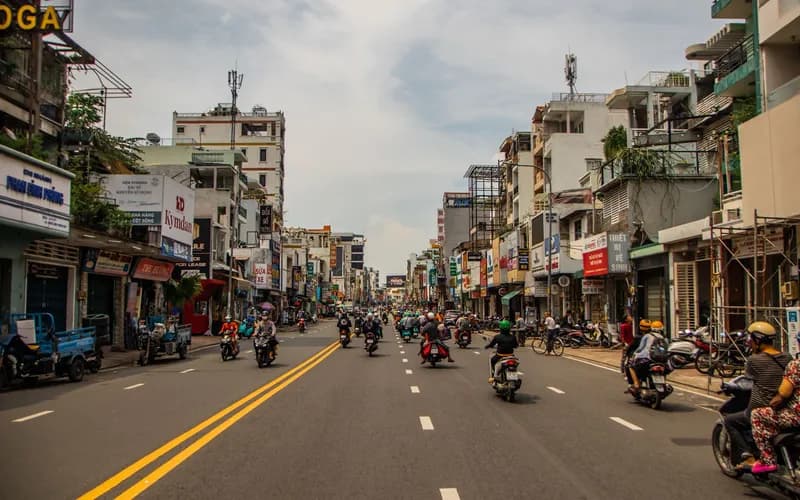
Rental helmets are often poor, undersized and with broken straps. If you plan to ride for more than a couple of days, buy a better one; they are cheap and available in any decent-sized town, and it is the best twenty dollars on the trip.
Beyond helmets, police attention at checkpoints tends to focus on the visible and easily verified: mirrors present, lights working, number plate attached, no more than the legal number of passengers. Check all of those on the bike before you accept it, because the fine falls on you rather than the shop.
Get matched with up to 5 trusted Cambodia agencies
- Free
- No obligation
- Up to 5 agencies
The fines, and what a stop actually looks like
Cambodia has amended its traffic law several times in recent years, tightening penalties on licences, drink-driving and speeding. Under the amended provisions, riding without a licence or on a suspended licence reportedly attracts fines in the region of 800,000 to 4,000,000 riel, roughly two hundred to one thousand dollars at about 4,000 riel to the dollar, with the possibility of a short custodial sentence for repeat offences. An earlier provision cited a flat 1.2 million riel. Police can also impound the machine.
Two honest caveats. The published penalty ranges and what is actually levied at a roadside stop are different things, and reported amounts vary between sources. And a stop is usually resolved on the spot for a modest sum rather than by formal process. None of that makes riding undocumented a good plan: the exposure is not the fine, it is the impounded bike, the voided insurance and the liability if you hit someone.
If you are stopped, stay polite, stay in the saddle until asked to dismount, hand over documents rather than cash, and ask for the amount before agreeing to anything. Keep the transaction small, calm and brief.
Insurance: the part that ruins trips
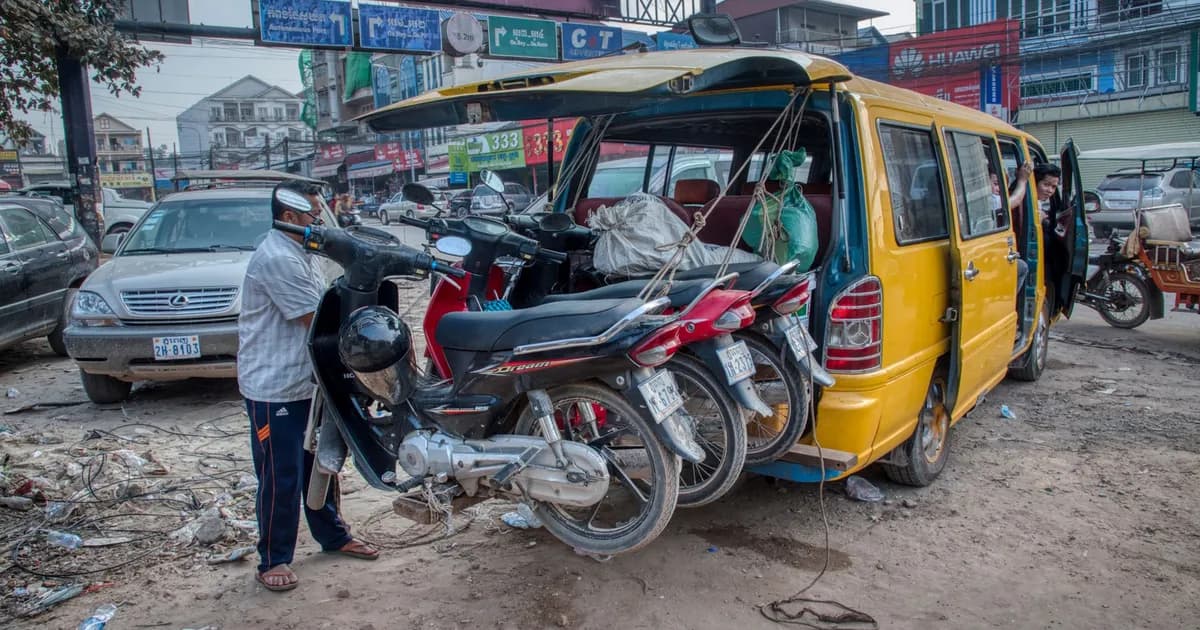
This is the section that matters most and gets read least. Cambodian rental shops do not, as a rule, provide insurance on a scooter. The bike is not covered, you are not covered, and third-party liability is not covered. If you damage the machine you pay for it; if you damage someone else, you negotiate.
Your own travel policy is therefore the only protection you have, and almost every standard policy carries motorcycle exclusions. The common conditions are that you hold a valid licence for the class of vehicle, that you carry an IDP where the country requires one, that you were wearing a helmet, and that the engine is within a stated capacity limit, frequently 125cc. Fail any one of those and the medical claim can be refused, which in a serious case means paying for evacuation yourself.
Read your own policy wording rather than a summary, and take a screenshot of the relevant clause. On the medical side, our article on staying healthy in Cambodia covers where the usable hospitals are and how evacuation to Bangkok or Singapore actually works, which is the scenario your policy exists for.
Where you can and cannot ride
Availability is not uniform. Rental rules and local practice differ by town, and there have been periods when shops in particular places were restricted from renting motorbikes to foreigners at all, or limited to small-capacity machines. Ask locally rather than assuming, and be suspicious of a shop that is unusually relaxed about documents in a town where others are not.
Within the Angkor Archaeological Park, motorbikes are permitted on the main circuits, and electric bicycles have become a popular alternative for the shorter loops. Some outlying temples are reached on tracks that a scooter handles badly after rain.
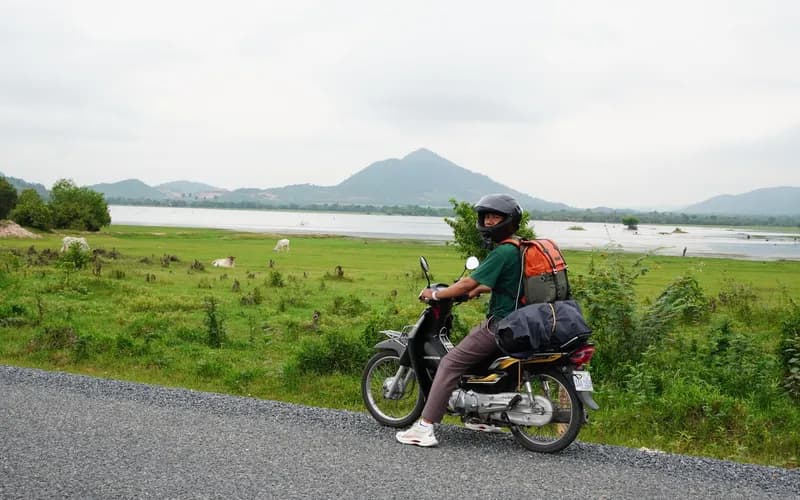
The best riding in the country is in the south and the northeast: the pepper-farm lanes and salt flats behind the coast, the river roads in the northwest, the red laterite tracks of the highlands. Our article on Kampot and Kep covers the stretch most travellers rate highest, with short, low-traffic loops that do not require a long-distance ride to reach.
One firm rule: you cannot take a rented Cambodian motorbike across an international border. Rental agreements prohibit it, the paperwork does not exist, and you will be turned back.
Renting well: deposits, condition checks and passports
Never leave your passport as a deposit. This is standard practice at many shops and you should decline it every time. Your passport is not yours to pledge, you may need it for an accommodation registration or a bank, and recovering it from a shop in a dispute is genuinely difficult. Offer a cash deposit or a photocopy instead, and walk away from a shop that insists.
Keeping the passport matters administratively too. Your accommodation is required to register your stay in the national Foreigners Present in Cambodia System, and anything touching your visa depends on that record being correct. Our explainer on Cambodia's FPCS address registration sets out how it works and why a missing registration causes problems later.
Before you ride away, do this: photograph the bike from four sides and the odometer, test both brakes, check tyre tread and pressure, confirm the lights, horn and indicators work, count the mirrors, and check that a number plate is attached. Note the fuel level in the agreement. Ask what happens if it breaks down fifty kilometres away, and get an answer with a phone number in it.
Converting your licence if you are staying longer
If you are in Cambodia for months rather than weeks, converting is the better route. Foreigners holding a valid long-term visa can exchange a home country licence for a Cambodian one without sitting a driving or theory test. You need the original valid licence, a translation if it is not in English or French, and the usual photographs and forms. The fee has been in the region of 120,000 riel, and the resulting licence has typically run for one year and been renewable annually.
The process is run by the Ministry of Public Works and Transport, which operates an online application portal and service counters in Phnom Penh, including at shopping-mall locations. The ministry also issues international driving permits against Cambodian licences, which is useful if you intend to ride in neighbouring countries.
The important limitation: conversion requires a long-term visa, so it is not available to someone on a tourist visa. If you are extending your stay anyway, our update on Cambodia visa extensions in 2026 covers the current categories, fees and the sequencing you need to get right.
Riding conditions, honestly
Cambodia's road fatality rate is among the higher ones in the region, and motorcycles account for the large majority of deaths and serious injuries. The specific hazards are consistent: overtaking into oncoming traffic, trucks without functioning lights, livestock and dogs on rural roads, unlit roadworks, sand and gravel on bends, and flooding in the wet season.
Three habits reduce the risk substantially. Do not ride after dark outside towns, because rural roads are unlit and the traffic mix at night is the worst of the day. Do not ride any distance on a national highway if a bus or train covers the same route; save the bike for local exploring. And assume that anyone pulling out has not looked, because frequently they have not.
Used that way, a scooter is genuinely the right tool. The countryside around provincial towns is flat, quiet, beautiful and almost entirely unreachable any other way. Our piece on Battambang and the countryside around it describes exactly the kind of low-traffic day loop that a rented bike turns from difficult into easy.
What to Do Next
- Check whether your home licence carries a motorcycle entitlement, not just a car one, before you count on riding.
- Apply for an International Driving Permit from your national motoring authority before you leave; allow a few weeks.
- Read your travel insurance motorcycle clause in full and screenshot it, noting any engine capacity limit.
- Buy or bring a properly fitting helmet rather than relying on the rental shop's.
- Refuse any request to leave your passport as a deposit; offer cash or a photocopy.
- Photograph the bike and its odometer before you ride, and note existing damage on the agreement.
- If you are staying long-term on an appropriate visa, price out converting your licence with the ministry instead.
Frequently Asked Questions
Do I legally need a licence to ride a scooter in Cambodia?
You should hold a valid motorcycle licence from your home country and carry an International Driving Permit with it. You will often read that machines of 125cc or under are exempt; that claim is widely repeated but not reliably sourced, and it does nothing for your insurance position. Carry the documents regardless.
Does Cambodia accept an International Driving Permit?
Yes. Both the 1949 and 1968 convention permits are recognised. Remember that an IDP is only valid when presented with the original licence it translates, and that an IDP issued against a car-only licence does not cover a motorcycle.
What is the fine for riding without a licence?
Under the amended traffic law, reported penalties fall in the region of 800,000 to 4,000,000 riel, roughly two hundred to one thousand dollars, with a possible short custodial sentence for repeat offences, and the bike can be impounded. Reported figures vary between sources, and roadside outcomes are often settled for less.
Are rental motorbikes insured?
Generally not. Cambodian rental shops rarely include any insurance, so damage to the bike, injury to you and liability to third parties are all uncovered. Your own travel policy is the only real protection, and most policies exclude motorcycle claims unless you held a valid licence, carried an IDP, wore a helmet and stayed within a stated engine capacity.
Should I leave my passport as a deposit?
No. Decline it every time, even though many shops ask. You may need the passport for accommodation registration or banking, and recovering it during a dispute is difficult. Offer a cash deposit or a photocopy, and use a different shop if they will not accept that.
Can I ride a rented Cambodian bike into Vietnam, Laos or Thailand?
No. Rental agreements prohibit taking the machine across a border and the customs paperwork for a temporary vehicle export does not exist for a rental. You will be refused at the crossing. Plan to return the bike and cross as a passenger.
Can I convert my home licence to a Cambodian one?
Yes, if you hold a valid long-term visa. The exchange requires no driving or theory test, needs your original licence plus a translation if it is not in English or French, and has cost in the region of 120,000 riel for a licence valid one year and renewable. It is not available on a tourist visa.
Is it safe to ride in Cambodia?
It carries real risk: the country's road fatality rate is among the region's higher ones and motorcycles account for most serious casualties. The risk drops substantially if you avoid riding after dark outside towns, avoid long stretches of national highway, wear a proper helmet and ride defensively on local roads only.