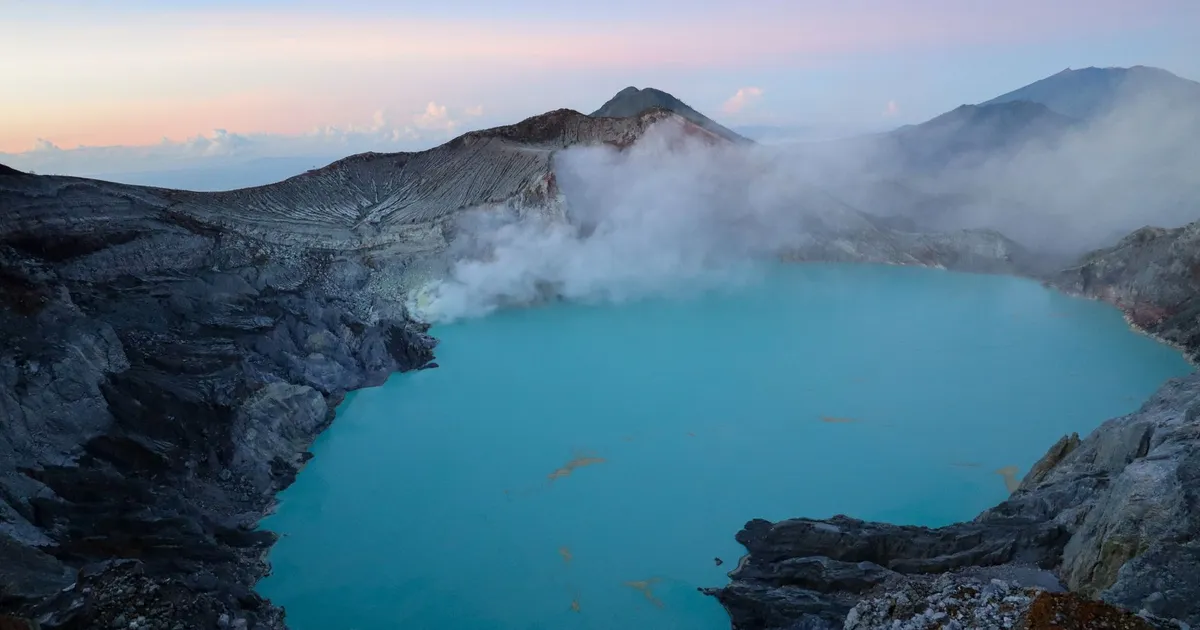

Kawah Ijen draws hikers for its turquoise acid lake, its working sulphur mine and the chance of blue flames in the dark. Planning a visit now involves as much paperwork as hiking. Since 2024 you need a doctor's health certificate, tickets go through a national booking platform, and in 2026 alone the park closed for a search for a lost hiker in February, for a wildfire in September and for a cleaning day every month.
This page gathers the current rules in one place, with dates and sources, for anyone planning Ijen between now and the end of the 2027 dry season. It also covers what the rules do not settle: whether you will actually see the blue fire, and why a night in Banyuwangi or Licin beats the 1 a.m. dash from Bali.
Is Ijen open right now?
Ijen is open on most days, but it closes more often than most travellers expect, so check its status the week you go and again the day before.
The routine closure is Ijen Rijik, a monthly cleaning and conservation day run by the park authority, the East Java conservation agency (BBKSDA Jawa Timur). It falls on the first Friday of the month. The official schedule for the second half of 2026 lists 5 June, 3 July, 7 August, 4 September, 2 October, 6 November and 4 December. The 2027 dates had not been published when this page was written. The pattern points to first Fridays again, but wait for the official list before you build a trip around a Friday.
Unscheduled closures do more damage to travel plans. In September 2026 a wildfire spread from the slopes into the park, which shut on 4 September and reopened on 28 September once the fire was out and the trail had been checked. Local press met a French couple on honeymoon who had come for the blue fire and had to leave without seeing it. In February 2026 hiking stopped on 19 February while rescuers searched for a hiker who had become separated from his group near the crater; he was found alive and the park reopened on 26 February.
Watch out
Ijen is an active volcano. The geology agency (PVMBG) has raised it from Level I (Normal) to Level II (Waspada) several times since 2024, and at Level II hikers can be kept 1 to 1.5 km away from the crater. Check the current level on the MAGMA Indonesia volcano service before you travel. The park can also close at short notice for weather, gas or fire.
Early January deserves a note too. In January 2024 the park closed for several days for a review of the previous year, the first time it had done so. This has not been announced as a yearly fixture, but if you plan a New Year hike, keep a spare day.
One request. Up to five tailored proposals.
Skip contacting agencies one by one — share your trip once and let up to five trusted Indonesia agencies come to you. Free, with no obligation.
Get my free quotesTickets: the official platform and what you pay
Tickets are sold online on AyoKeTamanNasional, the booking platform of the Ministry of Forestry. It replaced the old BBKSDA ticket site, which ran alongside it during a trial that began in May 2026. When the park reopened after the fire, bookings opened on the new platform from 25 September.
Kawah Ijen at a glance
- Foreign visitor ticket
- IDR 150,000 per person per day
- Indonesian visitor ticket
- IDR 20,000 weekdays, IDR 30,000 holidays
- Hiking gate hours
- 02:00 to 12:00 (Western Indonesia Time)
- Health certificate
- issued no more than 3 days before the visit
- Routine closure
- Ijen Rijik, first Friday of the month
- Summit height
- 2,386 m
The foreign rate of IDR 150,000 comes from the 2024 national tariff regulation for conservation areas (PP 36/2024), applied at Ijen since 30 October 2024. Older blogs still quote IDR 100,000 on weekdays, which was the previous scale. Bromo works on a similar online system with a daily quota, explained on our Mount Bromo rules page.
Three conditions on the booking matter more than the price. Tickets cannot be cancelled, moved or refunded under any circumstances, so a rain closure or a missed bus costs you the ticket. The name and passport details must match your documents, because staff check them at the Paltuding counter when you swap the booking code for a paper ticket. And according to the local conservation office in 2026, the official ticket now includes basic insurance; that cover is limited, so travel insurance that includes hiking still makes sense.
Daily numbers are capped, and weekends and Indonesian holidays fill first. A weekday ticket booked a few days ahead is usually the easy option.
The health certificate, explained
The rule arrived in January 2024, when the park reopened after a closure with a new list of conditions, and it has been enforced since. You must be in good physical and mental health, and people with a history of heart disease, asthma or breathing problems are advised not to hike. The proof is a certificate (surat keterangan sehat) from a doctor, clinic, community health centre (puskesmas) or hospital, issued no more than 3 days before the date on your ticket.
Staff check it at the counter in Paltuding before you get your paper ticket. The exam is basic: usually blood pressure, pulse, oxygen saturation and a few questions. Doctors from Airlangga University's Banyuwangi campus who ran health checks at the trailhead named high blood pressure, heart conditions and breathing problems as the risks they screen for.
You can get one in three ways. A clinic or puskesmas in Banyuwangi will issue it the day before, which suits anyone sleeping in town. Most organised tours stop at a partner clinic on the way up; some include the fee and others list it as an extra, quoted at around IDR 35,000, so read what your tour covers. There is also a health post at Paltuding that issues certificates during the night, but if it is busy or closed you lose your slot, so treat it as a fallback.
A certificate from home is valid if it is recent enough. Most travellers reach East Java more than 3 days after leaving home, so plan on a local one.
Get matched with up to 5 trusted Indonesia agencies
- Free
- No obligation
- Up to 5 agencies
Guides, solo hiking and the trail itself
The trail from Paltuding to the crater rim runs about 3 km each way on a wide, sandy path, steep in the middle third and gentler near the top. Most people take 1.5 to 2 hours to climb it in the dark. It needs no technical skill, but cold air before dawn, altitude, lack of sleep and sulphur gas make it harder than the distance suggests.
You can still walk to the rim without a guide. The park strongly recommends a licensed local guide, and it has pressed the point harder since February 2026, when the conservation office concluded that the missing hiker had broken the hiking procedure and lost touch with his group. The office said it would tighten checks on hikers' fitness and on compliance with the rules. Guides commonly charge from around IDR 250,000 for a group of up to five, arranged at Paltuding, through your guesthouse or as part of a tour. If you go alone, stay on the main trail with the other headlamps, especially at the junction between the crater path and the sunrise point, where the February hiker went astray.
Going down into the crater towards the sulphur vents is a separate matter. Access depends on gas and volcanic conditions and is sometimes closed, and when it is open you should only go with a guide. The geology agency's standing advice is to stay off the crater floor and away from the lip when activity rises, and camping within 500 m of the crater is not allowed.
The kit rules at the gate are simple: a headlamp, a warm jacket, shoes with grip and a mask, and you carry your rubbish out. After the September fire the park also asked hikers not to light fires of any kind. Gas masks rent at Paltuding for roughly IDR 25,000 to 50,000, and a proper respirator matters most if you go down or the wind turns. Our notes on trekking Indonesia's volcanoes responsibly cover the wider etiquette.
Ijen is also a workplace. Sulphur miners carry heavy loads on the same path, so step aside for them on narrow sections, and do not ask anyone carrying a load to stop for a photo.
The blue fire question
The blue fire is real. Sulphur gas escaping from vents ignites on contact with air and burns with a blue flame that shows only in full darkness, before first light. What has changed is how much of it you can expect to see. Recent visitor reports and Indonesian guides describe weak flames, flames seen only from a distance, or none at all on many nights. Gas flow, mining at the vents, wind and cloud all play a part, and when the crater descent is closed you will not get close.
Treat the blue fire as a possible extra. The more reliable reward is dawn on the rim, when the lake turns from grey to turquoise and the plume lifts off the crater, with Mount Raung and Mount Ranti behind it on a clear morning. If you plan around that, a night with weak flames is still worth the walk.
Tours sell the 1 a.m. start partly on the blue fire. If you care more about the sunrise than the flames, you can start at 2:30 or 3:00, still reach the rim before light and spend less time waiting in the cold.
Ijen in the rainy season and the holidays
December to March, when many Europeans have time off, is East Java's wet season. Rain usually falls in the afternoon and evening, so a night hike can stay dry, but the path gets slick, cloud often fills the crater at dawn and weather closures become more likely. January and February are the riskiest stretch. If Ijen is the reason for your trip, the dry season from May to September is the safer bet.
- Jan 2024Health certificate rule introduced at a reopening; brief closure for an annual review
- Oct 2024New national tariff: IDR 150,000 for foreign visitors
- Feb 2026Hiking suspended 19 to 26 February during a search for a lost hiker
- May 2026Bookings start moving to the AyoKeTamanNasional platform
- Sep 2026Wildfire closure from 4 to 28 September
- Dec 2026Next scheduled Ijen Rijik closure on 4 December
Indonesian holidays bring crowds. Over the 2025 to 2026 year-end holidays the conservation office counted 808 hikers on Christmas Day and 744 on New Year's Day; in early 2025 the same office put an ordinary weekend at around 600. Those numbers are far below Bromo's, but they still mean a queue at the counter and a busy rim. A weekday in the second half of January can be quieter if the weather holds.
Our guide to travelling Indonesia in the rainy season explains how to build buffer days into a wet-season route.
The slow way: sleep near the mountain
The classic package leaves south Bali in the evening, crosses on the ferry from Gilimanuk to Ketapang, drives up to Paltuding, hikes through the night and returns to Bali the same day. It works on paper. In practice it means close to 24 hours awake, a health check squeezed in around midnight, and a non-refundable ticket that depends on ferry timings.
Day trip from Bali
- Fits a Bali-based holiday
- One price covers transport, ferry, ticket and often the health check
- Close to 24 hours without proper sleep
- A ferry delay or a closure costs you the whole trip
Two nights in East Java
- Health certificate sorted in Banyuwangi the afternoon before
- A few hours of sleep before a 1:30 or 2:00 a.m. pickup
- Room to move the hike by a day if it rains or the park closes
- Needs more planning and one more travel day
Licin, the district below the trailhead, has guesthouses about 30 minutes from Paltuding, which shortens the night drive. Banyuwangi town has more choice and a train station, and a DAMRI shuttle runs from Taman Sritanjung in the centre to Paltuding (book seats ahead at weekends). If you are coming overland from Bromo or Malang, Ijen fits at the end of an East Java overland route without doubling back.
What to Do Next
- Check the official AyoKeTamanNasional page for the Ijen Rijik date in your month, and look up the volcano level on MAGMA Indonesia.
- Choose a weekday that is not the first Friday, ideally with a spare day after it in case of rain or a closure.
- Book the ticket with your exact passport name, knowing it cannot be refunded or moved.
- Arrange the health certificate in Banyuwangi the afternoon before, or confirm in writing that your tour includes it.
- Decide on a guide, and hire one if you plan to go down into the crater or hike in cloud.
- Pack a headlamp, warm layers, shoes with grip and a mask.
If you would rather hand over the logistics, our Indonesia trip planning page explains how to build a slower East Java route with a local specialist.
Frequently Asked Questions
Is Kawah Ijen open in 2026 and 2027?
Yes. The park reopened on 28 September 2026 after the wildfire closure. It closes every first Friday for Ijen Rijik (next on 4 December 2026) and can close at short notice for weather, gas, fire or a raised volcano alert. Check the official page and the volcano level before you go.
How much is the Kawah Ijen ticket for foreigners?
IDR 150,000 per person per day under the national tariff applied since October 2024, booked online on the AyoKeTamanNasional platform. Tickets are non-refundable and cannot be moved to another date.
Do I need a health certificate for Ijen?
Yes. You need a certificate from a doctor, clinic, puskesmas or hospital issued no more than 3 days before your visit. Clinics in Banyuwangi issue them for a small fee, and many tours include the stop.
Can I hike Ijen without a guide?
You can walk the main trail to the rim on your own, but the park strongly recommends a licensed guide and has stressed this since a hiker got lost in February 2026. Go with a guide if you want to descend into the crater, where access depends on conditions.
Will I see the blue fire?
Possibly, but do not count on it. In recent years the flames have often been weak, distant or absent, and the crater descent is sometimes closed. Sunrise over the turquoise lake is the more reliable reason to go.