
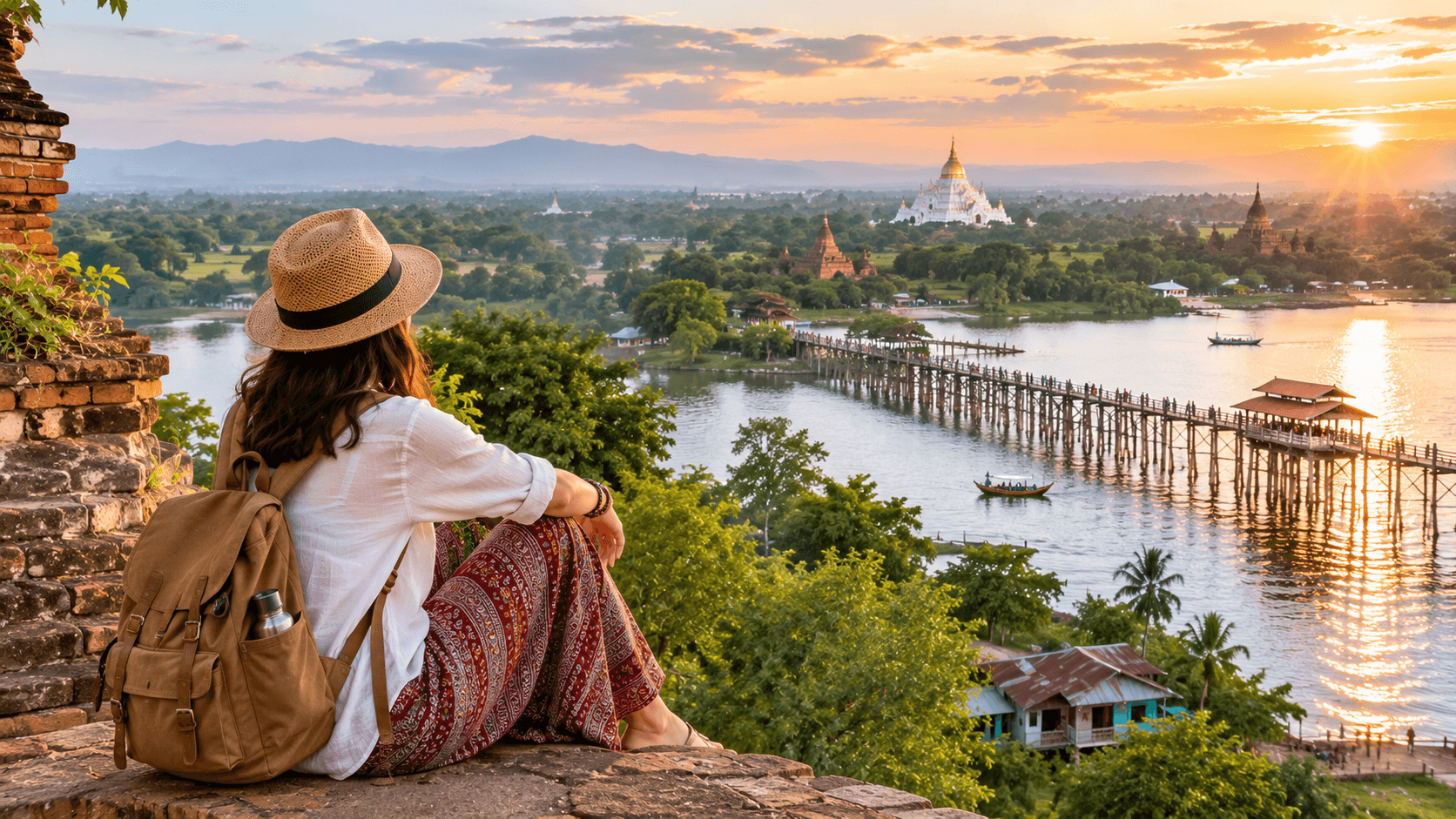
Off the Beaten Path in Myanmar: Hidden Gems for Slow Travelers
Some travellers arrive in Myanmar chasing a version of "off the beaten path" that no longer exists in the way the guidebooks once described it. The honest starting point, in 2025 and into 2026, is this: much of the country's classic off-beat map is currently affected by conflict and is not accessible or advisable to visit. Since the events of February 2021, Myanmar has been in the grip of a widespread internal conflict, and major governments — including the United States, the United Kingdom, France, Australia and others — maintain significant "do not travel" advisories for large parts of the country. On top of that, the powerful earthquake of March 2025 near Mandalay and Sagaing caused severe damage and a long recovery that is still ongoing.
None of this means Myanmar has closed its heart. It means the meaning of "off the beaten path" has shifted. The remaining, realistically accessible parts of the country — broadly the corridor linking Yangon, Mandalay, Bagan and Inle Lake, plus a handful of quieter pockets nearby — are themselves so lightly travelled right now that going "deeper" has become far more rewarding than going "further." This is a guide to the quieter corners within the areas that remain accessible: the empty temple at dawn, the village weaver away from the tour buses, the monastery hill where you are the only visitor. It is not a guide to slipping past checkpoints into restricted regions, and it never will be. Throughout, the single most important instruction is to verify current conditions before you commit to anything, and to travel with a knowledgeable, current-aware local operator who knows which roads opened last week and which closed.
What "off the beaten path" means in Myanmar today
For most destinations, going off the beaten path is a matter of taste and effort. In Myanmar right now it is also a matter of responsibility and safety. The distinction that matters is not between "famous" and "remote" but between accessible and restricted. Some of the country's most celebrated hidden gems — Mrauk U's temple valley, the face-tattoo villages of Chin State, the islands of the Mergui Archipelago, the community tourism of Kayah State — sit in areas currently affected by conflict or under travel restrictions. We cover them honestly further down, but only to explain why they are off the table for now, not to tempt you toward them.
Instead, the opportunity today lies in depth. The main circuit that remains open is quieter than it has been in a generation. Sites that were once shoulder-to-shoulder are now calm. A slow traveller who lingers — three nights instead of one, a bicycle instead of a coach, a shared meal instead of a photo stop — will find that even the "on the beaten path" places feel off it. The paradox of Myanmar in 2026 is that the beaten path is barely beaten at all.
Before you go, read widely and recently. Advisories change, and a road or town that was fine one season can be affected the next. Our companion piece on where to go and when is a good place to understand the shape of the accessible circuit, and you should always cross-check it against your own government's latest advisory and a trusted local operator's on-the-ground read.
One request. Up to five tailored proposals.
Skip contacting agencies one by one — share your trip once and let up to five trusted Myanmar agencies come to you. Free, with no obligation.
Get my free quotesThe quieter Shan hills: Kalaw, Pindaya, and the question of Hsipaw
The Shan hills are the emotional centre of Myanmar's trekking tradition, and they are also where the accessible and the restricted sit uncomfortably close together. The important thing is to know which is which.
Southern Shan — the highlands around Kalaw, Pindaya and Inle Lake — has generally remained more accessible than the north, and it is where responsible slow travel in the hills is still realistically possible. Kalaw itself is a cool, faded former hill station wrapped in pine and tea. The classic walk from Kalaw down to Inle Lake, spread over two or three days through Danu, Palaung and Pa-O villages, is the kind of experience Myanmar does better than almost anywhere: no dramatic peaks, just a slow descent through terraced fields, bamboo groves and hamlets where you sleep in a monastery or a family home and eat what the household eats. Done well, with a local guide who has standing relationships in those villages, it is a quiet, respectful, low-impact journey.
Pindaya, a short trip from Kalaw, is best known for its limestone cave crowded with thousands of gilded Buddha images accumulated over centuries — atmospheric and, more often than not these days, nearly empty of other visitors. The surrounding valley, with its Danu farming villages and the Shan paper and parasol workshops, rewards an unhurried day.
Hsipaw is the harder conversation. In the pre-2021 era, Hsipaw in northern Shan was one of the country's premier independent trekking bases — a small town from which travellers walked to Shan and Palaung villages and rode the famous train over the Gokteik Viaduct. Today the situation is very different. Northern Shan has been one of the most actively contested regions in the country, and independent trekking from Hsipaw has largely been suspended, with access frequently restricted. For the purposes of this guide, treat Hsipaw and the north generally as not currently recommended, and do not plan around it. If you have your heart set on the Shan trekking experience, the accessible answer is the southern hills around Kalaw and Pindaya — and even there, conditions can shift, so confirm the current picture with your operator before booking. When you are ready to translate this into a real itinerary, our plan your journey resources are built for exactly this kind of conditional, verify-first planning.
Around Mandalay: Sagaing, Mingun, Inwa, and the Ayeyarwady villages
Mandalay is the practical hub of the accessible circuit, though it is worth knowing that the city and its surroundings were among the areas most affected by the March 2025 earthquake, and recovery in parts of the region is ongoing. Some heritage structures were damaged. This is one more reason to travel with a current-aware operator who can tell you honestly what is open, what is under repair, and what is best left for another year.
What makes the Mandalay area quietly extraordinary is the ring of ancient capitals and monastic hills within a short river or road hop, most of which now see only a trickle of visitors. Sagaing Hill, just across the Ayeyarwady, is a landscape of hundreds of white-and-gold stupas and working monasteries and nunneries draped across a wooded ridge. Come in the soft light of late afternoon, climb slowly, and you may share the view with nothing but the sound of bells and the murmur of chanting. It is one of the most contemplative places in the country and, for a slow traveller, one of the most rewarding.
Mingun, reached by a gentle boat trip upriver, holds the enormous unfinished base of what would have been the world's largest stupa, cracked by an old earthquake, alongside the graceful white Hsinbyume Pagoda. Inwa (Ava), a former royal capital, is a scatter of monasteries and brick ruins among farmland, best explored slowly by pony cart or on foot along dirt lanes. None of these places is a secret, exactly — but with today's low visitor numbers, they can feel like private discoveries.
The real off-the-beaten-path reward here is the Ayeyarwady itself. The river is Myanmar's oldest highway, and the villages along its banks — potters, weavers, farmers, boat-builders — live at a rhythm that has barely changed. A slow local ferry or a small chartered boat, with time to step ashore and share tea rather than photograph and move on, is one of the most honest ways to meet the country. If travelling by private boat appeals, understanding the charter and slow-travel approach will help you do it in a way that is calm, low-impact and genuinely connected to the places you pass.
Get matched with up to 5 trusted Myanmar agencies
- Free
- No obligation
- Up to 5 agencies
The quiet side of Bagan and Mount Popa
Bagan needs little introduction: a plain scattered with thousands of temples and pagodas built across centuries, one of the great sights of Asia. What has changed is the crowd. Where sunrise over Bagan was once a jostle of tour groups and camera tripods, it is now, most mornings, remarkably calm. This is the moment to rediscover it as a slow traveller should.
The trick in Bagan is to leave the handful of headline temples to the day-trippers and go quiet and lateral. Rent a bicycle or an e-bike and ride the sandy back tracks between the lesser-known monuments, where you can often sit alone inside a brick temple with a single shaft of light falling on a faded mural. The southern and eastern clusters, and the villages fringing the archaeological zone — Minnanthu, New Bagan's edges, the lacquerware workshops and toddy-palm farms — reward an unhurried half-day far more than another tick-list temple. Talk to a lacquer artisan, watch toddy climbers work the palms, buy directly from the maker.
An easy add-on is Mount Popa, an extinct volcano about an hour and a half from Bagan, crowned by a monastery perched on a sheer volcanic plug — Taung Kalat — and wrapped in the lore of the nats, Myanmar's animist spirits. The climb up the covered stairway (mind the resident macaques) is short but memorable, and the greater Popa massif is a green, cooler world of villages and shrines that most visitors skip entirely. Between temple mornings and village afternoons, Bagan is also one of the best places to eat well and slowly; our guide to Myanmar's food is a good companion for knowing what to look for at a Bagan market or a roadside toddy stand.
Inle beyond the tourist loop
Inle Lake is one of the four corners of the accessible circuit, and for good reason: the leg-rowing Intha fishermen, the floating gardens, the stilt villages and the lake-bound monasteries make it one of the most photographed places in Myanmar. Precisely because of that, the standard boat tour has a well-worn loop — a silversmith, a weaving workshop, a cheroot maker, a "long-neck" souvenir stop — that can feel like a conveyor belt.
Going deeper at Inle means slowing the boat down and widening the map. Ask to start before the day-tour flotilla, when mist still sits on the water and the fishermen are actually fishing rather than posing. Head to the quieter southern reaches of the lake and the channels leading to Sagar (Samkar), where half-submerged stupas stand in the shallows and the villages see far fewer boats. Spend time in the market that rotates around the lakeside towns on a five-day cycle, arriving when it is a genuine local trading day rather than a tourist set-piece. Walk or cycle the vineyards and villages of the western hills above the lake, where the pace drops to nothing.
The most meaningful Inle experiences tend to be the least engineered: a family lunch in a stilt house, an afternoon learning how the floating gardens are actually built and tended, a conversation with a weaver working lotus fibre by hand. A good operator can arrange these in a way that puts money directly into the households you visit, rather than a commission chain — which is the whole point of travelling here slowly.
The coast: Ngapali's quieter stretches
Myanmar's coastline is long and, in normal times, gloriously underdeveloped. The one stretch that remains part of the accessible conversation is Ngapali, on the Rakhine coast — a string of soft-sand beaches, fishing villages and casuarina trees that has long been the country's flagship seaside escape. Even at its busiest, Ngapali was never a party beach; it is a place of quiet mornings, fishermen hauling nets, and grilled seafood eaten barefoot.
The important caveats are honest ones. Ngapali sits within Rakhine State, a region with a complex and sensitive situation, and while the beach area itself has generally remained accessible, the wider state includes areas that are restricted and should not be entered. Access can also depend on flight availability and current conditions, which have been variable. So Ngapali belongs in this guide with an asterisk: a genuinely quiet coastal option within the accessible sphere, but one to confirm carefully and recently before building a trip around it.
If it is open when you travel, the off-the-beaten-path move at Ngapali is simply to walk. Follow the sand away from the cluster of hotels to the working fishing villages at either end, where the day begins and ends with the boats. Buy fish at the morning landing, eat where the fishermen eat, and let the days blur — which is, after all, what a slow beach is for.
The places currently out of reach — and why to check anyway
Honesty requires naming what you cannot do, and why. These are, in more settled times, some of the very best off-the-beaten-path experiences in Myanmar. Right now they are not realistic options, and this guide does not encourage travel to any of them. They are listed so you understand the map — and so that, if you are reading in a future when conditions have changed, you know what to re-verify.
Mrauk U, in Rakhine State, is a valley of weathered stone temples often mentioned in the same breath as Bagan and, for atmosphere, sometimes above it. It sits in an area affected by conflict and has effectively been off-limits to visitors; treat it as inaccessible and check the situation carefully before ever imagining otherwise.
The Chin State villages, famous for the intricate facial tattoos of the elder women, lie in mountainous terrain that is largely restricted and difficult to reach; visiting responsibly is not currently feasible, and the ethical questions around tattoo-village tourism deserve care even in better times.
The Mergui (Myeik) Archipelago, a scatter of hundreds of near-empty islands in the far south and home to the seafaring Moken, has historically required special permits and now sits behind uncertain access and restrictions. It is not a reliable option at present.
Kayah State (Loikaw), a pioneer of community-based tourism before 2021, has been among the areas most affected by conflict, and its community tourism is not currently operating in a way you can responsibly join.
The through-line is simple: verify, verify, verify. Advisories and access can change in either direction, and the only trustworthy sources are your own government's current advisory and a local operator who is genuinely on the ground this month, not last year.
Sample slow routes within the accessible areas
None of these is a fixed itinerary — conditions decide the details — but they show how to go deeper rather than further within what is open.
A two-week classic, slowed down: three or four nights in Yangon to acclimatise, walk the old downtown and eat well; fly to Bagan for three or four nights of temple mornings, village afternoons and a Mount Popa day; a night or two around Mandalay with unhurried time for Sagaing Hill, Mingun and the river; then Kalaw for a two- or three-day walk down into the Inle valley; and four nights at Inle to explore beyond the standard loop before flying home. That is a fortnight that never rushes and never strays into restricted ground.
A river-focused variation trades some temple time for the Ayeyarwady, adding a slow boat segment between the Mandalay area and Bagan with time ashore in potters' and weavers' villages. A hills-focused variation deepens the southern Shan portion — more days walking around Kalaw and Pindaya, a rotating five-day market, and slow time on the western side of Inle. For help turning any of these into something bookable and current, start with our Myanmar planning resources and cross-check every leg against present-day advice.
Travelling responsibly: who benefits, and how to be a good guest
In a country going through what Myanmar is going through, the responsibility question is not an afterthought — it is the deciding factor in whether your trip does more good than harm. Slow travel here is only worthwhile if it is also careful travel.
Start with who benefits. Choose family-run guesthouses, community-based homestays, local guides and small workshops over anonymous chains, so your money reaches households directly. Buy crafts from the person who made them. Eat where local people eat. Tip fairly. When you visit a village, you are a guest in someone's home, not an audience at a performance; go with a guide who has real relationships there, ask before photographing people, and accept that some things are not yours to document.
Be sensitive to the context. This is a moment of hardship for many people, and political topics can be dangerous for locals to discuss — do not put anyone in a difficult position by pressing them. Dress modestly at religious sites, remove shoes and socks at pagodas, and follow your guide's lead on etiquette. Understanding the practical costs involved also helps you spend in ways that support local livelihoods rather than leak out of the community; our Myanmar budget guide breaks down where the money goes. Responsible travel in Myanmar is less about grand gestures and more about a hundred small, humble choices made in the right direction.
Logistics and the essential role of a current-aware local operator
If there is one non-negotiable in this guide, it is this: do not attempt Myanmar right now as a fully independent, improvised trip. The single most valuable thing you can do is travel with a knowledgeable local operator whose information is genuinely current. Roads open and close. Towns move in and out of accessibility. Flights and permits change. A good operator knows this week's reality, not last year's, and can quietly steer you away from anything unwise while opening doors to the quiet, respectful experiences at the heart of this guide.
Practical notes within the accessible circuit: internal flights connect the main points (Yangon, Mandalay, Bagan area, Nyaung Shwe for Inle) and are often the sensible way to cover distance, though schedules can be variable. Cash matters — international cards and ATMs are unreliable, so plan your money carefully and bring clean, newer bills. Connectivity is patchy. Travel insurance that genuinely covers your situation is essential, and you should read the small print with the current advisories in mind. Register with your embassy where that service exists. And build slack into every plan, because the whole ethos here is to move gently and stay adaptable. A trusted, vetted operator is the backbone of all of this; our directory of Myanmar travel agencies is a starting point for finding one whose values and current knowledge you can rely on.
The reward of going deeper, not further
It would be easy to read all these caveats as reasons not to come, and for some travellers, in some seasons, staying away will be the right call — there is no shame in deciding the moment is not right, and you should make that decision with clear eyes and current information. But for those who do come, thoughtfully and responsibly, Myanmar offers something increasingly rare: an encounter that has not been polished for visitors, in a country where kindness and grace endure through hardship.
The gift of Myanmar in 2026 is that the crowds are gone from places that used to be crowded, so the depth is there for the taking. You do not need to reach a restricted valley to find the real thing. It is in the empty temple at first light, the monastery hill shared with no one, the family who feeds you in a stilt house, the weaver who shows you her loom, the boatman who cuts the engine so you can hear the river. Go deeper, not further. Move slowly, verify everything, choose the humble option, and let the country reveal itself at its own unhurried pace. That is the whole of slow travel in Myanmar, and right now it is also the only responsible way to do it.
Frequently Asked Questions
Is it safe and responsible to travel to Myanmar in 2026?
It depends entirely on where and how. Myanmar is in the midst of a widespread internal conflict, and major governments maintain significant "do not travel" advisories for large parts of the country; the March 2025 earthquake added further disruption in the central regions. That said, the core accessible circuit — broadly Yangon, the Mandalay area, Bagan and Inle Lake, plus a few quieter pockets nearby — has generally continued to receive visitors. Whether it is right for you is a personal decision that should be made with your own government's current advisory in front of you, appropriate insurance, and the honest read of a local operator. This guide never encourages travel into conflict-affected or restricted areas, and neither should anyone else.
Can I still go trekking in the Shan hills like travellers used to?
Partly. The southern Shan highlands around Kalaw and Pindaya have generally remained more accessible, and the classic multi-day walk from Kalaw down to Inle Lake through hill villages is still realistically possible with a good local guide. The northern Shan trekking scene centred on Hsipaw, however, is a different story: northern Shan has been heavily affected by conflict, independent trekking there has largely been suspended, and it should not be part of your plans right now. Always confirm the current picture with your operator, because even the accessible hills can shift season to season.
Which famous "hidden gems" are currently off-limits?
Several of Myanmar's most celebrated off-beat destinations are not realistic options at present: Mrauk U's temple valley and the wider parts of Rakhine State, the face-tattoo villages of Chin State, the Mergui (Myeik) Archipelago in the far south, Kayah State around Loikaw, and northern Shan including Hsipaw. These sit in areas affected by conflict or under travel restrictions. This guide names them only so you understand the map — not to encourage visiting them. If you are reading in a future when conditions may have changed, treat every one of them as something to re-verify from scratch.
What does "off the beaten path" actually mean in Myanmar right now?
It means going deeper within the accessible areas rather than further into the restricted ones. Because visitor numbers are so low, even the main sights — Bagan's temples at dawn, Sagaing Hill, the quieter reaches of Inle — now feel remarkably uncrowded. The reward comes from lingering: cycling Bagan's back lanes, sharing tea in an Ayeyarwady river village, walking the southern Shan hills, meeting artisans directly. The paradox is that the beaten path is barely beaten at all, so depth, not distance, is where the real discovery lies.
Do I really need a local operator, or can I travel independently?
For Myanmar in its current situation, a knowledgeable, current-aware local operator is close to essential. Conditions change frequently — roads, towns, flights and permits can all shift with little notice — and a good operator knows this week's reality rather than last year's. They can keep you away from anything unwise while opening the door to the quiet, respectful, community-based experiences that make a slow trip here worthwhile. Fully improvised independent travel is not advisable right now. Choosing a vetted operator whose values and current knowledge you trust is the single most important decision you will make.
How do I make sure my visit actually benefits local people?
Direct your spending toward households and small enterprises: family-run guesthouses, community homestays, local guides, and craftspeople you buy from directly. Eat where local people eat, tip fairly, and avoid anonymous chains and long commission chains that leak money out of communities. Be a considerate guest — ask before photographing people, dress modestly at religious sites, remove shoes and socks at pagodas, and never press anyone to discuss politics, which can be genuinely dangerous for them. Responsible travel here is built from many small, humble choices rather than grand gestures.
When is the best time to make a trip like this, and how far ahead should I plan?
The cooler, drier months from roughly November to February are the most comfortable for the accessible circuit, with clear skies over Bagan and pleasant days in the Shan hills; the hot season and the mid-year rains each bring their own challenges. More important than the calendar, though, is timing your decision to current conditions. Because advisories and access can change, avoid locking in non-refundable arrangements far in advance, plan with flexibility, and confirm every element close to departure with your operator and your government's latest advice. Going slowly starts with planning slowly and keeping your options open.


