Myanmar's 2026 Visitor Numbers: What They Do and Don't Tell You
Tourism statistics are rarely neutral, and in Myanmar they are actively contested. State media reported more than 530,000 foreign visitor arrivals in the first half of 2026, following roughly 973,000 for the whole of 2025, and the authorities have set a target of 1.8 million arrivals for the year. Read quickly, those numbers suggest a recovery. Read carefully, alongside the advisories, the conflict map and the makeup of the arrivals themselves, they say something considerably more complicated. This piece is an attempt at the careful reading — written for people weighing whether travel to Myanmar is defensible at all, for those with family or professional reasons to be there, and for anyone who wants the trend described honestly rather than sold.
Where the Advisory Line Sits First
Before any analysis of visitor figures, the context has to be stated plainly. Myanmar has been under military government since February 2021. Armed conflict continues across multiple states and regions, martial law applies in parts of the country, conscription has been enforced since 2024, and elections held in phases from late 2025 into 2026 left the military leadership in place in a process widely rejected as neither free nor fair. As of September 2026, France discourages travel to Myanmar and formally advises against travel to large parts of it, and the United States, United Kingdom, Canada and Australia maintain advisories against all or non-essential travel.
That is not a footnote to the tourism story; it is the frame around it. Our separate briefing on what the current advisories say and how to check them goes through the mechanics. Nothing below implies the situation is normal, and choosing not to travel remains an entirely reasonable position.
One request. Up to five tailored proposals.
Skip contacting agencies one by one — share your trip once and let up to five trusted Myanmar agencies come to you. Free, with no obligation.
Get my free quotesThe Headline Numbers and Where They Come From
The figures in circulation for 2026 come from Myanmar government sources reported through state and regional media: 448,205 arrivals in the first five months, 530,973 in the first half, growth of roughly five percent on the same period a year earlier. The 2025 total of around 973,000 is the comparison point, against a pre-2020 peak that was several times higher.
Two caveats matter. First, these are official counts produced by an administration with an interest in showing normalisation; independent verification is limited. Second, the definitions are loose. Arrival counts typically include land border crossings and business travellers, not only holidaymakers, and a border trader crossing regularly is not a tourist in any useful sense. Treat the direction of travel as indicative and the precision as unreliable.
Who Is Actually Arriving
This is the part the headline number hides. The largest source market by air is China, followed by Thailand and South Korea, with Chinese air arrivals reported up around twelve percent in early 2026. Visa policy has followed the same logic: visa on arrival has been extended to a widening list of nationalities, with Hong Kong added in March 2025 and Japan, Macau and South Korea in October 2025.
In other words, the recovery in the statistics is largely a regional and business-driven one, not a return of long-haul leisure travel from Europe or North America. Western visitor numbers remain a small fraction of the total, constrained by the advisories, by insurance exclusions and by the ethical arguments. Anyone reading the arrival figures as evidence that European travellers have concluded it is fine to go is reading them wrong.
Get matched with up to 5 trusted Myanmar agencies
- Free
- No obligation
- Up to 5 agencies
The Gap Between Promotion and Advisory
There is now a wide and growing gap between how Myanmar is marketed and how it is officially assessed. Promotional material emphasises visa reform, Buddhist pilgrimage circuits, heritage sites and regional air connections. Foreign ministries emphasise armed conflict, arbitrary detention, limited consular assistance and the risk of sudden travel disruption.
Both descriptions can be factually accurate about different things at the same time, which is exactly what makes this destination difficult to write about. A temple can be genuinely extraordinary and a country can be genuinely dangerous. The honest editorial position is to hold both, state the advisory first, and leave the decision with the reader rather than nudging it.
A Smaller Map Than Before
The practical map available to foreign visitors in 2026 is far narrower than it was a decade ago. Most travel concentrates on a handful of established places, with permits or local permission required for certain areas and whole regions formally off limits under advisories. The slow-travel instinct to wander, to take the small road, to follow a recommendation into a region you had not planned on, does not apply here. Improvisation has become a safety question rather than a style choice.
That narrowing also has an economic effect. Where visitors do go, they cluster, which concentrates both the income and the pressure on a small number of sites and communities. Our guide to where to go and when in Myanmar sets out the geography; the caveat in 2026 is that any such map is provisional and subject to advisories.
What the Earthquake Changed
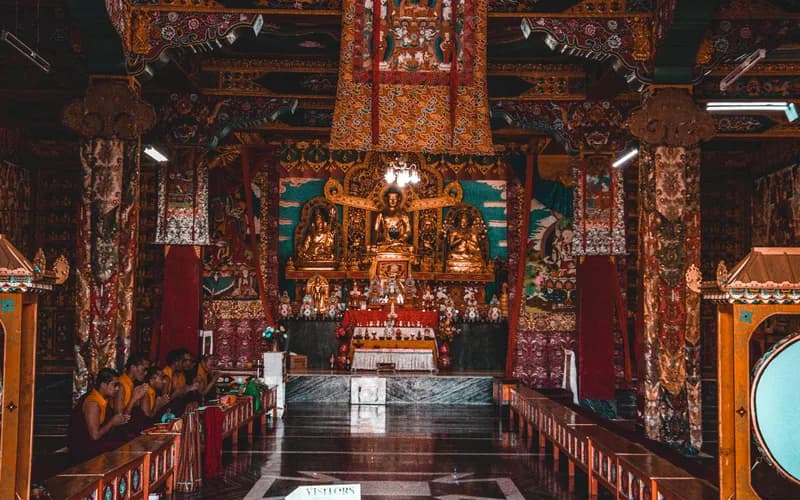
The magnitude 7.7 earthquake of 28 March 2025, with its epicentre near Mandalay, affected more than fifteen million people and damaged over half a million buildings. Cultural losses were severe across the ancient cities of Upper Myanmar, including serious structural damage at Kuthodaw Pagoda, home to stone scripture tablets inscribed on the UNESCO Memory of the World register. UNESCO, ICOMOS and SEAMEO SPAFA conducted a joint technical assessment mission, supported by the UNESCO Heritage Emergency Fund.
More than a year on, recovery in Sagaing, Mandalay, Nay Pyi Taw, southern Shan and parts of Bago continues slowly and unevenly, complicated by conflict, displacement and funding shortfalls. Any visitor figure for 2026 should be read against that backdrop: heritage tourism is being promoted in regions where reconstruction is far from finished. We looked at this specifically in our piece on temple tourism after the 2025 earthquake.
Money, Sanctions and the Shape of the Industry
Two military conglomerates, Myanmar Economic Holdings Limited and Myanmar Economic Corporation, hold interests across more than a hundred businesses, tourism among them, and have been documented by a United Nations fact-finding mission and targeted by sanctions. In January 2024 several United States government departments published a supplemental business advisory identifying high-risk sectors, and European Union measures have been extended repeatedly, most recently rolled over into 2026.
For the traveller, the consequence is not abstract. Entry fees at major sites are collected by state-linked bodies. Some hotels and carriers have military ownership links. Card payments and international transfers are constrained. The distinction between money reaching a household and money reaching an institution is real, but it is also imperfect and unverifiable at the margins. Our longer discussion of responsible, community-based travel in Myanmar treats this in depth, including the case for not going.
What the Numbers Do Not Count
Arrival statistics count entries. They do not count displaced people, and estimates of internal displacement in Myanmar run into the millions. They do not count the hospitality workers who lost livelihoods after 2021 and have not regained them, the guides who left the industry, or the households now relying on remittances. They do not count how much of the visitor spend leaves again immediately, nor how much reaches the people whose faces appear in the promotional photographs.
A rising arrivals curve in a country in conflict measures traffic, not recovery. Reading it as recovery is the single most common error in the coverage of Myanmar tourism, and it is worth resisting.
What This Means for a Slow Traveller
Slow travel is built on time, depth, local spending and the assumption that staying longer is better for everyone. In Myanmar in 2026, several of those assumptions are under strain. Staying longer increases exposure to an unpredictable situation. Local spending is harder to route cleanly. Depth requires conversations that could carry risk for the person you are talking to, not for you.
That does not make careful, well-founded travel impossible for those with genuine reasons to go. It does mean the usual slow-travel arguments cannot simply be transplanted here, and that our own slow travel charter has to be applied with an unusual amount of judgement rather than as a set of comfortable defaults.
How to Read Coverage of Myanmar Tourism
Most of what is published about travel to Myanmar falls into two predictable shapes, and recognising them saves a great deal of time. The first is the promotional shape: it leads with temples, sunsets and visa liberalisation, mentions the political situation once in a softening clause, and concludes that now is a quiet, uncrowded moment to visit. The second is the alarm shape: it treats the entire country as a single undifferentiated danger zone and offers no usable detail about what is actually happening where.
Neither is much help. A more reliable approach is to separate sources by what they are for. Foreign ministry advisories tell you what your own government assesses and what consular help exists. United Nations agencies, UNESCO and ICOMOS documents tell you about humanitarian conditions and heritage damage. Independent news organisations covering Myanmar report conflict developments. Tourism boards and operators tell you what is being sold. Reading all four, and noticing where they disagree, gives a far better picture than any single article, including this one.
What to Do Next
- Read the arrival figures as official, approximate and interested rather than as an independent measure of recovery.
- Check your own government's advisory in full before drawing any conclusion about feasibility.
- Separate the two questions clearly: whether travel is possible, and whether it is appropriate for you.
- If you have professional, humanitarian or family reasons to travel, plan around conflict geography, permits and disrupted transport.
- Assume cash, patience and flexible dates, given power, fuel and flight disruption.
- Follow the earthquake recovery through UNESCO and United Nations sources rather than tourism press releases.
- Revisit the decision periodically; the situation in Myanmar changes faster than most published travel content does.
Frequently Asked Questions
Does rising tourism mean Myanmar is getting safer?
No. Arrival figures reflect regional travel patterns, visa policy and business movement more than they reflect security conditions. As of September 2026, advisories from France, the United States, the United Kingdom, Canada and Australia continue to warn against all or non-essential travel to the country or to large parts of it.
How reliable are the 2026 visitor numbers?
They come from official Myanmar sources reported via state and regional media, and independent verification is limited. The general direction — a slow increase driven by regional markets — is plausible and consistent across several reports, but individual figures should be treated as approximate.
Which nationalities are travelling to Myanmar now?
By air, the largest groups are reported to be Chinese, Thai and South Korean visitors. Visa on arrival has been extended to a widening list of nationalities since 2025. Long-haul leisure travel from Europe and North America remains a small share of the total.
Is it ethical to visit Myanmar in 2026?
There is no consensus, including among people from Myanmar. Some argue independent travel sustains households with almost no other income. Others argue that visiting normalises the military government and risks funding military-linked businesses. Both views are held sincerely, and deciding not to go is a fully legitimate answer.
What happened to the earthquake-damaged heritage sites?
The March 2025 earthquake caused severe damage to cultural sites across central Myanmar, including at Kuthodaw Pagoda and several national museums. UNESCO and ICOMOS have been involved in assessment and recovery planning, but reconstruction is long-term work, and progress as of 2026 is partial and uneven.
Should slow travellers wait?
Many will, and that is a reasonable choice. Waiting does not require believing that travel is always wrong; it can simply reflect that the conditions slow travel depends on — flexibility, open movement, candid conversation, traceable local spending — are not currently available in the way they usually are.