
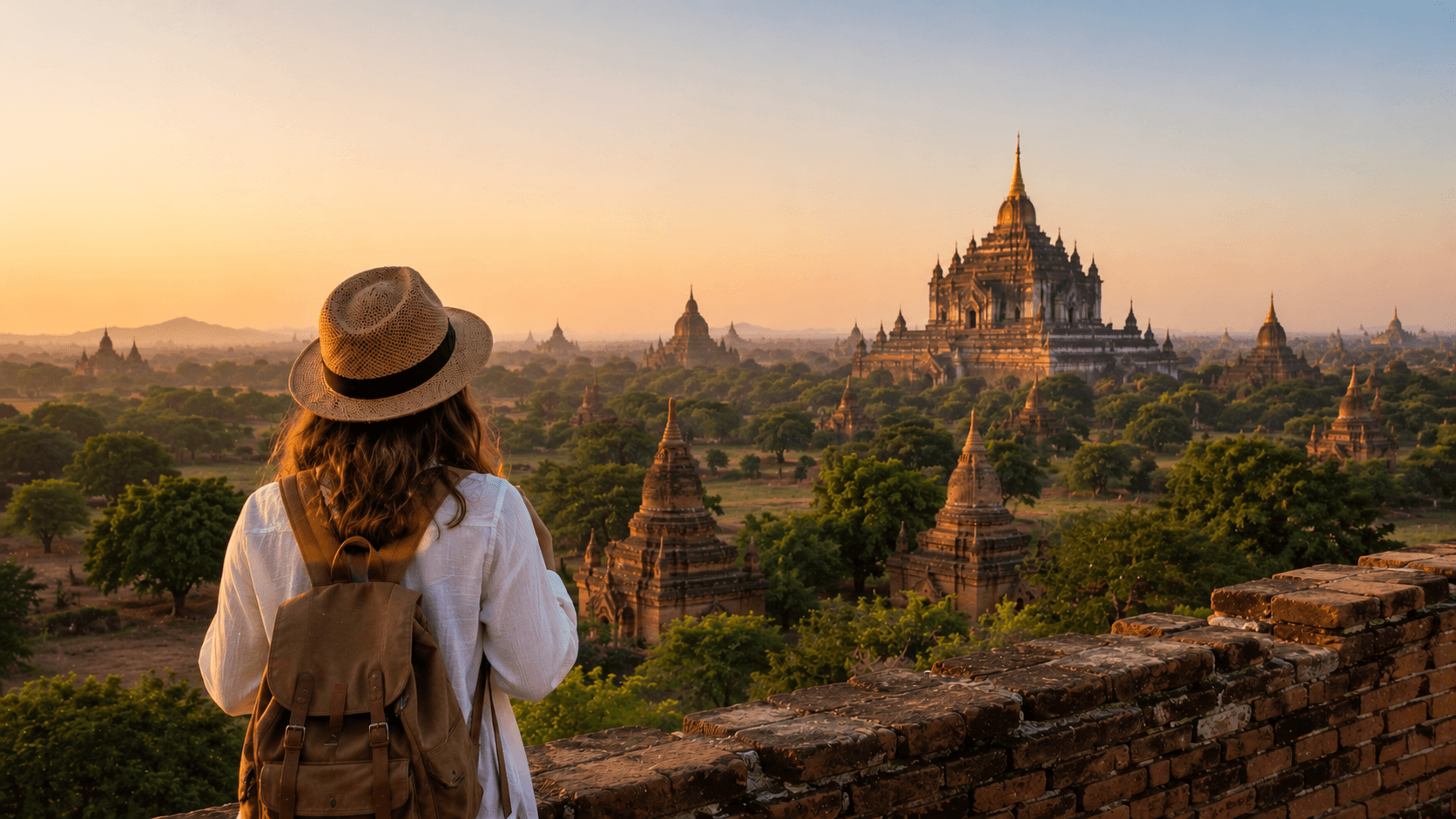
The Slow Traveler's Guide to Myanmar: Where to Go and When
Few countries reward patience the way Myanmar does. The morning mist that lifts off the Ayeyarwady River, the slow creak of a teak footbridge at Amarapura, the shuffle of pilgrims circling a golden stupa at dawn — these are not moments you rush past. They are the whole point. And yet Myanmar today is also a country that asks more of a traveler than most: more honesty, more homework, more care about where your money lands. This guide is written in that spirit. It will not pretend the picture is simple, and it will not tell you to be afraid. It will tell you, as plainly as we can, what is realistically open, when the light and weather are kindest, and how to move through this extraordinary land at the unhurried pace it deserves.
The honest picture: Myanmar today
Let us begin where an honest guide should begin. Since 2021, Myanmar has been living through a period of profound instability, and armed conflict affects large parts of the country. This is not a political statement — it is a practical reality that shapes every itinerary. Major governments, including the United States, the United Kingdom, Australia and Canada, currently maintain their highest-level "do not travel" advisories for Myanmar as a whole. Those advisories are real and you should read the current version from your own government before you commit to anything.
At the same time, a core circuit of the country continues to receive visitors and to operate day to day. Travelers often call it the "tourist kite" — the diamond of Yangon in the south, Mandalay in the centre, Bagan on the plains and Inle Lake in the Shan hills. Within this circuit, hotels are open, guides are working, temples receive pilgrims and the rhythms of ordinary life carry on. Many parts of the country, however, are not accessible and should not be attempted: much of Rakhine State (including the once-popular temple city of Mrauk U), Chin State, Kachin State, Kayah State, large stretches of Sagaing and Magway, and most of Shan State beyond the immediate Kalaw–Inle area. Access can and does change, sometimes quickly.
The single most important thing we can tell you is this: current, on-the-ground local advice matters more than any guidebook, including this one. Conditions shift week to week. A route that is fine one month may see checkpoints or closures the next. That is exactly why serious travel here is done in partnership with a reputable local operator who knows which roads are open today, which flights are running and which areas to avoid. If you are weighing the decision at all, start by reading our honest overview on the plan your journey page and by speaking to people who are physically there. Overland travel between the main hubs is widely discouraged because of unpredictable checkpoints; where possible, travelers fly between the pillars of the circuit rather than drive.
None of this is meant to alarm you. It is meant to arm you. Plenty of people continue to visit Myanmar's core sights thoughtfully and come home moved. But they do it with open eyes, comprehensive insurance that covers a high-advisory destination, and a plan built around current information rather than old assumptions.
One request. Up to five tailored proposals.
Skip contacting agencies one by one — share your trip once and let up to five trusted Myanmar agencies come to you. Free, with no obligation.
Get my free quotesThe slow-travel mindset
Myanmar is, almost by nature, a slow-travel country. The distances are large, the roads are slow, the internet is patchy and the economy still runs substantially on cash. You cannot bend this place to a tight, over-scheduled itinerary, and you should not try. The travelers who love Myanmar most are the ones who surrender to its pace — who spend three unhurried days in Bagan rather than one frantic one, who linger over a bowl of mohinga at a roadside stall, who let a monastery visit run long because the conversation is good.
Slow travel here is also the responsible way to travel. Moving slowly means staying in family-run guesthouses, eating where local people eat, hiring local guides and buying from the artisans whose lacquerware and weaving have been perfected over generations. It keeps more of your money in the hands of ordinary people rather than passing straight through. This is the heart of what we mean by the slow-travel charter: fewer places, more deeply, with the people who live there. In a country going through what Myanmar is going through, that ethic is not a luxury. It is the difference between tourism that helps and tourism that merely takes.
Practically, the slow-travel mindset also protects you. A packed schedule pushes you toward risky overland shortcuts and long, tiring days. A gentle one lets you fly the sensible legs, rest when the heat is brutal, and keep enough slack in your plans to adapt when a road closes or a flight shifts. Depth over distance is not just a philosophy in Myanmar. It is good sense.
When to go: season by season
Myanmar has three broad seasons, and choosing the right one will shape your trip more than almost any other decision.
Cool and dry: November to February
This is the best window, and it is not close. From November through February the northeast monsoon brings dry, clear skies and comfortable temperatures across most of the circuit. Bagan and Mandalay are warm but bearable, mornings on Inle Lake are crisp enough for a light layer, and the famous Bagan sunrises come with clean, golden light. This is peak season for good reason: the weather cooperates, the balloon festival near Taunggyi lights up the November skies, and the whole landscape feels at its most photogenic. Book accommodation ahead for December and January, which are the busiest weeks.
Hot and dry: March to May
From March the mercury climbs steeply, and by April the central plains around Bagan and Mandalay become genuinely punishing — daytime temperatures regularly push past 40°C (104°F). This is not a season to underestimate. If you come now, structure your days around the heat: temples at dawn, a long rest through the worst of the afternoon, and sightseeing again in the golden evening. The reward is thinner crowds and, in mid-April, the country's most joyful festival — Thingyan, the water festival that marks the Burmese New Year (more on that below). The Shan hills around Kalaw and Inle stay noticeably cooler and become a natural refuge from the lowland heat.
The wet monsoon: June to October
The southwest monsoon arrives around June and runs into October, bringing heavy, humid rain — heaviest on the coast and in the delta, somewhat lighter in the "dry zone" of central Myanmar around Bagan. This is low season. Ngapali and the beach resorts largely close down, boat schedules thin out and some rural roads turn to mud. But it is not without its rewards: the landscape turns a brilliant green, the temple plains empty of crowds, prices soften and the light between downpours can be spectacular. The Thadingyut festival of lights, usually in October, is one of the loveliest times to be here as the rains ease. If you do not mind a daily shower and a flexible plan, shoulder-season Myanmar has a quiet magic.
Get matched with up to 5 trusted Myanmar agencies
- Free
- No obligation
- Up to 5 agencies
Yangon: the gateway that deserves your time
Most journeys begin in Yangon, the country's largest city and its commercial heart, and it deserves far more than the single arrival night many travelers give it. Yangon is generally considered the most settled major city for visitors, and it rewards slow wandering.
At its centre — literally and spiritually — rises the Shwedagon Pagoda, a vast golden stupa said to enshrine relics of the Buddha and glittering above the city like nothing else in Southeast Asia. Come at dusk, when the gold catches the last light and turns molten, when families picnic on the marble terraces and monks and pilgrims move slowly around the platform. It is one of the great sacred spaces on earth, and it is worth timing your day around.
Yangon also holds the richest concentration of colonial-era architecture in the region: a downtown grid of faded, magnificent buildings from the British period, many crumbling, some restored, all atmospheric. Wander the streets around the old Secretariat and Pansodan, browse the crowded aisles of Bogyoke Aung San Market for lacquerware and jade, and ride the Yangon Circular Railway — a slow, three-hour loop through suburbs and paddy fields that is a moving portrait of everyday life. Yangon is also the best place to begin eating your way into the cuisine; our guide to Myanmar's food will help you order beyond the obvious.
Mandalay and around: the last royal capital
Fly north to Mandalay, Myanmar's second city and the last capital of the Burmese kings before the colonial era. Mandalay itself is a sprawling, workaday place, but it is the cultural heartland of the country and the base for some of its most rewarding day trips. Climb Mandalay Hill at sunset for the classic view over the city and the moated royal palace, and visit the Mahamuni Pagoda, where devotees have pressed so much gold leaf onto the revered Buddha image that its surface has become soft and irregular.
It is worth noting that Mandalay and the surrounding region were close to the epicentre of the powerful magnitude-7.7 earthquake that struck central Myanmar on 28 March 2025. The quake caused loss of life and damaged buildings, monasteries and heritage sites across Mandalay, Sagaing and Bagan. Recovery is ongoing, and some individual monuments remain closed or under repair. A good local guide will know exactly which sites are currently accessible.
The real magic here lies in the ancient capitals that ring the city. At Amarapura, the U Bein Bridge — a 1.2-kilometre teak footbridge over Taungthaman Lake, one of the longest in the world — fills with monks, cyclists and fishermen at sunset, its silhouette one of Myanmar's defining images. Across the river, the hills of Sagaing are dense with white-and-gold monasteries and stupas, a working centre of Buddhist life where thousands of monks and nuns study. Upriver, Mingun holds the enormous unfinished base of what would have been the world's largest stupa and the graceful, wave-white Hsinbyume Pagoda. These places are best strung together slowly over a day or two, with time to sit and watch rather than tick and run.
Bagan: the temple plains
If Myanmar has one image seared into the imagination of travelers, it is Bagan at dawn: thousands of brick temples and stupas scattered across a dusty plain, emerging from the mist as the sun rises over the Ayeyarwady. Between the 11th and 13th centuries the kings of Bagan built temples here on a staggering scale, and though earthquakes over the centuries have taken their toll, more than two thousand still stand across the plain. There is nowhere else quite like it.
The best way to experience Bagan is also the slowest: rent an e-bike and spend two or three days simply wandering, following dirt tracks to temples with no name and no crowd, ducking into cool brick interiors to find faded murals and serene Buddha images. Sunrise and sunset are the headline events — from a designated viewing mound or terrace you can watch the light move across the plain — but the quiet mid-morning and midday hours, when the tour groups retreat from the heat, are when Bagan feels most like itself.
The March 2025 earthquake did reach Bagan, cracking some structures and toppling smaller stupas and finials from a number of temples; several major monuments were temporarily closed for assessment and repair. By 2026 the plain has broadly reopened to visitors and the overwhelming majority of temples are accessible, but restoration continues and a handful of specific monuments may be fenced or scaffolded. Climbing on temples has been restricted for years to protect the fragile structures, so watch sunrise from an approved mound or the terrace of your hotel rather than scrambling up ancient brick. If you want to go deeper than the famous few, our guide to off-the-beaten-path Myanmar points toward the corners of the plain most people miss.
Inle Lake and the Shan hills
East and up into the cool of Shan State lies Inle Lake, a broad, shallow, silver sheet of water ringed by hills and floating villages. The gateway town is Nyaungshwe, at the lake's northern edge, and from there you glide out by long-tail boat into a world that runs on water. Inle is famous for its Intha fishermen, who row standing on one leg with an oar wrapped around the other while they tend conical nets — a technique found nowhere else. But the lake is more than a photograph. Whole villages are built on stilts above the water; farmers tend floating gardens of tomatoes rooted in mats of weed; workshops weave lotus-stem fibre into cloth and hammer silver by hand.
Give Inle at least two full days. Take a slow boat to the crumbling, atmospheric stupas of Indein up a side creek, visit a morning market that rotates between villages, and let a whole afternoon go by watching the light change over the water. The pace here is gentle and the air is clean, and after the heat of the plains it feels like exhaling. In November, the nearby town of Taunggyi hosts the spectacular Tazaungdaing balloon festival, when enormous hot-air balloons — some carrying fireworks — are launched into the night sky.
Kalaw and Hsipaw: trekking in the highlands
For many travelers the highlight of the whole trip is walking. The old hill town of Kalaw, once a British summer retreat, sits in pine-scented highlands and is the classic base for treks through Shan farmland. The most beloved route is the two- or three-day walk from Kalaw down to Inle Lake, passing through villages of the Palaung, Danu and Pa-O peoples, sleeping in simple homestays or monasteries, and arriving at the lake by boat — a wonderful, low-impact way to travel that puts your money straight into rural households.
Further north, the town of Hsipaw offers gentler day walks through hill-tribe villages and tea plantations and has long been a favourite of independent travelers. It is important to note, however, that northern Shan State is more sensitive than the Kalaw–Inle corridor, and access to Hsipaw and the roads around it can be affected by the security situation. This is a place where current local advice is essential: check whether it is open and reachable before you build it into a plan, and go with a guide who knows the ground. When it is accessible, the trekking here is quietly wonderful.
The Ayeyarwady: travel by river
Myanmar's great artery is the Ayeyarwady (Irrawaddy) River, which runs the length of the country and has carried goods and pilgrims for a thousand years. Travelling a stretch of it by boat is one of the most peaceful ways to move through the country and a natural fit for slow travel. The classic leg runs between Mandalay and Bagan — roughly a day on a simple public-style boat, or two to four days aboard a comfortable river cruiser — drifting past sandbanks, riverside villages, ox carts, pagodas on the bluffs and fishermen casting nets in the flat morning light. You arrive at Bagan not with the jolt of a flight but with the slow anticipation of a river bend. River schedules vary with the season and the water level, and cruise operations can change, so confirm current sailings with your operator before you count on them.
Ngapali: the slow beach
When it is time to stop moving altogether, Myanmar's finest beach is Ngapali, on the Bay of Bengal in Rakhine State. This is a quiet, palm-fringed stretch of white sand and clear water, with fresh seafood grilled at simple beach restaurants and fishing villages at either end — a world away from the mega-resorts elsewhere in Southeast Asia. It makes a restful few days at the end of a temple-and-lake circuit. Two practical notes: Ngapali is reached by a short flight (overland is not sensible), and it is strictly a dry-season destination — most resorts close during the monsoon from around May or June to October. It sits in a coastal pocket of Rakhine that has continued to receive visitors, but as always, confirm current conditions before you book.
Putting it together: slow routes
You do not need to see everything. Myanmar rewards the traveler who chooses a few places and inhabits them. Here are two unhurried frameworks built entirely on the accessible core circuit, flying between the main hubs rather than driving.
Around one week. Fly into Yangon and give it a day and a half — Shwedagon at dusk, the colonial core, the circular train. Fly to Bagan for three nights, exploring the plain slowly by e-bike with early mornings and long midday rests. Fly on to Heho for Inle Lake and give it two nights, out on the water and up a side creek to Indein. Fly back to Yangon for your departure. It is relaxed, it is achievable, and it hits the soul of the country.
Around two weeks. Follow the same opening in Yangon, then fly to Mandalay for three nights to take in the ancient capitals — Amarapura at sunset, Sagaing's monastic hills, Mingun by boat. Travel down the Ayeyarwady to Bagan by river and settle in for three or four nights. Continue to Kalaw and walk the two- or three-day trek down to Inle Lake, then relax by the water for a couple of days. If the season is right and you want a final exhale, finish with a short flight to Ngapali for three nights on the beach before returning to Yangon. To pace the days and budget the whole thing sensibly, our Myanmar trip cost and budget guide breaks down what a slow trip actually costs.
Whichever shape you choose, build in slack. The point is not to compress more sights into fewer days but to give each place the time it needs.
Getting around and the cash economy
Domestic flights are the backbone of travel here. A handful of local airlines connect Yangon, Mandalay, Bagan (Nyaung U), Heho (for Inle) and Ngapali on short, inexpensive hops, and because overland travel between hubs is widely discouraged, most itineraries are built around flying. Schedules can change at short notice, so keep your plan flexible and let a local operator hold the bookings.
Within a region, you will move by taxi, e-bike, boat and on foot. Bagan is made for e-bikes; Inle runs on long-tail boats; Yangon and Mandalay have plentiful taxis and ride-hailing apps. The long-distance buses that connect the cities are comfortable and cheap but travel roads that pass through checkpoints, which is why flying is generally preferred for the main legs.
The most important practical point is money. Myanmar runs heavily on cash, and international banking links are unreliable — foreign cards frequently do not work at ATMs, and you should not count on being able to withdraw money once you arrive. The standard advice is to bring enough clean, crisp, undamaged US dollars for your whole trip (older, torn or marked notes are often refused) and to change or spend as needed. Budget carefully in advance, keep your cash secure, and plan as though cards will not work — because they often will not. Our budget guide goes into how much to bring and how to manage it. On entry, most visitors now use the online eVisa: apply in advance through the official government portal, allow several working days for approval, and enter through one of the international airports.
Festivals worth planning around
Myanmar's calendar follows the moon and the monsoon, and its festivals are among the most joyful in Asia.
Thingyan, the water festival, marks the Burmese New Year in mid-April (usually around 13–16 April). For several days the whole country turns into a giant, good-natured water fight — people douse each other from the streets to wash away the old year — alongside deeper religious observance in the temples. It is exuberant, soaking and unforgettable, though it does mean many businesses close, so plan around it either way.
Thadingyut, the festival of lights, usually falls in October and marks the end of Buddhist Lent, when the rains ease. Homes, monasteries and streets are lit with candles, lanterns and lights to welcome the Buddha's return from the celestial realms. It is gentle, luminous and deeply atmospheric.
The Tazaungdaing balloon festival at Taunggyi, near Inle Lake, usually in November, is a spectacular and slightly wild affair, with teams launching enormous illuminated hot-air balloons — some rigged with fireworks — into the night sky in a competition of craft and daring.
Responsible travel: who your money reaches
In a country living through hardship, how you travel matters more than usual, and the central question is simple: who does your money reach? The goal is to steer as much of your spending as possible toward ordinary people — family guesthouses, local guides, independent restaurants, market stalls, artisans and community homestays — rather than toward large, well-connected enterprises. Slow travel makes this easier almost by definition, because staying longer in fewer places naturally deepens your relationships with the people who live there.
Choose your operator with care. A good, locally rooted agency does more than book your logistics: it keeps you safe with current information, and it directs your money into the local economy. You can browse vetted, community-minded operators on our Myanmar travel agencies page. Beyond money, travel gently in other ways: dress modestly at religious sites and remove shoes and socks at pagodas, ask before photographing people, learn a few words of Burmese, and be sensitive in conversation about a difficult situation. Buy the lacquerware, the weaving and the silver directly from the makers where you can. Small, considered choices, multiplied across a trip, are what turn tourism into something that genuinely helps.
Frequently Asked Questions
Is it safe to travel to Myanmar right now, and can you actually visit?
This is the question that matters most, and it deserves a straight answer. As of 2026, several major governments — including the United States, the United Kingdom, Australia and Canada — maintain their highest-level "do not travel" advisories for Myanmar because of armed conflict and instability in many parts of the country. Those advisories are serious and you should read the current version from your own government. At the same time, the core tourist circuit — Yangon, Mandalay, Bagan and Inle Lake — continues to operate and receive visitors day to day. The honest answer is that many people do still visit these central areas thoughtfully, but only after checking current official advice, arranging comprehensive insurance that covers a high-advisory destination, avoiding the many off-limits regions, and travelling with a reputable local operator who knows the situation on the ground today. Conditions change, so current local advice always overrides any guidebook.
When is the best time of year to visit?
The cool, dry season from November to February is the clear best window, with comfortable temperatures, clear skies and beautiful light across the whole circuit. March to May is very hot, and the central plains around Bagan and Mandalay can exceed 40°C, though the Shan hills stay cooler. June to October is the southwest monsoon, when it is green and quiet but wet, and the beach resorts at Ngapali largely close.
How many days do I need?
Around one week is enough for the essential trio of Yangon, Bagan and Inle Lake at a relaxed pace. Around two weeks lets you add Mandalay and its ancient capitals, a river journey down the Ayeyarwady, a highland trek from Kalaw, and perhaps a few days on the beach at Ngapali. Because Myanmar rewards slow travel, it is better to see fewer places properly than to rush.
Do I need a visa, and how do I get one?
Most visitors need a visa, and the simplest route is the online eVisa, which you apply for in advance through the official government portal. A tourist eVisa typically allows a stay of around 28 days and requires a passport valid for at least six months. Allow several working days for approval and enter through one of the international airports, such as Yangon or Mandalay. Always confirm current requirements before you travel, as rules can change.
How does the earthquake affect a trip to Bagan and Mandalay?
A powerful magnitude-7.7 earthquake struck central Myanmar on 28 March 2025, close to Mandalay and Sagaing, causing casualties and damaging monasteries and heritage sites across Mandalay, Sagaing and Bagan. By 2026, Bagan has broadly reopened and the great majority of its temples are accessible, though restoration continues and a handful of specific monuments may be closed, fenced or under scaffolding. A knowledgeable local guide will know exactly which sites are open on the day you visit.
Can I use my bank cards and ATMs, or do I need cash?
Plan as though your cards will not work. Myanmar runs heavily on cash, and international banking links are unreliable, so foreign cards frequently fail at ATMs and shops. The safe approach is to bring enough clean, crisp, undamaged US dollars for your whole trip, budgeted in advance, and to change or spend them as you go. Damaged or marked notes are often refused, so bring pristine ones.
Is it responsible to travel to Myanmar at all?
There is no single right answer, and thoughtful travelers disagree. The strongest case for going is that careful, independent travel can put money directly into the hands of ordinary people — guesthouse owners, guides, drivers, cooks and artisans — who are having a very hard time. The way to make your visit a positive one is to travel slowly, spend locally, choose a community-minded operator, avoid areas that are off-limits, and stay informed and sensitive throughout. If you go, go with your eyes open and your spending pointed at the people who need it most.


