
The Slow Traveler's Guide to Myanmar Food: What to Eat in Myanmar
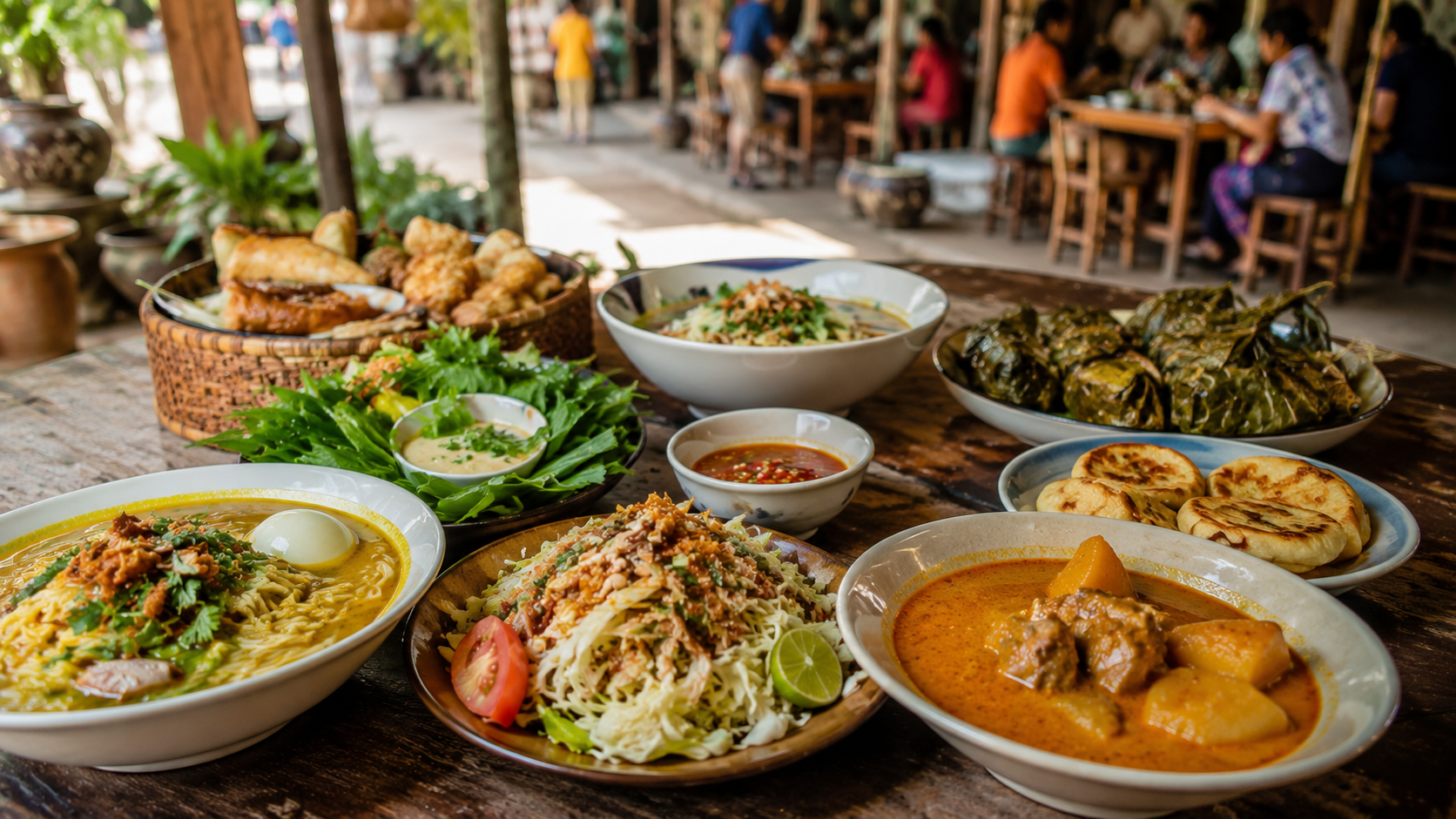
Some of the best meals you will eat in Myanmar arrive without ceremony. A low plastic stool on a Yangon pavement, a chipped enamel bowl of mohinga handed over before you have finished sitting down, a squeeze of lime, a scatter of crisp fritters, and a first spoonful that tastes of the whole country at once. Burmese food rarely announces itself. It is not the pageant of neighbouring Thai cooking, nor the household name that Vietnamese food has become. It is quieter, earthier, and in many ways more surprising, built from sour ferments, roasted pulses, oil-slicked salads, and long-simmered curries that ask you to slow down and pay attention.
That is exactly why it suits the way we like to travel. You cannot rush Burmese food. The teashop wants you to sit for an hour. The curry shop wants you to graze across a dozen little dishes. The tea-leaf salad wants to be tossed at the table and eaten slowly, layer by crunchy layer. Eat this way and Myanmar starts to make sense from the inside out. This guide walks you through the dishes worth crossing a city for, the cultural rituals around them, the regional differences that reward a longer trip, and the practical, honest details you need to eat well and spend in a way that helps the people cooking for you.
A crossroads on a plate: the making of Burmese food
Myanmar sits at a genuine crossroads, wedged between India to the west, China to the north and east, and Thailand and Laos to the southeast, with a long coastline down the Bay of Bengal and the Andaman Sea. Its food carries all of those neighbours, folded into something distinctly its own. The dominant thread is Bamar cooking, the cuisine of the ethnic majority of the central lowlands, but Myanmar is home to well over a hundred ethnic groups, and the country's kitchens reflect that diversity far more than most visitors expect.
From India came the curry itself, along with samosas, flaky flatbreads, biryani, chickpeas and lentils, and the whole vocabulary of turmeric, chilli and masala. From China came the wok, soy sauce, noodles, and stir-frying, most visible in the food of the Kokang and the Chinese-Burmese communities of the cities. From the Shan hills came a lighter, more herbal, sometimes sour and fermented style that many Burmese themselves consider the most refined regional cooking in the country. And along the coast, Rakhine and Mon kitchens lean into seafood, chilli heat, and fish-based sourness.
What binds it together is a handful of signature techniques and flavours. Burmese cooks love oil, and a proper curry is often finished with a slick of it floating on top, which acts as a natural seal and a mark that the dish is done. They love the umami depth of ngapi, a pungent fermented fish or shrimp paste that underpins countless dishes and dips. They love sourness, from tamarind, lime, and fermented greens. They love the texture contrast of crunchy fried things, roasted chickpea powder, and toasted sesame scattered over soft rice and noodles. And, uniquely, they eat their tea as much as they drink it. Once you learn to read these habits, the whole cuisine opens up.
One request. Up to five tailored proposals.
Skip contacting agencies one by one — share your trip once and let up to five trusted Myanmar agencies come to you. Free, with no obligation.
Get my free quotesMohinga: the national breakfast
If Myanmar has one dish everyone agrees on, it is mohinga. This is a fish and rice-noodle soup, and it is the closest thing the country has to a national dish, eaten most classically at breakfast but sold at all hours. The broth is the heart of it: catfish or a similar freshwater fish simmered down with lemongrass, ginger, garlic, onion, and crucially the tender inner core of the banana stem, then thickened with toasted chickpea flour and sometimes crushed rice. The result is savoury, gently fishy, herbal, and comforting, poured over soft, thin rice vermicelli.
The genius of mohinga is in the finishing. You dress your own bowl at the table or the stall: a squeeze of lime for sourness, dried chilli flakes for heat, a spoon of fish sauce for salt, fresh coriander, sliced raw onion, and a handful of crunchy garnishes. The most beloved of these are fritters, especially split-pea fritters and crisp-fried gourd or split-yellow-lentil crackers that you crumble in for texture. A boiled egg is a common add-on. No two bowls of mohinga taste quite the same, because no two vendors make their broth alike, and Burmese people are fiercely loyal to their neighbourhood mohinga lady.
For a traveller, mohinga is the perfect first meal in the country. It is cheap, it is everywhere, it is usually safe because it moves fast and is cooked long, and it tells you a great deal about the local palate in a single bowl. Seek it out from a busy morning stall with a queue of locals rather than a hotel buffet, and eat it the way it is meant to be eaten: sitting low, unhurried, dressing it to your own taste as the street wakes up around you.
Lahpet: the tea-leaf salad that belongs to Myanmar alone
If mohinga is the dish everyone eats, lahpet is the dish nobody else has. Myanmar is one of very few places on earth where tea is a food, not only a drink. Lahpet is fermented tea leaf, and lahpet thoke is the salad made from it: a tangle of the soft, slightly bitter, tangy pickled leaves tossed with fried garlic, roasted peanuts, fried split peas and beans, toasted sesame, dried shrimp, crunchy fried garlic, a little tomato and shredded cabbage, all dressed with peanut oil, fish sauce and lime.
Eating it is an experience of pure texture and contrast. The tea leaves are savoury and astringent with a caffeine lift; the fried pulses and nuts bring crunch and nuttiness; the lime and fish sauce sharpen everything. It is often served after a meal as a digestif and pick-me-up, and it is deeply woven into Burmese social and ceremonial life. For centuries lahpet was exchanged as a peace offering to settle disputes, offered to guests as the ultimate gesture of hospitality, and served at weddings, funerals, and religious occasions. A formal presentation, sometimes called a lahpet ohk, arranges the tea and each garnish in the separate compartments of a lacquered dish so guests can mix their own.
Try it both ways: as the tossed salad, and in the more formal platter form where you build each bite yourself. Because the leaves are caffeinated, students and workers eat lahpet thoke to stay alert, which tells you something honest about how central it is to daily life. If you take one culinary memory home from Myanmar, let it be this one, because you genuinely cannot get the real thing anywhere else. For where these food traditions cluster most richly, our guide to where to go and when in Myanmar is a good companion to plan around.
Get matched with up to 5 trusted Myanmar agencies
- Free
- No obligation
- Up to 5 agencies
The Burmese curry meal: hin, rice, and the supporting cast
The everyday backbone of Burmese eating is the curry meal, and it is one of the great value experiences in Asian food. A Burmese curry is called hin, and it is quite different from an Indian or Thai curry. It is typically milder, oilier, and slow-cooked until the meat is meltingly tender and the sauce has reduced to a thick, glossy, oil-topped base. Onion, garlic, ginger, turmeric, chilli, and often ngapi form the foundation; the protein might be chicken, mutton, pork, fish, or prawns, and there are plenty of vegetable and bean versions too.
But the curry is never the whole meal, and this is what makes eating at a Burmese curry shop such a pleasure. You choose one or two main curries, and they arrive surrounded by a whole supporting cast that comes free with the meal and is endlessly refilled: a mound of steamed rice, a light clear soup called hincho to cleanse the palate between bites, a basket of raw and blanched vegetables to eat with a pungent dip, and an array of condiments. The most famous condiment is balachaung, a fiercely savoury relish of fried dried shrimp, garlic, chilli, and shallots that you dab onto rice a little at a time. Alongside it you will usually find ngapi yay, a thin, intense fermented-fish dip for the raw vegetables, plus pickles, fried things, and fresh herbs.
The proper way to eat is to treat the whole spread as one composition. Take a little rice, a spoon of curry, a dab of balachaung, a raw vegetable dipped in ngapi, a sip of the clear soup, and repeat, adjusting the balance as you go. It is grazing, not gorging, and it rewards a slow pace. A single-person curry meal at a modest shop is remarkably cheap, and you can eat a genuinely regional, home-style meal this way for very little, which matters when you are thinking about a longer trip and your overall Myanmar trip cost and budget.
The great world of thoke: Burmese salads
Beyond lahpet, Myanmar has a whole universe of salads, all called thoke, and they are among the most addictive and least-known foods in Southeast Asia. Thoke simply means something tossed or mixed by hand, and almost anything can become one. The unifying idea is a bright, textural mix of a base ingredient with crunchy fried garnishes, roasted chickpea powder, fried onion and garlic, chilli, lime, fish sauce, and a slick of oil, tossed together to order.
The variety is enormous. Nan gyi thoke is a hearty salad of thick round rice noodles tossed with chicken curry, chickpea flour, and crunchy garnishes, so substantial it is often eaten as a breakfast in its own right. Samosa thoke, or samusa thoke, is a genius bit of Burmese-Indian fusion: samosas broken up and tossed with cabbage, onion, mint, chickpeas, and a ladle of thin curry gravy poured over the top, eaten with a spoon. There are ginger salads made from shredded pickled ginger, tomato salads, pennywort salads, ripe-tamarind-leaf salads, pomelo salads, and salads built on everything from fried tofu to fermented mango. Shan tohu thohk, made from Shan chickpea tofu, is a particular delight.
If you want a fast way to understand the Burmese palate, order three or four different thoke in a sitting and notice how the same core seasonings transform each base. This is where Burmese cooking is at its most creative and its most vegetarian-friendly, since many thoke contain no meat at all. It is also the food most likely to convert a sceptic, because the balance of sour, salty, nutty, and crunchy is instantly likeable.
Shan food: the mountain kitchen
Many Burmese will quietly tell you that the best food in the country comes from Shan State, the vast hill region in the east. Shan cooking is lighter and more fragrant than lowland Bamar food, with a pronounced love of tomato, garlic, turmeric, fermented soybean, and mild heat, and it travels well: you will find Shan restaurants and noodle stalls all over Myanmar, not just in the hills.
The dish you must not miss is Shan noodles, shan khao swe. In its classic form it is rice noodles, either in a clear tomato-and-pork broth or tossed dry, topped with a savoury marinated minced pork or chicken, crushed peanuts, pickled greens, and fried garlic, with a little bowl of broth on the side if you order it dry. It is clean, warming, and completely moreish, and it makes an outstanding breakfast or light lunch. The second Shan essential is Shan tofu, which is not soy tofu at all but a smooth, golden set made from chickpea (or yellow split pea) flour. It is eaten warm as a soft porridge-like dish, set and sliced into a salad, or cut into batons and deep-fried until the outside crackles and the inside stays custardy. Dressed as tohu thohk, it is one of the great vegetarian dishes of the region.
Shan State is also the source of much of Myanmar's tea, including the leaves that become lahpet, and its markets are a joy to wander for pickles, ferments, and hill produce. If you are drawn to this kind of regional, lesser-trodden eating, it pairs naturally with the ideas in our guide to off-the-beaten-path Myanmar, which leans into exactly the slow, out-of-the-way corners where Shan food is at its best.
Teashop culture: the social heart of Myanmar
To understand Myanmar you have to understand the teashop, because it is where the country actually happens. The teashop, or lahpet yay saing, is a semi-open room of low tables and tiny stools that opens before dawn and hums until night. People come to eat breakfast, to read the paper, to talk politics in low voices, to do business, to kill time, to watch football, to simply be among others. It is the neighbourhood living room, and it is open to everyone.
The drink at its centre is lahpet yay, Burmese sweet milk tea: strong black tea brewed hard and cut with evaporated and condensed milk, often poured from a height to aerate it into a smooth, sweet, tan-coloured cup. There is a whole quiet vocabulary for ordering it to your taste, sliding from very sweet to strong and less sweet, and part of the pleasure is learning to ask for it the way you like. Green tea, plain and slightly bitter, is usually free on the table as a palate cleanser, refilled endlessly from a battered flask.
The food matters as much as the tea. Teashops are one of the best places to eat mohinga and a whole array of snacks: Indian-style flatbreads such as palata (a flaky paratha) served with a little curry or with sugar, samosas, deep-fried doughsticks called e kya kway that you dunk in your tea, steamed and fried buns, and sweet and savoury little cakes. Sitting in a good teashop for a slow hour, nursing a milk tea and grazing on snacks while the city moves around you, is one of the most quietly rewarding things you can do in Myanmar, and it costs almost nothing. When you are ready to build a trip around experiences like this, our plan your journey page is where to start.
A regional tour: Yangon, Mandalay, Shan State, Rakhine
Myanmar is large and varied, and its food shifts noticeably as you travel. Yangon, the biggest city and former capital, is the great melting pot. Its colonial and trading history gave it deep Indian and Chinese communities, so alongside classic Bamar curries you will find superb biryani, dosa and Indian breads, Chinese noodle houses, and the country's most cosmopolitan street-food scene, especially around the night markets of the old downtown where the pavements fill with stalls after dark.
Mandalay, the cultural capital of the centre and heartland of Bamar tradition, has its own specialities. The signature is Mandalay mee shay, rice noodles dressed with pork, a sweet-savoury sauce, pickled vegetables, and bean paste, tangy and comforting. Mandalay is also a strong place for Shan food, given its proximity to the hills, and for the fried-snack and teashop culture that the city takes seriously.
Shan State, as above, offers the lightest and most herbal cooking, built on tomato, fermented soybean, and hill vegetables, with Shan noodles and Shan tofu leading the way and Inle Lake adding its own freshwater fish and floating-garden produce. And on the western coast, Rakhine State cooks the country's boldest food: markedly spicier than the rest of Myanmar, heavy on fresh seafood, and defined by a fiery, funky fermented-fish sourness. The Rakhine signature is mont di, rice noodles with a fish-based broth or sauce and a serious chilli kick, a coastal cousin of mohinga that locals will tell you is even better. Travelling between these regions and tasting how the same country cooks so differently is one of the real pleasures of a longer, slower trip, and our where to go and when guide helps you sequence them.
Where to eat: teashops, curry shops, markets, and stalls
Eating well in Myanmar is less about restaurants than about knowing which kind of humble place does which thing best. Four categories will cover almost everything you want to eat.
Teashops, as described, are your breakfast and snack headquarters: mohinga, flatbreads, fritters, buns, and endless tea. Curry shops, often marked simply by a row of aluminium trays of pre-made curries in the window, are where you go for the full hin-rice-soup-condiment spread at lunch; point at the curries you want, and the rest arrives around them. Point-and-choose is the norm, and it removes any language barrier. Noodle stalls and Shan noodle shops handle the middle of the day, doing one or two things extremely well. And night markets and street stalls come alive in the evening, especially in Yangon and Mandalay, with grilled skewers, fried snacks, thoke made to order, barbecue, and sweets.
A few honest practicalities. Choose stalls that are busy and turning over food quickly, which is both the tastiest and the safest signal. Eat freshly cooked hot food, be a little more cautious with raw salads and tap water and ice at the very cheapest end, and carry hand gel. Almost all of this eating happens in cash, and small, worn notes are what stalls want; more on that below. Portions are generally modest and cheap, so the best strategy is to eat little and often across several places rather than one big sit-down meal. If you would rather have a local expert build this into your days rather than navigate it solo, browse our vetted Myanmar travel agencies, who can arrange food-focused, slow-paced itineraries.
Sweets and drinks
Burmese sweets, known broadly as mont, are less sugary than their Western equivalents and often built on rice, coconut, palm sugar, and pulses. Semolina cake, sanwin makin, is a dense, buttery baked pudding of semolina, coconut milk, and ghee, sometimes studded with raisins and poppy seeds, and it is a teashop staple. Sticky-rice sweets, coconut jellies, steamed rice cakes, and little palm-sugar confections turn up at markets and with tea. The great cooling dessert is shwe yin aye, a colourful iced bowl of coconut milk, jellies, tapioca, bread or sago, and sometimes a scoop of ice cream, perfect in the heat. Faluda, inherited from South Asia, is the other beloved cold sweet: rose syrup, milk, jelly, basil seeds, and ice cream in a tall glass.
On the drinks side, tea rules, both the sweet milk tea of the teashops and plain green tea. Burmese coffee culture is growing in the cities, though the traditional standby is sweet instant coffee mix. In toddy-palm country you can try htan yay, fresh or lightly fermented palm sap, and its stronger distilled cousin. Myanmar Beer is the ubiquitous local lager, refreshing and easy with grilled food and seafood; regional beers and a growing craft scene exist too. And you will notice betel everywhere, the areca-nut-and-lime quid wrapped in a leaf that many chew as a mild stimulant, sold at red-stained stalls on every corner. It is not food exactly, but it is part of the sensory texture of the country.
Vegetarian and dietary notes
Myanmar is a broadly Buddhist country, and vegetarian eating is both understood and genuinely well served, more so than many travellers expect. The whole world of thoke gives you endless meat-free salads; Shan tofu and its dishes are a vegetarian highlight; and curry shops almost always offer several vegetable and bean curries, from potato and okra to gourd, beans, and pennywort. Mont, the sweets, are largely vegetarian by nature.
Two honest caveats. First, ngapi, the fermented fish and shrimp paste, and dried shrimp are used very widely as background seasoning, including in many dishes that look vegetable-based, and balachaung and the ngapi dips are fish-based. If you are strictly vegetarian or vegan, it is worth learning to ask whether a dish contains ngapi or dried shrimp, and leaning on the explicitly vegetarian curry shops and the tofu-and-salad dishes where you can see what goes in. Second, at monastery-adjacent and dedicated vegetarian restaurants, especially around pilgrimage sites, you can eat entirely meat-free with ease. Gluten-conscious travellers do reasonably well too, since rice and rice noodles dominate, though wheat flatbreads, some sauces, and fritter batters are exceptions to check. As always, a phrasebook line and a friendly, patient approach go a long way.
Food, cash, and spending that stays local
A practical point that shapes every meal in Myanmar: this is largely a cash economy. International cards and mobile payment often do not work at the small teashops, curry shops, stalls, and markets where the best food is, and ATMs can be unreliable. Carry enough clean local currency in small denominations, keep a reserve, and change money at reputable places. The upside is that paying cash at a family stall means your money goes directly to the person who cooked for you, with no middleman, which is exactly the kind of spending that helps.
Myanmar has been through a great deal, and tourism revenue is unevenly distributed. Eating at small, independent, family-run places, tipping fairly, buying snacks and produce directly from market vendors, and choosing locally owned teashops over international chains are simple, meaningful ways to make sure the money you spend on food reaches ordinary people. This is at the heart of how we think about travel: slower, more direct, more human. Our slow travel charter sets out the principles we hold ourselves to, and choosing where and how you eat is one of the most immediate ways to live them out.
Why food is the best way to understand Myanmar
Myanmar can be a hard country to read from the outside. It is beautiful, complicated, and often quiet with visitors, and its people have carried a lot. Food is the doorway that opens most easily. Sit in a teashop for a morning and you will feel the rhythm of a neighbourhood. Share a curry-shop spread and you will taste the whole logic of the culture, the grazing generosity, the layering of oil and ferment and crunch. Toss a plate of lahpet and you are holding a tradition that is genuinely, uniquely Burmese, exchanged for centuries as a token of peace.
That is why we think eating is not a sideline to a Myanmar trip but close to its centre. It is cheap, it is welcoming, it slows you down, and it puts you shoulder to shoulder with people at their most relaxed. Go with curiosity and an open appetite, follow the crowds of locals rather than the guidebook stars, and let the meals set the pace. The food will teach you more about this country than almost anything else, one unhurried bowl at a time.
Frequently Asked Questions
What is the national dish of Myanmar?
Mohinga, a fish and rice-noodle soup, is widely regarded as Myanmar's national dish. It is a fragrant, savoury broth built from freshwater fish, lemongrass, banana stem, and toasted chickpea flour, poured over soft rice vermicelli and finished at the table with lime, chilli, crunchy fritters, and fresh herbs. Traditionally a breakfast, it is now sold at all hours from stalls, teashops, and markets across the country, and it is the single dish most worth trying on your first morning.
Is Burmese food spicy?
Most everyday Burmese food is surprisingly mild compared with Thai or Indian cooking. Classic Bamar curries are gently spiced and oily rather than hot, and heat is usually added to taste through chilli condiments, dried chilli flakes, and pungent dips like balachaung and ngapi. The big exception is Rakhine cuisine on the western coast, which is markedly spicier and more chilli-forward. If you prefer little heat, you can easily eat around it; if you love it, the condiments are there for you to build up.
What is lahpet thoke and why is it special?
Lahpet thoke is a salad made from fermented tea leaves, tossed with fried garlic, peanuts, roasted split peas and beans, sesame, dried shrimp, tomato, and cabbage, dressed with oil, fish sauce, and lime. It is special because Myanmar is one of the very few countries where tea is eaten as a food, not just drunk. The leaves are savoury, tangy, and mildly caffeinated, and the dish is woven into Burmese hospitality, ceremony, and even historic peace-making. You genuinely cannot find the authentic version anywhere else in the world.
Is it easy to eat vegetarian in Myanmar?
Yes, more easily than many travellers expect, thanks to the country's strong Buddhist tradition. The huge range of thoke (salads), Shan tofu dishes, and vegetable and bean curries at curry shops give vegetarians plenty to eat, and dedicated vegetarian restaurants exist near many temples. The main thing to watch is that ngapi (fermented fish or shrimp paste) and dried shrimp are used widely as a background seasoning, so strict vegetarians and vegans should learn to ask whether a dish contains them and favour clearly meat-free options.
What is a Burmese teashop and should I visit one?
A teashop, or lahpet yay saing, is a casual open-fronted cafe of low tables and small stools that serves sweet milk tea, free green tea, and a range of snacks and breakfasts from early morning until night. It is the social heart of every Burmese neighbourhood, where people eat, read, talk, and pass the time. You should absolutely visit one: it is inexpensive, welcoming, and one of the best windows into daily life in Myanmar. Order a lahpet yay, try some mohinga or a flaky palata flatbread, and simply sit for a while.
Do I need cash to eat in Myanmar, or can I use cards?
You will need cash for almost all of the best eating. Teashops, curry shops, street stalls, and markets are overwhelmingly cash-only, cards are rarely accepted outside upscale hotels and a few restaurants, and ATMs can be unreliable. Carry enough local currency in small, clean denominations, keep a reserve, and change money at reputable outlets. Paying cash at family-run stalls also has the benefit of putting your money directly into the hands of the people cooking for you.
What drinks should I try in Myanmar?
Start with lahpet yay, the sweet, strong Burmese milk tea that defines teashop culture, and the plain green tea that comes free alongside it. Beyond that, try shwe yin aye or faluda for a cooling sweet drink in the heat, sample toddy-palm sap in rural areas, and have a cold Myanmar Beer with grilled food or seafood. Urban coffee culture is growing too, though the traditional cup is a sweet instant mix. Each of these is part of the daily rhythm and worth trying at least once.


