
The train to Nam Tok leaves Kanchanaburi station in the cool of the morning, and for the next two hours it does the one thing modern travel rarely allows: it slows down. Timber sleepers creak underfoot at Wang Pho, the carriage leans out over a limestone cliff with the Kwai Noi River glinting fifty metres below, and nobody on board is looking at a phone. This is the Death Railway, built at staggering human cost during the Second World War, and it is the spine of a region that rewards travellers who choose to stay rather than pass through. Kanchanaburi has always sat close enough to Bangkok to visit, yet far enough to feel like a genuine departure. In 2026 that equation has changed again: the new M81 motorway has cut the drive from Bangkok to around an hour, turning a once-tiring half-day trip into an easy morning transfer. The risk is that Kanchanaburi becomes a rushed day-trip destination, ticking off the bridge and the falls before racing back to the city. The opportunity, for anyone willing to stay two or three nights, is a slower version of the province: forest waterfalls best seen without a bus schedule, a war history that deserves quiet attention rather than a photo stop, and river accommodation that runs on no electricity at all.
Getting there: the new M81 motorway changes the calculus
For decades, the Bangkok-to-Kanchanaburi road trip meant two to three hours of traffic through the western suburbs before the scenery opened up. The M81 motorway, a 96-kilometre elevated route connecting Bang Yai to Kanchanaburi through Nakhon Pathom and Ratchaburi, has cut that drive dramatically, with journey times now closer to one hour under normal conditions. For slow travellers this is not an invitation to squeeze Kanchanaburi into a single day — it is the opposite. A shorter transfer means you can arrive by mid-morning, settle into a riverside room, and still have a full afternoon before the light softens over the water. It also means a two-night stay is no longer a scheduling stretch; it fits comfortably into a wider northern Thailand itinerary that might also take in Nan province's quiet valleys or a rail journey further west. The motorway does not replace the older, slower route through Nakhon Pathom, which some travellers still prefer for its temple stops and roadside food stalls — it simply adds an option, which is the most useful thing infrastructure can do for a place that depends on people staying rather than rushing.
One request. Up to five tailored proposals.
Skip contacting agencies one by one — share your trip once and let up to five trusted Thailand agencies come to you. Free, with no obligation.
Get my free quotesThe Bridge, the Death Railway and the JEATH War Museum
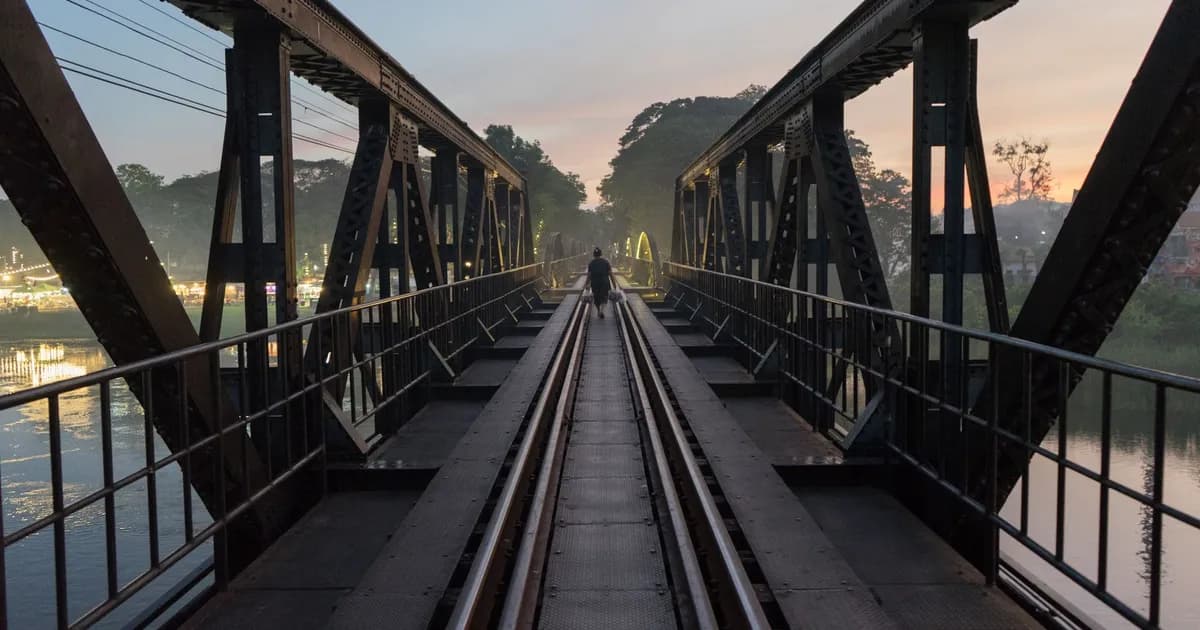
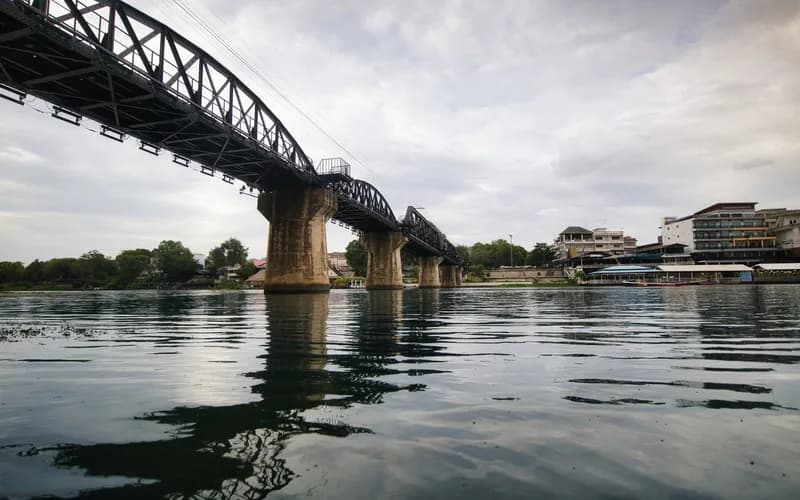
The Bridge over the River Kwai is smaller and less dramatic than the film of the same name suggests, and that modesty is part of its power. Walking across the black steel spans, past the curved sections rebuilt after wartime bombing, it is easy to forget that this crossing represents one node in a 415-kilometre railway built by Allied prisoners of war and conscripted Asian labourers under Japanese command between 1942 and 1943, at a cost historians estimate in the tens of thousands of lives. The JEATH War Museum, close to the bridge, takes its name from the six nations involved — Japan, England, Australia, America, Thailand, Holland — and its bamboo-hut replica of prisoner barracks is a plain, unsentimental way to understand conditions on the line. From the bridge, the railway continues to Wang Pho viaduct and on to Nam Tok, tracing the route prisoners built by hand through solid rock. Riding this section is the single best way to understand the railway's engineering and its human cost simultaneously, and it pairs naturally with a wider rail itinerary — see our guide to travelling Thailand by train for how to link it to other slow rail routes. Walking sections of the line is slower still, and several operators now offer short guided sections on foot along maintained boardwalks.
Hellfire Pass: the memorial that asks for time
Further west, past the end of the passenger line, Hellfire Pass Memorial marks the deepest rock cutting on the entire railway, so named by prisoners for the flickering torchlight of night shifts that made the site look infernal. The Australian-built museum above the cutting is thorough and quietly devastating, but the real memorial is the walk down into the cutting itself — a narrow slice through solid stone, cut largely by hand with basic tools under conditions that killed thousands of labourers. Audio guides let visitors set their own pace, and the walking trail continues well beyond the main cutting to other former railway sites if time allows. Most day-trippers from Bangkok never reach Hellfire Pass because it sits an hour beyond the bridge; staying overnight in Kanchanaburi is what makes this detour possible, and it is arguably the most important single site in the province for understanding what the railway actually cost.
Get matched with up to 5 trusted Thailand agencies
- Free
- No obligation
- Up to 5 agencies
Erawan Falls: seven tiers, and why tier two and four matter
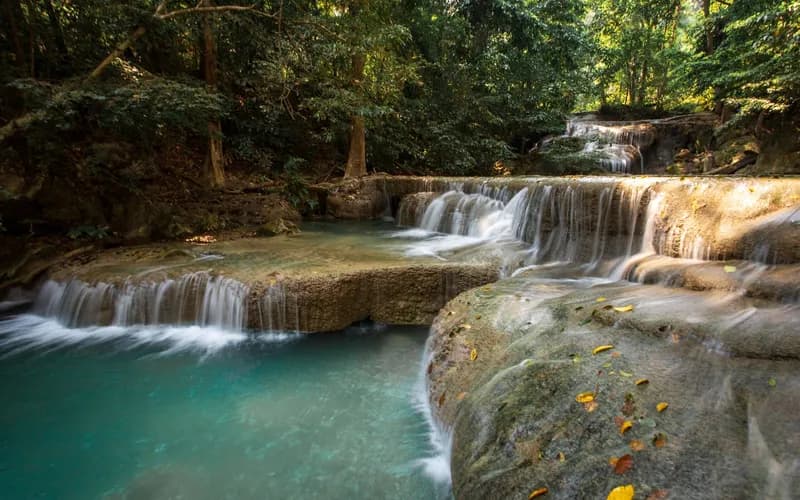
Erawan National Park's seven-tiered waterfall is Kanchanaburi's best-known natural attraction, and for good reason: each tier has its own character, from wide turquoise pools near the entrance to smaller, quieter cascades higher up the trail. The full climb to tier seven covers roughly 2.5 kilometres of forest path, with some sections requiring scrambling over rocks and tree roots, and takes most visitors two to three hours round trip at an unhurried pace. Swimming is officially permitted at tiers two and four, where the pools are deep and calm enough for a proper swim rather than a quick paddle, and both are worth allocating real time to rather than treating as a photo stop en route to the top. The water's mineral content gives it a distinctive pale green-blue colour, most vivid in the dry season between November and April; during and after the rains the falls run fuller but murkier. Arriving early, ideally before nine, matters here more than almost anywhere else in Thailand — Erawan is popular, and the lower pools crowd quickly once tour buses arrive from Bangkok.
Sai Yok National Park: caves, a suspension bridge and quieter waterfalls
West of Erawan, Sai Yok National Park sees a fraction of the visitors and offers a genuinely different pace. The park's namesake waterfall drops directly into the Kwai Noi River beside a swaying suspension bridge, and nearby limestone caves — including Daowadueng Cave, reached via a steep but short climb — reward those willing to bring a torch and take their time underground. Sai Yok is also where the Death Railway's story continues visually: sections of original rail bed and a preserved steam locomotive sit near the park entrance, a reminder that the line once continued much further than the section still in operation today. Compared with Erawan, Sai Yok rewards unstructured time — a picnic by the river, a slow walk through the cave system, an afternoon watching light change on the limestone cliffs — over a checklist of sights. Independent operators listed with our Thailand travel agencies can arrange a driver for the day, which is the easiest way to cover Sai Yok and Erawan without doubling back to town.
Floating on the river: rafts, bamboo and a night without electricity
No visit to Kanchanaburi captures its particular stillness like a night on the water. Along the upper reaches of the Kwai Noi, operators such as River Kwai Jungle Rafts run floating accommodation built from bamboo and timber, moored to the riverbank and running entirely without electricity — lighting comes from oil lamps, and the soundtrack after dark is water against the raft's hull and insects in the forest canopy. It is a deliberately basic experience, and that is the point: no wifi, no charging ports, no television, just a river, a jungle wall on the opposite bank, and an early wake-up call from birdsong rather than an alarm. Bamboo rafting itself, a gentler cousin of whitewater rafting done on hand-poled bamboo platforms, is available on calmer stretches of the river and makes for an unhurried afternoon activity that suits every fitness level. It is exactly the kind of unhurried, low-intensity day covered in our slow traveller's guide to Thailand, which treats a province like Kanchanaburi as a place to inhabit rather than tick off.
What to do next
- Decide on two or three nights minimum — one night barely covers the bridge and Erawan; three allows Hellfire Pass and Sai Yok as well.
- Book a floating raft house early for the November-to-February cool season, when demand from both Thai and international travellers peaks.
- Take the train from Kanchanaburi to Nam Tok at least one way, even if you drive the rest of the route.
- Arrive at Erawan Falls before 9am and prioritise tiers two and four over rushing to the summit.
- Set aside a half-day, not an hour, for Hellfire Pass — the walking trail and museum both deserve unhurried attention.
- Pack a torch, water shoes and insect repellent regardless of season; caves, falls and forest trails all call for them.
Frequently Asked Questions
How long should I spend in Kanchanaburi?
Two nights is a reasonable minimum for the bridge, the railway, Erawan Falls and one additional site such as Hellfire Pass or Sai Yok. Three nights allows a proper pace, including a night at a floating raft house without feeling rushed.
Has the new M81 motorway made Kanchanaburi a viable day trip from Bangkok?
Technically yes — the drive is now around an hour each way — but a single day only allows time for the bridge and perhaps Erawan's lower tiers. The faster road is better used to add a relaxed overnight stay than to compress the province into a rushed day trip.
What is the best time of year to visit?
The dry season, from November to April, offers the clearest water at Erawan Falls and the most comfortable hiking conditions at Hellfire Pass and Sai Yok. The rainy season, roughly May to October, brings fuller but murkier waterfalls and fewer crowds.
Is the Death Railway train ride worth doing if I am not a history enthusiast?
Yes. The Wang Pho viaduct section is a striking piece of railway engineering in its own right, running along a cliff face above the river, and the short journey to Nam Tok is scenic regardless of interest in the wartime history behind it.
Can I swim at Erawan Falls?
Swimming is officially permitted at tiers two and four, where pools are deep enough and the current gentle enough for casual swimming. Higher tiers are shallower and better suited to wading and photography than a proper swim.
Is a floating raft house comfortable, or is it too basic for most travellers?
It is intentionally simple — no electricity, shared or basic bathroom facilities depending on the operator, and lighting by oil lamp — but rooms are clean, beds are proper beds, and the setting more than compensates for the lack of modern conveniences. It suits travellers who want a genuine change of pace rather than a five-star river view.
How does Hellfire Pass differ from the bridge and museum in town?
The bridge and JEATH War Museum sit in Kanchanaburi town and can be visited in an hour or two. Hellfire Pass is roughly an hour further west, involves an actual walking trail through a rock cutting, and requires a half-day round trip — which is exactly why fewer visitors make it there, and why those who do tend to call it the most affecting site in the province.