
Tucked into a fold of mountains against the Laos border, Nan is the corner of northern Thailand that the crowds never reached. While Chiang Mai grew coffee shops and Chiang Rai grew tour buses, Nan kept its rice valleys, its 400-year-old temple, and its habit of doing everything a little more slowly. It is not undiscovered, exactly, but it is unhurried in a way that has become rare. For travelers who measure a place by depth rather than by the length of a checklist, Nan rewards patience like almost nowhere else in the country.
This is a province, not a single town, and that matters. The provincial capital is small enough to cross on a bicycle in an afternoon, but the reasons to come are spread across river valleys, mountain passes and villages that have kept their own language and weaving traditions. Getting between them is part of the point. Below is an honest guide to what Nan is, how to reach it, and how to travel it without spoiling the very quiet that makes it worth the trip.
Why Nan Rewards the Slow Traveler
Nan sits roughly 668 kilometres north of Bangkok and about six to seven hours by road east of Chiang Mai, hemmed in by mountains on almost every side. That geography is the whole story. For centuries Nan was a semi-independent kingdom with closer ties to the Lao and Tai Lue worlds than to Bangkok, and the isolation that once made it hard to govern is exactly what preserved its character. Development that flattened other northern towns simply arrived late here, and lightly.
The result is a place where the calendar still turns on rice, where temple murals show ordinary nineteenth-century life rather than only gods and kings, and where you can drive for an hour on a mountain road and pass more water buffalo than cars. None of this is staged for visitors. It is simply how Nan has continued, and the best thing a traveler can do is slot into that rhythm rather than fight it.
If you are still deciding where a trip like this fits into a wider Thai itinerary, our off-the-beaten-path guide sets Nan alongside the country's other genuinely quiet regions and helps you weigh the trade-offs of going this far north.
One request. Up to five tailored proposals.
Skip contacting agencies one by one — share your trip once and let up to five trusted Thailand agencies come to you. Free, with no obligation.
Get my free quotesWat Phumin and the Murals That Made Nan Famous
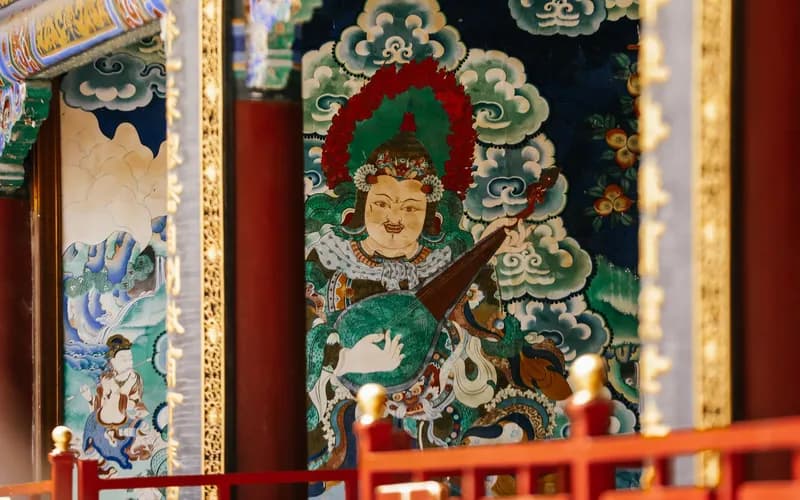
Nan's single most famous sight is a temple mural of two people leaning close, one whispering into the other's ear. It sits inside Wat Phumin, in the heart of the old town, and it has been reproduced on everything from postage stamps to T-shirts. But the "whispering lovers" are only the doorway into something richer.
Wat Phumin's cruciform ordination hall was first built in 1596 and thoroughly restored between roughly 1867 and 1874, during the reign of the local ruler Chao Anantavorarittidet. The murals date from that restoration and are attributed to a Tai Lue artist. What makes them extraordinary is their subject: alongside Buddhist legend, they record everyday life of the era, foreign traders, tattoos, courtship, weaving and commerce, painted with a directness that feels startlingly human. Four Buddha images sit back to back at the centre, each facing a cardinal direction, and the whole hall appears to rest on the backs of two great nagas.
Directly opposite stands the Nan National Museum, housed in a former royal palace, which gives useful context on the old kingdom, its people and its most prized possession, a black elephant tusk. Seeing the two together in a single unhurried morning is one of Nan's quiet pleasures.
The Old Town on Two Wheels
Nan town itself is best met on a bicycle. It is flat, compact and low-rise, and the distances between temples are short enough that pedalling from one to the next, pausing at a coffee stall, is the natural way to spend a day. Bicycle and motorbike hire are easy to arrange in the centre.
A short ride east across the Nan River brings you to Wat Phra That Chae Haeng, the province's most sacred temple, where a golden chedi some 55 metres tall is said to enshrine a relic of the Buddha. Its hilltop compound and long naga staircase reward the small effort of getting there. To the west, a road and a flight of steps climb to Wat Phra That Khao Noi, where a large golden Buddha looks east over the whole valley. Come in the late afternoon: on clear evenings during the cool season the sun drops behind the mountains, the Nan River threads silver through the rice fields, and the ranges fade to blue. Sunset in the cool months falls at roughly a quarter to six.
Get matched with up to 5 trusted Thailand agencies
- Free
- No obligation
- Up to 5 agencies
Into the Mountains: Doi Phu Kha and Route 1256
North of the city the land rises fast into Doi Phu Kha National Park, one of the great forest reserves of the north and the source of both the Nan and Wa rivers. Its highland forests shelter rare palm species and, in February and March, pink-flowering trees that locals loosely call sakura, though they are a native species and not cherries at all.
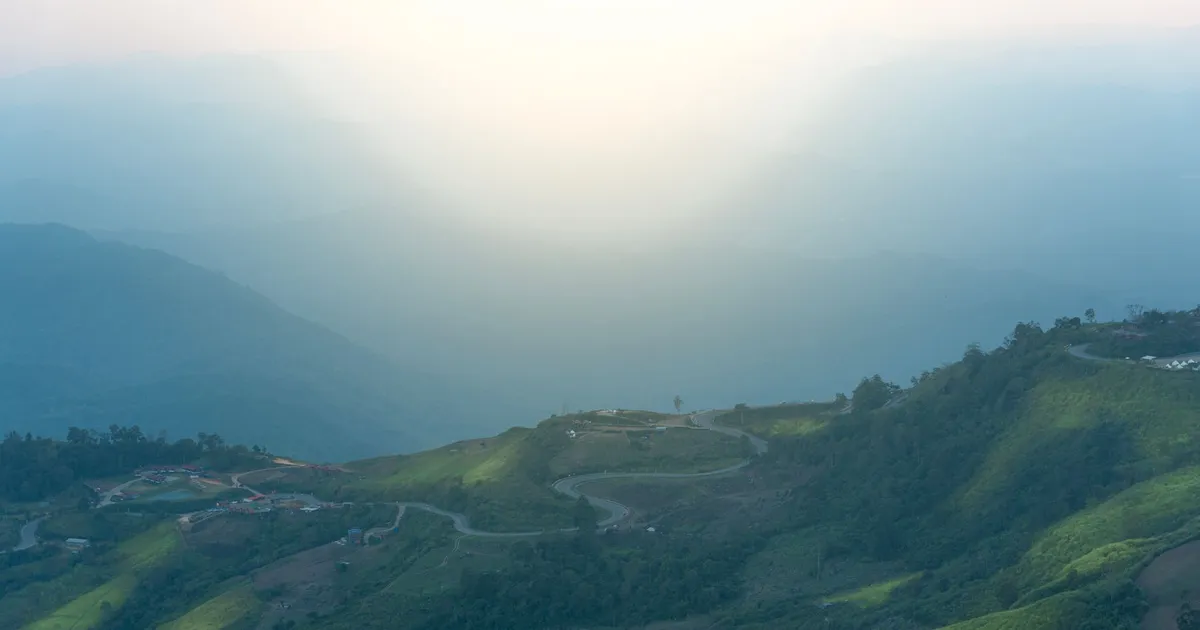
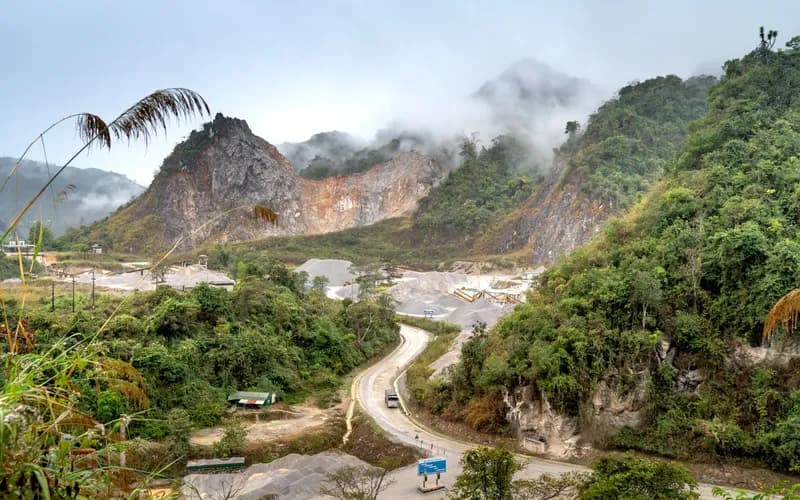
The approach is half the reward. Route 1256, climbing east from the town of Pua toward Bo Kluea, is widely called the most beautiful mountain road in Thailand, and on a misty morning it is hard to argue. A well-known viewpoint on the route sits at 1,715 metres, with the ranges rolling away in every direction. As of 2026 the park charges 200 baht for adult foreign visitors and 100 baht for children, plus small vehicle fees, and rents simple tents at the visitor centre for around 450 baht a night. The monsoon months of July to October bring mist and green intensity but also slick roads; the cool, clear window from November to February is the safest and most comfortable time to drive up.
A word of caution worth taking seriously: these are steep, winding mountain roads with sharp drops and few barriers. If you are not a confident rider, hire a driver or join a local tour rather than tackling Route 1256 on an unfamiliar scooter.
Bo Kluea: Salt from the Mountains
Beyond the pass lies one of Thailand's stranger and more moving sights. In the valley of Bo Kluea, hundreds of kilometres from any sea, villagers have drawn salt from mountain brine wells for more than eight centuries. The water is pumped or hauled up, then boiled down over wood fires in rustic wooden huts until the salt crystallises, an ancient process now almost unique in the country.
You can watch the boiling, buy a bag of the finished salt, and talk with the families who still do this work by hand. It is not a spectacle so much as a living craft, and it repays a respectful, curious visit. Bo Kluea also makes a logical overnight stop if you are looping through the eastern mountains rather than doubling straight back to the city.
Tai Lue Villages and the Weaving Tradition
Much of what feels distinct about Nan comes from the Tai Lue, a people whose ancestors migrated from southern China and Laos and who kept their own dialect, dress and crafts. The clearest window into that world is Ban Nong Bua, a village on the Nan River about 40 kilometres north of the city, near Tha Wang Pha.
Nong Bua has a small museum, a preserved classic Tai Lue house open to visitors, and, at its centre, Wat Nong Bua, whose nineteenth-century murals closely echo those of Wat Phumin. The village is also a working centre of Tai Lue weaving, and buying a length of cloth directly from the women who wove it is one of the most direct ways a traveler's money reaches the people who make Nan what it is.
Support for that kind of community-rooted tourism has grown across the country in recent years; our overview of regenerative, community-based travel in Thailand explains why it matters and how to tell the genuine article from the label.
When to Go, and How Long to Stay
Nan has three broad seasons, and the choice shapes the trip. The cool season, roughly November to February, brings clear skies, comfortable days, safe mountain driving and the best light for the valley viewpoints; it is the easiest time to come and the most popular. The hot season from March to May is quieter but hazy, and agricultural burning can dull the air. The green season from June to October drapes the mountains in mist and turns the rice a vivid green, at the cost of rain and slippery roads.
Give Nan at least three full days, and four or five if you want the mountains as well as the town. This is not a place to see in a rushed overnight. To understand how it fits into the wider seasonal picture of the country, our slow traveler's guide to Thailand is a useful companion for planning the shape of a longer trip.
What to Do Next
- Pick your season first. Aim for November to February for clear mountain driving and the best valley light, and book flights or buses well ahead if you travel around the New Year peak.
- Choose how you arrive. Flights from Bangkok's Don Mueang run several times daily and take a little over an hour; buses from Bangkok take ten to thirteen hours, and from Chiang Mai six to seven. Flying in and busing out is a sensible compromise.
- Base yourself in Nan town for the first two days, hire a bicycle, and cover Wat Phumin, the National Museum, Wat Phra That Chae Haeng and a Khao Noi sunset without hurrying.
- Decide honestly about the mountains. If you are a confident rider, plan a day on Route 1256 to Doi Phu Kha and Bo Kluea; if not, arrange a driver or a local tour.
- Build in a Tai Lue morning at Ban Nong Bua, and buy your cloth and salt directly from the people who make them.
- When you are ready to turn this into a booked itinerary, browse Nan-ready travel agencies who work with local guides and can handle the mountain logistics for you.
Frequently Asked Questions
How do I get to Nan from Bangkok or Chiang Mai?
From Bangkok, the fastest option is a flight from Don Mueang Airport to Nan, running several times a day and taking a little over an hour, with fares typically between about 1,500 and 3,000 baht. Buses from Bangkok take roughly ten to thirteen hours. From Chiang Mai, buses take about six to seven hours, and limited flights run on some days.
What is the best time of year to visit Nan?
The cool season from November to February is the most comfortable and the safest for mountain driving, with clear skies and excellent light over the valleys. The green season from June to October is beautiful and misty but brings rain and slippery roads, while March to May can be hot and hazy from agricultural burning.
How many days do I need in Nan?
Plan for at least three days, and four or five if you want to include the mountains. Two days is enough for the town's temples and museum at a relaxed pace, but Doi Phu Kha, Bo Kluea and the Tai Lue villages each deserve their own unhurried day.
Is Nan good for travelers who do not ride motorbikes?
Yes. The town itself is flat and easily explored by bicycle, and its main sights are close together. For the mountain roads to Doi Phu Kha and Bo Kluea, which are steep and winding, it is easy and wise to hire a driver or join a local tour rather than ride an unfamiliar scooter.
What makes Wat Phumin so important?
Wat Phumin is famous for its nineteenth-century murals, especially the "whispering lovers," which depict not only Buddhist legend but everyday life of the era in a strikingly human style. Its cruciform hall, four back-to-back Buddha images and naga base make it one of the most distinctive temples in all of northern Thailand.
Can I visit the Bo Kluea salt wells year-round?
The salt wells operate largely in the drier months, and salt-boiling is most active outside the heaviest rains. Roads to Bo Kluea can be affected by monsoon weather from July to October, so the cool season is both the safest time to drive there and a reliable window to see the boiling in progress.
Is Nan suitable for a first trip to Thailand?
Nan works best as part of a longer or second trip, or for travelers who already know they prefer quiet places to famous ones. It has limited nightlife and few big-name attractions, and its rewards are cultural and scenic rather than convenient. If that is what you are after, few places in Thailand do it better.