How to Choose a Vietnamese Cooking Class and Market Tour
A cooking class is the most commonly booked activity in Vietnam after a boat trip, and it is also the most variable. The same three hours can give you a working understanding of how a Vietnamese kitchen balances sour, salty, sweet and herbal, or it can give you a plastic apron, a pre-measured tray of ingredients and a photograph of yourself holding a spring roll. Both cost roughly the same. The difference lies almost entirely in decisions you make before you pay, and none of them are difficult once you know what to look at.
What You Are Actually Buying
Strip away the marketing and a Vietnamese cooking class is a bundle of four separate things, sold as one: a market visit, a demonstration, a hands-on cooking session, and a meal. The proportions vary wildly and almost no listing tells you the split.
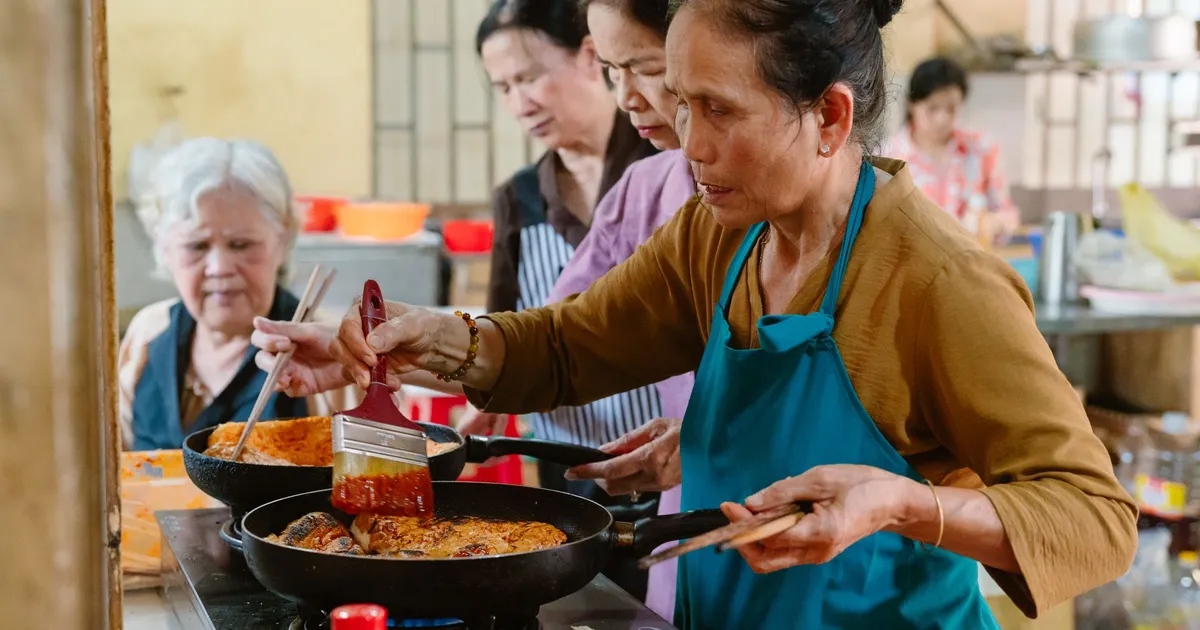
Some classes are eighty percent demonstration, which is fine if you want to watch a professional and eat well, and disappointing if you wanted to cook. Some are essentially a restaurant lunch with a twenty-minute cooking segment attached. A few are genuinely instructional, with a small group, real knife work, and a teacher who explains why fish sauce goes in at that moment rather than five minutes earlier.
Decide which of the four parts you care about before you start comparing listings. If your answer is "the market", you should be booking a food tour instead, and saving your money.
One request. Up to five tailored proposals.
Skip contacting agencies one by one — share your trip once and let up to five trusted Vietnam agencies come to you. Free, with no obligation.
Get my free quotesThe Market Visit Is the Part That Matters Most
Almost every class advertises a market visit, and the quality of that half hour predicts the quality of the whole experience better than any other variable.
A good market visit is led by someone who buys there. They will show you how to tell young tamarind from old, why one pile of herbs costs twice what the identical-looking pile beside it costs, what the various shrimp pastes smell like, and how a Vietnamese household shops daily rather than weekly. You will leave able to identify perilla, fish mint, sawtooth coriander and Vietnamese balm, which is a genuinely useful skill for the rest of your trip.
A weak market visit walks a group of twelve through a covered aisle in eight minutes, stops at three stalls that receive a commission, and returns to the minibus. You will recognise it by the pace.
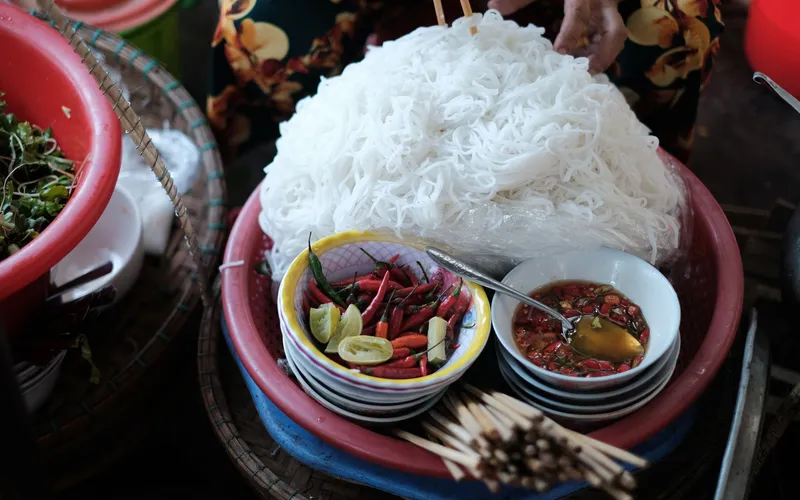
Ask one question when booking: do we buy the ingredients at the market, or are they already prepared at the school? If the answer is the latter, the market visit is sightseeing, not shopping. That may still be worth doing; just price it accordingly.
City by City: Where a Class Makes Most Sense
Choosing the city matters more than choosing the school, because the curriculum changes with the region.
Hoi An has by far the largest concentration of classes in the country, which means the widest price range and the widest quality range. The signature format involves a market visit, a boat ride out to a riverside school, and a menu built around cao lau, white rose dumplings, banh xeo and fresh rolls. Competition keeps prices low and standards mostly decent, but the volume is high and the most heavily advertised operations are also the most industrial.
Hue is the connoisseur's choice and has fewer classes, which is exactly why it is interesting. The imperial tradition here is fussier, more decorative and more technically demanding, and several of the better options are based out in the countryside near the Thanh Toan covered bridge, combining the class with a village bike ride. If the food of this city is the reason you are travelling, our piece on Hue's imperial table explains what makes the cuisine distinct.
Hanoi classes lean northern: restrained, less sweet, herb-forward, built around bun cha, cha ca and pho. Many are run out of small kitchens in the Old Quarter with no space for large groups, which tends to work in your favour.
Ho Chi Minh City offers the broadest range, from formal cooking schools with professional stations to home kitchens in District 3, plus southern specialities and delta influences. The market visits here, at Ben Thanh or better still at a neighbourhood market, are the most chaotic and the most educational.
The Mekong Delta and Da Lat add agricultural classes attached to farms or orchards, where you pick before you cook. These are usually less technical and more about provenance, which suits some travellers perfectly.
Get matched with up to 5 trusted Vietnam agencies
- Free
- No obligation
- Up to 5 agencies
What It Costs in 2026
Prices have risen but remain modest by international standards.
- Group classes in Hoi An start around 25 to 30 US dollars per person for a three-hour session with a market visit and a full meal.
- Hanoi and Ho Chi Minh City group classes and food tours typically run between roughly 950,000 and 1,500,000 dong, which is around 38 to 60 US dollars.
- Private classes, or classes at high-end hotels and restaurants, start at roughly double the group rate and rise steeply from there.
- Rural and farm-based classes vary most, since transport is usually the largest component of the price.
What to check rather than the headline number: how many dishes, whether the meal is the dishes you cooked or a separate menu, whether the recipe booklet is included, whether hotel pickup is included, and whether drinks are extra. A class that looks 20 percent more expensive and includes transport from your hotel is frequently the cheaper option.
Class Size, Format and Length
Most classes run three to four hours and take somewhere between six and twelve participants. Those are reasonable numbers, and anything much larger changes the nature of the experience.
Under six people, you get individual attention and the teacher can adapt to what you want to learn. Between six and twelve, it works if the school has enough cooking stations, which is the detail to verify. Above twelve, expect a demonstration with brief hands-on moments and a shared wok.
Two other format questions are worth asking. Does everyone cook the same dishes, or can you choose? Schools offering a customisable menu tend to be smaller and more flexible. And is the class taught by the person who wrote the menu, or by a rotating staff member? In small operations these are the same person, which is usually a good sign.
Book at least two days ahead, and further in high season. Many schools also have minimum group sizes, which means a class can be cancelled the evening before if numbers do not materialise. If your schedule is tight, ask about this explicitly and have a second option in reserve.
Seven Things That Should Give You Pause
- Ingredients pre-portioned in identical plastic trays before you arrive.
- A "market visit" that does not involve buying anything.
- Groups above twelve with a single teacher and no assistant.
- A menu identical to every other school in town, with no explanation of why those dishes.
- No mention of what happens if you have dietary restrictions.
- Heavy pressure to buy fish sauce, chilli paste or knives at the end.
- A schedule that includes a shopping stop at a silk or jewellery workshop.
The last one deserves emphasis. A cooking class with a retail stop bolted on is a commission vehicle first and a class second. This is the same dynamic that pushed Vietnam's tour market towards no-shopping itineraries, and it is worth avoiding on principle. Our broader analysis of how the Michelin effect is reshaping Vietnamese food tourism covers the commercial pressures now acting on the sector.
Questions Worth Asking Before You Pay
Message the school directly rather than relying on the listing. Four questions do most of the work.
How many people will be in my class on that date? A school that answers with a number is a school that keeps its numbers.
Do we shop at the market for the ingredients we will use? This separates the shopping trip from the walk-through.
Can I choose or adjust the menu? Even a partial yes indicates flexibility and a smaller operation.
Who teaches it? A named person, particularly a family member or the owner, is a better sign than "one of our chefs".
If you are travelling with dietary restrictions, ask a fifth: vegetarian and vegan adaptations are usually easy, because Vietnamese Buddhist cooking is a well-developed tradition, but shellfish and peanut allergies need explicit confirmation because fish sauce, shrimp paste and peanuts appear in places you would not expect.
Making the Class Worth More Than the Afternoon
The best classes pay off for the rest of the trip, and a few small habits multiply their value.
Take photographs of the market stalls and the raw ingredients, not just the finished plates. You will use them to order confidently for the next three weeks.
Write down the Vietnamese names of dishes and the three or four herbs you did not recognise. Being able to say the name of what you want is the single biggest upgrade to eating in Vietnam.
Ask what the teacher eats at home, which is almost never what is on the class menu, and then go and find it.
Book the class early in your stay in a given city, not on your last day. A class on day one changes how you eat for the following week; a class on the last day is a souvenir. If you want a foundation before you arrive, our guide to Vietnamese food sets out the regional differences the classes assume you already know.
A Note on Hygiene and Confidence
One quiet benefit of a good class is that it teaches you to read a street stall. You learn what fresh herbs look like, how fast a broth should be moving, what properly handled raw fish smells like, and why the busiest stall is almost always the safest.
That knowledge transfers directly to eating well and eating safely for the rest of the trip. Our practical guide to eating Vietnamese street food safely covers the same ground from the other direction, and the two work well together.
If you would prefer the class arranged as part of a wider food-focused itinerary, with a market, a producer visit and a meal in a family home, a local specialist will put together something better than the standard three-hour product. Our directory of vetted agencies is a reasonable place to begin.
What to Do Next
- Decide which of the four components matters to you: market, demonstration, hands-on cooking, or the meal. Book accordingly.
- Choose the city for its cuisine, not its convenience. Hue for technique, Hanoi for restraint, Hoi An for range, Ho Chi Minh City for breadth.
- Message the school directly and ask about group size, market shopping, menu flexibility and who teaches.
- Confirm what is included: transport, recipe booklet, drinks, and whether the meal is what you cooked.
- Book at least two days ahead, and check whether there is a minimum group size that could cancel your class.
- Schedule it for early in your stay in that city so the knowledge has time to pay off.
- Decline any class that includes a shopping stop at a workshop or showroom.
Frequently Asked Questions
How much does a cooking class in Vietnam cost?
Group classes start at roughly 25 to 30 US dollars per person in Hoi An and typically run between about 950,000 and 1,500,000 dong, or 38 to 60 US dollars, in Hanoi and Ho Chi Minh City. Private classes usually start at double the group rate. Always confirm whether transport, drinks and a recipe booklet are included before comparing prices.
How long do classes last and how many dishes will I cook?
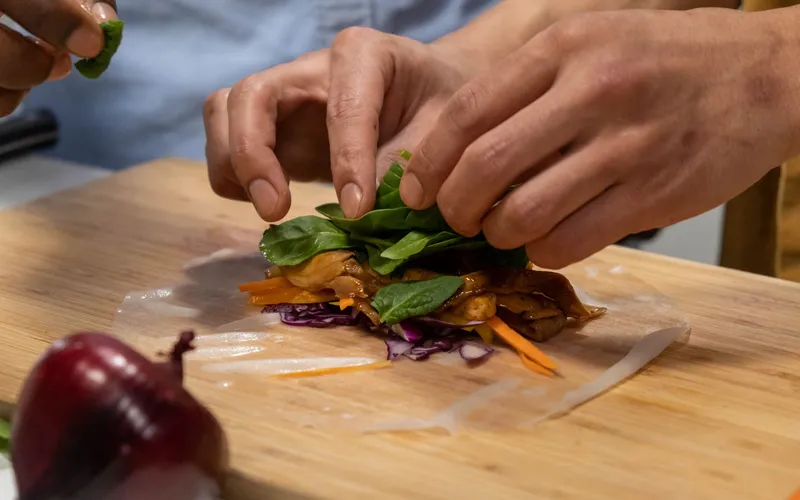
Three to four hours is standard, covering a market visit, cooking and the meal. Most classes produce three to five dishes, usually a salad or fresh roll, a soup or noodle dish, a main and sometimes a dessert. Anything advertising eight dishes in three hours is a demonstration with tasting, not a cooking class.
Which city has the best cooking classes?
It depends on what you want. Hoi An has the most options and the most competitive prices, Hue has the most technically interesting cuisine and fewer classes, Hanoi teaches the restrained northern style, and Ho Chi Minh City offers the greatest variety along with the most educational markets. Choose by cuisine rather than by volume of reviews.
Do I need to book in advance?
Yes, at least two days ahead, and longer in high season or around Vietnamese holidays. Many schools also operate a minimum group size, so a class can be cancelled at short notice if too few people sign up. Confirm that policy when you book and keep an alternative in mind.
Are classes suitable for vegetarians or people with allergies?
Vegetarian and vegan versions are generally straightforward, because Vietnam has a substantial Buddhist vegetarian tradition. Allergies need more care: fish sauce and shrimp paste are in a great many dishes, and peanuts appear in sauces and garnishes. State the restriction clearly when booking rather than on the day.
Is a cooking class worth it if I already cook well?
Often yes, but choose differently. Skip the standard tourist menu and look for a private class, a regional speciality class, or one attached to a farm or a specific producer. Experienced cooks generally get more from the market visit and the technique explanations than from the recipes themselves.
Can children join a cooking class?
Most schools accept children, frequently at a reduced rate, and many enjoy the fresh-roll rolling and the market. Check whether there is knife and wok work involved and whether the school provides a supervised alternative. Smaller private classes work far better with children than a group of twelve adults.