

There is a moment, familiar to anyone who has taken a cheap group tour in Vietnam, when the bus slows not at a viewpoint but at a warehouse. The sign outside promises pearls, or jade, or bird's nest. The guide's tone shifts. Time, which was scarce at the actual bay or the actual mountain, suddenly becomes abundant. This is the architecture of the legacy tour model — and a growing number of Vietnamese travelers have decided they are done with it.
The shift is not marginal. Across booking platforms, social media communities, and operator product lines, the signal is consistent: travelers are choosing smaller groups, transparent pricing, and itineraries free of commission-driven detours, and they are paying substantially more to do so. Industry pricing comparisons suggest the premium runs two to three times the cost of a conventional package. That willingness to pay is not simply a spending story. It is a values story — about what travel is for, and who gets to decide.

The Model That Built Vietnam's Tour Industry — and Its Contradictions
The conventional Vietnamese group tour was engineered around a simple logic: keep the headline price low enough to sell, then recover margin through the itinerary itself. Shopping stops at jewelry outlets, pearl farms, and handicraft warehouses are not incidental to these packages — they are structural. Operators on routes through Ha Long, Sapa, and Nha Trang have long scheduled three to five such stops per day, with commissions from partner shops subsidizing what would otherwise be an unviable price point.
For years, this model worked because the alternative was invisible. Travelers who wanted to see Ha Long Bay had limited ways to compare what a better product might look like. The cheapest option dominated the market by default.
Social media ended that invisibility. Vietnamese TikTok creators and YouTubers now document cheap tours in real time — the rushed cave visit, the hour lost in a warehouse, the lunch that bore no resemblance to the advertised meal. The phrase "tour không mua sắm bắt buộc" (tours with no forced shopping) has become a genuine search term and a selling point, appearing in operator listings and traveler recommendations alike. The backlash is not abstract; it is algorithmic, and it compounds.
Regulatory pressure has added a second layer. Provincial authorities in Quang Ninh and Khanh Hoa have periodically sanctioned operators for deceptive practices, and Vietnam's broader tourism governance — shaped by the 2017 Law on Tourism — requires operators to publish clear itinerary and pricing information at the point of sale. The law does not ban shopping stops, but it creates a framework under which undisclosed ones become legally actionable. Ha Long Bay's ongoing tightening of cruise licensing and safety standards has pushed some operators toward higher-quality products simply to remain compliant. The economics of the cheap model are becoming harder to sustain from both directions.
One request. Up to five tailored proposals.
Skip contacting agencies one by one — share your trip once and let up to five trusted Vietnam agencies come to you. Free, with no obligation.
Get my free quotesWhat the Middle Class Changed
The structural critique of kickback tours has been available for years. What changed is who is making it.
Vietnam's middle class has expanded rapidly, and with it a cohort of domestic travelers who have the disposable income to choose differently and the reference points to know what differently looks like. Many have traveled to Thailand, Japan, or South Korea — markets where tour transparency is more normalized — and returned with recalibrated expectations. They are not willing to spend their annual leave in a bus, moving between shops.
This is not a niche demographic. Pre-pandemic World Bank projections suggested that more than half of Vietnam's population could reach middle-class status by the mid-2030s, with domestic tourism among the primary spending categories. The post-COVID rebound in domestic travel has been sharp, with tens of millions of trips taken annually to destinations like Da Nang, Phu Quoc, Quy Nhon, and Ha Long. A meaningful share of those travelers are now arriving with a different brief: fewer stops, more control, and a clear accounting of where their money goes.
The values driving this shift are worth naming precisely. Transparency — no hidden costs, no surprise detours — is the baseline demand. Beyond that, travelers cite time value: the sense that a vacation day spent in a warehouse is a day stolen. They cite experience quality: more time at the cave, the rice terrace, the fish market. And, increasingly, they cite something closer to ethics — a preference for money reaching local guides and family-run guesthouses rather than commission networks. These are not the concerns of a luxury traveler. They are the concerns of someone who has thought carefully about what they are buying.
What a Credible Alternative Actually Looks Like
The phrase "small-group tour" has become marketing shorthand, which means it requires scrutiny. Not every tour capped at twelve people is a genuine departure from the legacy model. The structural features that distinguish a credible alternative are specific.
Group size matters, but it is not sufficient on its own. The more meaningful markers are itinerary transparency — what is included, what is extra, and what is explicitly absent — and the absence of undisclosed commercial stops. Responsible Travel's Vietnam small-group guide frames this clearly: the value of a smaller group is not just fewer people at a viewpoint, but a different relationship between the traveler and the itinerary. Pacing becomes negotiable. Detours become possible. The guide's role shifts from crowd manager to interpreter.
On Ha Long Bay, the credible version of this is an overnight cruise on a mid-range or boutique vessel — typically priced between US$120 and US$250 per person for one to two nights — where kayaking, cave visits, and onboard meals are the substance of the itinerary, not the filler between commercial stops. The contrast with a US$30 day trip from Hanoi, which often includes two or three shopping visits, is not merely one of comfort. It is one of what the trip is actually for.
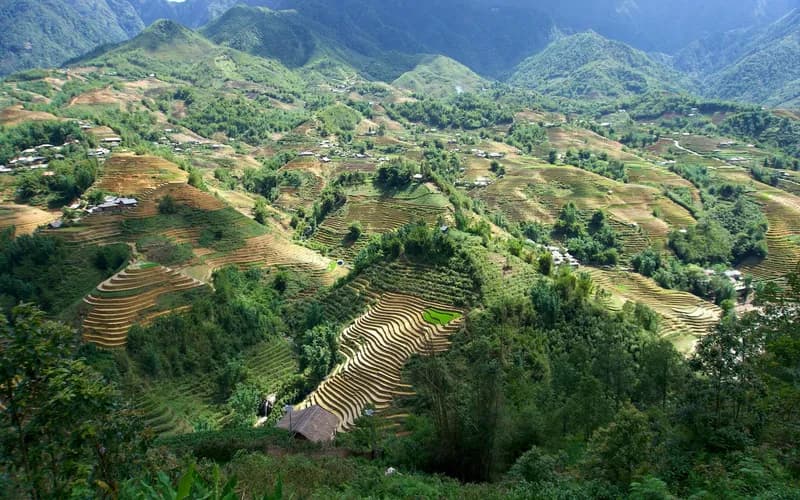
In Sapa, the shift looks different. The most credible products here are micro-group treks — two to six people, with a local guide from the community, overnighting in a village homestay in Ta Van or Lao Chai. These operate closer to community-based tourism than to conventional tour packaging. They are harder to book through a standard OTA and often require direct contact with a small local operator. The premium over a mass trekking package is real, but so is the difference in what the day contains.
Nha Trang presents the starkest version of the problem. The city's dependence on high-volume group tourism — particularly from Chinese and Russian markets — has produced some of the most documented cases of kickback-driven itineraries, with day trips priced as low as US$20 to US$30 that are commercially viable only if a significant portion of the day is spent in partner shops. The alternative — a small-boat snorkel or dive tour capped at eight to ten people, priced in the US$40 to US$80 range — is not a luxury product. It is simply a product that does not require deception to function.

Get matched with up to 5 trusted Vietnam agencies
- Free
- No obligation
- Up to 5 agencies
The Maturation Argument — and Its Limits
It is tempting to frame this shift as straightforward progress: Vietnam's travel culture is maturing, and the kickback model is simply being outgrown. There is truth in that reading. The combination of rising incomes, social media accountability, and international travel experience has genuinely changed what a significant portion of Vietnamese travelers expect and demand. TourRadar's Vietnam small-group listings — with daily costs running between US$80 and US$180 and twelve-day itineraries priced around US$1,049 — reflect a product category that did not have meaningful domestic demand a decade ago.
But the maturation frame has limits. The cheap tour model has not collapsed; it has bifurcated. For travelers with less disposable income, the legacy package remains the only accessible option. The shift toward transparency and small-group travel is, for now, a middle-class phenomenon — and Vietnam's middle class, while growing, is not yet the majority. The risk is that "no forced shopping" becomes a premium feature rather than a baseline standard, available to those who can afford to pay for what should simply be honest dealing.
The regulatory framework exists to address this, but enforcement is uneven. Periodic sanctions against deceptive operators in Ha Long and Nha Trang have not restructured the market. What has moved the needle more visibly is social pressure — the TikTok expose, the Facebook group warning, the one-star review that names the shopping stop that wasn't in the itinerary. Consumer accountability, in Vietnam's travel market, is currently doing more work than regulatory accountability.
That may change. As the middle class expands and the social norm around transparent travel deepens, the commercial logic of the kickback model becomes harder to sustain. Operators who have already moved upmarket are not waiting for regulation to catch up. They are building products for a traveler who has already decided that the cheap tour is not, in any meaningful sense, cheap.
Frequently Asked Questions
Is the preference for no-shopping tours a Vietnamese trend or a global one?
Both, but the Vietnamese context has its own character. Globally, small-group and independent travel have grown steadily as travelers seek more control and authenticity. In Vietnam specifically, the backlash is sharper because the legacy model was more extreme — shopping stops were not occasional inconveniences but structural features of the itinerary. The domestic rejection of this model is partly a convergence with global travel norms and partly a response to a local problem that became impossible to ignore once social media made it visible.
Does paying more actually guarantee a better experience, or just a more expensive one?
Price is a necessary but not sufficient signal. A higher-priced tour that does not explicitly state its group size, itinerary inclusions, and absence of commercial stops may simply be a more expensive version of the same product. The markers worth scrutinizing are specificity — does the itinerary name what you will do and for how long — and the presence of clear language around shopping. Vague references to "cultural experiences" that turn out to be warehouse visits are not confined to the cheapest packages.
What does this shift mean for local communities in places like Sapa?
The answer depends on which alternative replaces the legacy model. Community-based tourism — small groups, local guides, village homestays — can direct more money to the communities that tourism is nominally celebrating. But not every "small-group" or "private" tour is structured this way. A boutique product that uses a city-based operator and a non-local guide may be more comfortable than a mass package without being more beneficial to the village it passes through. The ethical dimension of this shift is real, but it requires more than a smaller bus.
Why has regulation not solved the forced-shopping problem already?
Vietnam's 2017 Law on Tourism requires operators to publish clear itinerary and pricing information, but it does not prohibit shopping stops — only undisclosed or coercive ones. Enforcement at the provincial level has been periodic rather than systematic, and the commercial incentives for operators to maintain the kickback model remain strong where consumer demand for cheap packages persists. Social accountability has, in practice, moved faster than regulatory accountability in reshaping market behavior.