
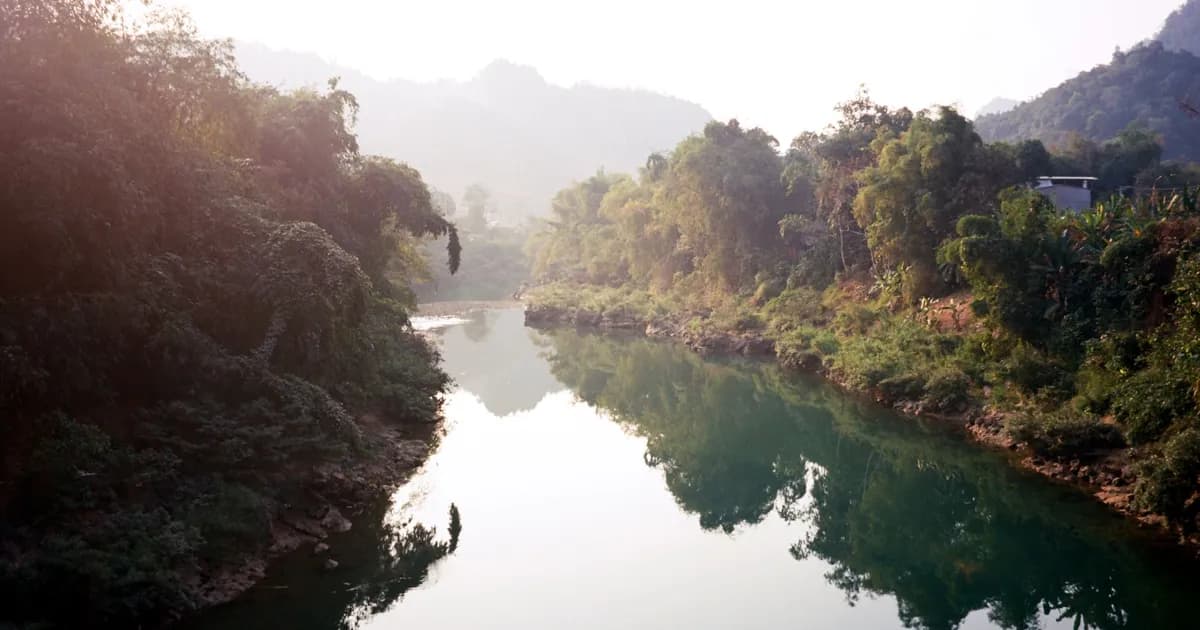
Koh Kong and the Cardamom Coast: Tatai, Chi Phat and Cambodia's Quietest Corner
Koh Kong is the province most Cambodia itineraries skip, and that is precisely the argument for going. There is no famous temple here, no sunrise crowd, no ticket booth at dawn. What there is instead is part of the largest surviving block of rainforest in mainland Southeast Asia, rivers that come out of the Cardamom Mountains in wide brown-green curves, and a coast of mangrove that still functions as a fish nursery rather than as a backdrop. Koh Kong rewards travellers willing to stay three or four nights and do very little. It punishes anyone passing through in a day.
Where Koh Kong actually is
Koh Kong province occupies Cambodia's southwestern corner, wedged between the Thai border at Cham Yeam, the Gulf of Thailand, and the Cardamom Mountains inland. The provincial capital, usually called Koh Kong town or Khemarak Phoumin, sits near the river mouth about ten kilometres from the border. South and east of it stretch Botum Sakor National Park, the Tatai river valley, Peam Krasaop Wildlife Sanctuary and the Southern Cardamom landscape, which together form one of the most ecologically significant areas in the country.
Distances feel longer than the map suggests. National Road 48 runs west from the Sre Ambel junction on the Phnom Penh to Sihanoukville corridor, crossing a series of bridges before reaching Koh Kong town, and it is the spine of the province. Almost everything worth seeing sits within an hour or two of that road, but an hour or two here often includes a boat.
Three places absorb most visits: the Tatai river, roughly 20 kilometres southeast of Koh Kong town; the community tourism village of Chi Phat, reached by boat from Andoung Tuek further east; and Koh Kong town itself, with its mangrove sanctuary and offshore island. They are three different experiences, and you do not have to choose only one.
One request. Up to five tailored proposals.
Skip contacting agencies one by one — share your trip once and let up to five trusted Cambodia agencies come to you. Free, with no obligation.
Get my free quotesGetting there, and why the journey sets the pace
From Phnom Penh the road trip takes roughly five to six and a half hours depending on how long it takes to clear the capital. Operators such as Virak Buntham run daily buses and minivans, with typical fares in the region of 9 to 12 US dollars; departures cluster in the morning, often around 07:45. From Sihanoukville the journey is shorter, around five hours, with morning departures and fares near 8 dollars.
For Chi Phat the drop-off is different. You leave the bus at Andoung Tuek, a roadside settlement on the Preak Piphot river about four to five hours from Phnom Penh, then continue upstream by boat for one to two hours depending on the water level. Tell the bus company in advance that you want Andoung Tuek: it is a request stop, not a terminal, and drivers will not assume it.
This is the first thing Koh Kong teaches. You cannot compress it. Anyone trying to wedge it between Kampot and the islands will spend the entire visit in transit and come away thinking there was nothing there. If you are still shaping the outline of a trip, our Cambodia trip planning page is a better starting point than a day-count spreadsheet.
Tatai: a river that asks nothing of you
The Tatai river is the easiest entry point into the Cardamoms and, for most travellers, the most memorable. A handful of lodges sit along the banks between the Road 48 bridge and the estuary. Most are reachable only by boat, most run on solar power with limited hours of electricity, and none of them have road noise.
The days here are simple to the point of being austere. Kayak upstream in the early morning while the water is glassy and the mist is still sitting in the trees. Swim at Tatai waterfall, which is a broad set of rapids rather than a vertical drop, calmest and most swimmable in the dry months from November to April and a genuine torrent after heavy rain. Take a boat out at dusk to watch fireflies working the mangrove fringe. Sleep early, because there is nothing else to do, and wake to gibbon calls carrying across the water from the far bank.
A half-day tuk-tuk excursion from Koh Kong town to the waterfall costs roughly 15 to 18 dollars for the vehicle rather than per person. Lodge boat transfers are usually either included in the room rate or charged as a modest fixed fee each way, and they run to a fixed timetable, so confirm the last pick-up of the day before you plan an afternoon in town.
Get matched with up to 5 trusted Cambodia agencies
- Free
- No obligation
- Up to 5 agencies
Chi Phat and the community forest experiment
Chi Phat is the most discussed community-based ecotourism project in Cambodia, and it earns the attention. The village sits deep in the Southern Cardamoms, in an area that until the mid-2000s ran substantially on logging, charcoal burning and wildlife poaching. From 2007, working with the conservation organisation Wildlife Alliance, the community built an alternative economy around guided trekking, mountain biking, birdwatching, river trips and homestays, with bookings routed through a village-run office rather than to individual touts.
What you get is not luxury. Homestay rooms are simple, the food is home-cooked Khmer, and several of the guides are former hunters who know the forest with an intimacy no outside operator can match. Treks run from a single day to about a week, sleeping in hammocks at forest camps. Bird lists here include great hornbill and a long supporting cast; the mammal lists are also long, but an honest guide will tell you that sightings are rare and largely a matter of luck. Come for the forest itself, not for a guaranteed animal.
Be realistic about two things. First, it is slow to reach and slow to leave, so two nights is the practical minimum and four is better. Second, community tourism is not a museum. Chi Phat is a working village with generators, phones, motorbikes and school runs, and the visit goes better if you arrive curious rather than hunting for a picture of the past.
Chi Phat also sits inside a broader national shift, which we cover in our piece on Cambodia's turn towards community-run forest tourism across the Cardamoms and the northeastern highlands.
Koh Kong town, the mangroves and the island
Koh Kong town is not beautiful, and pretending otherwise does nobody a favour. It is a border town that spent two decades living off casinos, cross-border trade and transit traffic, and it still has a slightly provisional feel. But it is a comfortable and cheap base, with river-facing guesthouses, a good evening market and a genuinely useful set of day trips within reach.
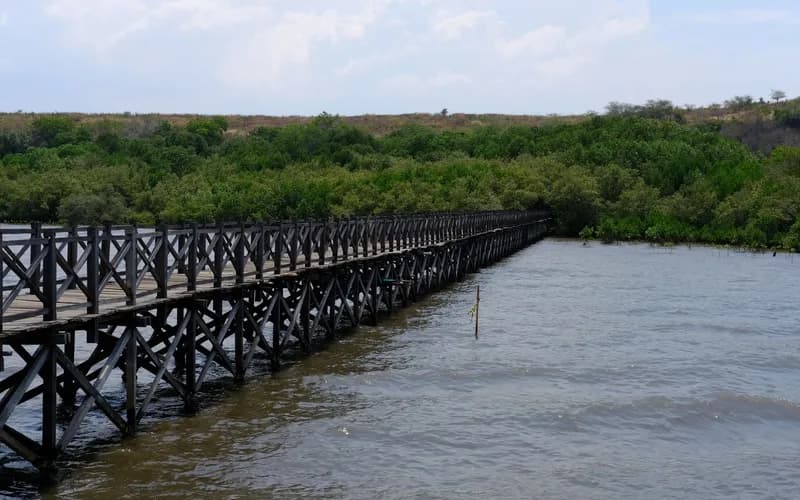
The best of them is Peam Krasaop Wildlife Sanctuary, roughly 25,000 hectares of protected mangrove a short tuk-tuk ride from town, where a concrete stilted walkway around a kilometre long carries you through the mangrove canopy to a viewing tower. Go late in the afternoon when the light drops and the crabs come out, and give yourself time to stand still. Almost everyone gets there by tuk-tuk, and the same half-day hire covers the waterfall, so it is worth reading how hiring a driver or tuk-tuk in Cambodia usually works before you negotiate. It is one of the few places in Cambodia where you can watch an intact coastal ecosystem doing its ordinary work.
Koh Kong Island, confusingly not the town of the same name, is about two and a half hours away by boat, with trips generally leaving around 08:00 and returning mid-afternoon. It has a run of empty west-facing beaches and reasonable snorkelling, and most operators combine it with a mangrove stop on the way back. It is a long day on the water. If the forecast is poor, wait a day rather than insisting.
A sample four-night shape
Four nights is the shortest visit that does not feel like a transfer marathon, and it can be arranged in two clean halves.
- Day one: morning bus from Phnom Penh or Sihanoukville, afternoon arrival in Koh Kong town, sunset at Peam Krasaop.
- Day two: full-day boat to Koh Kong Island, with the mangrove channel on the return.
- Day three: transfer to the Tatai river, afternoon swim at the waterfall, evening firefly boat.
- Day four: dawn kayak upstream, a slow day at the lodge, reading and swimming.
- Day five: morning boat out and onward road transfer.
If you would rather trade the island for deep forest, replace days one and two with a Chi Phat leg, getting off the bus at Andoung Tuek instead.
What it costs, and what it does not
Koh Kong is not expensive, but it is not the cheapest part of Cambodia either, because the good lodges are remote and run on generators and boats. As a rough 2026 guide, expect:
- Guesthouse in Koh Kong town: 12 to 25 dollars a night
- Tatai river eco-lodge: 45 to 150 dollars a night, often including boat transfers and sometimes meals
- Chi Phat homestay: around 8 to 15 dollars a night, plus guide and activity fees
- Full-day boat to Koh Kong Island: around 25 to 35 dollars per person in a group
- Local forest guide for a full day: 20 to 30 dollars
The real cost is time, and it is the one worth paying. If you are weighing Koh Kong against other quiet corners of the country, our guide to Cambodia off the beaten path sets it alongside the alternatives.
When to come, and the honest caveats
The dry season from November to April gives calm seas, swimmable waterfalls and reliable boat schedules. It is the safe choice, and December to February is the most comfortable stretch. The green season from roughly May to October turns the Cardamoms spectacular and the rivers powerful, but island boats are frequently cancelled, some forest trails become impassable, and leeches are simply a fact of life. Neither season is wrong. They are different trips, and you should pick one deliberately.
Other honest caveats are worth stating plainly. Mobile coverage is patchy once you leave Road 48, and several Tatai lodges have deliberately kept it that way. Medical facilities in the province are basic, and anything serious means a long transfer to Phnom Penh. Large-scale coastal development around Botum Sakor has reshaped parts of the province and remains genuinely controversial, so do not expect untouched wilderness the whole way. And if what you actually want is beach time rather than forest time, the islands off Sihanoukville are the better fit, as we set out in our piece on the slow rhythm of Koh Rong Samloem.
Who to travel with
Koh Kong is one of the places where a good operator genuinely earns a fee, because so much depends on boat logistics, protected-area permissions and knowing which guide really knows the forest. Community bookings at Chi Phat should always go through the village booking office rather than a third party taking a margin. For the rest of the province, a Cambodian agency with real Cardamom experience will save you days of guesswork and a fair amount of money. You can see the operators we have assessed in our Cambodia travel agencies directory.
What to Do Next
- Decide your season first: dry months for water and boats, green months for forest and solitude.
- Block at least four nights in the province. Two in Tatai and two in Chi Phat is the classic pairing; three and three is better.
- Book Chi Phat directly through the community booking office, and confirm your Andoung Tuek boat pick-up time in writing.
- Tell your bus company you are getting off at Andoung Tuek when you buy the ticket, not on the day of travel.
- Bring cash. There are ATMs in Koh Kong town but not in Tatai or Chi Phat, and cards are rarely accepted outside the larger lodges.
- Pack for wet feet: quick-dry clothing, a dry bag for electronics, and shoes you are happy to soak.
- Leave a buffer day before any onward flight, because boats and weather do not negotiate.
Frequently Asked Questions
How many days do I need in Koh Kong?
Four nights is the realistic minimum if you want more than a bus window view, and six is where the province starts to open up. A single night is not worth the eleven or twelve hours of return road and river time it costs you.
Is Chi Phat suitable for people who are not experienced trekkers?
Yes. The community booking office offers half-day and single-day options, including river trips, mountain biking on flat sections and short village walks, alongside the multi-day forest treks. Be candid about your fitness when you book, and remember that heat and humidity, not gradient, are usually the limiting factor.
Can I still cross into Thailand at Cham Yeam?
Treat this as unresolved and check before you plan around it. Cambodia's land border with Thailand has been subject to closures and restrictions since the 2025 conflict, and the situation has changed more than once. Do not build an itinerary that depends on that crossing without confirming its status within a few days of travel.
What is the difference between Koh Kong Island and Koh Rong?
Koh Kong Island is a large, essentially undeveloped island visited on day trips from Koh Kong town, with no meaningful accommodation. Koh Rong and Koh Rong Samloem, off Sihanoukville, are established island destinations with a range of places to stay. If you want to sleep on a beach, you want the latter.
Do I need to book Tatai lodges in advance?
Yes, and not only for availability. Most lodges are boat-access only and need to schedule your pick-up at the bridge or in town, so an unannounced arrival can leave you stranded on the bank. Book at least a few days ahead and confirm the transfer time.
Is there mobile signal and internet?
In Koh Kong town, yes, and it is reliable. On the Tatai river it ranges from weak to none, depending on the lodge. In Chi Phat there is patchy coverage in the village and effectively nothing on the trails. Download maps and tickets before you leave the main road.
Is Koh Kong a good destination in the rainy season?
It is a good destination for forest and rivers, and a poor one for islands. From May to October the Cardamoms are at their greenest and visitor numbers fall away, but boat trips to Koh Kong Island are often cancelled and some trekking routes close. If you accept those trade-offs deliberately, the green season is a rewarding time to come.