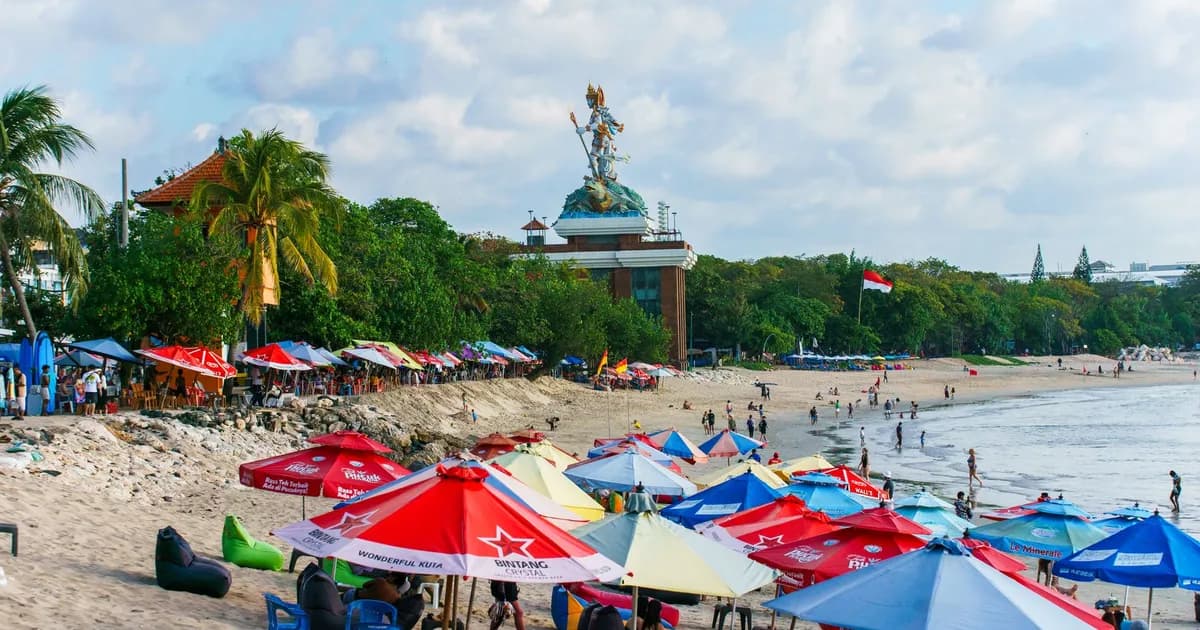


Bali spent the first half of 2026 collecting superlatives. Record arrivals, top-destination awards, another year of double-digit growth in hotel keys. Underneath the announcements sits a quieter and far more consequential story: the island is using more fresh water than it can replace, and 2026 is the year the authorities finally started counting. For anyone planning a trip, this is not an abstract environmental footnote. It shapes where you stay, what your visit costs the people who live there, and whether the Bali you are travelling to still exists in a decade.
The Numbers Behind the Thirst
Bali received close to seven million international visitors in 2025 and more than sixteen million arrivals in total once domestic travel is included, on an island of roughly 4.4 million residents and 5,780 square kilometres. Estimates repeated by researchers, NGOs and the provincial government put tourism's share of Bali's total water consumption at around 65 per cent, concentrated overwhelmingly in the south.
The scale is easier to grasp per head. A resident household in a Balinese village might use 100 to 150 litres of water per person per day. A guest in a mid-range hotel with a pool typically uses several times that, and a private villa with its own pool, garden irrigation and daily linen changes can run into four figures per guest per day. Multiply that by the tens of thousands of villa units built in Canggu, Pererenan, Uluwatu and Ubud over the past decade and the arithmetic stops being surprising.
None of this is new information. What is new is that the pressure has become visible enough to force policy, which is the same dynamic driving Bali's wider crackdown on low-value tourism. Water is simply the least negotiable of the constraints.
One request. Up to five tailored proposals.
Skip contacting agencies one by one — share your trip once and let up to five trusted Indonesia agencies come to you. Free, with no obligation.
Get my free quotesWhere Bali's Water Actually Comes From
Bali's fresh water has three sources, and all three are under strain.
- Surface water from the central lakes and rivers. Lakes Beratan, Buyan, Tamblingan and Batur sit in the volcanic uplands and feed the rivers that historically irrigated the whole island. Lake Buyan, the largest freshwater body, has recorded drops of several metres over recent decades, with a decline of around 3.5 metres frequently cited by local researchers.
- Springs. Hundreds of springs emerge along the mid-slopes and have supplied villages and temples for a thousand years. A significant share have reduced flow or dried up entirely.
- Groundwater. The aquifers beneath the southern plain, which is where nearly all tourism development sits and where almost no rain falls into the ground because so much of it is now sealed under concrete.
The mechanism is unglamorous. The uplands catch the rain; forest and terraced rice slow it down and let it soak in; the aquifers refill; the springs run. Break any link in that chain — clear forest, concrete the recharge zones, pump faster than refill — and the system fails from the bottom up. Bali has broken all three links simultaneously.
What Changed in 2026: Permits, Meters and Enforcement
For years, drilling a bore and pumping what you liked was effectively unregulated in practice, whatever the law said. That changed this year.
Indonesia's updated groundwater framework, administered through the energy and mineral resources ministry, now draws a hard line between business and non-business groundwater use, and requires commercial users to hold a groundwater extraction permit. In Bali the compliance deadline for existing operators fell on 31 March 2026. The permit regime comes with real teeth by Indonesian standards: volumetric metering is a minimum condition, reporting is mandatory, and local water tax is now assessed against metered volume rather than a flat guess.
In practice this means hotels, villas, restaurants and wellness businesses that have been quietly running unlicensed bores are either regularising, capping their draw, or buying tankered water at market rates. Several villa operators in Canggu and Seminyak now truck in a meaningful share of their supply. The cost is starting to appear in room rates.
This sits alongside the moratorium on new construction in the most saturated districts, which we covered in detail in our piece on Bali's building moratorium and the fight against overdevelopment. The two policies are two halves of the same argument: you cannot keep adding pools to an island that cannot fill the ones it has.
Get matched with up to 5 trusted Indonesia agencies
- Free
- No obligation
- Up to 5 agencies
The Subak Problem
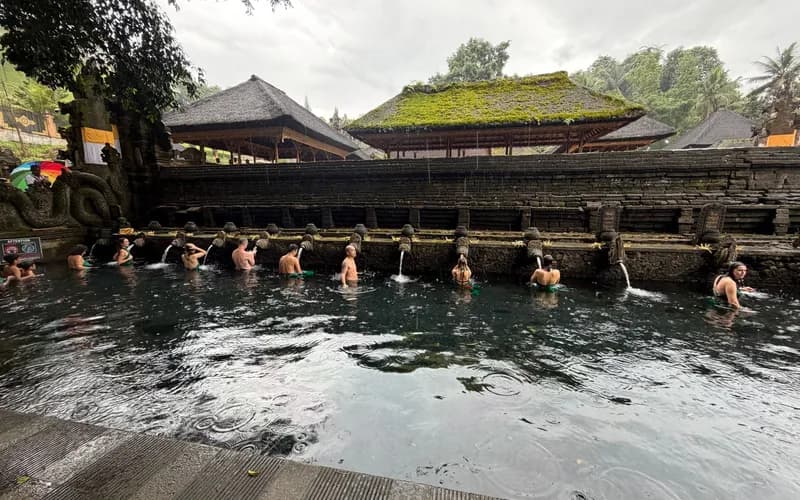
Bali's subak system — the cooperative, temple-linked water councils that have shared irrigation between rice farmers since the ninth century — is a UNESCO World Heritage listing and, more importantly, a functioning institution. It works by allocating water fairly along a gravity-fed chain of canals, with each farmer taking a turn.
The system assumes there is water in the canal. Where upstream extraction, sealed land and diverted supply have reduced flow, subak councils downstream simply receive less, later, or not at all. Farmers respond by switching to less thirsty crops, by cutting from three rice harvests to two, or by selling the land — often to the villa developer whose bore contributed to the problem. That last step is the loop that makes the crisis self-reinforcing, because every hectare converted removes both a recharge zone and a member of the council that manages the water.
When you see a rice terrace in Bali, you are looking at a piece of water infrastructure that is a millennium old and is currently losing an argument with a bore pump.
Saltwater at the Edges
The most alarming indicator is the least visible. Where coastal aquifers are pumped faster than they refill, the pressure that keeps seawater out drops, and salt water moves inland into the fresh reserve. This is saline intrusion, and it has been detected in parts of Bali's southern coastal strip.
It matters because it is functionally irreversible on human timescales. A depleted aquifer can refill given rain and time. A salinised one cannot be flushed clean for decades, sometimes longer. Reports of the water table falling tens of metres in parts of the south over the past decade, and of wells running brackish or foul, are the leading edge of that process rather than isolated complaints.
This is why the water story is more serious than the traffic story or the waste story, both of which are solvable with money and administration. Water is a budget with a hard ceiling, and Bali is close to it.
What Hotels Are and Are Not Doing
The picture is genuinely mixed, and it is worth being fair about it.
A meaningful minority of properties have invested: rainwater harvesting, greywater recycling for gardens, low-flow fittings, refill stations instead of bottled water, and in a few cases participation in recharge-well programmes that inject rainwater back into the aquifer rather than letting it run off. The Bali Water Protection programme run by the IDEP Foundation has pushed this recharge-well model for years and has installed wells across the island with hotel and corporate funding.
Against that, the majority still treat water as a line item rather than a constraint. Pools are drained and refilled on schedule. Lawns are irrigated at midday. Guests are offered the towel card and little else. And a subset of properties advertise "eco" credentials that consist of a bamboo straw and a sign about the ocean.
The honest position for a traveller is that you cannot reliably tell from a listing. What you can do is ask directly, before booking, and treat a straight answer as a signal in itself.
What This Means for How You Travel
None of this argues for skipping Bali. Boycotts hurt the people who most need visitor income and change nothing about the villa sector, which is largely foreign-owned and would survive your absence comfortably. What it argues for is a different shape of trip.
Staying longer in fewer places reduces the linen-and-laundry cycle that drives a surprising share of hotel water use. Choosing a family-run guesthouse over a private-pool villa cuts your personal water footprint by an order of magnitude, and it puts the money into Balinese hands rather than into a development company. Moving inland or east — Sidemen, Munduk, Amed, the Karangasem coast — spreads the load off the aquifers that are under the most pressure, and those areas are also where the island's tourism-village movement has built genuine local capacity to host visitors.
Small habits matter less than these structural choices, but they are not nothing: refill rather than buy bottled, skip the daily towel change, keep pool use to what you will actually swim in, and do not water-fight your way through a villa stay.
Where the Pressure Goes Next
The uncomfortable corollary is that dispersal has consequences too. Every article urging travellers to leave south Bali, including this one, contributes to pressure somewhere else. Lombok, Sumba, Labuan Bajo and the Gilis are all growing quickly, and several of them have thinner water reserves and weaker planning enforcement than Bali did in 2005.
Indonesia's own tourism strategy is explicitly pushing visitors outward, as we discussed in how Indonesia is rewriting its tourism map. The lesson from Bali is not that dispersal is wrong. It is that dispersal without infrastructure, metering and enforcement simply exports the problem, more slowly, to places with less capacity to absorb it. Travellers who arrive early in that cycle carry a proportionately larger responsibility to behave well.
What to Do Next
- Ask one question before you book. Email or message the property and ask where their water comes from and whether they recycle greywater. Vague answers are answers.
- Choose the guesthouse over the private pool. If you want a swim, use the sea, a public pool or a day pass. A private pool is the single largest discretionary water cost of a Bali trip.
- Stay put for longer. Five nights in one place uses far less water than five nights in five places, and it is a better trip anyway.
- Rebalance your route. Give at least half your Bali time to the north, east or central highlands rather than the Canggu-to-Uluwatu strip.
- Refill, do not buy. Carry a bottle and use refill stations; Bali has hundreds, and the plastic saved is a secondary benefit to the water saved in bottling.
- Read the commitments you are signing up to. Our slow travel charter sets out the standards we ask of both travellers and operators, water included.
Frequently Asked Questions
Is Bali actually going to run out of water?
Not in the sense of taps failing island-wide, but parts of the south are already past the point where local supply meets local demand, which is why tankers and imported bulk water are now normal there. The more accurate framing is that Bali is drawing down a savings account: aquifer levels have fallen tens of metres in some southern areas over roughly a decade, and saline intrusion in coastal zones is difficult to reverse.
Is the tap water safe to drink?
No. Tap water in Bali is not potable and should not be drunk untreated anywhere on the island, including in upmarket hotels. Use refill stations, filtered water dispensers or a bottle with an effective filter. Ice in established restaurants and warungs is generally made from treated water and is fine; be more cautious with roadside stalls.
Does staying in a hotel with a pool make me part of the problem?
Partly, and it is a matter of degree rather than guilt. A shared hotel pool spread across sixty rooms is a far smaller per-guest cost than a private villa pool used by two people. If you want to reduce your footprint meaningfully, the private pool is the first thing to give up, ahead of towels, showers or anything else on the usual list.
Are the new 2026 groundwater rules actually being enforced?
Enforcement is real but uneven. The permit deadline of 31 March 2026 has pushed a large number of commercial operators into the licensing system, and metering plus tax assessment gives the province a financial reason to keep checking. Smaller and informal properties remain largely outside the net, and inspection capacity is limited, so the practical effect is strongest among mid-size and large hotels.
Which parts of Bali are least affected?
The central uplands and the north and east generally have better local supply and far lower tourism density: Munduk, Bedugul, Sidemen, Amed, Tulamben and much of Karangasem. Water there is not unlimited, and the uplands are the recharge zone that everything else depends on, so the same restraint applies. But your marginal impact is lower and the money spreads further.
Can travellers do anything beyond changing their own habits?
Yes, modestly. Choosing accommodation that funds recharge wells or greywater systems shifts demand toward operators who invest. Donating to or volunteering with the recharge-well programmes run by local NGOs has a direct effect. And leaving honest reviews that mention water practice, positively or negatively, is one of the few pressures small properties reliably respond to.
Should I go to Bali at all in 2026?
Yes, if you go well. Bali's economy depends on visitors, and the households you stay with, eat with and travel with need that income. The problem is not the number of people who love the island; it is the form the accommodation has taken and the absence, until recently, of any limit on extraction. Travel in a way that does not require a private pool and you are part of the solution rather than the load.