

Ten volcanic islands sit in the middle of the Banda Sea, closer to Papua than to Java, and for nearly two centuries they set the price of the most valuable commodity on earth. Nutmeg and mace grew nowhere else. Empires sailed halfway around the planet for them, fought over them, and redrew the map because of them. Today the archipelago holds a few thousand people, one short airstrip, a scatter of family guesthouses and water so clear it flattens your sense of depth. Reaching the Banda Islands is genuinely difficult, and that difficulty is the whole reason they are still worth the journey.
Why the Banda Islands Reward Slow Travel
Almost everything that makes the Bandas special is a consequence of how hard they are to reach. There is no resort strip, because no charter airline can deliver enough guests to justify one. There are no touts, because the number of visitors on the islands at any moment is usually measured in dozens rather than hundreds. Dinner is whatever came off the boat that afternoon, cooked in the guesthouse kitchen and eaten at a communal table with the other four people who happen to be there.
This is the opposite of a stopover destination. The transport rhythm alone imposes a minimum stay: boats and flights run on fixed days, and if you miss one you wait for the next. Five days is the sensible floor, seven to ten is where the archipelago actually opens up. If you have been reading about the quieter corners of the country in our roundup of places most itineraries skip entirely, the Bandas are the extreme end of that spectrum: a place where the schedule, not the sightseeing list, decides how long you stay.
The reward is a rare thing in Indonesian travel in 2026. You are not competing for a viewpoint. You are the only person on the reef.
One request. Up to five tailored proposals.
Skip contacting agencies one by one — share your trip once and let up to five trusted Indonesia agencies come to you. Free, with no obligation.
Get my free quotesThe History That Explains Everything You See
Until the middle of the eighteenth century, the Banda Islands were the only known source of nutmeg and mace in the world. Bandanese traders had run the spice through Asian networks for centuries before Europeans arrived. When the Dutch East India Company decided that a monopoly required control of the source, the consequences for the islands were catastrophic: the campaign of 1621 under Jan Pieterszoon Coen destroyed or displaced most of the indigenous Bandanese population, and the groves were reorganised into plantations worked under a colonial licence system.
The strangest footnote sits on the archipelago's smallest inhabited island. England held Run, a sliver of land barely three kilometres long, and gave up its claim in the 1667 Treaty of Breda in exchange for a Dutch-held island on the other side of the world: Manhattan. Standing on Run today, with its handful of houses and its single track through the nutmeg, that trade seems less like a bargain and more like a joke history has been telling ever since.
Later, the islands became a place of exile. Mohammad Hatta and Sutan Sjahrir, both future architects of Indonesian independence, were banished to Banda Neira in the 1930s. Their houses are open to visitors, and they are the quietest, most affecting museums in the archipelago: a desk, a blackboard, a veranda, and a view of a volcano.
Getting There: Three Doors, All of Them Slow
Every route begins at Ambon, the capital of Maluku province, reached by direct flights from Jakarta, Surabaya and Makassar. From Ambon there are three ways onward, and none of them is guaranteed.
- Small plane. Susi Air flies Ambon to Banda Neira in around 40 minutes, typically twice a week, with fares in the region of 350,000 rupiah. The aircraft is tiny, the seats are few, and the checked-baggage allowance is often around 10 kg. Book this leg as early as you can and expect weight limits to be enforced.
- Fast boat. A passenger fast boat runs from Tulehu harbour, about an hour by road from Ambon city, usually a couple of mornings a week. Crossing time is roughly six hours depending on sea state.
- Pelni ferry. The national ferry line calls at Banda Neira on its eastbound runs, roughly twice a month. The passage from Ambon takes anywhere from seven to fourteen hours or more, tickets run from about 35,000 to 150,000 rupiah, and a cabin upgrade adds something like 350,000 to 450,000 rupiah. Schedules are usually published only about a month ahead.

The practical rule is to hold a spare day at both ends of your Banda stay and never to book an international flight home for the day after you are due back in Ambon. Our guide to moving between Indonesian islands without wrecking your itinerary covers the buffer-day arithmetic in more detail; in the Bandas, treat it as non-negotiable rather than cautious.
Get matched with up to 5 trusted Indonesia agencies
- Free
- No obligation
- Up to 5 agencies
When to Go: A Calendar That Runs Against Indonesia's
Maluku does not share the seasonal pattern that governs Java, Bali and Nusa Tenggara. The rough weather here comes with the southeast monsoon, broadly June through August, when swell in the Banda Sea regularly cancels boats and makes small-plane landings unreliable. The calmest, clearest windows fall roughly from March to May and again from late September into November, with the turn of the year often pleasant as well.
This inversion is useful. If you are building a longer Indonesian trip, the Bandas can absorb the months when Bali and Flores are least appealing, and vice versa. It also means the standard advice about the Indonesian dry season is actively misleading here, so check Maluku forecasts specifically rather than national ones.
Banda Neira: A Town You Can Walk in an Hour
Banda Neira, the main settlement, is small enough to cross on foot in twenty minutes and interesting enough to keep you walking for days. Fort Belgica, the pentagonal VOC fortress above the town, is the largest European fort in Indonesia and the best orientation point you will find: from its walls the whole archipelago arranges itself, with the perfect cone of Gunung Api directly across the channel and Banda Besar curving away behind it. Below, the ruins of Fort Nassau sit half-swallowed by vegetation.
The town itself is a grid of Dutch colonial houses in various states of grace and collapse, a church with worn grave slabs, a working harbour, and streets where children play badminton across the road until a motorbike interrupts. There is a small number of warungs, a market, and one or two cafes near the fort. Evening entertainment is the sunset and the conversation.
Gunung Api itself can be climbed. It is a steep, loose, roughly two-to-three-hour ascent usually started before dawn, and it needs a local guide, real shoes and an honest assessment of your knees. The summit view over the archipelago at first light is the single image most people carry home.
Under the Water: The Lava Flow and the Outer Reefs
The Bandas sit on deep, cold, nutrient-rich water, and the diving reflects it. The signature site is the north shore of Gunung Api, where the 1988 lava flow poured into the sea and has since been colonised by hard coral at a speed that startles marine biologists. Snorkelling above a reef that is younger than most of the people looking at it is a genuinely odd experience.
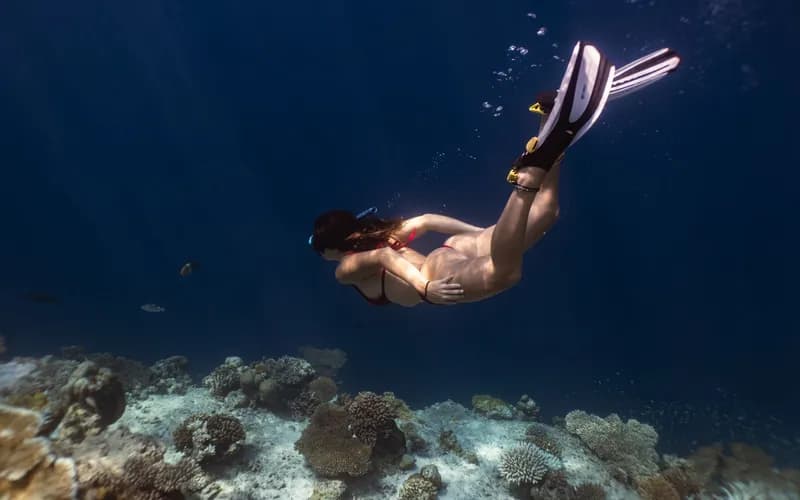
Beyond that, the good sites are mostly boat trips: the walls off Pulau Hatta, the reefs of Pulau Ai, the pinnacle at Batu Kapal, the drop-offs around Pulau Pisang. Visibility is often excellent, currents can be strong, and there is no recompression chamber within easy reach, which should shape your conservatism about depth and repetitive dives. Day boats are arranged through guesthouses and local boat owners rather than a booking platform.
Because the reefs here are lightly visited and slow to recover, the ordinary rules matter more than usual. Our piece on diving and snorkelling without damaging the reef applies with full force in Maluku: neutral buoyancy, no gloves on coral, reef-safe sunscreen, and no anchoring on live rock.
Banda Besar, Ai and Run: Days Beyond the Main Island
Banda Besar, the largest island, is a ten-minute boat hop and holds the heart of the nutmeg landscape. In Lonthoir village a long stone staircase climbs from the waterfront to the plantations, where nutmeg grows in the shade of enormous kenari trees. Walking those groves with someone who grew up harvesting them is the closest thing the archipelago has to a headline experience, and it costs almost nothing.
Pulau Ai is a flat, friendly island with a fine house reef and a couple of simple guesthouses, and it works well as a two-night detour for people who want the pace to drop even further. Run, the Manhattan island, is harder to reach and rewards the effort mostly in atmosphere: fort ruins, a track through the spice, and the sandbar at neighbouring Nailaka.
Boat crossings between the islands depend on weather and on someone being willing to go, so plan them loosely and confirm the day before.
Where to Stay, What to Eat, What It Costs
Accommodation is guesthouses and homestays, not hotels. Simple fan rooms start around 175,000 to 250,000 rupiah per night, and the better-known heritage guesthouses on Banda Neira run higher, broadly in the 300,000 to 750,000 rupiah range, usually including breakfast and often dinner. Booking is frequently done by message rather than through a platform, and confirming directly is normal here. Our practical notes on how to choose a homestay and what to ask before you book are worth reading before you send that first message.
Food is fish, rice, vegetables, sambal, and kenari nuts in everything from cakes to sauces. Nutmeg appears as jam, as syrup and as candied peel. Meals at your guesthouse are typically 50,000 to 100,000 rupiah.
Bring cash. ATM coverage on Banda Neira is minimal and unreliable, card payment is essentially absent, and QRIS acceptance is patchy. Withdraw what you need in Ambon and add a margin for a delayed departure. Mobile data works in the town and thins out fast beyond it.
What the Banda Islands Ask of You
This is not a hard trip in the sense of danger; it is a hard trip in the sense of patience. Boats are cancelled. Flights are rescheduled. Electricity has been known to take an evening off. If your temperament requires certainty, the Bandas will frustrate you and you will not see them properly.
They also ask for a certain amount of tact. This is a small Muslim community with a traumatic colonial history that is neither forgotten nor performed for visitors. Dress modestly away from the water, ask before photographing people, and let the history be told by the people who live inside it. Hiring local guides and boat crews directly is the single most effective way to make your visit worth something to the islands. If you would rather have the logistics handled end to end, the operators we list for Indonesia include specialists who work in Maluku and can hold the Ambon connections together for you.
What to Do Next
- Fix your Ambon dates first, then build the Banda leg around whichever onward option you can actually confirm.
- Book the Susi Air segment as early as possible if you are flying, and check the baggage allowance before you pack.
- Add a buffer day in Ambon before your Banda departure and another after your return.
- Choose your season using Maluku weather patterns, not the national dry-season rule.
- Message two or three guesthouses directly and ask about full board, boat trips and airport transfers in the same message.
- Withdraw all your cash in Ambon, and carry small notes for boats, guides and warungs.
- Read our Indonesia planning overview to slot the Bandas into a wider route rather than treating them as a standalone dash.
Frequently Asked Questions
How many days do I need in the Banda Islands?
Five is a realistic minimum once you account for the fixed transport days, and seven to ten is where the trip becomes genuinely relaxed. Anything shorter means spending most of your time worrying about the boat back to Ambon.
Do I need a permit to visit the Banda Islands?
No special permit is required for the Bandas themselves beyond your standard Indonesian entry documentation. Diving is arranged locally and does not involve the marine-park permit systems used in places such as Raja Ampat.
Is it possible to visit the Banda Islands without diving?
Absolutely. Snorkelling from the shore is excellent, the Gunung Api climb is a serious walk in its own right, and the historical layer of Banda Neira, Lonthoir and Run would justify the trip on its own. Many visitors never put on a tank.
Can I use cards or QRIS in the Banda Islands?
Assume not. ATM access on Banda Neira is limited and frequently out of service, card acceptance is close to non-existent, and QRIS coverage is inconsistent. Bring enough rupiah in cash from Ambon to cover your whole stay plus a delay.
When is the worst time to visit the Bandas?
Broadly June to August, when the southeast monsoon pushes swell across the Banda Sea. Sailings are cancelled, small-plane operations become unreliable, and diving conditions deteriorate. This is the inverse of the pattern in Bali and Java.
How do I get from Banda Neira to Ambon if my flight is cancelled?
The fallback options are the fast boat from Banda to Tulehu on its scheduled mornings, or the next Pelni sailing, which may be a fortnight away. This is exactly why a buffer day is not optional, and why a same-week international connection out of Jakarta is a bad idea.