

The single decision that most changes the character of an Indonesian trip is not the route, the season or the budget. It is where you sleep. Choose a chain hotel and Indonesia arrives filtered through a lobby. Choose a homestay and you get breakfast with the family, a scooter borrowed from a cousin, an invitation to a wedding you had no idea was happening, and a room that costs less than the airport taxi. Homestays are the practical backbone of slow travel here. They are also inconsistent, unevenly listed and occasionally disappointing, so it pays to know how to read them.
What "Homestay" Actually Means in Indonesia
In most of the world, homestay implies a spare room in a family house. In Indonesia the word has stretched. It covers everything from a genuine spare room with the family eating at the next table, to a row of four purpose-built bungalows behind the owner's house, to a small independent guesthouse with no family presence at all beyond a manager on a plastic chair.
What unites them is scale and ownership. Homestays are small, usually between two and ten rooms, and almost always owned and run by the household on whose land they sit. That is the meaningful distinction. Your money goes to a family in the village rather than to a management company in Jakarta or Singapore, and the person handing you the key has an interest in you liking the place.
The government has actively encouraged this model. The national tourism-village programme has spent years registering and certifying village homestays, and the results are visible in the growing number of small, decent, locally owned rooms in places that had none a decade ago. We covered that shift in our piece on Indonesia's tourism-village movement, and it is the main reason homestay quality has improved so much outside the classic tourist corridors.
One request. Up to five tailored proposals.
Skip contacting agencies one by one — share your trip once and let up to five trusted Indonesia agencies come to you. Free, with no obligation.
Get my free quotesThe Vocabulary: Losmen, Wisma, Pondok Wisata and Guesthouse
Signage in Indonesia uses several words more or less interchangeably, but the shades of meaning are useful.
- Losmen. The oldest term, meaning a basic inn. Expect a simple room, often with a shared or cold-water bathroom, a fan rather than air conditioning, and a price at the bottom of the range. Losmen are common in Java and Sumatra and are frequently excellent value.
- Wisma. Originally a guesthouse or lodging house, often slightly larger and plainer than a losmen, sometimes built for visiting officials or workers. Functional rather than charming, and usually clean.
- Pondok wisata. The formal licence category for a small tourist lodging run out of a private dwelling, capped at a small number of rooms. If a place advertises itself as pondok wisata, it is almost certainly a licensed family operation.
- Homestay. The catch-all marketing word now used by all of the above, plus villas that are nothing of the kind.
- Penginapan. Simply "lodging", the most generic term of all.
None of these labels guarantees quality. What they tell you is roughly what to expect in scale and formality, which helps when you are standing at a junction with three signs and a decision to make.
What You Get for the Money
Prices vary enormously by region. As a working set of 2026 figures for a double room per night:
- A basic losmen with fan and shared bathroom: 100,000 to 200,000 IDR.
- A typical village or small-town homestay with private bathroom and fan: 200,000 to 350,000 IDR.
- A well-run homestay with air conditioning, hot water and breakfast in a popular area such as Ubud, Yogyakarta or Labuan Bajo: 350,000 to 700,000 IDR.
- A boutique family guesthouse marketing itself as a homestay in Bali or the Gilis: 700,000 IDR and well upward.
Breakfast is included more often than not, and in a real homestay it is cooked rather than buffet: nasi goreng, banana pancakes, fried eggs, fruit, sweet coffee or tea. Laundry usually costs 10,000 to 20,000 IDR per kilo. Scooter rental arranged through the house is typically 70,000 to 150,000 IDR a day and often cheaper than a rental shop.
For how these numbers fit into a whole trip, our Indonesia budget guide for 2026 breaks down what a fortnight actually costs at different paces.
Get matched with up to 5 trusted Indonesia agencies
- Free
- No obligation
- Up to 5 agencies
Where Homestays Are the Best Option, and Where They Are Not
Homestays are unambiguously the right choice in villages, small towns, national park gateways and anywhere that sees more Indonesian visitors than foreign ones. In those places they are often the only accommodation, and they are usually good.
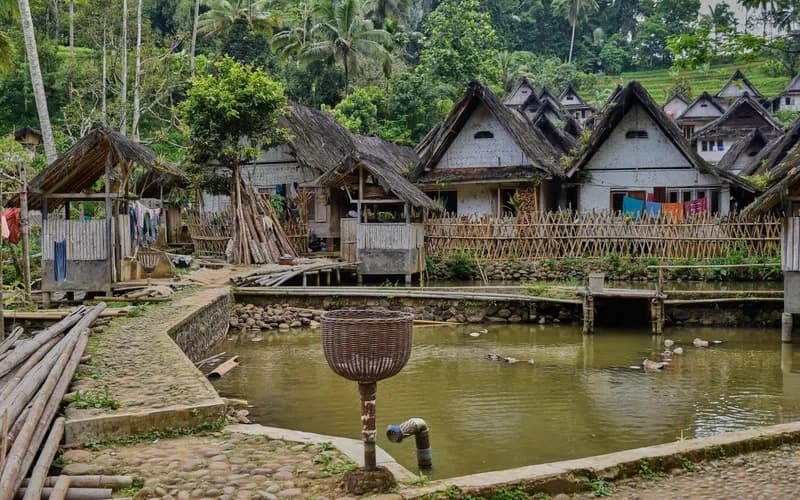
They are also the right choice wherever the point of the trip is contact with the place rather than comfort. Regions such as the Minangkabau highlands of West Sumatra, the Toraja highlands or the interior of Flores are essentially homestay country, and staying otherwise means missing the substance of the region.
Be more careful in three situations. First, in big cities, where a homestay may simply be a windowless room off a busy road and a business hotel is genuinely better value. Second, when you need reliable fast internet for work, since rural connections are often adequate for messaging and useless for video calls. Third, if you have real mobility limitations, because stairs, high steps, squat toilets and uneven paths are common and rarely mentioned in listings.
There is also a comfort threshold worth being honest about. Walls are thin, roosters start at four, mosque loudspeakers carry, and the family's television is part of the soundscape. If that will spoil your holiday, book accordingly rather than complaining about it later.
How to Find Them: Platforms, WhatsApp and Walking In
Three methods, and the best trips use all three.
Booking platforms. Booking.com, Agoda and Traveloka all list Indonesian homestays extensively, and Traveloka in particular carries small domestic properties the international sites miss. Use platforms to research, read recent reviews and secure your first two nights in a new region.
Direct contact. Almost every property has a WhatsApp number, and messaging it usually gets you a lower rate than the platform price, because the owner saves the commission. Write simply and politely in English or Indonesian, state your dates and number of people, and ask for the price. Expect a reply within a few hours. This is completely normal practice and nobody will be offended.
Walking in. In smaller places, arriving and looking is still the best method. Signs saying homestay, losmen or penginapan are everywhere, and you can see the room before you commit, which no photograph replaces. Ask to see two rooms; there is almost always a better one.
Payment is the piece travellers most often get wrong. Many homestays take cash only, particularly outside Bali and Java, and ATMs in small towns run empty at weekends. A growing number accept QRIS, Indonesia's unified QR payment standard, which foreign visitors can now use through several international wallets. Our guide to money, cards and QRIS in Indonesia explains what works and what does not.
Reading a Listing Properly
Photographs lie by omission, so read around them.
Check the date of the most recent review, not the average score; a homestay with a 9.4 from 2023 and nothing since has probably changed hands. Read the three-star reviews rather than the extremes, since that is where the honest detail lives. Look for the words that matter to you specifically: hot water, air conditioning, wifi speed, road noise, mosquito nets, stairs.
Be alert to the geography. "Ten minutes from the centre" in Indonesian listings usually means ten minutes by scooter, which can be forty on foot in the heat. Check the pin on the map rather than the description, and look at whether the property sits on a main road, because traffic noise starts at five in the morning.
Finally, look at how the host writes. A host who answers questions in detail before you book will solve problems while you are there. A host who sends one-word replies will not.
Being a Good Guest
Staying in someone's home carries obligations that a hotel does not, and meeting them is what makes the difference between a transaction and a welcome.
Take your shoes off at the door, always. Dress modestly around the house, including in Bali; a sarong or long shorts and a t-shirt is right, swimwear is not. Greet everyone you pass in the compound, including grandparents and small children, because not greeting people reads as rudeness in a way it does not at home. Use your right hand to give and receive. Ask before photographing the family or the house. Keep noise down after around ten at night, and be aware that in Muslim areas the household will be up before dawn.
If you are offered food or coffee, accept at least a little. Refusing outright is awkward; taking a small amount is polite. If you are invited to a ceremony, go, and ask what to wear and what to bring. These are the moments people remember from Indonesian trips, and they only happen if you are staying with someone who can invite you. Our note on everyday etiquette in Indonesia covers the wider ground, including temples and mosques.
Paying, Tipping and Small Frictions
Settle up in cash unless you have agreed otherwise, and pay on departure rather than arrival unless asked. Have small notes, since a 100,000 IDR note for a 60,000 IDR bill can genuinely be a problem in a village.
Tipping is not obligatory and not expected in the Western sense, but leaving 20,000 to 50,000 IDR for staff who cleaned and cooked for you over several days is appreciated and normal. If someone drove you somewhere as a favour, insist on covering fuel.
When something is wrong, say so early, calmly and directly to the owner rather than saving it for a review. Indonesian hospitality culture is strongly oriented towards fixing problems and strongly averse to open confrontation, so a quiet word almost always works and a public complaint almost always backfires. A broken fan gets replaced within the hour if you mention it; if you wait until checkout, nobody wins.
What to Do Next
- Book only your first two nights in each region. Lock in arrival, then choose the rest in person once you know the place.
- Save the WhatsApp number of every property you like. It is the fastest way to rebook, ask for a pickup, or get a recommendation two towns away.
- Carry cash in small denominations. Withdraw before leaving a city, and assume village ATMs will be empty or broken.
- Set up QRIS before you travel. If your wallet app supports it, test it once in a city so you know it works before you need it.
- Ask three questions before booking. Is breakfast included, is there hot water, and how far is it from the centre on foot. The answers sort most listings quickly.
- Sketch the shape of the trip first. Our plan your journey page walks through how to build an Indonesian route that leaves room for the places you have not heard of yet.
Frequently Asked Questions
Are homestays in Indonesia safe?
Overwhelmingly yes. Theft is rare, hosts are generally protective of guests, and the small scale means someone always knows who is coming and going. Standard precautions still apply: use the lock provided, keep your passport and cash out of sight, and prefer places with recent reviews if you are arriving late at night in an unfamiliar town.
Do I need to book in advance?
For your first night in a new region, yes. Beyond that, no, except during Indonesian public holidays, school holidays in June and July, the week around Idul Fitri, Nyepi in Bali and Christmas and New Year, when small properties fill quickly with domestic travellers. Outside those windows, walking in is normal and often gets you a better room at a better price.
Will anyone speak English?
Sometimes, and less than you expect outside Bali and the main tourist towns. Younger family members usually have some English, and translation apps work well offline if you download Indonesian first. Learning twenty words of Bahasa Indonesia changes the experience disproportionately, because Indonesian is a genuinely easy language to make a start in and the effort is always appreciated.
Is it rude to negotiate the price?
Not at all, if you do it gently and for a multi-night stay. Asking whether there is a better rate for four or five nights is normal and usually works. Haggling aggressively over a room already priced at 200,000 IDR is not; the margin you are fighting over is small for you and meaningful for the household.
Can two travellers of the same sex share a room?
Yes, and it is entirely unremarkable across Indonesia. Unmarried mixed couples are also accepted almost everywhere in practice, though in Aceh, which applies Islamic law, the rules are different and stricter, and you should not assume otherwise there.
What should I bring that homestays often lack?
A universal sink plug, a quick-dry towel, a headtorch for power cuts, earplugs, and your own soap if you are particular. Mosquito repellent is essential and mosquito coils are usually provided. If hot water matters to you, confirm it rather than assuming, as many perfectly good homestays have cold-water bathrooms only.
How do homestays compare with Airbnb in Indonesia?
Airbnb in Indonesia skews heavily towards foreign-owned villas and apartments, particularly in Bali, where the host may not live in the country at all. A homestay booked through a platform, through WhatsApp or in person is far more likely to put money into the local economy and to come with the human contact that is the point of staying small in the first place.