East Bali Slowly: Sidemen, Amed and the Karangasem Coast
Most visitors to Bali never see the island's east. They land in the south, drift up to Ubud, maybe cross to the Nusa islands, and fly home believing they have seen Bali. Meanwhile, two hours away, Mount Agung rises over a valley of rice terraces, fishermen still launch outrigger canoes from black-sand beaches at dawn, and a village of Bali's original inhabitants weaves a cloth so complex that a single piece can take years. This is Karangasem, the old eastern kingdom, and it rewards anyone willing to slow down.
Why East Bali Rewards the Slow Traveller
Karangasem regency covers the island's eastern flank, from the slopes of Agung down to the Lombok Strait. For centuries it was a kingdom in its own right, one that at times ruled over neighbouring Lombok, and its royal family left behind water palaces, court arts and a strong sense of local identity. Tourism arrived here late and in small doses, so the east still runs largely on agricultural and ceremonial rhythms rather than on the beach-club calendar of the south.
That does not mean it is untouched. Lempuyang's famous "Gates of Heaven" photo spot draws queues, Amed has grown steadily as a dive base, and the island-wide pressures on water and land are felt here too. But the scale is different. Villages remain villages, roads remain narrow, and evenings are quiet enough to hear the gamelan practice drifting over the paddies. If you want to understand Bali beyond the resort strip, this is where to base yourself for a week or more rather than a day trip.
The east also suits travellers who want to reduce their footprint. Distances between the main areas are short, many guesthouses are family-run, and the best experiences here, walking, snorkelling from the shore, sitting in on a weaving workshop, cost little and ask even less of the landscape.
One request. Up to five tailored proposals.
Skip contacting agencies one by one — share your trip once and let up to five trusted Indonesia agencies come to you. Free, with no obligation.
Get my free quotesSidemen: A Valley Built Around Rice and Weaving
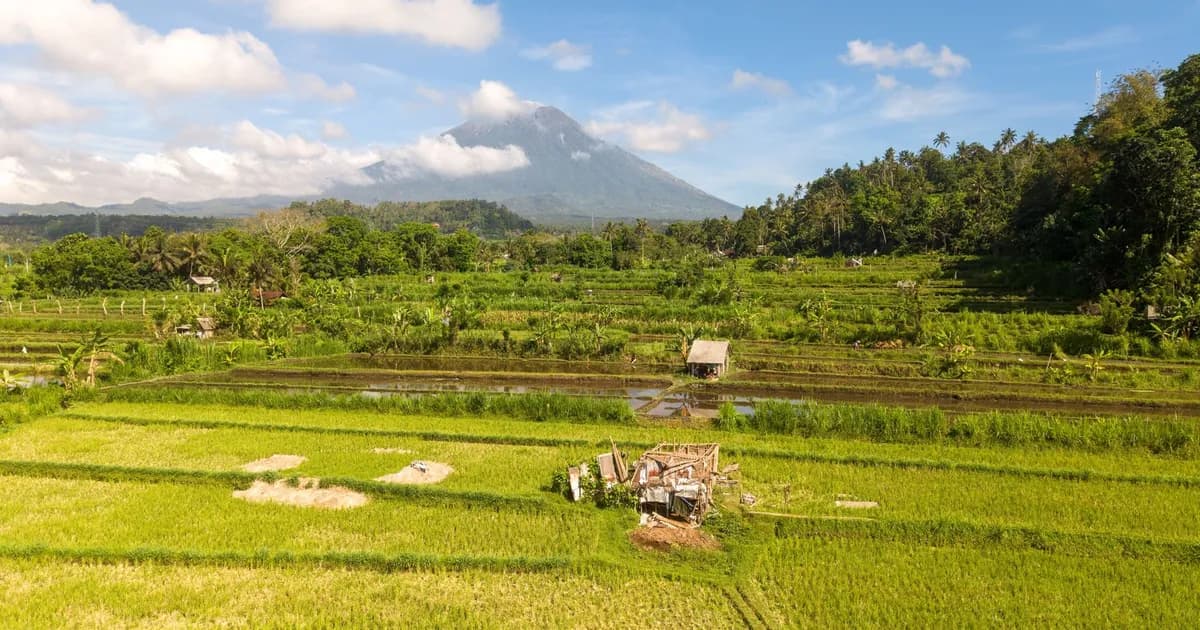
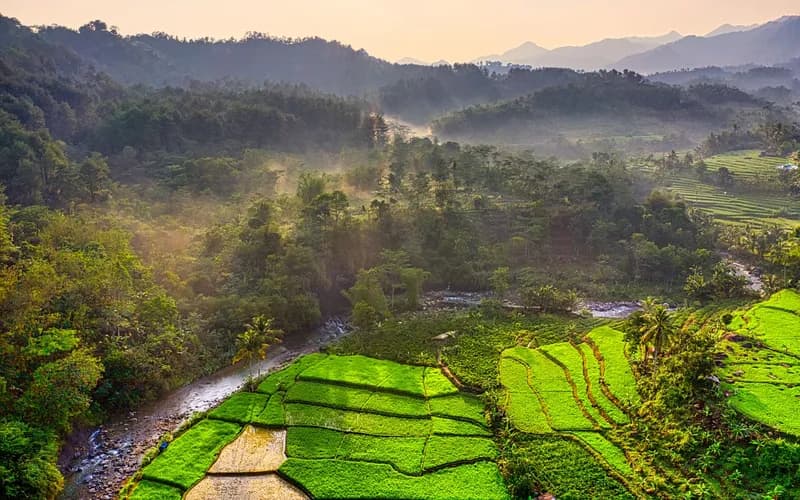
Sidemen sits in a green valley roughly an hour east of Ubud, with Agung's summit, just over 3,000 metres high, filling the northern skyline on clear mornings. The valley floor is a patchwork of terraced rice fields fed by the subak, the cooperative irrigation system that UNESCO recognised as part of Bali's cultural landscape. Paths follow the irrigation channels between villages, and the simplest way to spend a first day is to walk them: out along the terraces in the cool of the morning, back through groves of salak (snake fruit) and past family compounds where offerings are laid out on every step.
Walking routes range from easy one-hour loops along the channels to half-day hikes that climb the valley sides for views over the terraces. A local guide, easily arranged through your guesthouse, adds a great deal: they know which paths cross private land, which temple ceremonies are happening that week, and which farmers do not mind a visitor pausing to watch the planting or harvest.
Sidemen is also a weaving centre. Workshops in and around the village produce songket, a brocade shot through with metallic thread, and endek, the Balinese weft ikat now worn widely as office dress on the island. Watching weavers work a traditional loom for an hour tells you more about Balinese craft than any market stall. If you buy, buy directly from the workshop, and expect hand-woven pieces to cost what they are worth; machine-printed "ikat" is sold everywhere and is a different product.
Plan at least three nights. The valley's charm is cumulative: the second morning's walk is better than the first because you know where the light falls, and by the third evening the warung owner remembers how you take your coffee.
Temples of Karangasem: Besakih, Lempuyang and Honest Expectations
Two of Bali's most significant temples lie in Karangasem, and both deserve a clear-eyed approach.
Pura Besakih, on Agung's south-western slopes, is the island's "mother temple", a complex of more than twenty temples climbing the mountain in terraces. For years it was notorious for aggressive unofficial guides and donation demands. Since a new visitor facility opened, the system has become more orderly: recent visitor reports put the foreign entrance fee at IDR 150,000, including sarong hire, an official guide and an electric shuttle up from the car park. Go early, go with the included guide, and respect that large parts of the complex are closed to non-worshippers, especially during major ceremonies.
Pura Lempuyang, higher up in the hills to the east, is one of Bali's sacred directional temples. It is also the site of the most photographed gateway on the island, and the reality can disappoint: a numbered queue that commonly runs two to four hours at busy times, a brief turn at the split gate, and a photographer using a mirror under the phone lens to create the "reflection" you have seen online. There is no lake. Recent reports put the foreign entrance fee at around IDR 100,000, plus a shuttle from the lower car park. The slow alternative is to skip the photo queue entirely and climb the roughly 1,700 steps through the forest to Pura Lempuyang Luhur at the summit, a half-day pilgrimage walk that few tourists attempt and that feels entirely different from the scene at the gate.
At every temple, a sarong and sash are required, shoulders should be covered, and menstruating women are traditionally asked not to enter. Our guide to temple and mosque etiquette across Indonesia covers the details, from where to sit during a ceremony to how to handle offerings on the ground.
Get matched with up to 5 trusted Indonesia agencies
- Free
- No obligation
- Up to 5 agencies
Water Palaces and the Old Kingdom: Tirta Gangga and Taman Ujung
The last rajas of Karangasem built water gardens, and two of them are open to visitors.
Tirta Gangga, in the hills north of the regency capital Amlapura, was built in the mid-twentieth century as a royal bathing complex. Today it is a public garden of ornamental ponds, stepping stones, fountains and koi, backed by rice terraces. Recent visitor reports put entry at around IDR 50,000, with a small extra charge to swim in the spring-fed pool. Come at opening time, when the light is soft and the tour buses have not yet arrived, and consider staying a night in one of the guesthouses nearby: the terraces around Tirta Gangga are superb walking country, and the path up to the hilltop temples and viewpoints above the village is one of the finest short hikes in eastern Bali.
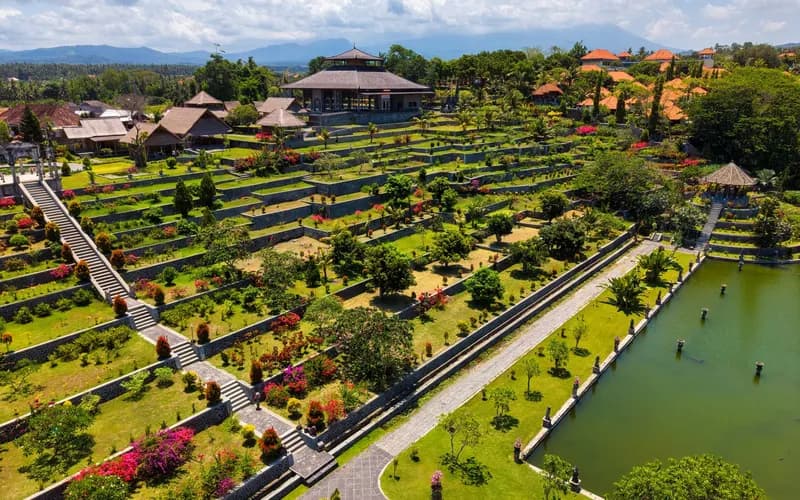
Taman Ujung, closer to the coast south of Amlapura, is grander and emptier. Built in the early twentieth century, badly damaged by earthquakes and later restored, it combines Balinese and European architecture around large pools, with a long causeway leading to a central pavilion. Most visitors spend an hour; a slow traveller can spend a morning, walking up to the hillside viewpoints that look over the palace, the sea and, on clear days, Lombok's Rinjani across the strait.
Both sites depend on the springs and streams of Agung's watershed, which is worth remembering. Water in Bali is under serious strain, as we explored in our report on Bali's water crisis and the record crowds. Choosing guesthouses that do not fill private pools every day is a small, practical way to travel lighter here.
Tenganan and Bali Aga Heritage
Near Candidasa, Tenganan Pegringsingan is one of the few remaining Bali Aga villages, home to descendants of the island's pre-Majapahit population. The village is walled, laid out along stone-paved terraces running north to south, and governed by its own customary rules on land, marriage and ritual. It is not a museum: people live, work and hold ceremonies here, and visitors are received on the village's terms.
Tenganan is known above all for geringsing, a double ikat cloth in which both the warp and the weft threads are tie-dyed before weaving. Only a handful of places in the world produce double ikat, and a single fine piece can take years to finish because the natural dyes are applied in slow cycles. Geringsing is believed to protect against illness and misfortune and is used in ceremonies across Bali. Households also sell lontar palm-leaf manuscripts, with scenes incised with a knife and blackened with soot.
There is no fixed entrance fee; a donation at the gate is expected, and a local guide from the village is the best way to visit. Keep purchases honest: genuine geringsing is costly, and the cheaper cloths on offer are often single ikat or made elsewhere. Ask, listen and do not haggle aggressively over a piece that took someone months of work.
Amed and Tulamben: The Slow Coast
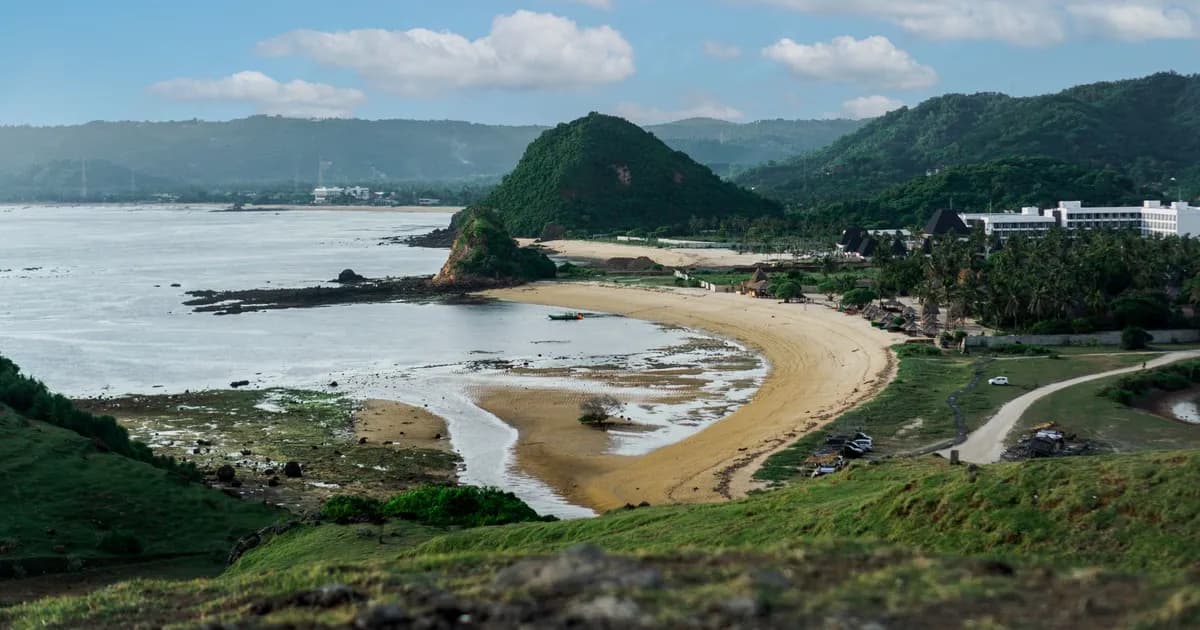
Amed is not one village but a string of fishing hamlets, Jemeluk, Bunutan, Lipah and others, strung along a winding coast road beneath dry hills. Colourful jukung outriggers line the black-sand beaches, and in a few places families still make sea salt the traditional way, spreading seawater over the sand and drying it in hollowed palm trunks.
The draw for most visitors is the water. Coral gardens start a few metres from the shore, particularly around Jemeluk Bay, so good snorkelling needs nothing more than a mask and fins. Up the coast at Tulamben lies the USAT Liberty, a US Army cargo ship torpedoed in January 1942 and beached on the shore. The 1963 eruption of Mount Agung pushed the wreck into the sea, where it now lies on a sloping sandy bottom, its shallowest parts only a few metres below the surface. It is one of the most accessible wreck dives in the world and is easily snorkelled at its upper sections. Dive centres in Amed run trips there daily.
The best conditions generally run from about June to October, when visibility is often excellent; the wet season brings more runoff and slightly murkier water but diving continues year-round. Before you go in, read our guide to how to snorkel and dive responsibly in Indonesia: never stand on coral, wear reef-safe sun protection, and choose operators who brief on buoyancy and do not touch or chase marine life.
Amed has grown in the past decade, but it remains low-rise and low-key. Stay a week, dive or snorkel in the mornings, and spend afternoons on a shaded terrace watching the fishing fleet return.
Candidasa and Padangbai: Hinges to the Rest of Indonesia
Candidasa, on the south-east coast, was one of Bali's first beach resorts in the 1970s and 1980s, then lost most of its sand to coral mining and sea walls. The result is a quiet, slightly faded town with good-value guesthouses, a lagoon full of lotus flowers and easy access to Tenganan. It works well as a calm base rather than a beach destination.
Padangbai, a little further west, is a working port. Public ferries cross to Lombok from here, and fast boats run to the Gili islands and Lombok. The town has two small beaches, including the sheltered Blue Lagoon with decent snorkelling, and it makes a natural last stop if you are continuing east. If you plan to island-hop from here, factor in buffer days: sea conditions in the Lombok Strait can cancel crossings with little notice.
How to Structure Ten Days in the East
The east is compact, which makes it ideal for a slow, single-region stay rather than a tour. A balanced ten days might look like this:
- Days 1 to 3, Sidemen: valley walks, a weaving workshop, an early visit to Besakih with the official guide.
- Days 4 and 5, Tirta Gangga: the water garden at opening time, a guided hike through the terraces, and Taman Ujung on the way to the coast.
- Days 6 to 9, Amed: snorkelling from the shore, a Liberty dive or snorkel trip at Tulamben, a morning with salt makers, and, if you want it, the long walk up to Lempuyang Luhur.
- Day 10, Candidasa or Padangbai: Tenganan in the morning, then onward by boat or back to the airport.
Resist the temptation to add Nusa Penida or Ubud into the same ten days. The east works because it gives you time; fragment it and you are back to seeing Bali through a car window. If you would rather have the logistics handled, our team can help you plan your journey around this kind of slower rhythm.
Practicalities: Getting Around, When to Go and Where to Stay
Getting there and around. There is little useful public transport in the east. Most travellers hire a private driver from the airport or Ubud, which is also the simplest way to move between bases. Agree the price and the stops in advance. Once settled, a local driver for day trips or a scooter (only with the correct licence and a helmet) covers short distances. Roads are narrow and steep in places, especially around Lempuyang and on the Amed coast road.
When to go. The dry season, roughly April to October, brings the clearest views of Agung and the best diving. The wet months are greener and emptier, with afternoon storms rather than all-day rain in most years. Major temple festivals follow the Balinese calendar and move each year; ask your host what is coming up.
Mount Agung. Agung is an active volcano. Its alert level is set by Indonesia's volcanology agency, and climbing is only possible when the status and local temple authorities allow it. Never attempt the climb without a licensed local guide, and check the current status before you plan around it.
Where to stay. The east's strength is small, family-run guesthouses and a handful of boutique lodges. Look for places that employ local staff, source food from the village and treat water carefully. For more ideas in the same spirit, our guide to off-the-beaten-path Indonesia covers regions beyond Bali that reward the same approach.
What to Do Next
- Decide how long you can give the east: seven days is a minimum, ten is better.
- Choose two or three bases, for example Sidemen, Tirta Gangga or Amed, rather than moving every night.
- Book a private transfer from the airport straight to your first base, avoiding a night in the south.
- Check the Balinese ceremonial calendar with your first host and adjust temple visits accordingly.
- If you dive, book a reputable Amed dive centre and check certification requirements for the Liberty.
- Pack a sarong, reef-safe sunscreen, sturdy walking shoes and a refillable water bottle.
- Build in a buffer day at the end if you are continuing by boat from Padangbai.
Frequently Asked Questions
Is East Bali worth visiting if I only have a week in Bali?
Yes, and arguably more than the south. A week split between Sidemen and Amed gives you rice terraces, temples, traditional villages and some of Bali's best shore snorkelling, with far fewer crowds. You lose the nightlife and big resorts, which is exactly the point for most slow travellers.
How do I get from the airport to Sidemen or Amed?
By private car. Sidemen is roughly one and a half to two hours from the airport, and Amed about three hours, depending on traffic. There is no practical public transport, so arrange a transfer through your guesthouse or a reputable driver and agree the price in advance.
Is the Lempuyang "Gates of Heaven" photo worth the queue?
It depends on your patience. Queues of two to four hours are common, the famous reflection is created with a mirror, and you get only a brief moment at the gate. Many travellers find the forest climb to Pura Lempuyang Luhur, or simply visiting in the late afternoon when queues shrink, far more rewarding.
Can I snorkel the USAT Liberty wreck without diving?
Yes. Parts of the wreck lie only a few metres below the surface and are visible from the shore at Tulamben on calm days. Go with a local guide who knows the entry points, wear fins because of the pebble beach and currents, and never stand on the wreck or the coral growing on it.
Do I need a guide to visit Tenganan village?
It is not compulsory, but it is strongly recommended. A guide from the village explains the customs, introduces you to weaving households and ensures you do not wander into private or ceremonial spaces. There is no fixed fee; leave a donation at the entrance and pay your guide fairly.
When is the best time to visit East Bali?
The dry season from about April to October gives the clearest views of Mount Agung and the best diving visibility. The wet season is quieter and greener, and still very pleasant for walking in the mornings. Check the Balinese calendar for major temple festivals, which can be remarkable to witness but also close parts of temples to visitors.