

Indonesia is an archipelago, so travellers arrive thinking in ferries and flights. Then they land, and discover that almost everything that happens between the airport and the thing they came to see happens on a road: a two-hour transfer through rice fields, a switchback climb to a crater rim, a ride to a warung that turns out to be the best meal of the trip. Road travel is where an Indonesian itinerary is actually won or lost, and it is also where visitors most often get stung, financially, legally and occasionally physically.
This is a practical guide to the four ways you will move overland here, what each one costs in 2026, and the rules that catch people out.
Why Road Travel Decides Your Itinerary
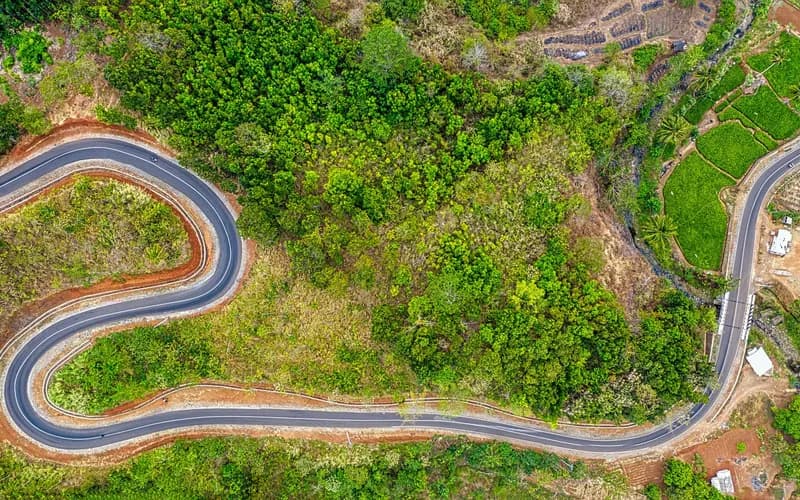
Distances on an Indonesian map are misleading. A hundred kilometres on Flores or in the Sumatran highlands can take five hours; the same distance on a Javanese toll road takes ninety minutes. Mountain roads are narrow, frequently under repair, and shared with trucks that overtake on faith. Add a market day or a religious procession and any estimate becomes fiction.
The slow-travel response is not to drive faster but to plan fewer moves. Two long transfer days in a two-week trip is comfortable; five is a holiday spent looking at the back of a headrest. When you are costing this out, our Indonesia budget guide is a useful sanity check: transport is usually the line item people underestimate by the widest margin.
One request. Up to five tailored proposals.
Skip contacting agencies one by one — share your trip once and let up to five trusted Indonesia agencies come to you. Free, with no obligation.
Get my free quotesThe Legal Basics: What You Must Carry
If you are driving anything yourself, you need three documents on your person:
- Your home country driving licence.
- A valid International Driving Permit, issued in your home country before you travel. It cannot be obtained in Indonesia.
- The vehicle registration document, known as the STNK, which the rental shop must give you.
The detail that catches people is the category. An International Driving Permit endorsed only for cars does not cover you on a motorbike. For the 125cc to 160cc scooters that dominate Indonesian rental fleets you need the motorcycle endorsement, category A. Riding without it means the fine, but more importantly it means your travel insurance will decline a medical claim after an accident.
Enforcement in 2026 is not theoretical. Police checkpoints operate routinely around Bali's tourist belt, from Canggu and Seminyak to Kuta and Uluwatu, checking permits, helmets and registration papers. A ticket, a surat tilang, carries a fine in the region of 250,000 rupiah for a helmet offence and up to around 500,000 rupiah for riding without a valid permit. Our summary of Bali's current rules and fines for visitors covers the wider enforcement picture.
Hiring a Driver: How It Works and What It Costs
For most visitors, most of the time, hiring a car with a driver is the right answer. It is not a luxury purchase in Indonesia; it is the normal way to cover ground, and the driver doubles as translator, navigator and local advisor.
Expect roughly 600,000 to 850,000 rupiah for a full day with an air-conditioned car, typically a Toyota Avanza or similar seven-seater, in Bali in 2026. Half days run around 400,000 to 600,000 rupiah. Rates outside Bali vary but are broadly comparable, sometimes lower in Java and higher in remote eastern islands where fuel and vehicles are scarcer.
A few conventions worth knowing. A "full day" usually means eight to ten hours, and drivers will normally agree an overtime rate rather than refuse. Fuel is normally included within a reasonable radius; long point-to-point transfers between regions are quoted separately. Parking and entrance fees for you are yours to pay. It is customary, and appreciated, to make sure your driver has a meal, though many prefer to eat separately at a warung rather than join you.
Book through your accommodation, through a driver recommended by a previous guest, or through an operator. Agree the price, the route and the finish time before you leave, and confirm whether it is a return or a one-way.
Get matched with up to 5 trusted Indonesia agencies
- Free
- No obligation
- Up to 5 agencies
Renting a Scooter: An Honest Risk Assessment
A scooter is cheap, liberating and the single most dangerous thing most visitors do in Indonesia. Both things are true.
Costs in 2026 are modest: a Honda Scoopy or Vario runs roughly 80,000 to 180,000 rupiah a day, a larger Nmax or PCX around 150,000 to 320,000 rupiah, with weekly rates typically 30 to 40 per cent cheaper than the daily figure. Helmets are usually included, and are usually terrible; if you plan to ride for weeks, buying a decent one is worth the outlay.
Before you accept the keys, do this checklist: brakes and tyres, working lights and indicators, the STNK in the compartment, photographs of every existing scratch, and a clear answer on what happens if the bike is damaged or stolen. Never hand over your passport as a deposit; a photocopy or a cash deposit is the norm and passports should stay with you.
Then be honest with yourself. If you have never ridden a motorbike at home, a chaotic left-hand-traffic environment with unlit trucks and monsoon rain is not the place to learn. Riders far more experienced than you are in hospital in Denpasar this week.
Grab, Gojek and the Rules of Ride-Hailing
The two ride-hailing apps are indispensable in cities and in most of southern Bali, and they solve the pricing problem completely because the fare is fixed in the app. A short motorbike taxi hop, a GoRide or GrabBike, costs roughly 10,000 to 30,000 rupiah; a car is generally 40,000 to 120,000 rupiah depending on distance and traffic.
Two caveats. First, coverage thins fast outside urban areas and popular tourist zones; in much of Flores, Sumba or Maluku the apps are effectively useless and a local ojek or a negotiated car is the only option. Second, in some places local transport associations restrict app pickups, particularly around airports, ferry terminals and certain markets. Where you see signs to that effect, respect them and walk a block; arguing on behalf of a multinational app is not a good use of your holiday.
Buses, Shared Minivans and the Long Roads
For long distances between towns, the choices are the intercity bus, the shared minivan known as a travel or angkot depending on the region, and increasingly on Java the train. Buses range from basic to genuinely comfortable overnight coaches with reclining seats and air conditioning that is set to arctic. Bring a fleece.
Shared minivans are the connective tissue of rural Indonesia. They leave when full rather than on a timetable, they will collect you from your guesthouse, and they are cheap. They are also slow and often cramped, which is fine for two hours and punishing for eight.
On Java, compare everything against the railway first. As we set out in our piece on Java's rail renaissance, the train is usually faster, safer and more pleasant than the equivalent road journey, and it is bookable in advance.
Toll Roads, Fuel and Paying on the Move
Java's Trans-Java toll network has transformed long-distance driving on the island, but it is cashless. Tolls are paid with a prepaid electronic money card, a kartu uang elektronik, tapped at the barrier. Any hired driver will have one; if you are self-driving a car, buy and top up a card at a convenience store before you set out.
Fuel is bought at Pertamina and private stations, with attendants who pump for you. In rural areas you will also see petrol sold by the litre in bottles at roadside stalls, which is normal and useful when the next station is 40 kilometres away.
For everything else, expect a mix of cash and QRIS, the national QR payment standard now accepted by an impressive number of small vendors. Our guide to money, cards and QRIS in Indonesia explains what works where; on the road, small cash notes remain essential for parking attendants, tolls on non-electronic roads and roadside food.
Road Safety: What Actually Causes Problems
The realistic hazards are dull and avoidable. Riding at night on unlit roads. Riding in flip-flops, which turns a minor slide into weeks of dressings on a wound that will not close in the tropics. Wet-season rain that arrives in ten minutes and makes painted road markings behave like ice. Dogs. Trucks overtaking uphill on blind corners. Alcohol.
Wear a proper helmet, fastened, every time, including the passenger. Wear covering clothes and closed shoes on a bike. Ride below the pace of the traffic around you rather than with it. Avoid night riding on rural roads entirely. And carry the number of your accommodation and your insurance emergency line somewhere that is not only inside your phone.
Etiquette on the Road
Indonesian traffic looks anarchic and is in fact highly cooperative. A light horn tap means "I am here", not "get out of the way". Larger vehicles have de facto priority. People merge by easing in slowly and expecting others to yield gradually, so hesitation and sudden braking are more dangerous than smooth, predictable movement.
If you are in a minor collision, stay calm, stay put, and let a local intermediary help; escalating rarely improves the outcome. If you would rather not deal with any of this yourself, the Indonesian operators we list can arrange drivers and transfers for a whole route, which is often better value than it appears once you count the days you do not spend negotiating.
What to Do Next
- Get an International Driving Permit at home, with the motorcycle category, before you travel.
- Map your route by hours rather than kilometres, and cut one transfer day out of the plan.
- Decide per region: driver, scooter, ride-hailing or public transport. Very few trips need only one.
- Check that your travel insurance covers motorcycle riding, and read what it demands in terms of licensing.
- Photograph any rental vehicle before you ride it, and keep the STNK with you.
- Download Grab and Gojek before arrival and set up payment while you still have reliable data.
- Use our Indonesia planning overview to sequence regions so that road days are short and infrequent.
Frequently Asked Questions
Do I really need an International Driving Permit in Indonesia?
Yes, if you are driving or riding yourself. Your home licence alone is not sufficient, and the permit must carry the correct category for the vehicle. Without it you risk a fine at a checkpoint and, far worse, refusal of a medical insurance claim after an accident.
How much does a private driver cost per day in Indonesia?
In Bali in 2026, budget roughly 600,000 to 850,000 rupiah for a full day with an air-conditioned car, or about 400,000 to 600,000 rupiah for a half day. Rates elsewhere are broadly similar, with remote eastern islands typically higher.
Is it safe to ride a scooter in Bali as a tourist?
It is legal with the correct permit and helmet, but it carries real risk, and foreign riders are heavily represented in accident statistics. If you have no motorcycling experience at home, use drivers and ride-hailing instead. If you do ride, avoid nights, rain and alcohol without exception.
Are Grab and Gojek available everywhere in Indonesia?
No. Coverage is strong in cities, Java and southern Bali, patchy in secondary towns and effectively absent across much of eastern Indonesia. Some airports, ferry ports and market areas also restrict app pickups in favour of local transport cooperatives.
Can I pay for tolls and fuel with a card?
Java's toll roads require a prepaid electronic money card, not a bank card. Fuel stations increasingly accept cards and QRIS, but rural stations and roadside sellers are cash only. Carry small notes for parking, tolls on older roads and food stops.
What documents should a scooter rental include?
The vehicle registration document, the STNK, must be in the bike and shown to you before you ride. If a shop cannot produce it, walk away. Never leave your passport as a deposit; a copy or a cash deposit is the accepted practice.
Is it better to take the bus or the train in Java?
The train, in almost every case. It is faster on most corridors, considerably safer, bookable in advance with assigned seats, and far more comfortable than an equivalent bus journey. Buses remain useful where the railway does not run.