

Before December 2021, moving through Laos meant committing to the road. Vientiane to Luang Prabang was ten hours of switchbacks in a minibus, or a very long day on a bus with questionable brakes. Then the Laos-China Railway opened and that same journey became one hour and fifty minutes in an air-conditioned carriage. It is the single most consequential change to travel in Laos in a generation, and it is also the piece of Lao logistics that most reliably trips up visitors, because the booking system behaves nothing like a European or Japanese railway. This is how to use it properly.
What the Line Actually Is
The railway runs roughly 420 kilometres from Vientiane in the south to Boten on the Chinese border in the north, continuing into Yunnan as part of a longer cross-border corridor. Within Laos the stations travellers actually use are Vientiane, Vang Vieng, Luang Prabang, Muang Xay (Oudomxay), Na Teuy and Boten, with a few smaller stops in between.
Two kinds of train run on it. The faster EMU services, prefixed C, run at up to 160 kilometres per hour and are what most visitors want. A slower conventional service, prefixed K, runs at up to 120 kilometres per hour, stops more often and is cheaper. On a typical day there are around five services in each direction, four fast and one slow, though the timetable is adjusted seasonally and around Lao and Chinese holidays.
The headline journey times are genuinely transformative: Vientiane to Vang Vieng in roughly an hour, Vientiane to Luang Prabang in under two, and Luang Prabang to the Chinese border in about three. The line runs through tunnel after tunnel, which is worth knowing if you were expecting scenery. Roughly half the route is underground or in cuttings.
One request. Up to five tailored proposals.
Skip contacting agencies one by one — share your trip once and let up to five trusted Laos agencies come to you. Free, with no obligation.
Get my free quotesStations Are Not Where You Think
This is the mistake that catches the most people. None of the main stations are in the towns they are named after.
- Vientiane station is around 12 to 15 kilometres northeast of the city centre. Allow 30 to 40 minutes in traffic.
- Vang Vieng station sits several kilometres east of town, roughly a 15 minute drive.
- Luang Prabang station is around 12 kilometres northeast of the old town, a 20 to 30 minute drive.
- Boten station is close to the border crossing but still requires a shuttle.
Shared minivans and tuk-tuks meet arriving trains, and most guesthouses will arrange a transfer. Budget for the transfer in both time and money; on a Vientiane to Luang Prabang trip, the two road legs can add more than an hour to a journey advertised as under two.
Arrive early. Security screening at Lao stations is thorough and queues build, particularly for morning departures. Forty-five minutes before departure is comfortable; thirty is tight. Gates close several minutes before the train leaves and they do not reopen.
Booking: The Part That Goes Wrong
The official channel is the LCR Ticket app, available for iOS and Android. You will need your passport details, an email address and a payment card. The app supports international Visa and UnionPay cards as well as regional wallets, but foreign card payments fail often enough that you should not treat the app as guaranteed.
The booking window is the crux. Domestic tickets have historically opened for sale in the early morning several days before departure, and the exact number of days has changed more than once since the line opened. Reports in 2026 vary between three and seven days ahead. The practical advice that survives every change: check the app for your specific route as soon as you know your dates, and be ready to buy the moment the window opens, because desirable morning departures on the Vientiane to Luang Prabang stretch sell out in minutes during high season. International tickets toward China open further in advance, typically around two weeks, and only for journeys originating in Laos.
Your alternatives if the app defeats you:
- Station and downtown ticket offices in Vientiane and Luang Prabang sell tickets for cash, with a small per-ticket service fee of around 20,000 kip.
- Guesthouses, hotels and travel agents will book on your behalf for a commission, typically a few dollars per ticket. In high season this is often the sanest option.
- Third-party booking sites list the route and can secure seats further ahead than the official window, at a markup.
Take your passport whichever route you use. It is required for purchase and checked at the gate against the ticket. Domestic travel uses a QR code on your phone; you do not need paper.
Get matched with up to 5 trusted Laos agencies
- Free
- No obligation
- Up to 5 agencies
Fares, Classes and What You Get
Fares are modest by any international standard. Second class from Vientiane to Luang Prabang has sat around the equivalent of twenty US dollars, with Vientiane to Vang Vieng roughly twelve. First class costs meaningfully more for wider seats and more legroom; business class exists on some services at a further premium. Prices are set in kip and shift with the exchange rate, so treat dollar figures as indicative rather than fixed.
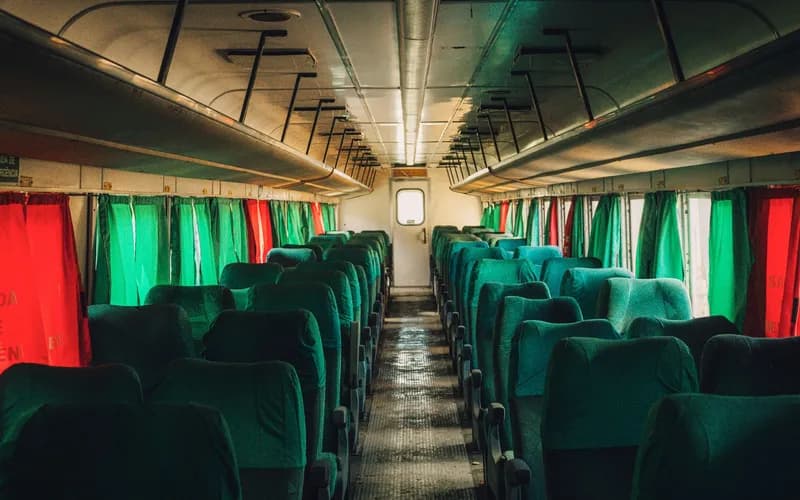
Second class is perfectly comfortable for these distances. Seats are arranged three-and-two, the carriages are clean, air conditioning is aggressive and there is a trolley service of drinks and snacks. Power sockets are not consistently available, so charge before you board. There is no dining car worth planning a meal around; bring food if you will be hungry.
For how rail fares sit alongside buses, boats and flights in an overall Laos budget, our Laos trip cost guide puts the numbers in context.
Onboard Rules, Luggage and the Border
Luggage allowances are enforced more strictly than most travellers expect. The general limit is around 20 kilograms and 160 centimetres in combined dimensions per adult, with oversized items refused at security. Bicycles, large surfboards and similar gear are a problem. Standard travel backpacks and suitcases are fine.
Prohibited items follow Chinese railway conventions and are checked properly. Lighters are limited, power banks above a certain capacity may be questioned, and anything resembling a blade will be removed. Note separately that Laos maintains a full ban on e-cigarettes and heated tobacco products, including possession, so do not carry a vape onto the train or into the country at all.
If you are continuing into China at Boten, the process is a full international border crossing with separate exit and entry formalities, and you need a Chinese visa arranged in advance. Allow several hours. Most travellers heading north stop at Luang Namtha or Oudomxay instead and stay in Laos.
Using the Train Without Losing the Journey
Here is the honest tension. The railway is a wonderful piece of infrastructure and a slightly awkward fit with slow travel. It compresses distance so effectively that it encourages people to see Laos as three stops rather than a country. A traveller can now do Vientiane, Vang Vieng and Luang Prabang in four days, and many do, and they leave having seen almost nothing.
Use it as a tool rather than an itinerary. Take the train to skip the sections that are genuinely just transit, then spend the time you saved staying longer in fewer places. Get off at Muang Xay, which almost nobody does, and go on into the Nam Ha area. Ride to Luang Prabang and then travel onward by river. The slow river journey remains one of the great Lao experiences, and we make the case for it in our piece on the Mekong slow boat from Huay Xai.
The railway also does not go south. Everything below Vientiane, including Thakhek, Savannakhet, Pakse and the whole of the Bolaven Plateau, is still road, bus and river country. That is a feature rather than a defect, and it is a large part of why the south feels different.
What to Do Next
- Fix your Laos dates first, then check the LCR Ticket app to see exactly how far ahead your specific route opens.
- Install the app and register your passport details before you need to buy, so you are not creating an account while the window opens.
- Have a fallback ready: identify a downtown ticket office or ask your accommodation to book, especially between November and February.
- Add transfer time at both ends of every leg. Assume 30 to 40 minutes each side, more in Vientiane traffic.
- Weigh your bag if you are near 20 kilograms, and repack anything oversized before you reach security.
- Deliberately plan at least one non-train leg into your route, whether that is the river, a southern bus or a stop nobody gets off at. Our Laos planning page can help you shape the sequence.
Frequently Asked Questions
How far in advance can I book Laos-China Railway tickets?
The domestic booking window has changed several times since the line opened and sits somewhere between three and seven days ahead depending on the period. Check the LCR Ticket app for your route rather than relying on any fixed figure, including this one. International tickets toward China open roughly two weeks ahead.
Can I buy tickets at the station on the day?
Sometimes, on quieter services and outside peak season. On the Vientiane to Luang Prabang route in high season, assume you cannot. Same-day purchase is a gamble that will occasionally strand you for a day.
Do I need my passport to travel?
Yes. Passport details are required at purchase and the document is checked against your ticket at the gate. Travel with the physical passport, not a photocopy or photo.
Is first class worth the extra cost?
For journeys under two hours, not particularly. Second class is clean and comfortable, and the difference is legroom and seat width rather than a different experience. On the longer run north toward Boten, first class is more defensible.
Does the train replace the bus entirely?
No. The line covers only the Vientiane to Boten corridor. Everything south of the capital, and most east-west movement, remains road-based. Buses also serve towns the railway skips entirely.
Is the railway a good way to reach Vang Vieng?
It is by far the best way, cutting a three to four hour road journey to about an hour. Just remember the station is outside town. For what to do once you arrive, see our analysis of how Vang Vieng has reinvented itself.
Is the scenery good from the train?
Patchier than you would hope. A large proportion of the route runs through tunnels, particularly north of Vang Vieng. There are fine stretches of river valley and karst between them, but do not book the train as a scenic experience; book it as efficient transport that happens to have good moments.