
Southern Laos does not announce itself. There is no ticketed old town, no procession of minivans, no queue for a sunrise viewpoint. There is Pakse, a low-slung Mekong town with a bus station and a handful of very good noodle shops, and then there is the road east, climbing steadily until the air changes. Somewhere above 800 metres the heat lets go of you. By 1,200 metres you are in coffee country, riding between rows of arabica under shade trees, and the Bolaven Plateau has begun. It is the part of Laos that rewards patience most obviously, and the part that most travellers skip because it sits four hundred kilometres south of the itinerary everyone else is following.
Where the Bolaven Plateau Actually Is
The plateau is a broad volcanic upland straddling four southern provinces: Champasak, Salavan, Sekong and Attapeu. It sits between roughly 800 and 1,350 metres above sea level, high enough that nights genuinely cool down and the rainy season arrives with real force. Pakse, on the Mekong at the plateau's western edge, is the gateway. Almost everyone arrives there by bus from Vientiane or Thakhek, by minivan from Si Phan Don, or by air on the short hop from the capital.
What makes the geography matter is the rain. The Bolaven catches an enormous amount of it, which is why the rivers running off its edges drop over basalt escarpments in a series of waterfalls that are, without exaggeration, among the most impressive in mainland Southeast Asia. The same rainfall and the same volcanic soil are why coffee grows here and almost nowhere else in the country.
If you are building a Laos itinerary that deliberately avoids the well-trodden north, this region belongs on the shortlist alongside the other quiet corners we cover in our guide to Laos off the beaten path. It is not undiscovered. It is simply under-visited relative to how good it is.
One request. Up to five tailored proposals.
Skip contacting agencies one by one — share your trip once and let up to five trusted Laos agencies come to you. Free, with no obligation.
Get my free quotesThe Coffee Story, and Why It Matters
Tip
Before committing to a coffee tour, ask whether the farm processes its own beans on site. If it does, the visit is usually worth it.
French planters put the first coffee into Bolaven soil around 1920, betting correctly that the altitude and the volcanic ground would suit it. A century later the plateau supplies the overwhelming majority of Laos's coffee, and Paksong, a small town at roughly 1,200 metres on the road east from Pakse, functions as its unofficial capital.
What you find on the ground is more interesting than a plantation tour. Coffee here is grown at very different scales at the same time: cooperatives of smallholders with a hectare or two, mid-sized estates with washing stations and drying beds, and a handful of larger operations with export contracts. Robusta dominates by volume; arabica, grown higher and picked later, is what the specialty buyers come for. Harvest runs roughly November through February, which is also the best time to be here for weather, so the two line up conveniently.
The honest caveat: many roadside places advertising a coffee tour will give you thirty minutes and a cup. The good ones will walk you through the whole chain, from cherry to drying bed to roast, and let you taste the difference between a washed and a natural process side by side. Ask before you commit whether the farm processes its own beans on site. If it does, the visit is usually worth it.
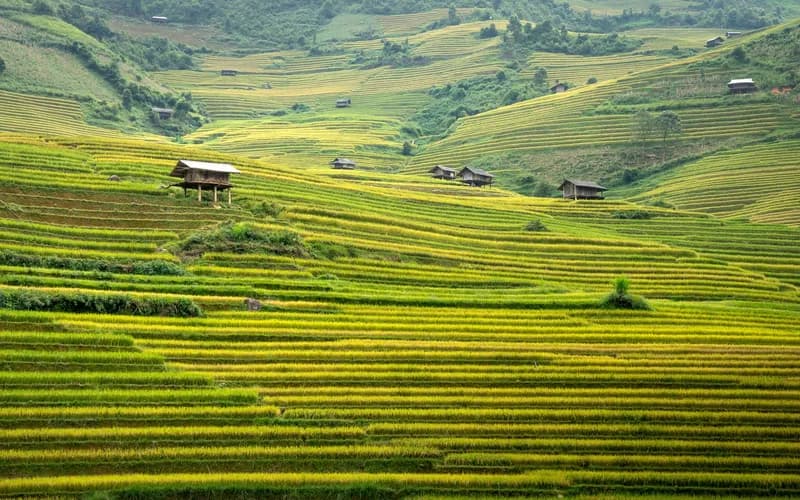
Coffee is also the most reliable everyday pleasure of the region. A strong cup at a farm guesthouse, taken slowly on a wooden terrace while the cloud burns off the valley, is one of those small experiences that justifies the whole detour. If you are the sort of traveller who plans around what is on the plate and in the cup, our guide to Lao food will give you the wider context for what you will be eating alongside it.
The Waterfalls: Four Sisters and Beyond
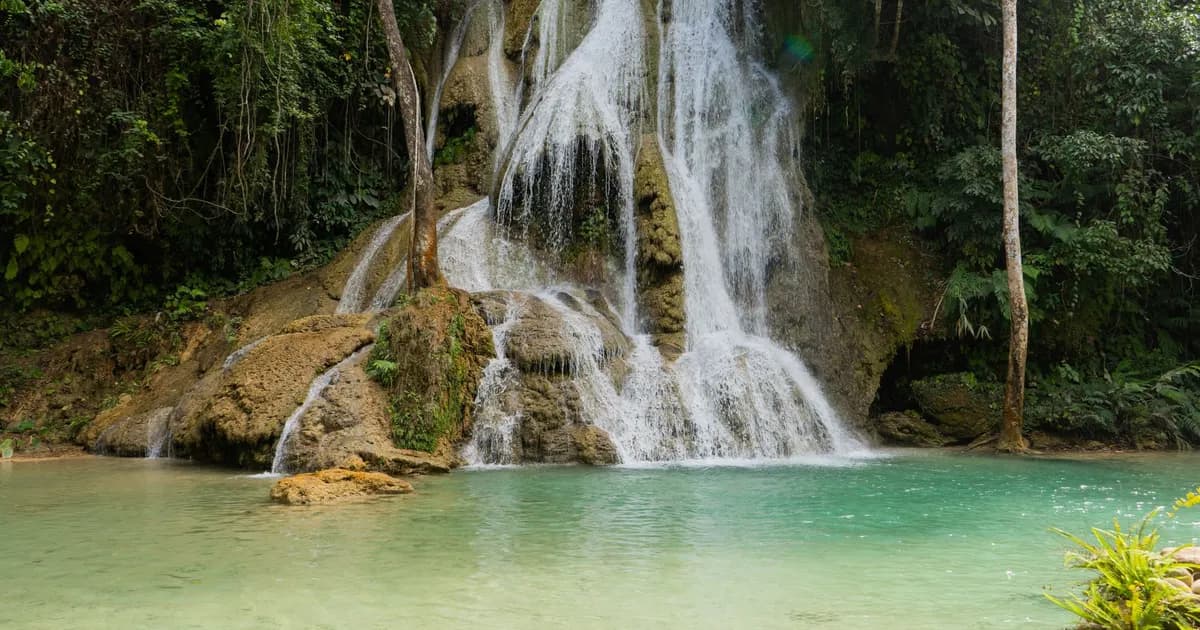
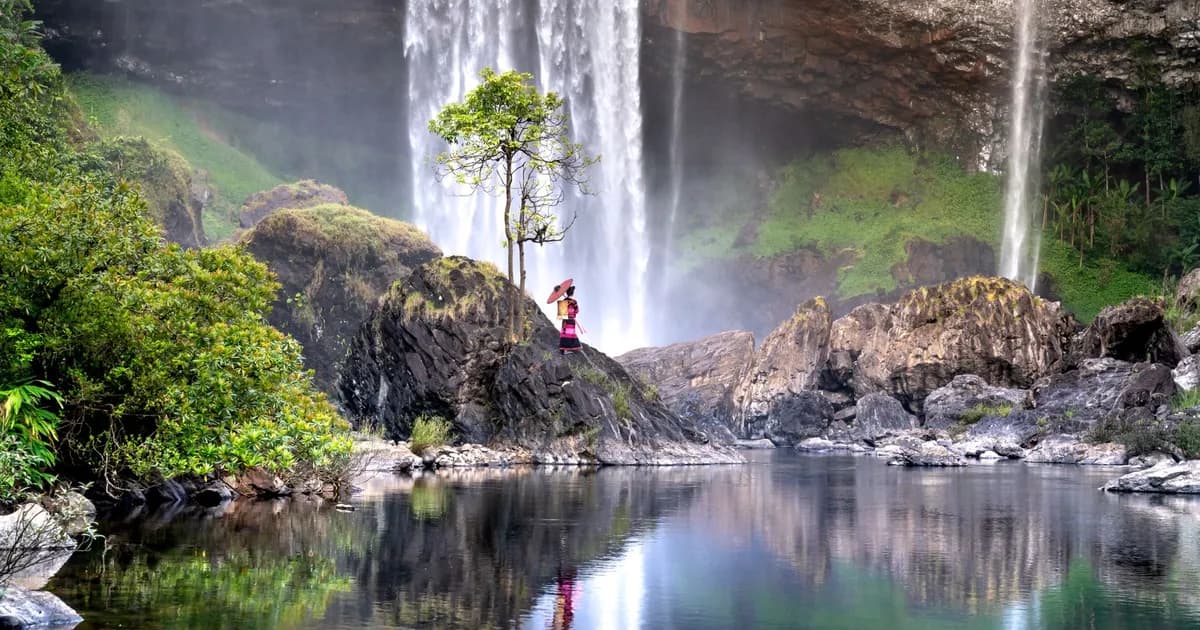
Locals speak of the four sisters around Paksong, and they are the headline act. Tad Fane is the tallest and most photographed: twin plumes dropping well over 100 metres into a forested gorge, best seen from the viewpoint across the ravine in the early morning before cloud fills it. Tad Yuang, a few kilometres away, is smaller and friendlier, with a pool you can actually swim in and a shaded path down beside the drop. Tad Champee and Tad Katamtok complete the set, the latter being the wildest and hardest to reach.
North of Paksong, in Salavan province, Tad Lo is a different proposition entirely. It is less a single waterfall than a cluster of three along the Xe Set river, with a village of guesthouses that has quietly become the most pleasant place to stop on the whole plateau. People arrive for one night and leave on the third. That is usually a sign you have found something worth staying for.
A few practical notes on the falls:
- Volume varies enormously by season. In the dry months from February onward some falls thin out considerably; in September and October they are thunderous and the spray can make viewpoints useless.
- Small entrance fees, typically tens of thousands of kip, are collected at most sites. Carry small notes.
- Rocks near the lips of falls are slick basalt. Every year there are accidents. Stay behind the barriers where they exist and well back where they do not.
Get matched with up to 5 trusted Laos agencies
- Free
- No obligation
- Up to 5 agencies
Riding the Loop: Small, Big, or Neither
Practical
- Small loop
- ~200 km, 2-3 days
- Big loop
- 300-340 km, 3-4 days
- Start and end
- Pakse
- Getting around
- semi-automatic motorbike or car with driver
The classic way to see the plateau is the Bolaven Loop, sometimes called the Pakse Loop because it starts and ends there. There are two standard shapes. The small loop runs roughly 200 kilometres over two to three days, taking in Tad Lo, Thateng and Paksong before dropping back to Pakse. The big loop adds Sekong and Attapeu province, stretching to somewhere between 300 and 340 kilometres over three to four days, and passes through noticeably quieter country.
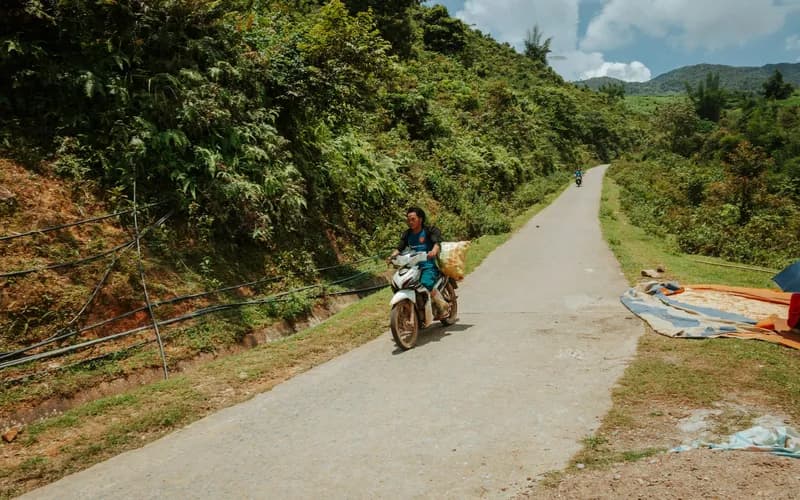
Most people ride it on a semi-automatic motorbike rented in Pakse, often with the rental shop storing luggage and providing a hand-drawn map. Roads on the main circuit are surfaced and generally in decent condition; the connectors on the big loop are rougher and can be genuinely difficult after heavy rain. If you are not a confident rider, do not learn here. Hire a car with a driver instead, which is easy to arrange in Pakse and costs less than most people expect, or take the loop as an organised trip with one of the operators we list on our Laos travel agencies page.
The temptation is to compress the loop into two days. Resist it. The plateau's whole character is in the pauses: the roadside coffee stop that becomes an hour, the village market that happens to be on, the afternoon storm that pins you under a tin roof with three farmers and a thermos. Four days is the right number for the big loop. Three is the minimum for the small one.
The Villages, and How to Visit Them Well
The Bolaven is one of the most ethnically diverse regions in Laos. Katu, Alak, Nge, Suay and Laven communities live across the plateau, many with distinct languages, house forms and textile traditions. This is genuinely interesting, and it is also the part of a Bolaven trip most easily done badly.
The bad version is a van pulling into a village so that visitors can photograph houses and leave. The good version involves arriving with someone who has a standing relationship there, staying long enough to be a guest rather than an audience, paying properly, and asking before photographing anyone. Several villages around Tad Lo and on the Sekong side run homestays on their own terms, and these are where the money actually lands locally.
We take a firm line on this, and the reasoning is set out in our charter for slow travel. In short: if a visit is arranged so that you can look at people, it is a bad visit. If it is arranged so that you can stay with people, it is usually a good one.
When to Go, and What It Costs
November to February is the sweet spot: dry, clear, and cool enough at plateau altitude that you will want a fleece after dark. This also coincides with the coffee harvest, so farms are working and the roads carry trucks full of cherries. March to May is hot and hazy, and agricultural burning across the region can flatten the views. June to October brings the monsoon, spectacular water volume, dramatic cloud, and genuinely difficult riding conditions on unsealed sections.
Costs on the plateau run below the Luang Prabang line. Simple guesthouses in Tad Lo or Paksong sit at the budget end, farm-stay rooms with a view cost more, and motorbike rental in Pakse is modest per day before fuel. The broader picture, including transport and how much a full Laos trip actually adds up to, is laid out in our Laos trip cost guide for 2026. One warning that applies everywhere south of Vientiane: this is a cash region. ATMs exist in Pakse and Paksong but not reliably beyond them, and card acceptance outside Pakse hotels is close to nonexistent.
What to Do Next
- Give the plateau four nights minimum in your outline, and treat Pakse as a base rather than a destination in itself.
- Decide early between riding and being driven. Book a car and driver in advance in high season; motorbikes can be arranged on arrival.
- Fix your dates around the November to February window if coffee harvest and clear views matter to you.
- Choose one village homestay and book it directly or through an operator with a real relationship there, rather than adding villages as stops.
- Draw enough kip in Pakse for the whole loop, in small denominations, and assume no card payments once you leave town.
- Build a rest day into Tad Lo. It is the one place on the plateau where doing nothing is the correct plan.
Frequently Asked Questions
How many days do I need for the Bolaven Plateau?
Three days is the practical minimum for the small loop and four is better for the big loop. If you only have two, do an out-and-back to Paksong and Tad Fane rather than rushing a circuit you will not enjoy.
Do I need a motorbike licence to ride the loop?
Legally you should hold a valid motorcycle licence, and increasingly an International Driving Permit is expected at checkpoints. More importantly, travel insurance will generally not cover a motorbike accident if you were riding without the correct licence class. Check your policy wording before you rent.
Is the Bolaven Plateau safe?
The main risks are ordinary road risks: gravel, rain, livestock and other traffic. Helmet use is legally required and enforced. Unexploded ordnance remains a serious issue in parts of southern Laos, particularly Sekong and Attapeu; stay on paths and marked ground, and never touch metal objects in fields or forest.
Can I visit the Bolaven Plateau without renting a vehicle?
Yes. Public songthaews and buses connect Pakse, Paksong, Thateng and Tad Lo, and shared minivans run to Sekong. It is slower and less flexible, but entirely feasible if you allow extra time and are relaxed about departure schedules.
How does the Bolaven compare with northern Laos?
They are different countries in feel. The north is river valleys, limestone and trekking, as at Nong Khiaw and the Nam Ou valley. The south is upland plateau, coffee, waterfalls and Mekong islands. If you have three weeks, do both. If you have ten days, pick one and go deep.
When is the coffee harvest?
Broadly November to February, with arabica picked later than robusta and exact timing shifting year to year with the rains. Visiting in this window means you will see cherries on the trees, pickers in the rows and drying beds in use.
What is the best way to get to Pakse?
Overnight buses run from Vientiane and Thakhek, minivans come up from Si Phan Don and across from Ubon Ratchathani in Thailand, and there are short domestic flights from Vientiane. For help sequencing all of this into a coherent route, start with our Laos trip planning page.