
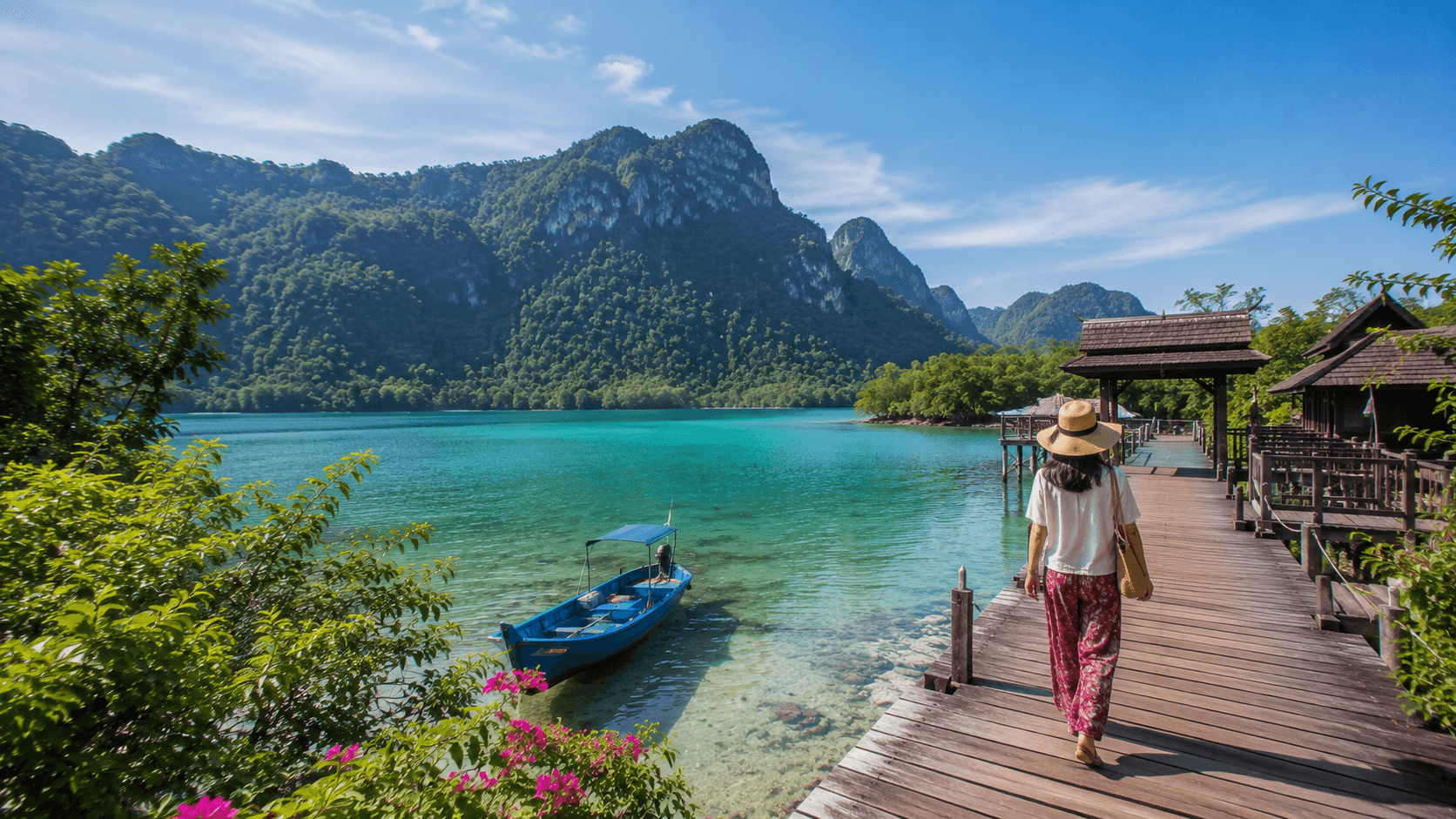

Malaysia rewards the traveller who slows down, and it quietly punishes the one who doesn't. On paper it looks compact: a peninsula the length of a long drive, plus two states on the island of Borneo. In practice it is one of the most geographically and culturally layered countries in Southeast Asia, and its weather does something few destinations do. The best time to visit is not a single month. It changes depending on which part of the country you stand in, because the rain arrives on one coast while the other stays dry.
This guide is built around that fact. Instead of a generic "go in the dry season," it walks you through Malaysia's regions and the monsoon that governs each of them, so you can match the right place to the right month and give it the time it deserves. The aim is not to help you tick off more. It is to help you choose less, and see it properly.
Malaysia has two halves, and you cannot rush either
The first thing to understand about Malaysia is that it is really two countries wearing one flag. Peninsular Malaysia hangs off the bottom of mainland Asia, sharing a border with Thailand and looking across to Sumatra and Singapore. Its rhythm is one of cities, tea-growing highlands, colonial trading ports and warm-water islands. Then, a two-to-three-hour flight across the South China Sea, you reach Malaysian Borneo, split into the states of Sabah and Sarawak. This is a different world: rainforest older than the Amazon, orangutans, a 4,000-metre mountain, river journeys and some of the finest diving on the planet.
The single most useful piece of planning advice we can give is this: do not try to do the peninsula and Borneo in one short trip. It is technically possible, and travellers do it, but it means spending your precious days in airports and transit rather than in places. If you have a week, choose one region and one theme. If you have two weeks, you can pair, say, the west-coast heritage cities with a Borneo add-on, but even then you are moving faster than we would like. Three weeks is where Malaysia opens up and lets you breathe. Slow travel here is not a luxury. It is the difference between skimming and understanding.
One request. Up to five tailored proposals.
Skip contacting agencies one by one — share your trip once and let up to five trusted Malaysia agencies come to you. Free, with no obligation.
Get my free quotesWhen to go: the monsoon changes with the map
Most countries have a wet season and a dry season, and everyone agrees on the calendar. Malaysia does not. It sits astride the equator, so it is warm and humid all year, with temperatures in the lowlands hovering around 30°C day after day. What varies is where and when the rain falls, and that is dictated by two monsoons blowing from opposite directions. Getting this right is the crux of planning a Malaysian trip, so it is worth slowing down over.
The west coast of the peninsula
The west coast, which holds Kuala Lumpur, Melaka, Penang and George Town, Ipoh, the Cameron Highlands and Langkawi, is the sheltered side. It is the most reliably visitable part of the country and can be travelled comfortably at any time of year. Its wetter stretch comes with the southwest monsoon, roughly April to October, but this rarely means washed-out days. It means afternoon and evening downpours, often heavy but short, that clear as quickly as they arrive. Mornings are frequently bright. The drier, clearer window tends to fall between roughly December and February. In short, the west coast has no season you need to avoid, only a rhythm to plan your days around: sightsee in the morning, take shelter, or a long lunch, when the sky opens.
The east coast of the peninsula
The east coast is a completely different story, and it is where planning matters most. This is the side facing the South China Sea, home to the islands travellers dream about: the Perhentians, Redang and Tioman, plus the Islamic-influenced cultural towns of Kota Bharu and Kuala Terengganu, and the gateway to Taman Negara national park. From roughly November to February, and sometimes stretching into March, the northeast monsoon slams into this coast. Rainfall is heavy and sustained, seas turn rough, and, crucially, most island resorts simply close. Boats stop running, flights to small island airports are cancelled by wind, and the water turns murky. If you arrive on the east coast in December hoping for turquoise snorkelling, you will be disappointed and possibly stranded.
The corollary is a beautiful window. From April to September, the east-coast islands are at their finest: calm, clear water, gentle weather and full-service resorts. If beaches and snorkelling are your priority, this is when to come, and it is the near-perfect mirror image of the peninsula's west coast. Plan the two coasts against each other rather than expecting one date to suit both.
Malaysian Borneo, Sabah and Sarawak
Borneo has its own pattern again. Both Sabah and Sarawak are wetter from around November to February, but here that does not mean shutdown. The rainforest is meant to be wet, and it stays fully open and rewarding through those months, if greener, muddier and more prone to short delays. Sabah's marine highlights follow their own logic: surface conditions for diving are calmest and visibility best from around March to June, though the reefs are dived year-round. River wildlife along the Kinabatangan is easiest to spot in the drier months of roughly March to September, when animals concentrate near the shrinking water. One firm date to know: Sipadan island is closed to all visitors every year during the whole of November for a rest period, so build around that if diving is your reason for coming.
The honest summary: there is no single perfect month for all of Malaysia. There is a perfect month for each region, and the skill of planning here is choosing your region first and letting the calendar follow, rather than the reverse. For a fuller month-by-month breakdown and help sequencing a route, our plan your journey page is a good next step.
Kuala Lumpur and the west-coast heritage cities
Kuala Lumpur is where most journeys begin, and it deserves more than the customary night-before-the-flight. It is a genuinely layered city: colonial arcades and a Moorish railway station sit beneath the Petronas Towers, Chinatown's morning markets give way to the Hindu shrines of the Batu Caves on the northern edge, and the food runs from banana-leaf curries to Cantonese noodle stalls that have been perfected over generations. Give it two or three unhurried days and let neighbourhoods, rather than sights, set your pace. The city is also the country's transport hub, so nearly every route threads back through here.
North up the coast lies the country's cultural heart. George Town, on the island of Penang, is a UNESCO World Heritage site and arguably the finest example of the Straits-Chinese, or Peranakan, culture that grew from centuries of trade. Its shophouses, clan temples, mosques and churches sit within a few walkable blocks, and its street food is regarded by many as the best in the country. This is a place to stay put for several days rather than day-trip: eat slowly, walk in the early cool, and let the layers of Chinese, Indian, Malay and colonial history reveal themselves. Melaka, south of KL, tells a parallel story from the Portuguese and Dutch side, its red church square and riverside lanes best enjoyed midweek when the domestic crowds thin.
Food is so central to these cities that it is really its own reason to travel, and we have written about it at length in the slow traveller's guide to Malaysian food. Treat the hawker centres and kopitiams not as refuelling but as the point of the day.
Get matched with up to 5 trusted Malaysia agencies
- Free
- No obligation
- Up to 5 agencies
Cameron Highlands and Ipoh: the cool interior
When the lowland heat begins to feel relentless, the peninsula offers an escape upward. The Cameron Highlands, a few hours inland from either KL or Penang, sit high enough that you will want a light jacket in the evening. This is tea country: rolling emerald plantations, cool mist, strawberry farms and mossy forest trails. It suits the slow traveller perfectly, because there is little to do except walk, drink tea grown on the hillside in front of you, and let a couple of days pass gently. Come aware that weekends and Malaysian school holidays bring crowds and traffic on the single mountain road; midweek is calmer and cooler in every sense.
Between the highlands and the coast sits Ipoh, a former tin-mining town that has quietly become one of Malaysia's most rewarding stops. Its old town is a walkable grid of restored shophouses, independent cafés and some of the country's most fanatically loved food, from white coffee to bean sprout chicken. Limestone hills riddled with cave temples ring the city. Ipoh is the kind of place hurried itineraries skip and slow travellers fall for, precisely because it asks nothing of you but time.
Langkawi: islands on the calmer side
If you want an island but are travelling during the east-coast monsoon, Langkawi is the answer. This archipelago of ninety-nine islands sits off the northwest coast, on the sheltered side, so it stays accessible year-round when the Perhentians and Redang are shuttered. It is a more developed, resort-oriented island than the east-coast pair, with duty-free shopping, a dramatic cable car and skybridge, mangrove boat tours and long beaches. It will not give you the castaway simplicity of the east, but it gives you reliable weather and easy logistics, which in the wrong months is exactly what you want. Ferries connect it to the mainland at Kuala Perlis and Kuala Kedah, and there are direct flights from KL and beyond.
The east-coast islands and Taman Negara
For many travellers, the image of Malaysia is a small, forested island ringed by clear water, and that image lives on the east coast. The Perhentian Islands are the backpacker-and-family favourite: two main islands, no cars, coral just off the beach, and a pace that slows to nothing within a day. Redang is a little more upmarket and resort-led, with some of the clearest water in the country. Tioman, further south and reached from Mersing, is larger and more varied, a duty-free island with jungle-covered peaks as well as reefs. All three share the same seasonal truth described above: come between April and September, and never plan a November-to-February beach holiday here.
Inland, the same eastern region holds Taman Negara, one of the oldest tropical rainforests on Earth at an estimated 130 million years. Reached by road and a long, atmospheric river-boat ride, it offers canopy walkways, night jungle walks, caves and the chance, if you are patient and lucky, of glimpsing rare wildlife. It is genuinely wild, and it rewards those who stay several nights over those who dash in for a day. The drier months from around February to September make trails more manageable, though rain is always part of the rainforest bargain. If you are drawn to the quieter, wilder corners of the country, our guide to off-the-beaten-path Malaysia goes deeper into places like these.
Sabah: mountains, orangutans and Sipadan
Cross the sea to Sabah, in the north of Borneo, and Malaysia changes register entirely. This is the state for travellers who come for nature, and it packs an extraordinary amount into a compact area. Kota Kinabalu, the laid-back coastal capital, is the arrival point and a fine spot to watch the sunset over island-dotted water. Rising behind it is Mount Kinabalu, at just over 4,095 metres the highest peak between the Himalayas and New Guinea. Climbing it is a two-day undertaking, ending with a pre-dawn scramble to a granite summit above the clouds. Permits and mountain huts are strictly limited and sell out, so if the climb is a priority, book two to three months ahead rather than hoping to arrange it on arrival.
Sabah's other great draw is wildlife. Near Sandakan, the Sepilok Orang Utan Rehabilitation Centre offers one of the most reliable and responsibly run chances to see these great apes, alongside a sun bear conservation centre next door. From there, most travellers continue to the Kinabatangan River, where boat safaris at dawn and dusk deliver proboscis monkeys, pygmy elephants, hornbills and, with luck, wild orangutans in the riverside forest. Wildlife is easiest to spot in the drier months from roughly March to September, when the receding water draws animals to the banks.
Then there is Sipadan, routinely ranked among the world's top dive sites: a single oceanic pinnacle rising from deep water, circled by turtles, barracuda tornadoes, grey reef sharks and, in the cooler upwelling months, the chance of hammerheads. Access is deliberately restricted to protect it. You cannot buy a permit as an individual; a strict daily cap of divers is issued only to licensed operators based on the nearby islands of Mabul and Kapalai and in Semporna, who allocate places among their guests. In practice this means booking a multi-night dive package well in advance, with longer stays improving your odds of a Sipadan day. Surface conditions and visibility are usually best from around March to June, and remember the island closes entirely every November. Arranging this kind of specialist, permit-bound trip is exactly where a good local operator earns its keep, and our Malaysia travel agencies directory is a place to start.
Sarawak: rivers, longhouses and the great caves
Sarawak, the larger Borneo state to the southwest, is quieter, wilder and, for many, the more soulful half. Its capital, Kuching, is one of the most likeable cities in Malaysia: a relaxed riverside town of restored shophouses, excellent food, and a genuine sense of the many indigenous cultures, collectively the Dayak, who call the region home. It makes an ideal, unhurried base for several days.
From Kuching, short trips reach Bako National Park, a compact peninsula of jungle, sculpted sea cliffs and reliable proboscis monkeys, and the semi-wild orangutans of the Semenggoh centre. Further afield lies Sarawak's crown jewel, Gunung Mulu National Park, a UNESCO site of vast caves, including some of the largest cave chambers on Earth, karst pinnacles and rainforest. Mulu is reached by a short flight from Kuching, Miri or Kota Kinabalu rather than by road, and entry is via a multi-day park pass; the popular caves and adventure activities should be booked ahead, especially in the busy July-to-September window.
Sarawak also offers one of Malaysia's most meaningful cultural experiences: staying overnight in a longhouse, the traditional communal dwelling of Dayak communities, often reached by river. Done respectfully and through the right hosts, it is a window into a way of life still lived rather than performed. Sarawak is wetter from November to February, but remains open and rewarding throughout; you simply travel with a little more flexibility for river levels and weather.
Putting it together: slow routes for one, two or three weeks
With one week, resist the urge to see it all. Pick a single thread. A west-coast heritage loop of Kuala Lumpur, Ipoh or the Cameron Highlands, and George Town gives you cities, food, tea country and easy transport, and works in any month. Alternatively, spend the whole week in Sabah, pairing Kinabalu or Kota Kinabalu with the Sepilok and Kinabatangan wildlife circuit. Either is a full, satisfying trip on its own.
With two weeks, you can add depth or a second region. One approach keeps you on the peninsula: the west-coast cities, then a crossing to the east coast for four or five slow days on the Perhentians or Tioman, weather permitting, between April and September. Another pairs a shorter peninsula leg with a Borneo add-on, for example a few days in KL and George Town followed by a week in Sabah. It works, but accept that a full travel day disappears into the flight and transfers.
With three weeks, Malaysia finally has room to breathe. You might spend the first week on the west coast, a middle stretch on the east-coast islands and in Taman Negara, and a final week in Borneo, choosing either Sabah for wildlife and diving or Sarawak for rivers, caves and culture. Even then, we would counsel choosing one Borneo state rather than both. The point of three weeks is not to add a fourth region; it is to stop rushing the three you have. Costs vary widely by region and pace, and our Malaysia trip cost and budget guide can help you plan realistically.
Getting around
Malaysia is one of the easier countries in Southeast Asia to move around, which is part of what makes slow travel here so pleasant. On the peninsula's west coast, an efficient network of intercity trains and the fast ETS service links KL with Ipoh, Penang and points north, making the classic heritage route almost entirely rail-based and refreshingly stress-free. Long-distance buses are comprehensive, comfortable and cheap, reaching corners the trains do not, including the east coast. Within cities, the ride-hailing app Grab is ubiquitous, transparent on price and the simplest way to get around door to door.
Islands are reached by ferry: from Kuala Perlis or Kuala Kedah to Langkawi, from Kuala Besut to the Perhentians, and from Mersing to Tioman, with services heavily reduced or suspended on the east coast during the monsoon. Reaching Borneo means flying; frequent, inexpensive flights connect KL and other hubs to Kota Kinabalu and Kuching, and onward light aircraft reach remote spots such as Mulu. Distances within Borneo are larger and roads slower than the peninsula, so internal flights and organised transfers often make sense. Build in buffers around island and small-aircraft flights in the wet months, when weather delays are routine.
Festivals worth planning around
Malaysia's multicultural calendar is one of its quiet joys, and a festival can transform a visit, for better or, if you have not planned around it, for more complicated logistics. In early February, Thaipusam sees enormous, moving Hindu processions, most spectacularly at the Batu Caves near KL. Chinese New Year, in mid-February in 2026, fills Chinatowns with colour but also empties transport seats and books out hotels as the country travels home, so reserve early. Hari Raya Aidilfitri, marking the end of Ramadan and falling around late March in 2026, is the year's biggest holiday; the preceding fasting month changes the rhythm of daily life, especially on the more conservative east coast, and the holiday itself triggers a mass exodus from the cities that affects every form of transport.
In Borneo, two harvest festivals are worth timing for: Kaamatan in Sabah at the end of May, and Gawai Dayak in Sarawak on the first days of June, both vivid celebrations of indigenous culture that are among the best times to experience Dayak communities. The Mid-Autumn or Mooncake Festival, in September or October, lights up the Chinese quarters with lanterns. None of these should stop you travelling; they simply reward a little forethought, both to catch the ones you want and to book ahead around the ones that move the whole country at once.
Travelling responsibly
Slow travel and responsible travel are close cousins, and Malaysia gives them plenty of room. Its natural highlights are also its most fragile: coral reefs stressed by warming seas and careless snorkellers, rainforests under pressure from plantations, and wildlife whose survival depends on tourism being done well rather than merely done. Choose reef-safe sunscreen, keep a respectful distance from animals, and favour wildlife encounters at genuine rehabilitation and conservation centres over roadside attractions. When visiting orangutans or river forests, a smaller group and a knowledgeable guide leave a lighter footprint and teach you more.
Culturally, a little sensitivity goes a long way in a Muslim-majority country with deep Chinese, Indian and indigenous communities living alongside. Dress modestly at mosques and temples, ask before photographing people, and on the east coast and in rural areas be mindful during Ramadan. Spending your money with locally owned guesthouses, hawker stalls and community-based operators, particularly for longhouse stays in Sarawak, keeps tourism's benefits where they belong. If you would like your whole trip to reflect these values, our charter for slow travel sets out the principles we plan by. Travel Malaysia slowly, and you will not only see more clearly; you will tread more lightly.
Frequently Asked Questions
When is the best overall time to visit Malaysia?
There is no single best month, because the weather depends on the region. For the west coast of the peninsula, including Kuala Lumpur, Penang and Langkawi, almost any month works, with December to February the clearest. For the east-coast islands like the Perhentians and Tioman, aim for April to September. For Borneo, conditions are good much of the year, with drier wildlife-watching from about March to September. Decide which region matters most to you, then let that choose your dates.
Can I visit both Peninsular Malaysia and Borneo in one trip?
You can, but we would not recommend trying to do both properly in less than two weeks, and ideally three. They are separated by a two-to-three-hour flight and are genuinely different destinations. In a short trip, combining them means losing whole days to airports and seeing each only in passing. If your time is limited, choose one and go deep; you will come away with a far richer experience than a rushed sampling of both.
Why do the east-coast islands close, and when exactly?
From roughly November to February, sometimes into March, the northeast monsoon brings heavy rain and rough seas to the peninsula's east coast. Boats cannot run safely, small island airports face wind cancellations, and most resorts on the Perhentians, Redang and Tioman close for the season. They typically reopen around March or April. The west-coast island of Langkawi stays open year-round, so it is the reliable choice if you want a beach during those months.
How do I dive Sipadan, and do I need to book far ahead?
Sipadan's access is strictly capped to protect the reef. You cannot obtain a permit as an individual; a limited number are issued daily only to licensed operators based on Mabul, Kapalai and in Semporna, who allocate them to guests. In practice you book a multi-night dive package, often three nights or more, well in advance, as longer stays improve your chances of a Sipadan permit. Surface conditions are usually best from March to June, and the island closes to everyone during November each year.
Do I need to book Mount Kinabalu and Gunung Mulu in advance?
Yes, for both. Climbing permits and the limited mountain accommodation on Kinabalu sell out, so book two to three months ahead if the summit is a priority. Gunung Mulu in Sarawak is reached by a short flight rather than road, and its most popular caves and adventure activities, along with park accommodation, should be reserved in advance, especially during the busy July-to-September period. Spontaneity is fine for much of Malaysia, but not for these two.
Is Malaysia easy to travel independently and get around?
Yes, it is one of the more straightforward countries in Southeast Asia for independent travel. English is widely spoken, the west-coast train network is comfortable and punctual, long-distance buses are cheap and extensive, and the Grab app makes city transport simple. The main planning points are ferries to the east-coast islands, which pause during the monsoon, and flights to and within Borneo, which need building into your schedule and a little weather buffer in the wet season.
What festivals should influence when I travel?
The biggest to plan around are Chinese New Year in February and Hari Raya Aidilfitri around late March in 2026, both of which see the whole country travel home, filling transport and hotels, so book well ahead or avoid the peak days. Thaipusam in early February is a spectacular sight at the Batu Caves. In Borneo, the harvest festivals of Kaamatan in Sabah in late May and Gawai Dayak in Sarawak in early June are wonderful times to experience indigenous culture. These are reasons to plan, not to stay away.