
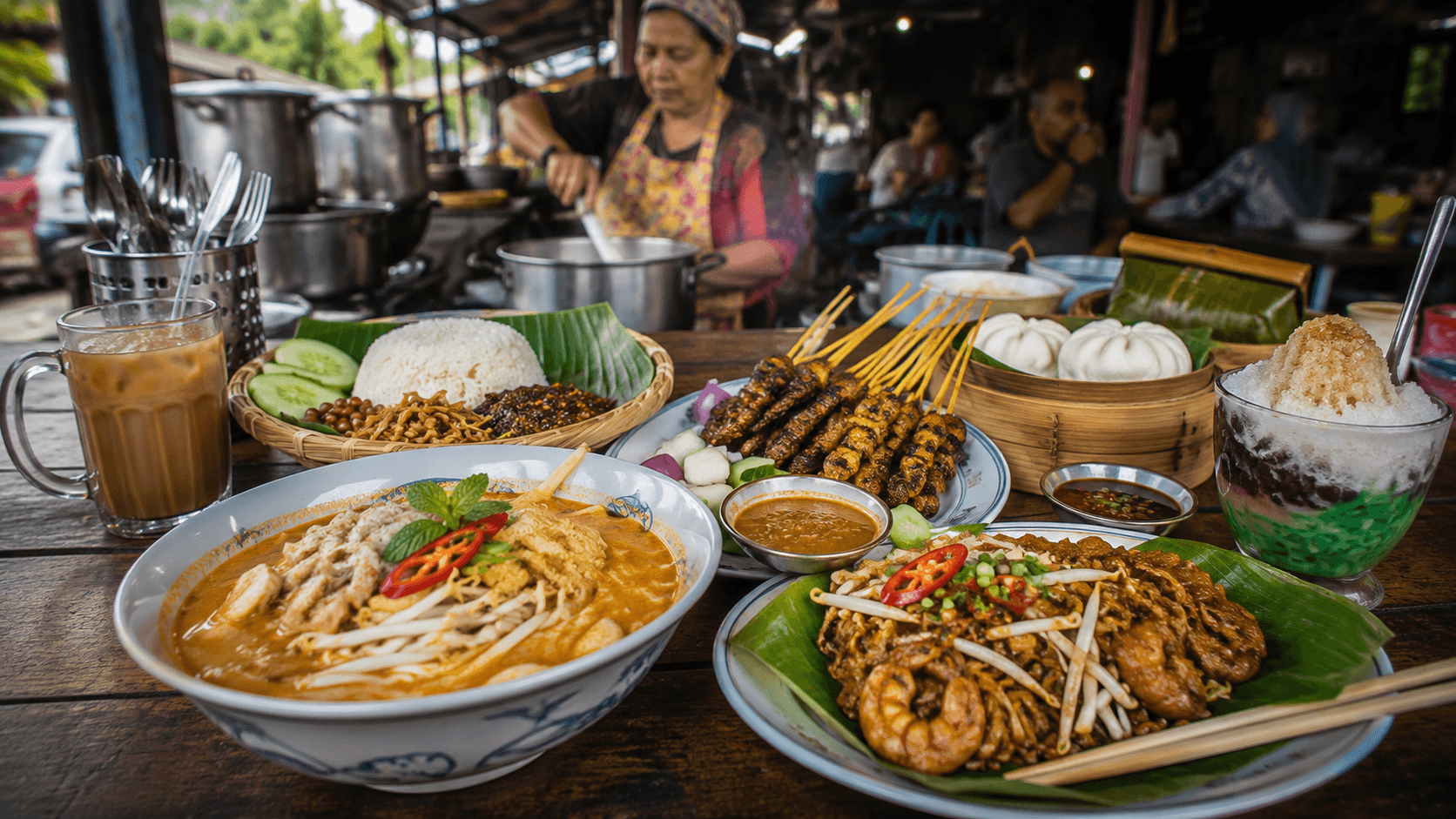

In Malaysia, the fastest way to understand a place is to sit down and eat. Not at a white-tablecloth restaurant, but on a plastic stool under a corrugated roof, elbow to elbow with taxi drivers and grandmothers and office workers on their lunch break, in front of a hawker who has been cooking the same single dish, and only that dish, for thirty years. Malaysian food is not one cuisine. It is a conversation held over centuries between Malay villages, Chinese trading ports, Indian labour lines, indigenous longhouses, and the Peranakan families who blended all of it into something new. To eat your way across the country is to read that history, one bowl at a time.
This is a country where breakfast can be a banana-leaf spread of curries eaten with your right hand, lunch a bowl of noodles pulled from a wok breathing with smoke, and a midnight snack a flaky flatbread torn apart at a 24-hour stall while the whole neighbourhood argues about football. Slow travel in Malaysia rewards the patient eater more than almost anywhere in Asia. You do not rush this. You linger, you order one more thing, you let a stranger tell you which stall is really the best. Here is how to eat in Malaysia, and why the table is the truest map you will find.
The multicultural table: Malay, Chinese, Indian, and Nyonya
Malaysian cuisine rests on three great pillars and one remarkable hybrid. The Malay foundation is built on rice, coconut, chilli, and a pantry of aromatics: lemongrass, galangal, turmeric, kaffir lime, and the fermented shrimp paste called belacan that gives so many dishes their deep savoury backbone. Malay cooking gave the country its national dish and its love of the spice paste known as rempah, pounded fresh and fried slowly until fragrant.
The Chinese arrived over generations of migration, mostly from the southern provinces of Fujian and Guangdong, bringing the wok, the noodle, and the art of roasting. Hokkien, Cantonese, Hakka, Teochew, and Hainanese communities each contributed their own dishes, which is why a plate of char kway teow and a bowl of bak kut teh can sit a few streets apart yet come from entirely different culinary grammars.
The Indian community, largely Tamil in origin but with North Indian and Muslim Indian threads too, gave Malaysia its breads and its banana-leaf feasts: roti canai in the morning, thali-style rice at midday, and the whole institution of nasi kandar in the north. And then there are the Peranakan, or Straits Chinese, descendants of early Chinese settlers who married into local Malay communities. Their Nyonya cuisine fused Chinese ingredients with Malay spice paste to create something that belongs wholly to Malaysia and nowhere else.
What makes the Malaysian table extraordinary is that these traditions did not stay in their lanes. They borrowed, adapted, and cross-pollinated until the boundaries blurred. A single hawker centre might offer all four at once, and nobody thinks this is unusual. It is simply lunch. If you are still deciding when and where to build your trip around this, our guide to where to go and when in Malaysia is a good place to start mapping the country's food regions.
One request. Up to five tailored proposals.
Skip contacting agencies one by one — share your trip once and let up to five trusted Malaysia agencies come to you. Free, with no obligation.
Get my free quotesNasi lemak and the national icons
If Malaysia has a single dish that everyone claims as their own, it is nasi lemak. At its heart it is deceptively simple: rice cooked in coconut milk and pandan leaf, served with a fiery-sweet chilli sambal, crunchy fried anchovies (ikan bilis), roasted peanuts, slices of cucumber, and half a hard-boiled egg, all traditionally wrapped in a banana-leaf and newspaper parcel. Eaten for breakfast at a roadside stall, it costs pocket change and fuels half the nation before work. But nasi lemak is also endlessly elaborated: with fried chicken, with rendang, with sambal sotong (squid), turning a humble parcel into a full meal at any hour.
Around nasi lemak orbit the other national icons. Satay is skewered, marinated meat grilled over charcoal and served with a thick peanut sauce, compressed rice cakes, and raw onion and cucumber. Rendang, a dry, slow-cooked beef curry where the meat braises for hours until the coconut sauce all but caramelises onto it, is a festival dish of extraordinary depth, and one of the great arguments for eating slowly. Mee goreng, spicy fried noodles, and its rice cousin nasi goreng, appear everywhere. Roti canai, the flaky, pan-fried Indian-Muslim flatbread served with dhal or curry for dipping, is arguably the country's favourite breakfast after nasi lemak.
These are the dishes a first-time visitor will meet quickly, and they deserve their fame. But treat them as the front door rather than the whole house. The deeper you travel, the more the map fragments into regional specialities that never make the tourist shortlists.
The laksa family: the Penang versus Sarawak divide
No single word causes more delicious confusion in Malaysia than laksa, because it does not describe one dish but a whole family of noodle soups that vary dramatically by region. Understanding the laksa family is a shortcut to understanding the country itself.
At one pole sits Penang assam laksa, a dish so beloved it regularly tops global street-food lists. It is sour, spicy, and unapologetically fishy: a broth built on tamarind (assam gives it its name) and flaked mackerel, brightened with torch ginger, and heaped over thick rice noodles with shredded cucumber, pineapple, raw onion, mint, and a dark, funky spoonful of prawn paste stirred in at the end. It is refreshing and confrontational at once, and it tastes like nowhere else.
At the other pole sits Sarawak laksa, from Malaysian Borneo, which could hardly be more different. Here the broth is rich and aromatic, built from a paste of dried spices, sambal belacan, garlic, galangal, and lemongrass, lightly enriched with coconut milk. It arrives over rice vermicelli topped with omelette strips, shredded chicken, prawns, bean sprouts, and coriander, with a wedge of lime and a dab of sambal on the side. The late food writer and chef Anthony Bourdain famously called it breakfast of the gods, and in Kuching people do eat it in the morning.
Between these two poles lies a whole spectrum. Curry laksa, sometimes called curry mee, is the coconut-rich, mildly spicy bowl most Westerners picture when they hear the word: yellow noodles and vermicelli in a curry broth with tofu puffs, cockles, and chicken. Laksa lemak, the Nyonya version from Melaka, leans into a luxurious coconut base cooked with prawn shells and chicken bones. There are Johor laksa made with spaghetti-like noodles, and dozens of local variants besides. The lesson is simple: never assume you know what laksa means until you know which town you are standing in.
Get matched with up to 5 trusted Malaysia agencies
- Free
- No obligation
- Up to 5 agencies
Mamak and kopitiam culture
To eat well in Malaysia you have to understand two institutions that have nothing to do with restaurants in the Western sense. The first is the mamak, the Indian-Muslim stall or open-air eatery that forms the backbone of the country's late-night social life. Mamaks are typically open 24 hours, cheap, and gloriously democratic: students, families, cab drivers, and executives all pull up a plastic chair. This is where you get roti canai at midnight, teh tarik pulled theatrically between two cups, maggi goreng (fried instant noodles elevated to an art form), and murtabak, a stuffed, folded pancake. Watching a football match at a mamak, with the whole street shouting at a wall-mounted television, is one of the essential Malaysian experiences, and it costs almost nothing.
The second institution is the kopitiam, the traditional coffee shop, usually Chinese-run, with marble-topped tables, ceiling fans, and a menu that has barely changed in decades. A classic kopitiam breakfast is kaya toast (charcoal-toasted bread spread with coconut-egg jam and cold butter), soft-boiled eggs eaten with soy sauce and white pepper, and a cup of strong local coffee. Many kopitiam operate on a stall-rental model, where the owner sells drinks while independent hawkers cook noodles and rice from separate counters, so a single shophouse might offer five different specialities under one roof.
Neither the mamak nor the kopitiam is trying to impress you. That is precisely their charm. They are where Malaysians actually eat, every day, and slowing down enough to become a regular at one, ordering the same drink until the auntie remembers your face, is worth more than any guidebook checklist. For travellers who want to build a whole itinerary around this unhurried rhythm, our overview of how to plan your journey through Malaysia helps you pace it properly.
Nyonya and Peranakan cuisine
Of all Malaysia's culinary traditions, the Nyonya kitchen is perhaps the most romantic and the most endangered. Peranakan culture arose when early Chinese immigrants, particularly in the Straits Settlements of Melaka and Penang, married local Malay women. Their descendants developed a distinct language, dress, and cuisine that fused Chinese techniques and ingredients (pork, soy, preserved vegetables) with the Malay spice pantry (belacan, tamarind, galangal, torch ginger, coconut). The result is intricate, labour-intensive home cooking that was traditionally judged by how well a young woman could pound a rempah, listening for the sound to change as the paste came together.
Signature Nyonya dishes reward the curious eater. Ayam pongteh is a comforting braise of chicken and potato in fermented soybean paste and palm sugar, sweet and savoury at once. Otak-otak is a fragrant fish mousse, spiced with chilli and turmeric, wrapped in banana leaf and grilled. Assam prawns, kapitan chicken curry, itik tim (a duck and salted vegetable soup), and the tangy pineapple curry called perut ikan all belong to this world. And Nyonya laksa, that coconut-rich lemak bowl, sits at the heart of the tradition.
Because Nyonya food is fundamentally home food, the best versions are increasingly hard to find as fewer families cook it from scratch. This is one reason Melaka and Penang matter so much to the food traveller: they are the living heartlands of Peranakan cuisine, where a handful of restaurants and family kitchens still make dishes that take a full day to prepare. Eating Nyonya food is, in a real sense, an act of preservation.
Regional cuisines: from Penang to Bornean Sarawak and Sabah
Malaysia's food changes as much by geography as by ethnicity, and chasing regional specialities is one of the great pleasures of slow travel here.
Penang, in the north, is widely considered the country's street-food capital. Beyond assam laksa, George Town is famous for char kway teow (flat rice noodles stir-fried with prawns, cockles, egg, and Chinese sausage over ferocious heat), Hokkien mee (a prawn-and-pork noodle soup, confusingly different from the Hokkien mee of Kuala Lumpur), oyster omelette, and cendol, a shaved-ice dessert.
Ipoh, in the tin-mining state of Perak, is quieter but no less serious. It is famous for its bean sprout chicken (poached chicken with plump, crunchy sprouts said to owe their texture to the local water), silky-smooth Ipoh white coffee, and kai see hor fun, a delicate chicken-and-prawn noodle soup.
The east coast states of Kelantan and Terengganu, more conservative and strongly Malay, produce sweeter, rice-forward cooking. Nasi dagang, a dish of steamed glutinous rice served with a rich tuna curry, is the definitive east-coast breakfast, alongside nasi kerabu, a striking blue rice (coloured with butterfly-pea flower) served with herbs, salted egg, and fried fish. Keropok lekor, a chewy fish sausage, is the region's iconic snack.
Melaka, in the south, is Peranakan heartland but also home to Portuguese-Eurasian dishes like the fiery devil's curry, a legacy of colonial history layered onto the local table.
And then there is Borneo. Malaysian Borneo, split between Sarawak and Sabah, has a food culture distinct from the peninsula, shaped by indigenous Dayak, Iban, Bidayuh, and Kadazan-Dusun communities. Sarawak gives us its laksa, of course, but also kolo mee (springy egg noodles tossed in a light, savoury sauce with char siu), umai (a raw fish salad dressed with lime, onion, and chilli, similar to ceviche), and midin, a wild jungle fern stir-fried with garlic or belacan that has a crunch found nowhere else. In Sabah, hinava is the signature: raw mackerel cured in lime juice with ginger, shallot, chilli, and grated bitter-gourd seed, a dish that shows how indigenous cooks turned the simplest ingredients into something refined. Bornean food is one of the most under-explored corners of Malaysian cuisine, and for the adventurous eater it is a highlight of any trip off the usual trail, as we explore in our guide to Malaysia off the beaten path.
Where to eat: hawker centres, night markets, and kopitiam
The best food in Malaysia is rarely found in restaurants. It lives in a handful of humble venues, and learning to navigate them is the single most useful skill a food traveller can develop.
Hawker centres are covered halls or clusters of stalls where dozens of independent cooks each sell one or two specialities. The etiquette is simple: find a table, note its number, then walk between the stalls ordering what you like; the food is brought to you and you pay each vendor as they deliver. The genius of the system is specialisation. A cook who makes only char kway teow, all day, every day, for decades, will make it better than any all-purpose kitchen ever could. Look for the stall with the longest queue of locals and the oldest, most weathered signage.
Pasar malam, the night markets, rotate between neighbourhoods on set evenings of the week, transforming an ordinary street into a river of food stalls, fresh produce, and cheap goods. They are the place for grazing: a stick of satay here, a bag of kuih (colourful steamed cakes) there, freshly griddled apam balik (a folded peanut pancake), and cut fruit to finish. Going hungry to a pasar malam and simply following your nose is one of the purest food experiences the country offers.
Kopitiam, as described earlier, are the coffee shops for breakfast and unhurried afternoons. And do not overlook the roadside gerai (stalls) and the ikan bakar spots along coastal roads, where whole fish and squid are marinated in spice paste, wrapped in banana leaf, and grilled over charcoal until smoky and blistered. A practical note for the budget-minded: eating this way is not only the best food in the country, it is also the cheapest, and our Malaysia trip cost and budget guide breaks down just how far your money goes when you eat like a local.
Drinks, coffee, and the durian question
Malaysian drinking culture deserves its own study. The signature beverage is teh tarik, literally pulled tea: strong black tea and sweetened condensed milk poured back and forth between two vessels from a height until it develops a thick, frothy head. The pulling both cools and aerates the tea, and skilled stall-hands turn it into a small performance.
Coffee, or kopi, follows its own vocabulary that trips up newcomers. Order kopi and you get coffee with condensed milk; kopi-o is black with sugar; kopi-o-kosong is black and unsweetened; kopi peng is iced. The beans are traditionally roasted with sugar and sometimes margarine, giving local coffee a dark, caramelised character quite unlike Western espresso. Ipoh white coffee, a regional pride, uses beans roasted in palm-oil margarine without sugar, producing a smoother, lighter cup. Alongside these sit cooling drinks for the tropical heat: limau ais (iced lime), sirap bandung (rose syrup with milk), air kelapa (coconut water), and freshly blended fruit juices at every market.
And then there is durian, the spiked, custard-fleshed fruit that Malaysians revere above all others. Its aroma, variously described as heavenly or like something gone off, means it is banned from many hotels and public transport, yet in season the country goes quietly mad for it. The prized Musang King (Mao Shan Wang) variety, with its deep-yellow, bittersweet, almost alcoholic flesh, commands high prices and fierce loyalty. Durian is polarising by design, and whether you love it or recoil, tasting it is a rite of passage. Eat it fresh from a roadside stall in season, ideally where you can point at the fruit and have it opened in front of you.
Halal, vegetarian, and dietary notes
Malaysia is a Muslim-majority country, and this shapes the food landscape in ways worth understanding. The vast majority of Malay and Indian-Muslim (mamak) food is halal, and halal certification is common and clearly signposted. Pork appears mainly in Chinese, non-halal establishments, which are equally abundant and openly labelled; you will not find pork at a mamak or a Malay warung, but you will find it central to dishes like bak kut teh (a peppery pork-rib herbal soup, itself a beloved specialty of Klang) and char siu. In practice the two worlds coexist easily, and travellers of any dietary background eat well.
Vegetarians and vegans are better served than in many parts of Asia, though it takes a little navigation. Indian vegetarian restaurants, especially those serving South Indian food, are a reliable haven: banana-leaf rice with vegetable curries, dosai, idli, and thosai are entirely meat-free and delicious. Chinese Buddhist vegetarian eateries, often marked with a swastika symbol (an ancient Buddhist emblem, unrelated to its later misuse) or the word for vegetarian, offer mock-meat dishes and pure-vegetable stir-fries. The main pitfalls are hidden belacan (shrimp paste), fish sauce, and ikan bilis stock, which find their way into many otherwise-vegetable dishes, so it is worth learning to ask. Those with allergies should note that peanuts are ubiquitous, particularly in satay sauce and many desserts.
For any traveller with specific dietary needs, working with a knowledgeable local operator smooths the way considerably. Our directory of vetted Malaysia travel agencies can connect you with people who know which kitchens can accommodate you and which regional dishes are safe.
Food experiences and where Penang fits
If you want to build travel around food rather than treat it as fuel, Malaysia offers experiences that go well beyond eating. Morning wet-market walks let you see the raw materials, the fish and herbs and spice pastes, before they become dishes. Cooking classes, particularly for Nyonya and Malay cuisine, teach you to pound your own rempah and understand why the coconut goes in when it does. Some of the most rewarding are run by home cooks who feed you around their own table.
Penang deserves special mention as the country's food pilgrimage. George Town, its UNESCO-listed capital, packs an astonishing density of specialities into a walkable heritage core: assam laksa, char kway teow, Hokkien mee, chee cheong fun, oyster omelette, cendol, and Nyonya kuih, often from families who have run the same stall for three or four generations. Spending several unhurried days in Penang, eating little and often, treating each meal as a small research project, is one of the great slow-travel experiences in Southeast Asia. It is a city best explored on foot and on an empty stomach.
For travellers who want the freedom to chase food across islands and coastlines at their own pace, without fixed schedules, a private charter slow-travel journey lets you follow the tides and the harvest rather than a timetable, which is exactly how the best eating tends to happen.
Why food is the best way to understand Malaysia
You can read about Malaysia's history of migration, trade, and coexistence in a book, or you can taste it in an afternoon. A single street might offer a Malay stall selling nasi lemak, a Chinese cook frying char kway teow, a Tamil family serving banana-leaf rice, and a Nyonya kitchen simmering laksa lemak, all within a few metres, all serving customers of every background. That everyday, unremarkable diversity is the real Malaysia, and no monument expresses it as clearly as the shared table.
Food here is also how relationships are built. Malaysians ask "sudah makan?", have you eaten, the way others ask how you are. Meals are the default setting for friendship, family, and hospitality. To accept an invitation to eat, to try the thing you cannot pronounce, to admit a stranger knows the best stall better than any app, is to be let a little way into the culture. Slow travel and Malaysian food are made for each other, because both reward the same things: patience, curiosity, and the willingness to sit still long enough for something good to arrive. Come hungry, order widely, and let the country explain itself the way it does best, one plate at a time.
Frequently Asked Questions
What is the national dish of Malaysia?
Nasi lemak is widely regarded as Malaysia's national dish. It consists of rice cooked in coconut milk and pandan leaf, served with a spicy-sweet chilli sambal, fried anchovies, roasted peanuts, cucumber, and hard-boiled egg, traditionally wrapped in banana leaf. Eaten most often at breakfast, it is also elaborated into fuller meals with fried chicken, rendang, or squid sambal. You will find it everywhere, from roadside stalls to upscale cafes, and no two versions taste quite the same, which is part of the fun of seeking out your favourite.
Is Malaysian food very spicy?
Malaysian food can be spicy, but it is not uniformly hot, and heat is usually adjustable. Many dishes rely on chilli-based sambal served on the side, so you control how much you add. Malay and Indian dishes tend to carry more heat, while much Chinese and Nyonya cooking balances chilli with sweetness, sourness, and coconut richness rather than raw fire. If you are sensitive to spice, you can ask for kurang pedas (less spicy), and there are plenty of mild options such as Hainanese chicken rice, kaya toast, and many noodle soups.
Can vegetarians and vegans eat well in Malaysia?
Yes, though it takes some navigation. Indian vegetarian restaurants serving South Indian food are a reliable option, offering banana-leaf rice, dosai, and vegetable curries that are entirely meat-free. Chinese Buddhist vegetarian eateries provide mock-meat and pure-vegetable dishes. The main things to watch for are hidden shrimp paste (belacan), fish sauce, and anchovy stock, which appear in many otherwise-vegetable dishes, so it helps to ask. Learning a few phrases and seeking out dedicated vegetarian establishments will let you eat very well.
What is the difference between Penang laksa and Sarawak laksa?
They are almost opposites. Penang assam laksa is a sour, spicy, fish-based noodle soup built on tamarind and flaked mackerel, topped with pineapple, cucumber, mint, and a spoonful of prawn paste. Sarawak laksa, from Malaysian Borneo, has a rich, aromatic broth made from dried spices, sambal, and coconut milk, served with vermicelli, omelette strips, chicken, prawns, and lime. Laksa is a whole family of dishes rather than one recipe, and it varies dramatically from state to state, so it is always worth asking what kind you are being served.
What is a mamak, and why should I eat at one?
A mamak is an Indian-Muslim stall or open-air eatery, usually open 24 hours and famously affordable. Mamaks are the heart of Malaysia's late-night social life, where people of every background gather over roti canai, teh tarik, and fried noodles, often to watch football on a shared television. Eating at a mamak is one of the most authentic and enjoyable experiences in the country, both for the food and for the lively, democratic atmosphere. The food is halal, quick, and consistent, making it an easy entry point for first-time visitors.
Do I have to try durian?
You do not have to, but it is worth attempting at least once. Durian is a large, spiky fruit with rich, custard-like flesh and a powerful aroma that people either adore or find overwhelming, which is why it is banned in many hotels and on public transport. Malaysians treasure it, and the prized Musang King variety is deeply bittersweet and almost creamy. If you are curious, buy it fresh from a roadside stall in season and have it opened in front of you. If the smell is too much, no one will judge you for passing.
Is it safe to eat street food in Malaysia?
Generally, yes. Malaysian street food is cooked fresh, often to order, and the busiest stalls have high turnover, which means ingredients rarely sit around. A good rule is to eat where the locals eat and where there is a queue, since popularity is a reliable sign of both quality and freshness. Choose stalls that cook food hot in front of you, stick to bottled or boiled drinks if you have a sensitive stomach, and you will find hawker food to be some of the safest and most rewarding eating anywhere in Southeast Asia.