The Ancient Royal Cities Around Mandalay: Amarapura, Inwa, Sagaing and Mingun
Mandalay was Myanmar's last royal capital, but it was never the region's only one. Within an hour of the modern city, strung along and across the wide Ayeyarwady River, sit four former seats of power and prayer that rose, ruled and faded in turn. Amarapura, Inwa, Sagaing and Mingun are not a checklist of monuments to be knocked off in a rush. They are places where time slows on purpose: a teak bridge that leans into the sunset, a country lane of leaning stupas reached by horse-cart, a green ridge crowded with monasteries, and a colossal brick pagoda that was never finished. Together they make one of the finest slow day trips in all of Myanmar.
This guide walks you through each of the ancient royal cities in turn, then shows how to thread them into a single unhurried day. It is written in the honest spirit of slow travel: we will tell you what is genuinely worth your time, what has changed, and how to visit with care. That last point matters more than usual here. The powerful earthquake of March 2025 was centred close to Mandalay and Sagaing, and it touched several of these sites. We flag the current picture below and remind you, gently, that conditions on the ground shift and that official travel advice for Myanmar remains elevated. Read this alongside up-to-date sources and a trusted local operator.
Amarapura and the U Bein Bridge
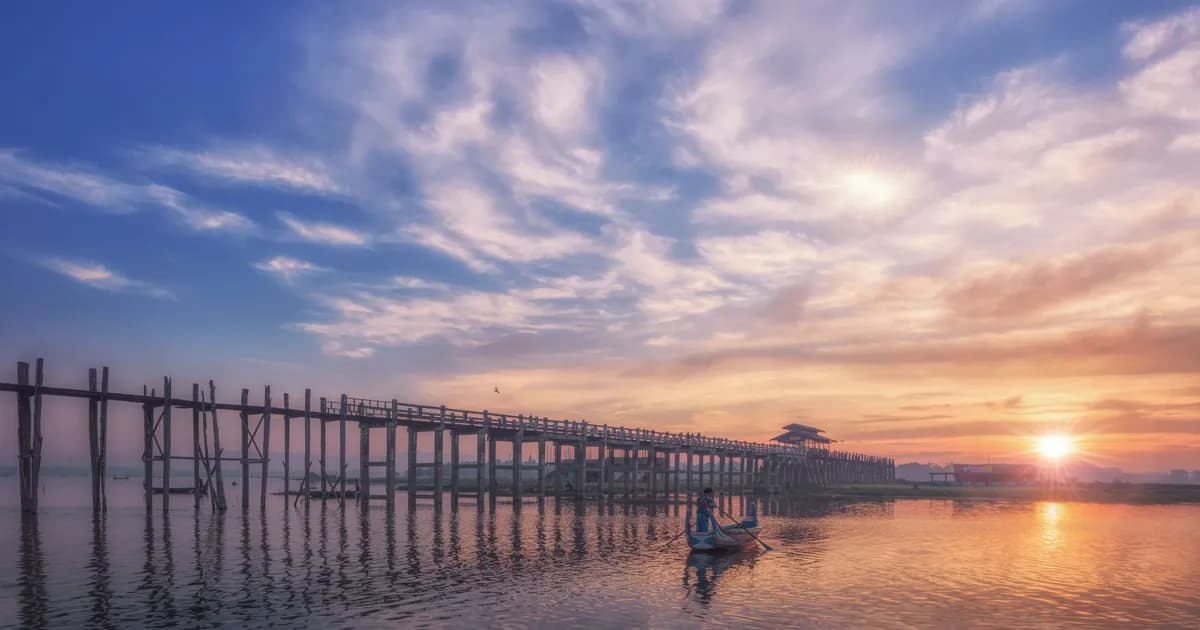
Amarapura, the "City of Immortality," served as a royal capital twice in the late 1700s and 1800s before the court moved on. Little of the palace survives, but Amarapura gave the region its most photographed landmark: the U Bein Bridge. Built around 1850 from teak salvaged from the dismantled old palace at Inwa, it stretches roughly 1.2 kilometres across shallow Taungthaman Lake and is widely called the oldest and longest teakwood footbridge in the world.
The bridge is not a museum piece. It is a working shortcut for monks, farmers, cyclists and traders who cross it every day, and that living, everyday quality is exactly what makes it worth lingering over. Come at first light and you will share the planks with saffron-robed novices heading to alms; come for sunset and the low sun turns the whole structure into a black silhouette above still water, with sampan rowers drifting beneath. Slow travellers do well to arrive early, walk out unhurried, and simply sit on one of the pavilions partway across to watch ordinary life pass.
A note of honesty and care: the March 2025 earthquake damaged sections of the bridge's teak decking, and authorities carried out safety inspections and repairs. Please check the current condition before you go, keep to any marked limits, and do not treat old timber as a place for stunts. The bridge is centuries old and, quite literally, still holding people up.
Amarapura is also a weaving town, known for silk and cotton longyi cloth, and you can watch treadle looms clatter in small workshops near the lake. If you are still shaping your route through the country, our overview of where to go and when in Myanmar sets Mandalay and its satellites in the wider picture of the seasons and the accessible core circuit.
One request. Up to five tailored proposals.
Skip contacting agencies one by one — share your trip once and let up to five trusted Myanmar agencies come to you. Free, with no obligation.
Get my free quotesInwa (Ava): The Old Capital Reached by Horse-Cart
If Amarapura is the region's postcard, Inwa is its dream of ruins. Known historically to the outside world as Ava, this island of paddy and palm was the capital of successive Burmese kingdoms for close to four centuries, on and off, from the 1300s onward. Earthquakes and shifting fortunes eventually emptied it, and today Inwa is farmland scattered with the bones of a royal city: crumbling brick stupas, a leaning watchtower nicknamed the "leaning tower of Inwa," and monasteries half-swallowed by greenery.
Reaching Inwa is part of the pleasure. A short ferry crosses a channel of the river, and on the far bank pony-drawn horse-carts wait to carry visitors along dirt lanes between the sights. It is a slow, jolting, delightfully old-fashioned way to travel, and it keeps the pace exactly where it should be. The two set-pieces most people come for are the Bagaya Kyaung, a serene teak monastery raised on towering posts and dark with age and carving, and the Maha Aungmye Bonzan, a graceful masonry monastery in warm stucco. Between them, the joy is really the ride itself: buffalo in the fields, children waving from doorways, and ruins appearing unannounced around bends.
A responsible word about the horse-carts. Ask your guide or operator to point you to drivers who keep their ponies in good condition, and do not overload a cart or push an animal in the fierce midday heat. If a pony looks distressed, choose another driver. Slow travel means the welfare of the animals carrying you counts too.
Sagaing: The Hill of a Thousand Monasteries
Cross the Ayeyarwady to the west and the mood changes entirely. Sagaing is not a ruin but a living centre of Buddhist devotion, a green ridge above the river studded with hundreds of white-and-gold stupas, meditation centres, nunneries and monasteries. For many Burmese it is the spiritual heart of the country, a place people retreat to for study and practice rather than sightseeing. The hush here is real, and it asks something of you in return: quiet feet, covered shoulders and knees, and an unhurried respect.
The classic climb leads to hilltop shrines with sweeping views over the river bend and the countless glinting spires below, an outlook that rewards the effort of the steps. Wander the linking paths and you pass working monasteries where the day is measured in bells, sweeping and study. This is a place to slow right down, to accept an offered cup of tea, and to remember that you are a guest in someone's practice, not a spectator at a show.
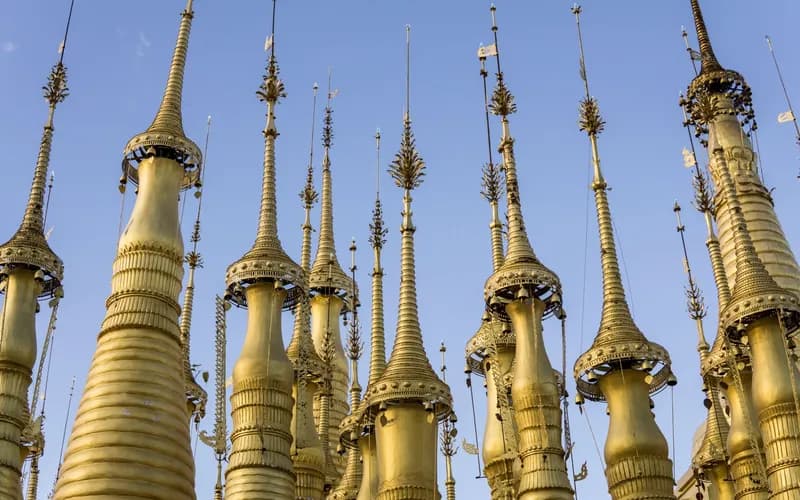
Sagaing sits in the region closest to the March 2025 earthquake's epicentre, and a number of its religious buildings were damaged; restoration and reconstruction have been ongoing since. Some structures may be closed, scaffolded or altered from older photographs, so treat guidebook images as historical rather than current, and follow local guidance about where it is safe and appropriate to go. When you pause for lunch, the riverside and market kitchens here serve the honest Burmese cooking we describe in our guide to what to eat in Myanmar — think mohinga, tea-leaf salad and river fish.
Get matched with up to 5 trusted Myanmar agencies
- Free
- No obligation
- Up to 5 agencies
Mingun: The Giant That Was Never Finished
Upstream from Mandalay lies the strangest and most ambitious of the four. In the late 1700s, King Bodawpaya set out to build the largest stupa on earth at Mingun. Had it been completed, the Mingun Pahtodawgyi would have stood some 150 metres tall. It never was. Work halted, and an earlier earthquake in 1839 left enormous cracks splitting the vast brick base, so that what remains is a monumental, fissured cube — a ruin of an idea as much as a building, and unforgettable for it.
Nearby stands the Mingun Bell, long celebrated as one of the largest ringing bells in the world, and a short walk away is the Hsinbyume Pagoda, a dazzling white confection of wavy terraces built to evoke the mythical Mount Meru. The traditional way to reach Mingun is the loveliest: a slow public or chartered boat up the Ayeyarwady from Mandalay, an hour or so of river life, fishing craft and passing sandbanks that is a highlight in its own right.
Here honesty is essential. The March 2025 earthquake struck Mingun hard. The white Hsinbyume Pagoda suffered severe damage with much of its structure collapsing, and the Mingun Pahtodawgyi was damaged too, with reports that one of its giant guardian lion statues lost a portion of its form. Access and appearance may differ substantially from older accounts, and some areas may be restricted for safety or restoration. Go with a good local operator who knows the current state of the site, keep well back from unstable masonry, and set your expectations by what is true today rather than by photographs from before the quake.
How to Link Them Into One Slow Day
The beauty of this cluster is that it forms a natural loop of contrasts, and you do not need to hurry to enjoy it. A classic unhurried itinerary begins at dawn with the U Bein Bridge at Amarapura, when the light is soft and the crowds are thin. From there it is a short hop to the Inwa ferry for a mid-morning horse-cart amble among the ruins. Cross the river to Sagaing for a quiet climb and a simple riverside lunch, then, if time and the boat schedule allow, take an afternoon on the water up to Mingun before returning to Mandalay as the day cools.
Purists of slow travel might split this across two gentler days rather than one full one — Amarapura and Inwa together, Sagaing and a Mingun boat trip on another — leaving room to sit, watch and talk rather than tick boxes. Either way, the golden rule is to let the river, the ferries and the light set your rhythm rather than a stopwatch. Hire a driver for the road legs and let someone else handle the logistics so your attention stays on the places themselves. For a broader sense of costs, our Myanmar trip budget guide for 2026 breaks down day-trip transport, entry tickets and boat fares.
If you would rather trade the standard loop for quieter corners of the same landscape, our roundup of off-the-beaten-path Myanmar points to the less-visited monasteries and villages that reward travellers willing to linger.
A Practical and Responsible Note
Practicalities first. Most sites levy a Mandalay Archaeological Zone fee, so keep your ticket to hand as it may be checked across several locations. Bring cash in small notes, sun protection and plenty of water, and dress modestly at every religious site — shoulders and knees covered, shoes and socks off inside temple precincts. Sunrise and sunset are the kindest hours for both light and heat; the middle of the day is fierce.
Now the honest part. Myanmar has been through a difficult period, and several governments maintain elevated travel advisories for the country, including guidance against certain overland routes. The March 2025 earthquake caused real loss of life and damaged heritage across the Mandalay and Sagaing area, and recovery is still underway. None of this is a reason to be flippant, and none of it is a matter we take a political side on. What we can say plainly is this: if you go, go softly. Travel with a reputable local operator who tracks current conditions day to day, favour flying over long overland legs where advice suggests it, carry insurance that covers medical evacuation, and let your spending reach the families, guides, cart drivers and small kitchens who most need it. Ask before photographing people, especially monks and worshippers. Slow, respectful, locally guided travel is not only safer here — it is the only kind that does any good.
What to Do Next
- Read the current situation honestly. Check your government's latest travel advisory for Myanmar and recent, dated reports on earthquake recovery around Mandalay and Sagaing before you commit to anything.
- Decide your pace. Choose between the classic one-day loop and a gentler two-day version, and be realistic about heat, ferry times and the Mingun boat schedule.
- Confirm what is open. Because several sites were damaged in 2025, verify the current status and access of U Bein, Inwa, Sagaing and especially Mingun with a local source rather than an old guidebook.
- Plan the framework of your trip using our plan your journey hub to slot the Mandalay day trips into a wider route.
- Work with people who know the ground. Browse our vetted Myanmar travel agencies to find an operator who can arrange a driver, a boat and a knowledgeable guide.
- Consider a slower, tailored trip. If you want the whole journey shaped around your own rhythm, explore our charter slow travel approach.
Frequently Asked Questions
Can I still visit Amarapura, Inwa, Sagaing and Mingun in 2026?
The sites lie within Myanmar's accessible core circuit and day trips from Mandalay have continued to operate, but the March 2025 earthquake damaged several structures and recovery is ongoing. Access, opening and appearance can differ from older accounts, and government travel advisories for Myanmar remain elevated. Check current, dated information and travel with a reputable local operator before you go.
How much time do I need for the ancient royal cities?
You can see all four in one long day, starting at dawn at U Bein and finishing with an afternoon boat to Mingun. Slow travellers often prefer to split the cluster across two gentler days, pairing Amarapura with Inwa on one day and Sagaing with the Mingun river trip on another, which leaves time to sit and watch rather than rush.
What is the best time of day to visit the U Bein Bridge?
Sunrise and sunset are the most rewarding, both for soft light and for cooler temperatures. Dawn is quieter and you will share the bridge mainly with monks and locals; sunset is more atmospheric but busier. The middle of the day is hot and harsh, so plan the bridge for the ends of the day.
How do you get to Mingun from Mandalay?
The classic and most enjoyable way is by boat up the Ayeyarwady River, roughly an hour each way on a public or chartered vessel, which is a genuine highlight in itself. Road access also exists. Confirm current boat schedules and the site's post-earthquake status with your operator before setting out.
Was Mingun damaged by the earthquake?
Yes. The March 2025 earthquake hit Mingun hard: the white Hsinbyume Pagoda suffered severe damage with much of its structure collapsing, and the giant unfinished Mingun Pahtodawgyi was also damaged. Some areas may be restricted for safety or restoration, so rely on current local guidance rather than pre-quake photographs.
What should I wear and bring for a temple day trip?
Dress modestly at every religious site, with shoulders and knees covered, and be ready to remove shoes and socks inside temple precincts. Bring small-denomination cash for entry fees, sun protection, a hat and plenty of water. Keep your Archaeological Zone ticket handy, as it may be checked at more than one location.
Is it responsible to travel here right now?
That is a personal decision, and we do not take a political position. If you do go, travel slowly and softly: use a reputable local operator who tracks conditions, follow official advice on routes, carry evacuation-capable insurance, ask before photographing people, and direct your spending toward local families, guides and small businesses who most need the support.