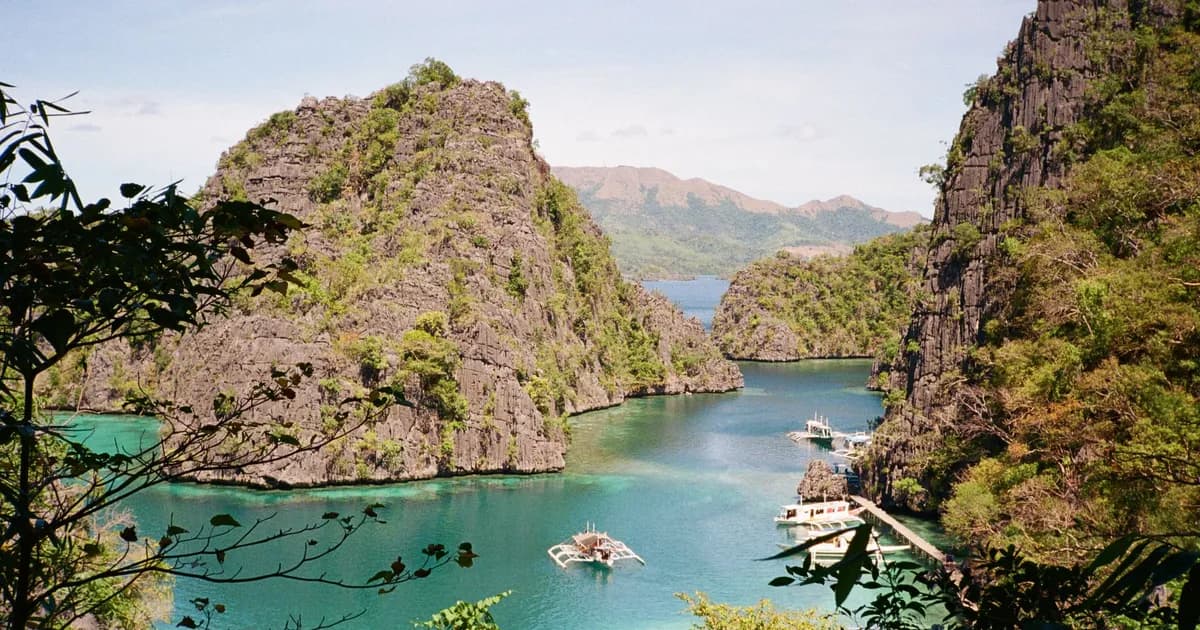


Most travellers meet Bohol in a single afternoon. A van collects them from the airport on Panglao, delivers them to a viewpoint over the Chocolate Hills, pauses at a tarsier enclosure, and returns them to the coast in time for a sunset beer. By evening the island has been filed away as done. That is a shame, because Bohol rewards precisely the opposite approach. Give it a week, drive east instead of west, and you find one of the most quietly satisfying places to spend time in the Philippines: a limestone island of cave pools and river towns, of rice terraces at altitude, of old churches rebuilt stone by stone, and of a coral wall that begins a few strokes from the shore.
An island that rewards a second week
Bohol covers a little over 4,800 square kilometres, which makes it big enough to hold genuine variety and small enough to cross in a day if you insist. Almost all of its visitor infrastructure sits on Panglao, the small island joined to the mainland by two bridges just south of the provincial capital, Tagbilaran. That concentration is the traveller's opportunity. Beyond a twenty-kilometre radius, Bohol reverts to what it has always been: a farming and fishing province where the day starts before six, the market is the social centre of the town, and visitors are a pleasant curiosity rather than an economy.
The practical consequence is that a week here does not mean a week of moving. It means two or three bases, each held for several nights, with the roads between them treated as part of the trip rather than an interruption. If you are still deciding when to come and what to pair Bohol with, our guide to where to go and when in the Philippines sets out how the seasons move around the archipelago.
One request. Up to five tailored proposals.
Skip contacting agencies one by one — share your trip once and let up to five trusted Philippines agencies come to you. Free, with no obligation.
Get my free quotesPanglao's shadow, and what lies behind it
Panglao is not the villain of this story. Alona Beach is genuinely pretty under the crowd, the diving off Balicasag is world-class, and the presence of an international airport since 2018 has made the whole province far easier to reach. But Panglao now carries a disproportionate share of Bohol's beds, boats and buses, and it shows in the pace: the strip is loud, the day tours leave in convoy, and the island's rhythm is set by departure times.
The mainland behind it works differently. Baclayon, the old coastal town a few kilometres east of Tagbilaran, has one of the oldest surviving stone churches in the country, badly damaged by the magnitude 7.2 earthquake of October 2013 and painstakingly restored since. Further east, the coast road runs through Loay, Loboc, Sevilla and Jagna, past bakeries selling broas and calamay, through barangays where the church square is still the largest open space in town. Nothing here is engineered for visitors. That is the point.
Loboc and the river towns
Loboc is where most day trips stop for lunch on a floating restaurant, and if that is your only exposure to the town you will misjudge it entirely. Stay a night or two instead. The Loboc River is at its best early, before the buffet boats start, when mist sits on the water and the only traffic is a paddled banca carrying schoolchildren. Kayaks can be hired from small riverside operators, and a slow upstream hour, drifting back down, costs almost nothing and shows you a river rather than a lunch venue.
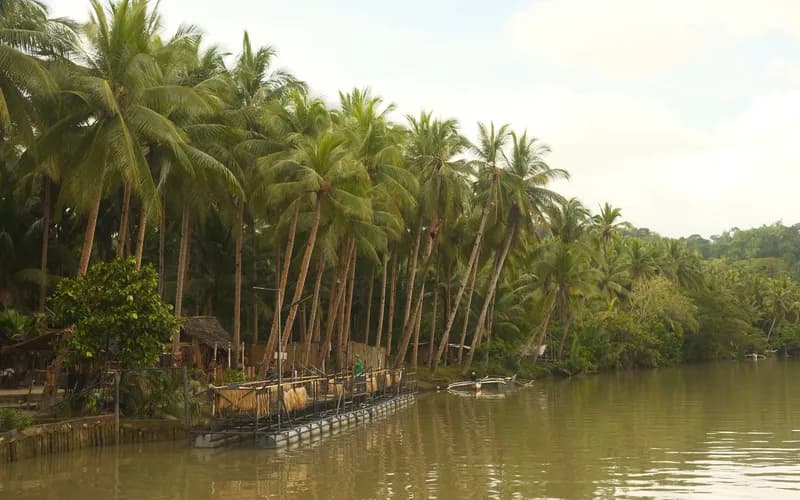
The town itself is worth the walk. Its church, San Pedro Apostol, dates from the eighteenth century and was ruined in the 2013 earthquake; the reconstruction, completed after years of careful work, is a lesson in how seriously Boholanos take their heritage. Loboc also has a musical reputation out of proportion to its size, with a children's choir that has toured internationally, and on many evenings you will hear rehearsal drifting out of an open hall. Nearby Sevilla has the much-photographed bamboo hanging bridges over the river, best visited at either end of the day when the tour vans are elsewhere.
Get matched with up to 5 trusted Philippines agencies
- Free
- No obligation
- Up to 5 agencies
The interior: Bilar, Rajah Sikatuna and the road to Carmen
Climb inland from Loboc and the temperature drops a few degrees. The road passes through the man-made forest at Bilar, a dense two-kilometre corridor of mahogany planted decades ago as a reforestation project, then opens into the uplands where the Chocolate Hills sit. There are more than a thousand of these conical limestone mounds, brown in the dry months and green after rain, and the Carmen viewing deck is the standard place to see them. It is also, inevitably, the busiest. Arrive at opening time or in the last hour of light and you will have a different experience entirely.
The hills have not been free of controversy. In 2024 the discovery of a resort built inside the protected landscape provoked a national argument about how Bohol's most famous scenery is governed, and the province has since tightened its scrutiny of development in the area. As a visitor, the honest response is to keep your money with operators and homestays outside the protected zone. A short detour from Bilar leads to the Rajah Sikatuna Protected Landscape, a forest reserve that birdwatchers rate among the best in the country; a guided dawn walk there, arranged the night before through your accommodation, is one of the finest mornings Bohol can offer.
Anda: cave pools, a long beach and a coral wall
Anda sits at the far eastern tip of Bohol, three to four hours from Panglao by public transport, and that distance is its great protection. Quinale Beach is a wide, pale, entirely public stretch of sand where the water stays shallow a long way out, and the town behind it has the unhurried feel of somewhere that has decided not to hurry. Three nights is the minimum that makes the journey worth it; five is better.
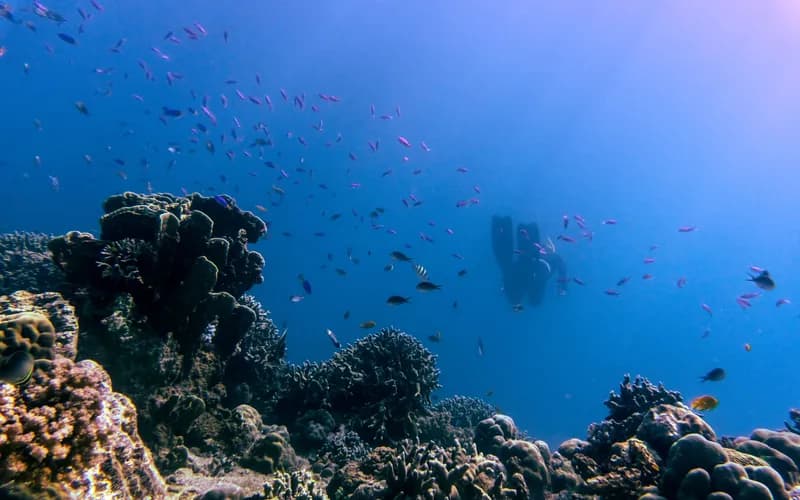
The limestone that shapes the whole island shows itself here as cave pools, freshwater sinkholes in the coral rock, cool and clear and startlingly deep. Cabagnow is the best known, with a modest entrance charge plus a small environmental fee, and it closes on some weekdays to give the water a rest, so ask in town before setting out. Underwater, Anda has a steep wall of hard coral running along the coast, reachable from shore at several points and in far better condition than reefs closer to the resorts. If that side of the country interests you, our analysis of the Philippines' diving and reef conservation revival explains what has changed and which operators are worth your business.
Candijay and Jagna: terraces, waterfalls and a ferry east
Between Anda and the south coast lie two towns that justify a full day each. Candijay holds the Cadapdapan rice terraces, a small amphitheatre of paddies carved into the hills above the town, and a short walk from them Can-umantad Falls drops around sixty metres into a pool you can swim in. It is the tallest waterfall in Bohol and, on a weekday morning, frequently empty.
Jagna, further west along the coast, is a working port town famous for calamay, a sticky sweet of glutinous rice, coconut milk and sugar sold in halved coconut shells sealed with paper. It is also Bohol's gateway east: a roll-on roll-off ferry crosses from Jagna to Balbagon on Camiguin a few times a week, taking around four and a half hours for a fare in the region of eight hundred pesos. Schedules shift with the weather and the season, so confirm at the port rather than online. That crossing makes an elegant onward leg, and our portrait of Camiguin, the island born of fire explains why it deserves a week of its own.
The geopark, and what it asks of visitors
In 2023 Bohol became the first UNESCO Global Geopark in the Philippines, a designation covering the whole province and its surrounding waters, roughly 8,800 square kilometres of land and sea. Geopark status is not a park in the fenced sense; it is a commitment by local government, schools and communities to interpret and protect a landscape whose limestone, caves, hills and reefs tell a single geological story. In practice it has pushed the province towards geotourism circuits, community-based tourism and heritage trails, all of which suit a slow traveller far better than the standard countryside tour.
What it asks in return is modest and specific. Pay the local environmental fees without grumbling; they fund the wardens and the rubbish collection. Take a community guide where one is offered, particularly at cave and ritual sites such as Lamanoc Island off Anda, where the caves hold ancient burials and access is properly controlled. Do not touch or feed tarsiers: the sanctuary at Corella, run by the conservation foundation, keeps visitors on a boardwalk and enforces silence, and it is the only tarsier stop worth your money.
Practicalities: getting there, getting around, when to go
Bohol-Panglao International Airport receives flights from Manila, Cebu and a growing list of regional cities. The alternative, and the more pleasant arrival, is the fast ferry from Cebu City to Tagbilaran, roughly two hours across the strait, with several sailings a day and fares typically in the several-hundred-peso range. Slower roll-on roll-off ships serve Getafe and Talibon on the north coast.
On the ground, buses run from Tagbilaran's Dao terminal to Carmen, Candijay, Jagna and Anda, cheap and frequent enough but slow. Vans are faster and more cramped. Motorbikes rent for a few hundred pesos a day and make sense for the interior, provided you hold the correct licence and helmet. The dry months, roughly February to May, are the most reliable; the wettest stretch is usually November to January, and Bohol sits south of the main typhoon corridor without being immune to it. For sequencing all this into a coherent trip, our plan your journey page for the Philippines is the place to start.
What to Do Next
- Decide on two bases rather than four. Loboc or Bilar for the interior, Anda for the east coast, with Panglao only as an arrival or departure night if your flights demand it.
- Book the Cebu-Tagbilaran fast ferry or the Panglao flight first, since these fix the shape of everything else.
- Reserve accommodation in Anda directly with the guesthouse. Many are family-run and not fully listed on booking platforms.
- Ask your host, on arrival, which cave pools are open that week and whether a Rajah Sikatuna dawn walk can be arranged for the following morning.
- Check the Jagna-Camiguin ferry days at the port itself if you plan to continue east, and build a spare day around it.
- If you would rather have the logistics handled by people who know the province, compare the vetted operators on our Philippines travel agencies directory.
Frequently Asked Questions
How many days do you need in Bohol?
Three days will cover Panglao and a countryside tour. Seven allows the version of Bohol described here: two or three nights in the interior around Loboc or Bilar, three or more in Anda, and a day in transit between them. Ten days lets you add the north coast and the Danajon Bank reef area around Talibon without rushing.
Is Anda worth the long transfer from Panglao?
If you are staying two nights, no. If you are staying four or more, it is the best decision you will make in Bohol. The beach is public and uncrowded, the reef is in noticeably better condition than sites near the resorts, and the cave pools are within easy reach by motorbike or tricycle.
When is the best time to visit Bohol?
February to May is the driest and most dependable window, with March and April the warmest. November to January tends to be wettest. Bohol lies south of the main typhoon track but can still be affected by storms and by the rough seas that follow them, which matter more for ferries than for anything on land.
How do you get from Cebu to Bohol?
Fast craft cross from Cebu City pier to Tagbilaran in about two hours, with several departures daily and additional services to Getafe and Talibon. Book a day ahead in high season and around public holidays, when sailings fill quickly and fares rise.
Are the Chocolate Hills worth visiting?
Yes, with expectations calibrated. The Carmen viewing deck is crowded through the middle of the day and the hills look best in the dry months when the grass has turned brown, or immediately after rain when they are vividly green. Go at opening or in the final hour of daylight, and treat the surrounding uplands, not the deck, as the real attraction.
Where can I see tarsiers ethically in Bohol?
At the Philippine Tarsier Sanctuary in Corella, run by the conservation foundation, where visitors stay on a boardwalk, guides point out animals at a distance, and silence is enforced. Roadside enclosures elsewhere on the island offer closer photographs at a cost to the animals; they are not worth supporting.