Driving in the Philippines in 2026: Licences, Motorbikes and the 90-Day Rule
Renting a scooter is the default move on most Philippine islands, and for good reason: it turns a place you were going to see into a place you can actually live in for a week. It is also the single most common way travellers get hurt, fined, or discover that their insurance policy does not apply. The rules are not complicated, but they are widely misunderstood — including by rental shops, who will hand you a key regardless. Here is where the law actually stands in 2026, and what it means in practice.
The 90-Day Rule, Precisely
Under the Land Transportation and Traffic Code, a visitor may drive in the Philippines on a valid driving licence issued by their home country for up to 90 days from the date of arrival, provided that licence is written in English.
Three parts of that sentence matter.
The clock starts on arrival, not on the day you rent. If you have been in the country for four months on extensions and then rent a car, your home licence no longer covers you.
The licence must be valid for the category of vehicle. A car licence does not authorise a motorcycle. This is the most common legal gap among travellers: most Western licences do not include a motorcycle entitlement, and riding a 125cc scooter on a car-only licence is, strictly, unlicensed riding.
It must be in English, or accompanied by an official translation or an International Driving Permit.
The 90-day allowance is tied to your stay, not your visa category, so it applies equally whether you entered visa-free or on a visa. If you plan to stay longer, our guide to visa-free entry and extending your stay explains how the immigration side interacts with the calendar.
One request. Up to five tailored proposals.
Skip contacting agencies one by one — share your trip once and let up to five trusted Philippines agencies come to you. Free, with no obligation.
Get my free quotesDo You Need an International Driving Permit?
Not usually, and it does not buy you extra time. An IDP is a translation, not a licence. If your national licence is already in English — as British, Irish, American, Australian, Canadian, South African, Indian and many others are — it is legally sufficient on its own for the first 90 days.
An IDP becomes necessary when your licence is not in English. French, German, Italian, Spanish, Japanese, Korean and Chinese licence holders should carry one, or an embassy-certified translation. Since an IDP must be issued in the country that issued your licence, you cannot obtain one after you arrive.
Even where it is not required, an IDP is often worth having. Rental companies use it as a simple check, insurers like to see it, and it removes an argument at a roadside checkpoint where the officer may not read your language. It also states your vehicle categories in a standard format, which is precisely the detail that decides whether you are legally on that scooter.
Renting a Motorbike: What Is Legal and What Is Normal
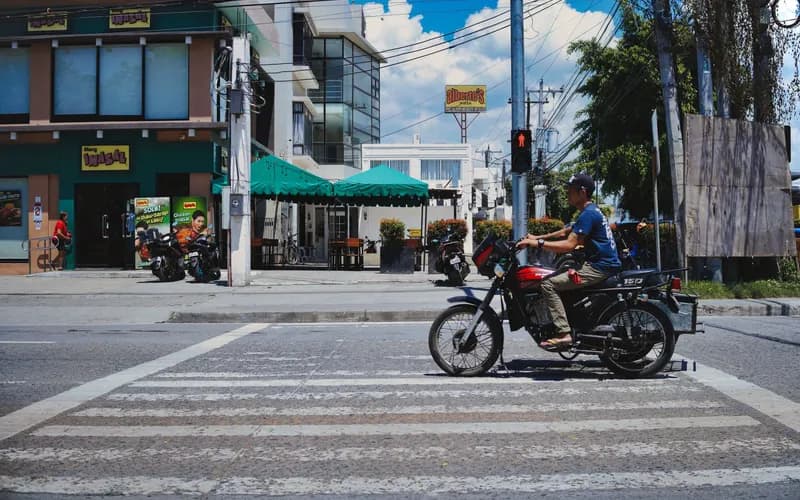
The gap between the two is wide. Legally, to ride a motorcycle you need a licence valid for motorcycles, the vehicle's registration documents in the bike, and a compliant helmet. In practice, small island rental shops ask for a passport as security, take a daily cash rate, and ask nothing else.
Accepting that offer is a decision, not an accident. If you ride without a motorcycle entitlement you are uninsured in every meaningful sense, personally liable for damage to yourself, the bike and anyone else, and exposed to a fine and impoundment at a checkpoint.
If you do ride, these are the practical points:
- Never leave your passport as a deposit. Offer a photocopy plus a cash deposit. A passport in a rental shop's drawer is a hostage, and replacing one from a provincial island is a serious undertaking.
- Photograph the bike from every angle before you leave, including existing scratches, and film the engine starting. Damage disputes on return are common.
- Check the brakes, the tyres and the lights yourself. Island rental bikes are worked hard.
- Ask to see the official receipt and certificate of registration, and keep it with you. Riding without the vehicle's papers is its own offence.
- Agree in writing what happens if the bike breaks down, and who pays for recovery.
On small islands where a scooter genuinely transforms the stay — the kind of place we describe in our profile of Camiguin, the island born of fire — it is worth getting the paperwork right rather than skipping it, because those are also the places with the fewest hospitals.
Get matched with up to 5 trusted Philippines agencies
- Free
- No obligation
- Up to 5 agencies
Helmets, Gear and the Rules That Get Enforced
Helmet law in the Philippines is stricter than most visitors expect, and it is one of the rules actually enforced at checkpoints.
Both rider and passenger must wear a helmet at all times, on any trip, however short. The helmet must carry an Import Commodity Clearance sticker or a Philippine Standard mark. A helmet without one of those marks counts as substandard, and wearing it can still attract a fine — which matters, because the free helmet handed over with a rental bike frequently has no sticker at all.
Beyond the helmet, enforcement commonly covers closed shoes rather than flip-flops, working headlights, tail lights and mirrors, and a maximum of one passenger. Riding with three people on a scooter is normal local practice and still an offence.
Buying your own helmet is worth considering for any stay beyond a couple of weeks. A compliant, correctly sized helmet costs a modest amount in any provincial hardware or motor shop, it fits you rather than the last twenty renters, and it settles the sticker question permanently.
Insurance: The Gap Most Travellers Miss
This is where the real cost sits, and it is almost never in the rental conversation.
Standard travel insurance policies exclude motorcycle riding unless you hold a licence valid for that vehicle in both your home country and the country you are in — and many exclude it entirely, or apply an engine-size limit, or require a helmet to have been worn. A policy that covers you for a scooter in Spain may not cover you in the Philippines. Read the wording before you ride, not after.
Philippine vehicles carry compulsory third-party liability cover, which is a legal minimum protecting other people, not you and not the bike. Rental shops that mention "insurance" are usually describing a damage waiver with a large excess, and some describe nothing at all.
The practical stack for a traveller who intends to ride is: a licence that includes motorcycles, an explicit motorcycle extension on your travel medical policy, a compliant helmet, and the acceptance that medical evacuation from a small island to Cebu or Manila is expensive and slow. If that stack is not in place, rent a bike with a driver instead. Habal-habal riders cost little, know the roads, and are a legitimate part of the local economy.
Fines, Checkpoints and What Happens If
Checkpoints are routine, particularly near town boundaries, and are usually brief. Officers ask for a licence and the vehicle's registration, check helmets, and wave you on.
Driving without an appropriate licence carries a fine in the region of PHP 3,000 plus disqualification, and the vehicle can be impounded, with recovery costs on top. Helmet and equipment violations carry smaller fines that escalate with repetition. Metro Manila and several cities also operate camera-based no-contact apprehension for traffic violations, which produces a notice sent to the registered owner — meaning, for a rental, a bill passed on to you weeks later.
If you are stopped, be calm and polite, hand over the documents, and ask for an official citation ticket if a violation is alleged. Paying at the office named on the ticket is the correct process. Offering money at the roadside is both an offence and, in practice, how a small problem becomes a bigger one.
In a collision, Philippine practice is to wait for the police rather than to settle privately at the scene, and to obtain a police report — without which no insurance claim will proceed.
Where Driving Makes Sense, and Where It Does Not
Driving yourself is genuinely valuable in exactly the places where public transport is thin: the interior of Bohol, the coast roads of Camiguin and Siquijor, the highlands of Negros, the long empty stretches of Catanduanes or Batanes. In those settings a scooter turns a three-day visit into a week.
It makes much less sense in Metro Manila and Cebu City, where traffic is heavy, parking is a problem and ride-hailing is cheap and abundant. It also makes little sense for long inter-provincial hops, where a bus or a van is safer, cheaper and lets you sleep.
The Philippines has an unusually good informal transport network — jeepneys, multicabs, tricycles, habal-habal, bangka boats — and using it is both the cheaper option and, for most slow travellers, the more interesting one. Our guide to getting around the Philippines covers how each of those works and what they should cost.
Road conditions vary enormously and change quickly after storms. Night riding is best avoided outside towns: unlit vehicles, roaming dogs and unmarked roadworks are all common.
What to Do Next
- Check your home licence for a motorcycle category before your trip. If it is car-only, plan to hire drivers rather than ride.
- If your licence is not in English, obtain an International Driving Permit at home. You cannot get one after arriving.
- Read the motorcycle clause in your travel insurance policy and, if needed, buy the extension in writing before you ride.
- Count your 90 days from your arrival stamp, not from when you rent, and stop driving on a foreign licence at that point.
- On arrival, buy or verify a helmet with an ICC or PS mark rather than relying on the one supplied.
- Photograph any rental vehicle thoroughly, keep the registration papers with you, and never surrender your passport as a deposit.
- For islands where a driver or a guided vehicle is the better answer, our Philippines travel agencies page lists local operators who arrange both.
Frequently Asked Questions
Can I ride a scooter on a car-only driving licence?
Not legally. Philippine law requires a licence valid for the category of vehicle you are operating. Rental shops rarely check, but a checkpoint will, and your insurer certainly will after an accident.
How long can I drive on my home licence?
Ninety days from your date of arrival, provided the licence is valid and in English or accompanied by a translation. After that you must convert to a Philippine licence through the Land Transportation Office.
What does converting a foreign licence involve?
An application at an LTO office with your passport and immigration records, a medical examination from an accredited clinic, a valid foreign licence and the applicable fees. It is designed for residents rather than visitors, and most travellers will simply stop driving instead.
Is an International Driving Permit mandatory?
No, if your licence is in English. Yes, in effect, if it is not. Either way it is a useful document to carry because it states your vehicle categories in a form any officer can read.
Are helmet rules really enforced?
Yes, and the sticker requirement is part of it. Helmets must carry an ICC or PS mark, and both rider and passenger must wear one on every trip. Fines are modest but routine.
What if I am in a road accident?
Stop, call for help, do not move vehicles unnecessarily, and wait for police so a report can be filed. Notify your insurer immediately. Avoid informal cash settlements, which have no legal standing and often reopen later.
Is driving worth it on remote islands?
Often, yes, if you are properly licensed. On a province like Catanduanes, where public transport runs on fixed routes and limited timetables, your own transport buys a great deal of freedom. Weigh that against limited medical facilities and roads that storms rearrange.