
The Philippines is one of the cheapest countries in Asia to spend a day in, and one of the more expensive to move around. That single sentence explains almost every budget surprise travellers have here. A plate of pork adobo with rice costs less than a coffee in Europe. A bed in a clean, family-run guesthouse on a quiet island costs less than a cinema ticket. And then you need to get from that island to the next one, and the boat, the flight, the van transfer and four separate municipal fees quietly cost more than three days of everything else combined.
This guide is our attempt to give you the real numbers, in Philippine pesos and in dollars and euros, as they stand in mid-2026. Not the fantasy figures from a decade-old blog post, and not the inflated ones from a package brochure. We have included the fees that catch people out at the pier, the taxes that appear at the airport, and the honest arithmetic of an archipelago with more than seven thousand islands. And because we are a slow travel company, we will also make an argument you may not expect: that in the Philippines, spending less per day and more per week — moving less, staying longer — is both cheaper and better.
The honest answer: what a day costs
Here is what a realistic day looks like across three travel styles in 2026. These figures are per person per day, assuming two people sharing a room, and they include accommodation, all food, local transport, water, and a modest allowance for activities. They exclude international flights and exclude the long inter-island hops, which we treat separately below because they are the line item that actually decides your budget.
| Style | Per person per day (PHP) | Approx. USD | Approx. EUR | What that buys |
|---|---|---|---|---|
| Shoestring | ₱1,900 – ₱3,000 | $31 – $49 | €27 – €43 | Dorm or basic fan room, carinderia meals, jeepneys and tricycles, one shared tour every few days |
| Mid-range | ₱4,500 – ₱8,500 | $73 – $138 | €64 – €121 | Good aircon room or small boutique guesthouse, restaurant meals, a daily activity, occasional private transfer |
| Premium | ₱12,000 and up | $195 and up | €170 and up | Design hotels and island resorts, private boats, private guides, dive packages, no compromises |
Two things stand out. First, the shoestring end really is that cheap — the Philippines remains one of the best-value countries in Southeast Asia for a traveller willing to eat where locals eat and sleep in simple rooms. Second, the gap between mid-range and premium is enormous, and it is almost entirely driven by two things: beachfront real estate and private boats. Everything else scales gently.
The number most people should plan around is the middle band. A couple travelling comfortably for two weeks, eating well, doing something interesting most days, and not counting every peso, should budget roughly ₱6,000 per person per day for the living costs, then add transport and fees on top. That is our starting point for the itineraries later in this guide.
One request. Up to five tailored proposals.
Skip contacting agencies one by one — share your trip once and let up to five trusted Philippines agencies come to you. Free, with no obligation.
Get my free quotesThe peso, cash and cards
The Philippine peso has been soft for two years, and that works in your favour. In mid-July 2026 the peso sits at roughly ₱61.7 to the US dollar, ₱70.4 to the euro, and around ₱82 to the pound sterling. Compared to 2023, your money goes noticeably further, and this has partly offset local inflation on food and fuel.
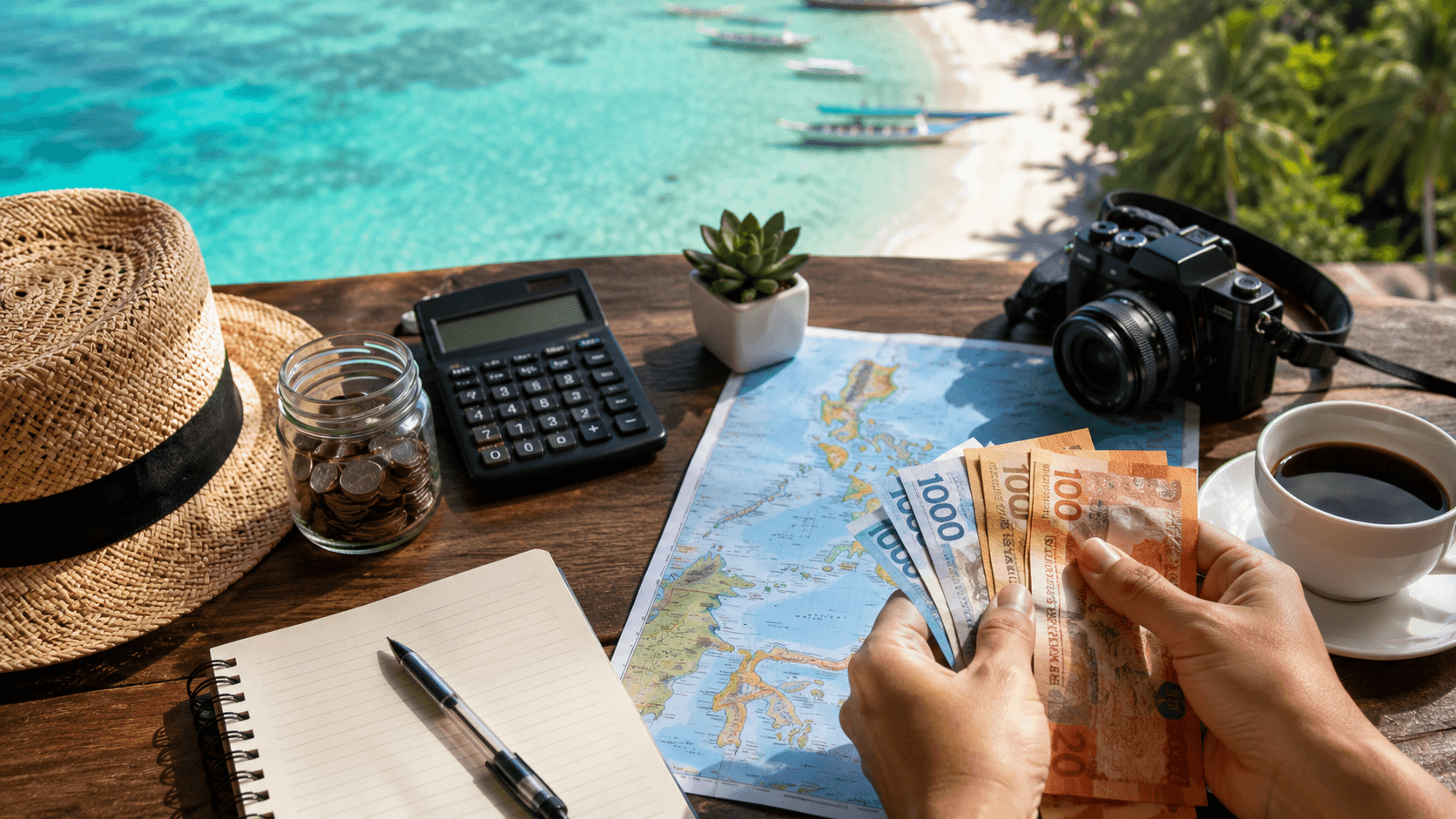
For mental arithmetic, use these rounded anchors: ₱1,000 is about $16 or €14. ₱100 is about $1.60 or €1.40. Most day-to-day prices in the Philippines are quoted in round hundreds, so once you internalise that a ₱150 tricycle ride is roughly two euros, you stop converting and start living.
The Philippines is more cash-dependent than Thailand or Vietnam. Manila, Cebu City and the big resorts take cards without blinking. Everywhere else — the carinderia, the tricycle driver, the bangka boatman, the sari-sari store, the small guesthouse on Siquijor — is cash only, and often cannot break a ₱1,000 note. Carry small denominations obsessively. A wallet full of ₱1,000 notes and no ₱20s and ₱50s is a wallet that cannot buy breakfast.
ATM fees are the quiet tax on travellers here. Most Philippine banks charge a withdrawal fee of ₱250 to ₱300 per transaction on foreign cards, on top of whatever your home bank charges, and many cap withdrawals at ₱10,000 per go. That is a 2.5% to 3% hit. Two banks are worth knowing: BPI and Security Bank generally allow ₱15,000 to ₱20,000 per withdrawal, which cuts the fee percentage roughly in half. Withdraw large amounts, infrequently, in cities — and always before you head to a small island, where the single ATM is often out of cash by Saturday afternoon.
GCash and Maya, the local mobile wallets, now dominate domestic payments, but both effectively require a Philippine mobile number and, increasingly, local ID for full functionality. A local SIM costs around ₱50 with data packages from ₱99 to ₱1,000, and is worth buying on arrival regardless — coverage is good, and having Grab and Google Maps working saves more money than it costs.
Entry costs, eTravel and what is genuinely free
Good news first: entry to the Philippines is cheap or free for most travellers.
Citizens of more than 150 countries — including the entire EU, the UK, the US, Canada, Australia and most of Asia — enter visa-free for 30 days. There is no fee, no application, no e-visa needed for a standard leisure trip. British, Brazilian and Israeli nationals get a longer visa-free window under separate arrangements.
eTravel registration is compulsory and free. Every arriving traveller must complete the online form at the official government portal within 72 hours before landing. You enter passport details, flight number, your first address in the country and a short health declaration, and you receive a QR code. Screenshot it; airport wifi is unreliable. The only official site is etravel.gov.ph and it never charges. A whole industry of lookalike sites charges $20 to $40 for the same free form. Do not use them.
Extensions are straightforward if you want to stay longer than 30 days. The first extension at a Bureau of Immigration office adds 29 days and costs roughly ₱3,030 all-in including the express lane fee — about $49. It is a two-hour errand, not a crisis. Longer extensions are possible up to 36 months, but each subsequent renewal adds fees such as the ACR I-Card if you pass 59 days, which alone is around ₱3,000 more.
The travel tax confuses almost everyone. The Philippines charges a ₱1,620 travel tax on economy departures — but foreign passport holders who have stayed less than one year are exempt. If you are a tourist on a 30-day or 60-day stay, you do not pay it, and it will not be bundled into your ticket. If it does appear on your fare, it is refundable. Filipino citizens and long-stay foreigners do pay it, and there has been active political discussion in 2026 about scrapping it entirely.
Airport terminal fees are usually now included in the ticket price at Manila and Cebu, but some smaller domestic airports still collect them in cash at the gate. Budget ₱200 to ₱300 in loose notes for regional departures such as Caticlan, Busuanga or Siargao.
Get matched with up to 5 trusted Philippines agencies
- Free
- No obligation
- Up to 5 agencies
Where you sleep: accommodation by tier
Accommodation in the Philippines spans an extraordinary range, and the price is governed less by quality than by how close you are to sand.
Dorm beds run ₱500 to ₱900 in most of the country, rising to ₱1,200 in El Nido and Siargao during high season. The hostel scene is genuinely good in Siargao, El Nido, Moalboal and Manila's Poblacion district.
Simple private rooms — fan or basic aircon, private bathroom, often in a family home — are the sweet spot of Philippine travel and cost ₱1,000 to ₱1,800 across most of the Visayas and northern Luzon. In Sagada, Siquijor, Bohol away from Alona Beach, or Camiguin, this is what most rooms cost, and many of them are lovely.
Comfortable mid-range rooms — good aircon, hot water, decent bed, breakfast, often a pool — run ₱2,500 to ₱4,500. This is the band most travellers will live in, and it buys a great deal outside the hotspots.
Boutique and small resorts sit at ₱6,000 to ₱12,000, and this is where the Philippines starts to shine: small, owner-run beachfront places with ten rooms, good food and a house boat.
High-end island resorts start around ₱18,000 and run past ₱60,000 a night at the famous private-island properties in Palawan and the Sulu Sea. These are all-inclusive by necessity — there is nowhere else to eat.
Two practical notes. First, high season pricing from December through April can double rates in Boracay, El Nido and Siargao, and Christmas and Holy Week are their own category of expensive. Second, weekly and monthly rates are often 30% to 40% below the nightly rate and are rarely advertised. If you are staying five nights or more anywhere, ask. This is the single easiest saving in the country, and it happens to align with travelling slowly. Our where to go and when guide breaks down the seasonal swings island by island, which matters enormously for what you pay.
Eating well for very little
Food is where the Philippines is spectacularly good value, and where the gap between the tourist price and the local price is widest.
A carinderia — the neighbourhood eatery where dishes sit in trays and you point at what you want — will feed you a generous plate of ulam with rice for ₱70 to ₱120. Prices rose around ten pesos per dish through early 2026 as cooking oil and fuel costs climbed, and portions in some places have shrunk slightly, but this is still a full hot meal for under two dollars. Eat this way once a day and your food budget collapses.
A local restaurant with a menu, tables and a fan costs ₱200 to ₱400 for a main. Grilled fish, sisig, kare-kare, a plate of pancit. Add a bottle of San Miguel at ₱60 to ₱90 and you have dinner for under six dollars.
A tourist-facing restaurant in El Nido, Siargao or Boracay charges ₱450 to ₱900 a main, and a cocktail is ₱250 to ₱450. This is not bad value by international standards, but it is four to six times the local price for food that is often less interesting.
Resort dining runs ₱1,200 to ₱2,500 a main and, on private islands, you have no alternative. Factor this in honestly when comparing an island resort to a mainland base.
Coffee deserves its own line. Third-wave coffee has arrived in the Philippines and a flat white in Cebu, Manila or General Luna costs ₱180 to ₱250 — close to European prices. Local barako or 3-in-1 in the same town costs ₱25.
Street food and markets are the real pleasure and the real saving: barbecue skewers at ₱20 to ₱30, a whole grilled fish at a public market for ₱250 that a nearby eatery will cook for you for ₱100, mangoes at ₱120 a kilo in season. If you want to understand what you are ordering and why it matters, our Filipino food guide covers the dishes worth crossing an island for.
Budget guidance: ₱600 to ₱900 a day if you eat mostly local, ₱1,200 to ₱2,000 a day for a mix of local and restaurant meals, ₱3,000 and up if you eat where the view is.
Getting around an archipelago
At a glance
- Backpacker day
- $31-$49
- Mid-range day
- $73-$138
- Two-week mid-range
- $1,540
- Currency
- Philippine peso (PHP)
- Biggest cost
- Inter-island flights and ferries
This is the section that decides your budget. Living in the Philippines is cheap. Moving through it is not.
Local transport is almost free. A jeepney costs ₱14 for the first four kilometres on traditional units and ₱17 on modern ones, rising about ₱2 per kilometre after the March 2026 fare adjustment. Tricycles start at ₱16 to ₱20 for short hops but negotiate to ₱100 to ₱200 for tourist runs — the "special trip" rate. Habal-habal motorbike taxis on the islands cost ₱100 to ₱300 depending on distance. Grab works in Manila, Cebu, Davao and Iloilo and is honest and metered; elsewhere, agree the price before you get in.
Long-distance vans and buses are the workhorses. A shared van from Puerto Princesa to El Nido — five to six hours — costs ₱700 to ₱900. An aircon bus from Manila to Banaue is around ₱1,200. These are excellent value and, if you have the time, they are how you should move within an island.
Domestic flights are the great enabler and the great budget risk. Cebu Pacific, Philippine Airlines and AirAsia Philippines cover the archipelago densely. Booked six to eight weeks ahead and outside holidays, a one-way domestic hop — Manila to Cebu, Cebu to Siargao, Manila to Busuanga — costs ₱2,000 to ₱4,500 including a checked bag. Booked a week out in December, the same seat is ₱7,000 to ₱12,000. Cebu Pacific runs frequent seat sales with base fares as low as ₱599, and these are real, though taxes and bags roughly triple the final figure. Always price the bag: base fares exclude checked luggage and adding 20kg at the airport costs far more than adding it online.
Ferries are cheaper and slower. The big 2GO vessels from Manila to Puerto Princesa cost ₱3,200 to ₱3,400 for a 17-hour crossing; Manila to Coron is ₱3,700 to ₱4,100 over about 13 hours. Regional fastcraft — Cebu to Bohol, Cebu to Ormoc, Batangas to Puerto Galera — cost ₱500 to ₱1,500 and take one to three hours. The El Nido to Coron fastcraft is around ₱2,500 to ₱3,000 and is genuinely rough in the wrong month.
Bangka boats, the outrigger workhorses, connect the small islands. Public bangka crossings cost ₱200 to ₱500 per person. Chartering one privately for a day costs ₱3,000 to ₱6,000 for the whole boat depending on size and distance, which is superb value split between four or six people and expensive alone.
Here is the arithmetic that matters. Every island change costs you roughly ₱1,500 to ₱3,000 per person in tickets, transfers and terminal fees, plus most of a day. A two-week trip with six islands burns around ₱12,000 per person in movement and four full days in transit. The same two weeks with three islands costs ₱5,000 and gives you four extra days of actually being somewhere. This is not a philosophical point — it is the single largest lever on both your budget and your experience, and it is the whole reason we charter our approach to slow travel around staying put.
Tours, dives and the fees nobody warns you about
Activity costs in the Philippines are reasonable. The fees layered on top of them are what surprise people, because they are collected in cash, at counters, without warning, and they add up.
Island-hopping tours. The standard El Nido tours — A, B, C and D — cost ₱1,200 to ₱1,600 per person including lunch. Coron's Ultimate tour is similar. Add-ons are separate: the Big Lagoon entrance is ₱200, kayak rental ₱150 to ₱300. A private boat for the day in either town runs ₱5,000 to ₱9,000 for the boat. Elsewhere — Moalboal, Siquijor, Bohol, Port Barton — a half-day hopping trip costs ₱800 to ₱1,500.
The environmental and terminal fees. These are the ones to plan for:
- El Nido Eco-Tourism Development Fee: ₱400, valid ten days, payable on arrival or at the tour office. Non-negotiable and checked.
- Boracay environmental fee: ₱300, plus a ₱150 terminal fee each way at Caticlan jetty, plus a ₱50 boat fare. Arriving in Boracay costs about ₱500 before you reach your hotel.
- Coron environmental fee: around ₱200, one-time.
- Puerto Princesa Underground River permit and fees: ₱1,000 to ₱1,800 depending on how you book, plus the mandatory permit which must be arranged in advance.
- Tubbataha conservation fee: ₱5,000 per person, normally bundled into liveaboard pricing.
- Marine park fees at dive sites: ₱100 to ₱400 per day, near-universal in Cebu, Bohol and Palawan.
- Municipal tourism fees of ₱50 to ₱200 in dozens of towns — Siquijor, Camiguin, Sagada, Batanes, Apo Island.
Budget ₱2,000 to ₱4,000 per person over a two-week trip purely for these. They are legitimate, they mostly fund genuine conservation and waste management on islands under real pressure, and they are far better paid cheerfully than argued about at a pier at seven in the morning.
Diving is world-class and priced fairly. A single fun dive with gear costs ₱1,800 to ₱2,500 in most of the country. Three-dive day packages run ₱4,500 to ₱6,000. Malapascua's famous pre-dawn thresher shark dives cost around ₱4,700 for a two-dive trip with equipment, plus a ₱400 daily marine park fee; three-dive packages there sit near ₱6,000. Coron's Japanese wrecks cost ₱5,000 to ₱5,500 for a three-dive day. An open water certification runs ₱18,000 to ₱25,000 — among the cheapest in the world for the quality of water.
Liveaboards are the premium tier. Tubbataha, accessible only from mid-March to mid-June, costs €1,800 to €3,800 per person for a six-night trip depending on the vessel, plus the ₱5,000 conservation fee and ₱9,000 to ₱14,400 for gear rental if you do not bring your own. Apo Reef and Visayas itineraries are cheaper, from around €1,200.
Regional cost differences: where the premium is real
The Philippines is not one price level. It is at least three.
The premium triangle is Boracay, El Nido and Siargao. These three carry a 40% to 60% markup on everything: rooms, restaurant meals, transfers, beer. El Nido in particular runs roughly half again the cost of a comparable town elsewhere, because everything arrives by boat or by a six-hour van ride and the town has more demand than beds. Boracay adds its layered arrival fees. Siargao's prices climbed sharply after 2023 and its high-season rooms now rival Bali's.
The mid tier covers Coron, Bohol's Panglao, Puerto Princesa, Cebu City, Moalboal and Port Barton. Prices are 15% to 25% above the national baseline, infrastructure is good, and value is strong.
The value belt is where the Philippines is quietly extraordinary: Siquijor, Camiguin, Southern Leyte, Romblon, Antique, Negros beyond Dumaguete, Northern Luzon's Cordilleras, and Batanes with the exception of its flights. Here you find ₱1,200 rooms with a sea view, ₱90 meals, and beaches with nobody on them. A traveller who spends two weeks in this belt will spend roughly half what the same trip costs in the premium triangle and will very likely come home happier. Our guide to the Philippines off the beaten path is essentially a map of this value belt.
The exception that proves the rule is Batanes: cheap on the ground, expensive to reach, because only two airlines fly there and fares rarely drop below ₱9,000 return.
Three costed two-week itineraries
These are per person, for two people sharing, over fourteen nights. They exclude international flights and include entry costs, domestic transport, fees, food, rooms and activities.
The shoestring fortnight: ₱42,000 (~$680 / €595)
Manila to Cebu on a sale fare, then a slow loop through Moalboal, Malapascua and Bantayan, ending in Siquijor. Dorms and simple fan rooms at ₱700 average, carinderia food at ₱550 a day, jeepneys and public bangkas, three paid activities across the fortnight, one dive day in Moalboal.
- Accommodation: ₱9,800
- Food and drink: ₱7,700
- Domestic transport and ferries: ₱9,000
- Activities and fees: ₱7,500
- SIM, ATM fees, laundry, contingency: ₱8,000
This is a genuinely good trip. It is not a deprived one.
The mid-range fortnight: ₱95,000 (~$1,540 / €1,350)
Cebu into Bohol for five nights, then a flight to Busuanga for Coron and a fastcraft to El Nido for the last stretch. Good aircon rooms at ₱3,200 average, a mix of local and restaurant eating at ₱1,400 a day, two island-hopping days, two dive days, private transfers where they save half a day.
- Accommodation: ₱22,400
- Food and drink: ₱19,600
- Domestic flights and ferries: ₱16,000
- Activities, tours and fees: ₱21,000
- Contingency and incidentals: ₱16,000
The premium fortnight: ₱285,000 (~$4,620 / €4,045)
Two nights in Manila, seven nights split between two small design-led resorts in Palawan, five nights at a boutique property in Siargao or Bohol. Private boats rather than shared tours, a private guide for two days, all internal flights booked in advance with flexibility, and food at the resort with a couple of deliberate excursions to eat where the fishermen eat.
- Accommodation: ₱168,000
- Food and drink: ₱42,000
- Flights and private transfers: ₱38,000
- Private boats, guides and fees: ₱30,000
- Contingency: ₱7,000
Note the shape of that last budget: 59% of it is rooms. If you want to spend less at the premium end without dropping the experience, the lever is accommodation, not activities. Two nights fewer at the resort funds an entire week of everything else. If you want help costing a version of this for your own dates, our plan your journey page walks through the practical steps.
Hidden costs and money traps
Sale fares that are not. A ₱599 Cebu Pacific base fare becomes ₱1,800 with taxes and ₱2,600 with a checked bag. Still cheap — but budget the real number.
The bag fee gap. Adding luggage at the airport costs two to three times the online price. Do it at booking.
Excess baggage on small aircraft. Flights to Busuanga, Siargao and Batanes on turboprops enforce weight limits strictly and charge ₱150 to ₱300 per kilo over.
The ATM drip. At ₱250 to ₱300 a withdrawal with a ₱10,000 cap, ten withdrawals over two weeks costs you ₱3,000. Use higher-limit banks and withdraw large.
Dynamic currency conversion. When an ATM or card terminal offers to charge you in your home currency, decline. The markup is 3% to 7%. Always choose pesos.
The special trip. Tricycle and habal-habal drivers quote a tourist rate. It is usually fair enough, but confirm before departure — disputes on arrival are unpleasant and always cost more.
Typhoon disruption. From June to November, cancelled ferries and flights are routine. Travel insurance that covers weather disruption, and a schedule with two spare days, will save you far more than they cost. Never book an international departure for the day after an internal flight.
Resort captivity. On private islands, a beer is ₱350 and lunch is ₱1,500, because there is no alternative. This is not a scam — it is the cost of running a kitchen on an island — but price it into the room rate when you compare.
Holiday multipliers. Christmas week, New Year, Holy Week and the Chinese New Year period lift accommodation and flight prices by 50% to 150% and fill everything. If your dates are flexible at all, avoid them.
How to get more value without going cheap
The best value in the Philippines does not come from downgrading. It comes from restructuring.
Move less. Three bases in two weeks instead of six saves around ₱7,000 per person in transport and four days of your life. Those four days are the actual holiday.
Stay longer in each place. Weekly rates are typically 30% to 40% below nightly rates and almost never advertised. Ask directly, by message, and mention the number of nights.
Book internal flights early, everything else late. Flight prices only rise. Room prices in the value belt barely move, and walking in often gets you a better rate than the booking platform.
Eat one local meal a day. Not out of austerity — the carinderia and the public market are where the food is best. This alone can halve your food budget while improving it.
Share the boat. A private bangka at ₱5,000 is expensive for two and cheap for six. Ask your guesthouse who else wants to go.
Choose the value belt for the bulk of your trip and the premium triangle for a few nights. Four nights in El Nido and ten in Siquijor costs less and feels richer than fourteen days of premium prices.
Travel in the shoulder months. Late May, early June, and October to mid-November offer lower rates, thinner crowds and workable weather in most of the country.
The value of a good local partner
There is a persistent assumption that booking through an agency costs more than doing it yourself. In the Philippines, this is often untrue, and the reason is structural.
A good local operator books domestic flights at consolidator rates, holds allocations at small guesthouses that never appear on international platforms, charters boats at the local rate rather than the walk-up tourist rate, and knows which of the three fastcraft operators on a route actually sails in October. They also absorb the cost of things going wrong — a cancelled ferry in a country with 7,600 islands and eight months of weather risk is not a hypothetical.
Where they genuinely add cost is in the premium tier, where a margin sits on top of resort rates. Where they save you money is in the middle: the fortnight where you would otherwise pay walk-up prices for six boat transfers and three domestic flights booked late.
More importantly, they change the shape of the trip. A local partner who knows that the good weather in November is on the eastern seaboard, not the western, will send you somewhere you would not have chosen, and it will be the best week of your trip. The agencies in our Philippines directory are assessed on exactly this: local ownership, real specialist knowledge, and a willingness to design a slower trip rather than a fuller one.
Frequently Asked Questions
How much money do I need for two weeks in the Philippines?
For two people sharing, budget roughly ₱42,000 per person for a genuine shoestring fortnight, ₱95,000 for a comfortable mid-range trip, and ₱285,000 and up for premium travel — that is about $680, $1,540 and $4,620 respectively, excluding international flights. The largest variable is not your daily spending but how many islands you visit, since each move costs ₱1,500 to ₱3,000 per person plus most of a day.
Is the Philippines cheaper than Thailand or Vietnam?
Day to day, the Philippines is comparable to Vietnam and slightly cheaper than Thailand for food and simple accommodation. Where it becomes more expensive is transport: an archipelago with over 7,000 islands cannot be crossed by bus, so you pay for flights and ferries that a mainland country does not require. A trip that stays in two or three places will be cheaper than the equivalent in Thailand; a trip that hops between eight islands will not be.
Do I need cash, or can I pay by card?
Bring and use cash. Manila, Cebu City, big resorts and international chains take cards reliably, but guesthouses, carinderias, tricycles, boatmen and island shops are cash-only and often cannot change a ₱1,000 note. Withdraw large amounts from BPI or Security Bank ATMs, which allow ₱15,000 to ₱20,000 per transaction against the usual ₱10,000 cap, and always carry small denominations.
What is eTravel and does it cost anything?
eTravel is the compulsory Philippine arrival registration, completed online within 72 hours before you land at etravel.gov.ph. It is completely free and takes about five minutes; you receive a QR code that immigration scans on arrival. Many third-party websites charge $20 to $40 to submit the same free form — ignore them and use only the official government site.
Which fees will catch me out on arrival at the islands?
The main ones are El Nido's ₱400 eco-tourism development fee valid for ten days, Boracay's ₱300 environmental fee plus ₱150 terminal fee each way at Caticlan, Coron's roughly ₱200 environmental fee, marine park fees of ₱100 to ₱400 a day at dive sites, and small municipal tourism fees of ₱50 to ₱200 in dozens of towns. Set aside ₱2,000 to ₱4,000 per person over a two-week trip, in cash, and treat it as the cost of islands that are working hard to stay worth visiting.
Do tourists have to pay the ₱1,620 Philippine travel tax?
No. Foreign passport holders who have stayed in the Philippines for less than one year are exempt from the ₱1,620 travel tax, so a standard tourist on a 30-day or 60-day stay does not pay it. If an airline includes it in your fare by mistake, it is refundable on presentation of your passport identification pages and arrival stamp. Filipino citizens and long-stay foreign residents do pay it.
When is the cheapest time to visit the Philippines?
The cheapest months are June through October, the height of the wet season, when accommodation rates in the beach destinations fall by 30% to 50% and flights are widely available. The best compromise between price and weather is the shoulder period — late May to mid-June, and October to mid-November — when rates are still low, crowds are thin and conditions are workable in most regions. Avoid Christmas week, New Year and Holy Week, when prices rise by 50% to 150% and availability disappears.