
Filipino food is the great under-explained cuisine of Southeast Asia. Travellers arrive with a clear idea of what a Thai curry or a Vietnamese noodle bowl will taste like, then land in Manila or Cebu with almost no map at all. What they find is a kitchen that does not behave like its neighbours: less chilli heat, far more sourness, more vinegar than lemongrass, more pork than fish sauce, and a sweet tooth that runs through everything from breakfast sausage to spaghetti.
It can be disorienting for a few days. Then it clicks — usually around your third bowl of sinigang, or the first time someone hands you a paper plate of lechon at a family birthday and quietly refuses to let you leave.
This guide is a slow traveller's map to that cuisine: what the flavours are built from, what to order, where the regional kitchens differ, and where to actually eat once you stop reading restaurant lists. It is written for people who want to understand the food rather than tick it off, and it tries to be honest about the parts that are difficult — the meat-heavy tables, the sugar, the dishes that get filmed for shock value rather than eaten with any real curiosity.
Rice, and why every Filipino meal begins with it
Rice is not a side dish in the Philippines. It is the meal, and everything else on the table exists to make rice interesting. Filipinos call the accompanying dish the ulam — the thing you eat with rice — and the grammar of that word tells you everything. A plate is built with a mound of steamed white rice at the centre and small, intensely flavoured portions arranged around it. Those portions are often salty, sour or rich to a degree that would be overwhelming on their own. With rice, they balance.
Understand this and half the puzzle of Filipino cooking resolves itself. Why is the adobo so sharp with vinegar? Because it is seasoning for rice. Why is the bagoong (fermented shrimp paste) so aggressively salty? Same reason. Why does a bowl of soup arrive alongside a plate of rice rather than instead of it? Because soup is also ulam.
Rice appears at every meal, including breakfast, and often three or four times a day. Garlic fried rice — sinangag, made with day-old rice, a great deal of garlic and a little oil — is the standard morning base. Rice is also a dessert, a snack and a drink: kakanin is the whole family of sticky rice cakes, from puto (steamed rice cakes) to biko (sticky rice with coconut caramel) to suman (rice steamed in banana or palm leaves).
Practically, this means two things for a traveller. First, an unlimited rice policy is common in casual eateries, and portions of ulam are calibrated accordingly — order fewer dishes than you think. Second, if you eat a Filipino dish without rice because you are avoiding carbohydrates, you are not tasting it as intended. You are tasting a seasoning.
One request. Up to five tailored proposals.
Skip contacting agencies one by one — share your trip once and let up to five trusted Philippines agencies come to you. Free, with no obligation.
Get my free quotesThe sour-savoury signature: vinegar, calamansi and tamarind
If Thai cooking balances sweet, sour, salty and hot, Filipino cooking tilts decisively towards sour and salty. Sourness — asim — is the flavour that defines the cuisine, and it comes from three main directions.
Vinegar (suka) is the backbone. The Philippines has a genuine vinegar culture: cane vinegar, coconut vinegar, palm vinegar, and sukang Iloko from Ilocos, each with its own character. Vinegar preserves, tenderises and cuts through fat, and it is the reason adobo exists in a country that spent centuries without refrigeration. Vinegar also appears constantly as a dipping sauce, usually spiked with crushed garlic, chilli and black pepper — the small saucer of sawsawan that arrives beside grilled meat is not optional decoration, it is part of the dish.
Calamansi is the small green-skinned, orange-fleshed citrus that Filipinos squeeze over almost everything: noodles, grilled fish, fried chicken, soup, tea. It is more floral than lime and less bitter, and once you get used to it, food without it feels slightly incomplete.
Tamarind (sampalok) provides the deep, fruity sourness of sinigang, the country's most beloved soup. Green mango, guava, kamias (bilimbi), santol and calamansi all serve as alternative souring agents depending on the region and the season, and each gives the same soup a different personality.
The counterweight is salt, and it arrives fermented: patis (fish sauce), bagoong (fermented shrimp or fish paste), and soy sauce inherited from Chinese trade. Sweetness is the third note, more prominent than most visitors expect — Filipino spaghetti is sweet, banana ketchup is sweet, and even savoury dishes often carry a spoonful of sugar.
What you will not find, as a rule, is heat. Chilli is regional rather than national, concentrated in Bicol and parts of Mindanao. Elsewhere it appears in the dipping sauce, where you control it.
The dishes everyone will tell you to try
Adobo is the unofficial national dish and the one most argued about. Meat — usually chicken, pork or both — is simmered in vinegar, soy sauce, garlic, bay leaf and black pepper until the liquid reduces to something glossy and sharp. Every family cooks it differently: some brown the meat first, some finish it dry and crisp, some add coconut milk (adobo sa gata), some skip soy sauce entirely for the older white adobo. There is no correct version, and saying so out loud is a reliable way to start a long, friendly argument.
Sinigang is adobo's great rival for the national title: a clear, sour soup of tamarind broth with pork, shrimp, milkfish or beef, plus water spinach, taro, long beans and radish. It is the dish Filipinos abroad miss most, and the one that most quickly explains the national palate. Order sinigang na baboy (pork) or sinigang na hipon (shrimp) and drink the broth.
Sisig comes from Pampanga: chopped pork jowl, ear and liver, seasoned with calamansi, onion and chilli, and served sizzling on a cast-iron plate, often with an egg cracked over the top. It began as a way of using parts nobody else wanted and became the country's best bar food.
Kare-kare is oxtail (sometimes tripe, sometimes vegetables) stewed in a thick peanut sauce, coloured with annatto and served with a side of bagoong. The stew itself is deliberately mild; the shrimp paste supplies the salt. Skip the bagoong and the dish falls flat.
Pancit covers the whole family of noodle dishes inherited from Chinese traders — pancit bihon with rice vermicelli, pancit canton with wheat noodles, pancit palabok with a bright orange shrimp-and-annatto sauce, crushed pork rind and boiled egg. Noodles are served at birthdays because their length symbolises long life.
Lumpia are the spring rolls: lumpiang shanghai (thin, fried, pork-filled) at every party, and lumpiang sariwa (fresh, unfried, wrapped in a soft crêpe with a sweet peanut-garlic sauce) as the more interesting version.
Tinola is a gentle ginger-and-green-papaya chicken soup, the dish served when someone is unwell or when the weather turns. Bicol express is pork simmered in coconut milk with a serious quantity of long green chillies, and laing is dried taro leaves cooked slowly in coconut cream until they collapse into something dark and savoury — both from the Bicol region.
Kinilaw is the Philippine take on raw fish: tuna, mackerel or wahoo cured in vinegar rather than citrus, with ginger, onion, chilli and sometimes coconut milk. It predates Spanish contact and is arguably the purest expression of the cuisine's vinegar instinct.
Chicken inasal, from Bacolod, is marinated in calamansi, lemongrass, garlic and annatto, then grilled over coals and basted with annatto oil. Longganisa is the local sausage, sweet in Pampanga, garlicky and sour in Vigan and Lucban.
And then there are the silogs — the breakfast architecture of the country. The name is a contraction of sinangag (garlic fried rice) and itlog (egg), prefixed by the protein: tapsilog (cured beef tapa), tocilog (sweet cured pork tocino), longsilog (longganisa), bangsilog (milkfish). Eaten at any hour, especially after midnight.
Balut deserves an honest paragraph rather than a dare. It is a fertilised duck egg, incubated for around 16 to 18 days and then boiled, eaten warm from the shell with salt or vinegar. In the Philippines it is an ordinary, protein-rich evening street food sold by vendors calling through neighbourhoods — not a stunt. If you want to try it, try it quietly, ask for a younger egg (fewer days incubated, softer texture), and drink the broth first. If you do not want to try it, that is entirely fine. What is not fine is filming it for a reaction. The vendors have seen that a thousand times.
Get matched with up to 5 trusted Philippines agencies
- Free
- No obligation
- Up to 5 agencies
Lechon and the feast tradition
Lechon — a whole pig, spit-roasted for hours over charcoal until the skin turns to glass — is the centrepiece of every significant Filipino occasion: fiestas, baptisms, weddings, Christmas, birthdays that matter. It is not restaurant food in origin. It is celebration food, cooked communally and carved in front of everyone.
Cebu makes the version most people consider the best. Cebuano lechon is stuffed with lemongrass, garlic, spring onion, black pepper and bay leaves, which perfumes the meat from the inside and means it needs no sauce at all. Elsewhere in the country, lechon is typically served with a thick, sweet-sour liver sauce. The regional partisanship on this point is intense and enjoyable.
Understanding lechon is really about understanding the Filipino fiesta, and the fiesta is the best possible reason to time a slow trip carefully. Almost every town has a patron saint's day, and on that day households cook far more food than they can eat and open their doors to whoever appears — including, very often, a foreigner who happens to be passing. Turning up in a town during its fiesta is one of the few travel experiences that cannot be booked. Our guide to where to go and when in the Philippines covers the seasonal rhythm that these celebrations follow.
Regional cuisines: the Philippines is not one kitchen
Seven thousand islands and more than 180 languages do not produce a single cuisine. Manila's restaurants flatten the differences; travelling flattens nothing.
Pampanga and Central Luzon are widely described as the culinary capital of the country, and the claim holds up. Kapampangan cooking is bold, technical and unafraid of offal — sisig was born here, as was bringhe (a turmeric-and-coconut-milk relative of paella), sweet tocino, and a long list of dishes built from parts other regions discard. If you care about food, Pampanga deserves days, not a lunch stop.
Ilocos, in the far north-west, cooks frugally and with real discipline. Bagnet is pork belly boiled, dried and twice-fried until the skin shatters; pinakbet is a vegetable stew bound with bagoong; Vigan empanada is a bright orange rice-flour turnover filled with grated green papaya, longganisa and a whole egg, fried to order. Ilocano food is salty, vegetable-heavy and built around vinegar and bagoong.
The Cordilleras, in the mountains above Ilocos, have their own tradition entirely — smoked and salt-cured meats, heirloom red and black rice from the Ifugao terraces, pinikpikan (a ritual chicken dish), and highland vegetables and coffee. It is the least tropical-tasting food in the country.
Bicol, in south-eastern Luzon, is the exception to the national mildness. Coconut milk and siling labuyo chilli define almost everything: Bicol express, laing, pinangat (fish and taro leaf parcels), and a chilli ice cream that is more thoughtful than it sounds.
The Visayas — Cebu, Bohol, Negros, Iloilo, Bacolod — lean towards grilling and seafood. Cebu has lechon; Bacolod has chicken inasal and a serious sugar-and-dessert culture from its plantation history; Iloilo has La Paz batchoy (a pork-offal noodle soup) and pancit molo (dumpling soup), and holds a UNESCO Creative City of Gastronomy designation. Seafood here is generally simply grilled and served with vinegar.
Mindanao and the Muslim south are the least visited and the most distinct. Maranao, Maguindanaon and Tausug cooking uses palapa (a fiery condiment of scallion bulbs, ginger, chilli and turmeric), piyanggang (chicken with burnt coconut), satti (grilled skewers in a spiced sauce with rice cakes, a Zamboanga and Sulu speciality), and pastil (rice and shredded meat wrapped in banana leaf). Much of the region cooks halal, so pork — the default protein everywhere else — is largely absent. General Santos is the tuna capital, and Davao is where durian is taken seriously. Security conditions vary considerably across Mindanao, so check current advice and work with people who know the ground; parts of it are covered in our guide to the Philippines off the beaten path.
Street food, carinderia and turo-turo: where to actually eat
The best Filipino food is rarely in a restaurant. It is in a carinderia — a small, family-run eatery with a handful of trays behind glass and a few plastic tables. The system is called turo-turo, literally "point-point": you look at what has been cooked that morning, point at two or three things, and they go on your plate with rice. A full meal costs a fraction of a restaurant one, and the cooking is the same as the cooking at home.
A few practical notes. Go at lunch, when the trays are freshest and turnover is highest — a carinderia at 3pm is serving what did not sell. Choose places that are busy, particularly with local office and construction workers. Ask what is good today; the answer is usually correct. Trays are typically at room temperature, which is normal here, but stick to dishes that have been cooked through and are moving quickly.
Street food proper is an evening affair. Grilled skewers dominate: isaw (chicken or pork intestine, cleaned and grilled), betamax (cubes of set pork blood), adidas (chicken feet), all dipped in sweet-sour vinegar. Alongside them, kwek-kwek (quail eggs in orange batter), fishball and squidball carts with three sauce buckets, banana cue and turon (caramelised bananas, the second wrapped in a spring roll and fried), and taho — warm silken tofu with brown sugar syrup and tapioca pearls, sold from two buckets on a shoulder pole in the early morning by a vendor calling "taho!" down the street.
Markets are the other essential stop. A palengke is the wet market where everything begins, and walking one at 6am tells you more about a region's cooking in an hour than a week of restaurants will. On the coast, look for dampa-style seafood markets, most famously in Metro Manila: you buy fish, crab, prawns or shellfish from the vendors, then carry them to an adjacent kitchen that cooks them however you ask for a small fee. Agree the cooking charge and the weight before anything is cooked.
Prices are one of the quiet pleasures of travelling here. Eating well in the Philippines is genuinely inexpensive if you eat where Filipinos eat, and our Philippines trip cost and budget guide breaks down what food actually costs across different styles of travel.
Kamayan and how Filipinos eat
Kamayan means eating with your hands, from kamay, hand. It is the pre-colonial way of eating and it has been consciously reclaimed over the last two decades, both in the provinces where it never stopped and in city restaurants that now build whole menus around it.
The technique matters. You use the right hand only, gathering rice and ulam together with the fingertips and pushing the mound into your mouth with the thumb — the food does not travel past the first knuckles, and the hand does not enter the mouth. Done properly it is neat. Done badly it is a mess, and Filipinos are very forgiving about this.
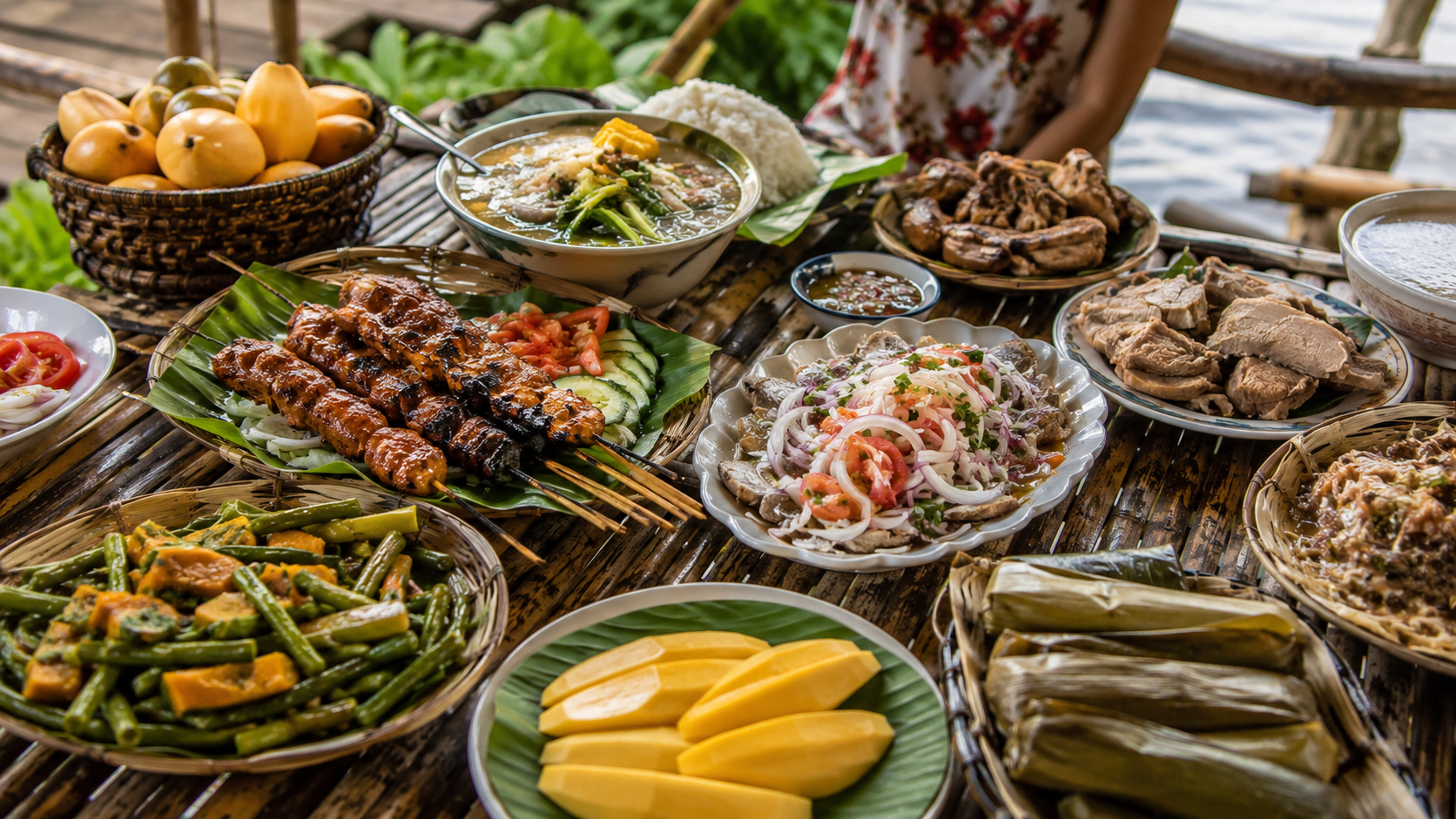
A boodle fight is kamayan at scale: banana leaves laid down the length of a table, rice heaped along them, grilled fish, meat, eggs, salted duck egg, tomatoes and fruit arranged on top, and everyone standing to eat together with their hands. The name and format come from the Philippine military, where it was designed to dissolve rank at the table, and that egalitarian logic still holds — nobody is served first, nobody gets a better seat.
Other customs worth knowing. Spoon and fork are the standard cutlery, not knife and fork; the spoon does the work and the fork pushes. You will be offered food constantly, and the ritual phrase is kain tayo — "let's eat" — said to anyone within earshot when you are eating. It is polite to accept at least a little. Pulutan is food eaten with drink, and it is where some of the country's best cooking lives. And pasalubong — the gift you bring home from a trip, almost always edible and regional — is a genuine institution: dried mangoes from Cebu, piaya from Bacolod, ube jam from Baguio, pastillas from Bulacan.
Sweets, halo-halo and the ube moment
Filipino desserts are their own world, shaped by a long sugar history and a deep affection for texture.
Halo-halo is the national dessert and the national argument. The name means "mix-mix", which is an instruction: a tall glass layered with shaved ice, evaporated milk, sweet beans, coconut strips, jackfruit, palm fruit, sweet plantain, leche flan, ube halaya and a scoop of ice cream, all of which you stir into a purple-brown slush before eating. It sounds chaotic and it is, deliberately. Good halo-halo has finely shaved ice and cold, fresh components; bad halo-halo is coarse ice and syrup. It is worth being fussy about.
Leche flan is the Spanish inheritance, made with egg yolks and condensed milk into something considerably denser than a European crème caramel. Bibingka and puto bumbong are Christmas breads — the first a rice cake baked in banana leaf with salted egg and cheese, the second a purple sticky-rice tube steamed in bamboo — both sold outside churches after the pre-dawn masses of Simbang Gabi in December. Puto is the everyday steamed rice cake, often eaten with savoury dishes rather than as dessert. Turon, maruya and ginataang bilo-bilo cover the fried and coconut-stewed end of the spectrum.
And then there is ube, the purple yam, which has become the most globally visible Filipino ingredient of the decade. At home it is ube halaya, a slow-cooked jam of grated purple yam, coconut milk and condensed milk, used in cakes, ice cream, pandesal and halo-halo. Abroad it has become a colour trend: ube exports have grown sharply, major international coffee chains have run ube drinks, and US restaurant menus featuring it have multiplied several times over in the past few years. The interesting twist is that demand has outpaced Philippine production, and the country has at times imported purple yam to meet its own needs. Eat it here, where it tastes of yam and coconut rather than of food colouring.
Coffee, tsokolate and what to drink
The Philippines has a coffee history that most visitors never hear about. In the nineteenth century it was one of the world's major coffee exporters, before disease destroyed the plantations. What survived is unusual: kapeng barako, grown mainly in Batangas and Cavite, is Liberica — a species barely cultivated anywhere else, with a heavy, almost aniseed-like aroma and a bluntness that suits condensed milk. Benguet coffee, from the Cordillera highlands, is a different animal entirely: Arabica grown at altitude, brighter and more floral, and the backbone of the country's speciality scene. Both are worth seeking out, and both are usually better bought at source than in a city café.
Tsokolate is thick hot chocolate made from tablea, pure roasted cacao pressed into discs, whisked with hot water or milk in a batirol. It is bitter, gritty and excellent, especially with bibingka. Philippine cacao — much of it from Davao — has quietly become very good.
For heat, nothing beats buko juice, coconut water drunk from the nut, ideally with the soft flesh scraped out afterwards. Sago't gulaman is a sweet street drink of tapioca pearls and jelly in brown sugar water. Fresh calamansi juice, hot or cold, is the standard non-alcoholic order.
Alcohol is straightforward. San Miguel dominates the beer market — Pale Pilsen is the classic, though the local craft scene in Manila, Cebu and Palawan has grown considerably. Lambanog is distilled coconut or nipa palm sap, clear, around 40 to 45 percent alcohol, drunk in the Quezon province heartland and increasingly bottled properly for export. Tuba is its unfermented ancestor: fresh palm sap, mildly alcoholic, sweet and sour, and drinkable for only a day or two before it turns to vinegar — which is precisely how much of the country's vinegar is made. Rum is the other national spirit; the Philippines has one of the world's best-selling rum brands.
Two practical notes: tap water is not drinkable in most of the country, and drinking is social here, so a bottle shared in a circle with pulutan is the norm rather than a round each.
Vegetarian and dietary realities
Honesty is more useful than optimism here. Filipino cuisine is meat-heavy and pork-centred, and vegetarian travel takes planning. Fish sauce, shrimp paste and pork stock appear in dishes that look plant-based, and a request for "no meat" is frequently understood as "no red meat" rather than as excluding fish or broth.
That said, the vegetable tradition is real. Pinakbet (though usually cooked with bagoong and pork), laing (taro leaves in coconut cream, sometimes made with dried fish), ginataang gulay (vegetables in coconut milk), ensaladang talong (grilled aubergine salad), lumpiang sariwa, chopsuey and monggo (mung bean stew, often with pork but easily made without) are all standard. Ask for dishes cooked sa gata — in coconut milk — and specify no bagoong, no patis, and no meat stock. The phrase hindi ako kumakain ng karne ("I don't eat meat") helps; walang bagoong ("no shrimp paste") helps more.
Cities are easier than provinces. Manila, Cebu, Baguio and the tourist centres of Palawan and Siargao all have committed vegetarian and vegan kitchens, and Buddhist-influenced Chinese restaurants are a reliable fallback. Fruit is abundant and outstanding — mango, mangosteen, lanzones, rambutan, pomelo, jackfruit, and durian if you are in Davao.
Gluten is generally manageable, since rice is the staple, but soy sauce is everywhere. Nut allergies require care around kare-kare and peanut sauces. And halal food is easy in Mindanao and increasingly available in Manila, but genuinely difficult in much of the Visayas and rural Luzon, where pork is the default.
Cooking classes, markets and food experiences worth your time
The best food experiences in the Philippines are the least formal, but a few are worth building a day around.
Market-to-table cooking classes exist in Manila, Cebu, Bohol, Iloilo, Vigan and Bacolod, and the good ones start at the palengke at dawn rather than in the kitchen. Learning to pick a souring agent, choose fish or judge coconut maturity is more useful than following a recipe.
Farm and estate visits have grown: cacao farms around Davao, coffee estates in Benguet and Batangas, heirloom rice terraces in Ifugao, and the sugar haciendas of Negros, where the food culture of Bacolod is inseparable from a complicated plantation past. A visit that includes that history is a better visit.
Fiestas and community meals remain the single best food experience in the country, and they cannot be bought — only timed and, ideally, arranged through someone local. This is where a good operator earns its fee.
Vinegar, salt and fish tours sound niche and are not: artisanal sea salt (asin tibuok in Bohol, made in clay vessels and nearly extinct), small-batch vinegar producers, and fish-drying communities give you the ingredients that everything else is built from.
If you want any of this to be more than luck, plan it with people who live there. Our Philippines planning guide sets out how to structure a slower itinerary, and the Philippines travel agencies we have vetted include operators who work directly with farming and fishing communities rather than with set-menu tourist restaurants.
Why food is the best way to understand the Philippines
Filipino cuisine is a record of everything that has happened to the archipelago. The vinegar-curing and coconut cooking are Austronesian and pre-colonial. The noodles, dumplings, soy sauce and lumpia came with centuries of Chinese trade. The adobo name, the leche flan, the fiestas and the lechon came with 333 years of Spain. The condensed milk, the fried chicken, the spam and the sweet spaghetti came with the American period. The palapa and halal traditions of the south trace to Islamic trade routes that reached Sulu long before Magellan.
No other part of Filipino life carries that history so plainly, or so unapologetically. And unlike a museum, it is offered to you — repeatedly, insistently, usually before you have asked.
That is also why the food rewards slowness. A week of restaurant meals in Manila will tell you very little. A month spent moving between a Pampanga lunch, a Cebu lechon stall, a Bicol kitchen and a Mindanao market will tell you almost everything, including things about class, religion, colonial history and family structure that nobody would say out loud. Filipino food does not need to be sold to you, and it does not oversell itself — which is precisely why it is worth taking seriously. The same principle underpins how we think about travel generally, set out in our slow travel charter.
Eat where the plastic chairs are. Accept the second helping. Learn to say salamat po.
Frequently Asked Questions
What is the national dish of the Philippines?
Adobo is the unofficial national dish — meat simmered in vinegar, soy sauce, garlic, bay leaf and pepper — though it has never been formally designated. Sinigang, the sour tamarind soup, is its constant rival and is arguably the dish Filipinos feel more strongly about. Lechon, the spit-roasted whole pig, is the ceremonial national dish in practice, appearing at every occasion that matters. If you want a single plate that explains the cuisine, order adobo; if you want the one that explains the palate, order sinigang.
Is Filipino food spicy?
Generally no. Unlike Thai or Indonesian cooking, most Filipino dishes are mild, and heat is added at the table through the vinegar-and-chilli dipping sauce, which means you control it. The major exception is Bicol, in south-eastern Luzon, where dishes like Bicol express and laing use large quantities of siling labuyo chilli in coconut milk. Parts of Mindanao, particularly Maranao cooking with its palapa condiment, are also genuinely hot. Elsewhere, expect sour and salty rather than spicy.
Is it safe to eat street food in the Philippines?
Broadly yes, with the same judgement you would use anywhere. Eat where there is a queue and high turnover, favour food cooked to order in front of you over anything sitting warm for hours, and go to carinderias at lunchtime rather than mid-afternoon. Grilled skewers and freshly fried items are low risk. Be more cautious with pre-shaved ice from unknown sources, uncooked shellfish, and raw preparations if your stomach is unaccustomed to travel. Drink bottled or filtered water; tap water is not safe in most of the country.
What should I eat for breakfast in the Philippines?
The silog family. The word combines sinangag (garlic fried rice) and itlog (fried egg), and the prefix names the protein: tapsilog with cured beef tapa, tocilog with sweet cured pork tocino, longsilog with garlic sausage, bangsilog with fried milkfish. Every version comes with a saucer of spiced vinegar. Alternatives include champorado (chocolate rice porridge, often with dried fish), arroz caldo (ginger chicken rice porridge), pandesal bread rolls with coffee, and taho from a street vendor.
Should I try balut, and what is it exactly?
Balut is a fertilised duck egg incubated for roughly 16 to 18 days, then boiled and eaten warm from the shell with salt or spiced vinegar. It is an everyday, inexpensive evening street food in the Philippines, not a challenge or a novelty. There is no obligation to eat it, and declining politely is completely normal. If you are curious, ask for a younger egg with a softer texture, sip the broth first, and eat it as the vendor does — quietly, standing up. What is genuinely unwelcome is treating it as a spectacle to film.
Can vegetarians eat well in the Philippines?
With planning, yes; without planning, it is difficult. The cuisine is meat-heavy and pork-centred, and fish sauce, shrimp paste and pork stock hide in dishes that look vegetable-based. Learn to ask for food sa gata (in coconut milk) with no bagoong, no patis and no meat, and lean on dishes like ginataang gulay, ensaladang talong, chopsuey, monggo and fresh lumpiang sariwa. Manila, Cebu, Baguio, Palawan and Siargao all have dedicated vegetarian and vegan kitchens; rural provinces have far fewer. The fruit, at least, is spectacular everywhere.
Which region has the best food in the Philippines?
Pampanga is the usual answer and the defensible one — Kapampangan cooking is the most technically ambitious in the country and gave the Philippines sisig, among much else. But the honest answer depends on what you want: Cebu for lechon, Bacolod and Negros for grilled chicken inasal and desserts, Iloilo for noodle soups and its UNESCO gastronomy credentials, Ilocos for frugal, vinegar-driven cooking and bagnet, Bicol for chilli and coconut, and Mindanao for the cuisines almost no visitor tries. Travelling between two or three of them beats any single city's restaurant scene.