

Vietnam's heritage reputation has been built on a short list of very photogenic places: a limestone bay, a lantern-lit trading town, an imperial citadel, a cave system. In July 2025 something different joined them. The UNESCO World Heritage Committee, meeting for its 47th session, inscribed the Yen Tu, Vinh Nghiem, Con Son and Kiep Bac Complex of Monuments and Landscapes as the country's ninth World Heritage property. It is not a single site, it is not compact, and it cannot be seen properly from a boat or a viewing platform. That makes it the most interesting thing to happen to Vietnamese heritage travel in years.
What Was Actually Inscribed
The property is a serial listing: twelve component sites spread across forested mountains, lowland valleys and river plains in what are now the provinces and cities of Quang Ninh, Bac Ninh and Hai Phong, following the 2025 redrawing of Vietnam's administrative map. The core zone covers roughly 525.75 hectares, with a buffer zone of about 4,380.19 hectares around it.
Three clusters anchor the whole. Yen Tu mountain in Quang Ninh is the spiritual centre, a long ridge of pagodas, hermitages and stupas climbing to the bronze Dong Pagoda at 1,068 metres. Vinh Nghiem Pagoda, in what was Bac Giang, is the scholarly heart, holding an archive of woodblocks already recognised on UNESCO's Memory of the World register for Asia and the Pacific. Con Son and Kiep Bac, in the former Hai Duong, tie the religious story to the political one, associated with the strategist Tran Hung Dao and the scholar-poet Nguyen Trai.
What holds them together is not architecture but an idea. This is the landscape of Truc Lam, the distinctly Vietnamese school of Zen Buddhism founded at the end of the thirteenth century by King Tran Nhan Tong, who won a war against the Mongols, abdicated the throne, walked up a mountain and became a monk. The listing recognises a living religious tradition and the terrain that shaped it, which is a very different proposition from recognising a building.
One request. Up to five tailored proposals.
Skip contacting agencies one by one — share your trip once and let up to five trusted Vietnam agencies come to you. Free, with no obligation.
Get my free quotesWhy a Zen King Matters to the Map
Most travellers arrive in Vietnam with a mental model of the country built from the twentieth century forwards. The Tran dynasty, Truc Lam and the idea of a monarch who chose the forest over the palace rarely feature. Yet this story is embedded in ordinary Vietnamese life in a way the war sites are not: Yen Tu draws hundreds of thousands of pilgrims each spring, and for many families the climb is a rite performed once in a lifetime or once a decade.
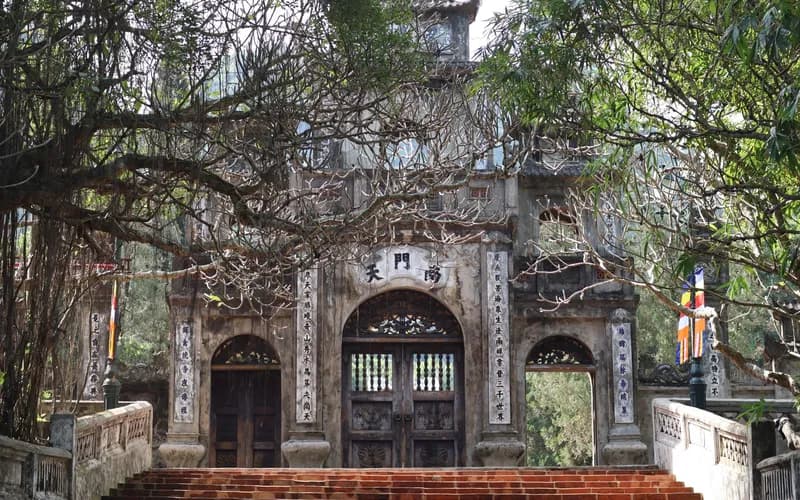
For a traveller interested in why a place feels the way it does, that matters. Walking Yen Tu among people who are there to pray rather than to photograph is one of the few remaining experiences in northern Vietnam where the visitor is clearly the minority. It also demands a level of care that a bay cruise does not. Our guide to cultural etiquette in Vietnamese temples and villages covers the practical side: dress, offerings, photography, and when to simply stand still.
The Listing Lands in a Record Year
Timing matters. Vietnam recorded roughly 12.3 million international arrivals in the first half of 2026, up close to 15 percent year on year, and domestic travel has grown into an enormous market in its own right, with more than 135 million domestic trips counted in 2025. A new World Heritage listing does not enter a quiet system. It enters one already running hot.
The commercial response has been immediate. Tour operators have added Yen Tu to Ha Long Bay itineraries as a half-day cultural bolt-on. Hotel groups have talked up the Quang Ninh corridor. Provincial authorities have staged ceremonies, festivals and certificate handovers. The Yen Tu Spring Festival opened on the tenth day of the first lunar month in 2026, its first festive season as a World Heritage site, and drew the crowds you would expect.
This fits a wider pattern we have written about before: Vietnamese tourism is deliberately shifting toward value per visitor rather than raw volume, a change explored in our analysis of Vietnam's premiumization shift. Heritage of this kind is attractive to planners precisely because it supports longer, higher-spending, multi-day itineraries instead of a single photograph.
Get matched with up to 5 trusted Vietnam agencies
- Free
- No obligation
- Up to 5 agencies
What Changes on the Ground in 2026
Several practical things have shifted, and travellers should check each one rather than assume.
- Access at Yen Tu is a two-part decision: you can walk the pilgrim path, roughly six kilometres of stone steps and forest, or take the cable car, which runs in two sections. A round trip covering both cable-car sections has been priced at around 430,000 dong including the shuttle and site ticket, with single sections at about 200,000 dong one way and 280,000 return.
- Quang Ninh has moved to waive the site's general sightseeing charge for a multi-year period beginning in 2026. Reporting on the exact scope and end date has been inconsistent, so treat it as likely rather than certain and confirm at the gate. The cable car remains a separate commercial ticket in any case.
- The three clusters sit in different provinces under new administrative names. Booking platforms and older signage still use the pre-2025 labels, which causes real confusion when arranging transport.
- Conservation management has tightened inside the core zone, which in practice means more marshalling at festival times and more restrictions on where vehicles can go.
None of this is dramatic on its own. Together it means the site is being formalised quickly, and the version of Yen Tu described in a blog post from three years ago is not the version you will find.
The Slow Traveller's Version
The obvious way to do Yen Tu is the way most operators sell it: a bus from Ha Long or Hanoi, the cable car up, an hour at the summit, back down by mid-afternoon. It works, and it misses almost everything.
The alternative takes two or three days. Sleep near the mountain and start the walk before seven, when the steps are cool and the forest is loud. Give the ascent four to five hours rather than one, stopping at Hoa Yen Pagoda and the stupa garden, both of which most day-trippers pass in minutes. Come down by cable car if your knees prefer it. Then, on a second day, drive to Vinh Nghiem for the woodblock archive, which is quiet on any ordinary weekday and explains the intellectual side of Truc Lam far better than the summit does. A third day at Con Son and Kiep Bac closes the loop between religion, scholarship and statecraft.
Done this way the listing stops being a tick and becomes a coherent journey through a single idea. It also spreads visitors across twelve sites rather than concentrating them on one summit, which is exactly what the property needs.
What the Listing Does Not Fix
Honesty matters here. World Heritage status is not protection, it is attention, and attention cuts both ways.
Yen Tu already had cable cars, a large resort complex at its base and a fully commercialised festival season before UNESCO arrived. The inscription does not undo any of that, and the pressure now runs toward more development in the buffer zone rather than less. Spring festival months bring genuine crowding on the upper steps, with queues at the Dong Pagoda that can run to hours. The quiet, contemplative Yen Tu exists mostly on weekdays outside the lunar new year period.
There is also a risk familiar from elsewhere in the country. Nearby Ha Long has spent years managing the consequences of concentration, and travellers looking for a calmer version of that seascape increasingly head for the alternative described in our piece on Cat Ba Island and Lan Ha Bay. The same dynamic will play out here if the whole property is marketed through one photogenic summit.
How This Fits Vietnam's Wider Heritage Turn
The listing is one signal among several. Provincial governments across Vietnam are investing in cultural and spiritual tourism because it is less seasonal than beaches, less weather-dependent than trekking, and appeals strongly to the domestic market. Craft villages, pagoda circuits, festival calendars and highland cultural weeks are all being formalised at the same time, including on plateaus far from the coast such as the tea country described in our guide to Moc Chau in the northwest.
For the slow traveller the implication is straightforward and rather encouraging. The country's tourism strategy and the values of unhurried travel are, for once, pointing in the same direction: longer stays, inland routes, cultural depth, shoulder seasons. The risk is that the execution defaults to volume anyway. Which version wins will depend heavily on how individual travellers and operators behave over the next few years, a point we set out in our slow travel charter.
What to Do Next
- Decide whether you want the summit or the story. If it is the story, budget two to three days and plan to visit at least two of the three clusters.
- Avoid the lunar new year window and the weeks that follow it unless the festival itself is the reason you are going.
- Confirm current ticketing directly with the site or your operator, including whether the sightseeing fee waiver applies to you and what the cable car costs on the day.
- Check the current provincial names for Vinh Nghiem and Con Son when arranging transport, since older listings use pre-2025 labels.
- Walk at least part of the pilgrim path rather than riding both cable-car sections. The forest is half the point.
- If you want the three clusters woven into a wider northern route, work with an operator who knows the region rather than booking three separate day trips.
Frequently Asked Questions
When exactly was the Yen Tu complex inscribed by UNESCO?
The World Heritage Committee inscribed the Yen Tu, Vinh Nghiem, Con Son and Kiep Bac Complex of Monuments and Landscapes in July 2025, at its 47th session. It became Vietnam's ninth World Heritage property and its first inter-provincial serial listing of this kind.
Can I see the whole property in one day?
No. The twelve component sites are spread across three provinces and several hours of driving. A single day realistically covers Yen Tu mountain alone, and only its main axis. Two to three days is the minimum for a coherent visit to all three clusters.
Is it free to visit Yen Tu in 2026?
Quang Ninh has moved to waive the general sightseeing charge at Yen Tu for a multi-year period starting in 2026, but the reporting on scope and duration has not been consistent, and the cable car is a separate commercial ticket regardless. Assume you will pay for the cable car and confirm the sightseeing fee at the entrance.
How hard is the walk up to Dong Pagoda?
It is a sustained climb of roughly six kilometres on stone steps, with a total ascent to 1,068 metres. Reasonably fit walkers take four to five hours up, and the descent is harder on the knees than the ascent is on the lungs. Many pilgrims walk up and take the cable car down.
When is the quietest time to visit?
Weekdays outside the lunar new year period, which usually falls in late January or February. The spring festival season is spectacular but extremely busy, and the upper sections can involve long queues. Autumn weekdays offer the best combination of clear weather and space.
Does the UNESCO listing mean the site will be better protected?
Inscription brings management obligations, monitoring and international scrutiny, but it does not freeze development, particularly in the buffer zone. Yen Tu was already heavily commercialised at its base before 2025. Realistically, listing raises both protection and visitor numbers at the same time.
Is this worth adding to a first trip to Vietnam?
If your interest is landscape and beaches, probably not on a first two-week trip. If you are drawn to religious history, architecture or the intellectual roots of Vietnamese culture, it is one of the most rewarding things in the north and far less visited by foreigners than its status suggests.