

Vietnam's northwest is usually sold as a loop: Hanoi, Mai Chau, Son La, Dien Bien, and home again. Moc Chau is the place most groups drive through on the first afternoon and remember as a photograph of a tea hill shaped like a heart. Give it four days instead and it stops being a waypoint. It becomes a plateau with its own weather, its own farming calendar, and a pace that has very little to do with the rest of the itinerary.
Where Moc Chau Actually Sits
Moc Chau lies in Son La province, roughly 190 to 200 kilometres west of Hanoi along Highway 6. The plateau sits at around 1,000 metres above sea level, and that altitude is the single most important fact about the place. It is why the tea grows, why strawberries ripen in the cold months, why nights can be cool enough for a blanket in July, and why dairy herds — genuinely unusual in tropical Vietnam — have grazed here since state farms were established in the 1950s. Moc Chau does not feel like the rest of Son La, and it certainly does not feel like the Red River Delta you left that morning.
The administrative picture has shifted more than once in recent years, first with the upgrading of Moc Chau town and then with the nationwide restructuring of provincial and commune boundaries. Signage, booking platforms and older guidebooks have not all caught up. In practice this matters less than it sounds: drivers know where the tea hills are, and locals still use the old district names in conversation. But if a map label and a road sign disagree, trust the road sign and ask.
Immediately to the east lies Van Ho, lower, greener and quieter, with a scattering of community-run homestays and far fewer weekend visitors. Travellers who find Moc Chau town itself too developed often end up basing themselves there instead. If you are still shaping the wider route, our guide to Vietnam off the beaten path sets out where a plateau like this fits between the delta and the far north.
One request. Up to five tailored proposals.
Skip contacting agencies one by one — share your trip once and let up to five trusted Vietnam agencies come to you. Free, with no obligation.
Get my free quotesThe Tea Hills, and How to See Them Properly
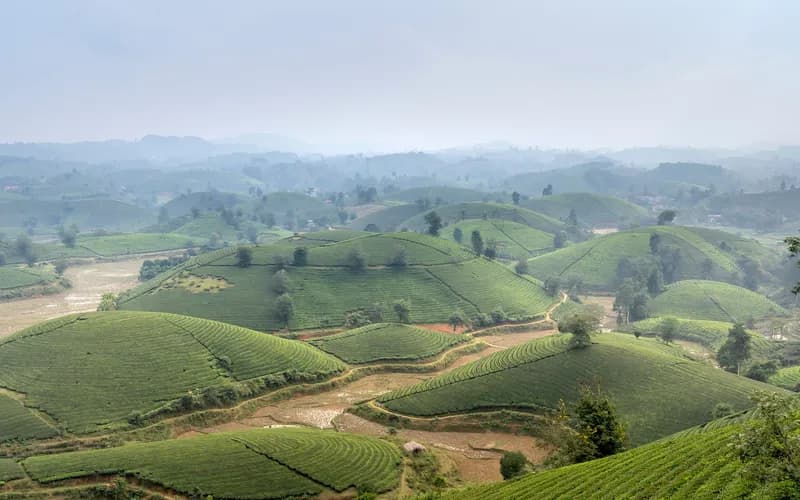
The tea is the reason most people come and the thing most people get wrong. The celebrated shapes — the heart-shaped hill, the long S-curve on the road toward Ngu Dong cave roughly fifteen kilometres from the town centre — are genuinely beautiful. They are also managed viewpoints, with parking attendants, a small entrance fee of a few tens of thousands of dong, costume rental stalls, and, at weekends, a queue of people waiting their turn on the same patch of grass.
The better version of Moc Chau's tea costs nothing at all. The working plantations around Tan Lap and Dai Loan spread over hillsides that you can simply walk into on farm tracks, provided you stay on the paths between the rows and do not trample the bushes. Pickers start not long after first light, moving along the contours with baskets on their backs, and by nine the mist has usually burned off the ridges. Several producers sell directly from the roadside or from small drying sheds; buying a hundred grams of green tea from the family that grew it costs less than a coffee in Hanoi and is a far better souvenir than anything in the town's gift shops.
The plateau's tea is mostly green, much of it grown for the Taiwanese and Japanese markets, and the processing sheds are worth asking about. Some will let you look in during the withering and rolling stages if you arrive at the right hour and ask politely rather than wandering in with a camera raised.
A Calendar Built on Blossom and Harvest
Moc Chau is one of the few places in Vietnam where the question is not really about rain but about what is flowering or ripening. Roughly speaking, January and February bring the plum and peach blossom, with the white plum blossom in the Na Ka valley drawing domestic visitors in large numbers around the lunar new year. Strawberries run through the cool months into early spring. The plum harvest itself arrives around May and June, when whole hillsides of fruit come down and roadside sellers weigh out bags by the kilo.
Tea is plucked in flushes across the warm months, so the hills look their most sculpted from spring through autumn. Dai Yem waterfall has real volume from about April to September and can be disappointing outside that window. October and November tend to give the clearest air and the longest views, which is why photographers favour them. Winter brings fog that can sit on the plateau for days — atmospheric if you have time, frustrating if you have one afternoon. It is worth checking the regional weather pattern for the northwest before you commit to dates.
Get matched with up to 5 trusted Vietnam agencies
- Free
- No obligation
- Up to 5 agencies
Villages, Stilt Houses and Who Actually Lives Here
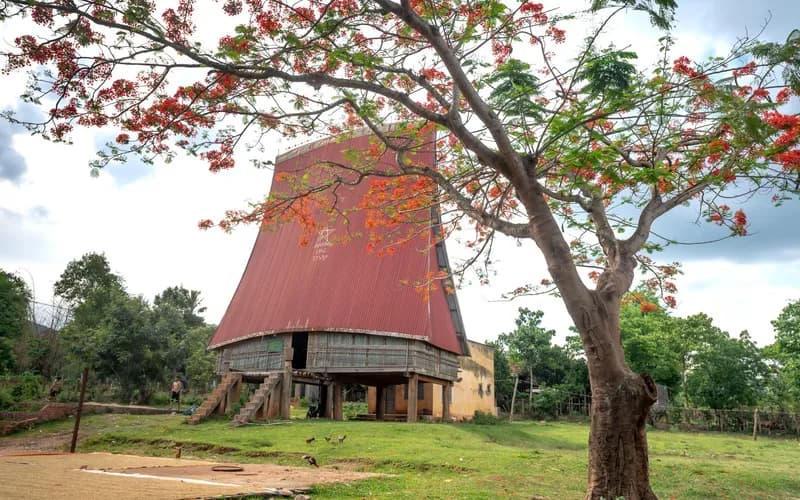
The plateau is home to H'Mong, Thai, Dao and Muong communities, alongside Kinh families who arrived with the state farms. This is not a museum landscape: the stilt houses you pass are lived in, the looms are working looms, and the markets are for buying vegetables, not experiences. That distinction shapes how a visit should feel.
The most rewarding hours here are usually the least programmed ones — sitting in a village kitchen while the rice steams, walking a track between maize plots, being shown a length of indigo-dyed cloth by the woman who dyed it. Some communities in Van Ho have organised themselves into small homestay networks with agreed prices and rotating hosts, which keeps the money local and the pressure low. If you have not stayed in a Vietnamese family home before, our practical guide to homestays covers booking, costs and the etiquette that makes the difference between a guest and a customer.
A word on photography. Ask before pointing a lens at anyone, especially children and elderly women in traditional dress, and accept a refusal gracefully. In villages that see regular visitors, some households now expect a small payment for portraits; that is a fair transaction, and it is better handled openly than avoided.
Waterfalls, Caves and the Long Walk Up Pha Luong
Dai Yem is the best-known waterfall, a two-tier drop of around fifty metres set among terraced fields, easy to reach and correspondingly busy at weekends. Ngu Dong Ban On, a cave complex near the tea hills, is worth an hour with a torch. Moc Chau Island, further out, has built a leisure complex around a long glass bridge and a set of viewpoints; it is popular with domestic families and entirely skippable if that is not your kind of day.
The serious walk is Pha Luong, a peak of roughly 2,000 metres sitting directly on the Laos border, with a summit slab that ends in a genuine drop. The ascent takes around three hours of steep, exposed climbing. Because it is a border zone, access is controlled: you register at the border post, and in practice most foreign travellers arrange it through a local guide who handles the paperwork. Rules here change, and they occasionally close the route entirely, so treat any online account more than a year old as unreliable and confirm on the ground. If you are weighing this against the better-known northern routes, compare grades, guiding standards and rescue arrangements before committing.
Getting There, and Getting Around Once You Arrive
There is no railway and no airport. Everything arrives by road on Highway 6. Buses leave Hanoi through the day from roughly half past six in the morning until nine at night and take about six hours; faster minivans do the run in four to five, with fares typically in the region of 200,000 to 280,000 dong. The road climbs steadily and includes long stretches shared with freight traffic, which is the main reason to think carefully about how you travel it.
Once you are on the plateau, distances are real. The tea hills, the waterfall, the caves and the outlying villages are spread across ten to thirty kilometres of winding road. A motorbike gives the most freedom and is what most independent travellers use, though the combination of fog, gravel and trucks deserves respect. The calmer option, particularly for two or more people or anyone arriving in the wet months, is a car with a driver for a day or two, which also lets you keep bags with you between stops. Our guide to hiring a car and driver in Vietnam explains what a fair day rate looks like and what is normally included.
Where to Stay, and How Long to Give It
Accommodation splits three ways. Moc Chau town has straightforward hotels and guesthouses, convenient and unremarkable. Scattered across the plateau are homestays and small lodges, some genuinely family-run, others styled for the domestic weekend market with photo props in the garden. Van Ho and the surrounding valleys hold the quietest options, including community homestays and a small number of well-run eco-lodges.
Three nights is the working minimum: one to arrive and adjust, one for the tea hills and villages at a walking pace, one for a waterfall, a cave or the long climb. Four nights lets you absorb a foggy morning without losing the trip. Anything shorter and you will spend most of your time on the road from Hanoi.
The Honest Caveats
Moc Chau is popular with Vietnamese travellers, and weekends and public holidays transform it. The Moc Chau Cultural and Tourism Week, held from 31 August to 5 September in 2026, fills beds across the plateau and brings crowds along with its dance, sport and market programme — excellent if that is what you came for, difficult if it is not. Prices for rooms roughly double around the lunar new year blossom season.
Development is visible. New viewpoints, cafés and photo installations appear each year, and some of the most-shared images online show places that now have a ticket booth and a fence. This is the same pattern playing out across the country, described in our piece on how overtourism is redrawing Vietnam's travel map. Moc Chau is early in that curve rather than late, which is precisely the argument for going now and going slowly.
Finally, the weather is genuinely changeable. Bring a warm layer in any season and waterproofs between May and September.
What to Do Next
- Fix your dates around what you actually want to see: blossom in January and February, plum harvest in May and June, clearest views in October and November.
- Decide your base — Moc Chau town for convenience, Van Ho for quiet — and book at least the first two nights ahead if your trip falls on a weekend.
- Choose your transport honestly. Minivan from Hanoi if you are travelling light; car and driver if you are two or more, carrying bags, or coming in the rains.
- Build in one unstructured morning for the working tea hills, before nine, on foot.
- If Pha Luong interests you, contact a local guide well in advance and confirm that the route is open and the permit process unchanged.
- Talk to a specialist if you want the plateau woven into a longer northwest route rather than treated as a stop. Start with our plan your journey page.
Frequently Asked Questions
How many days do I need in Moc Chau?
Three nights is the sensible minimum given the four-to-six-hour drive from Hanoi in each direction. Four nights gives you room to lose a morning to fog or rain without cutting anything. Day trips from Hanoi exist but involve roughly ten hours in a vehicle for a few hours on the plateau, which defeats the purpose.
When is the best time to visit?
There is no single answer, because the plateau's appeal is seasonal rather than weather-driven. January and February for plum and peach blossom, May and June for the plum harvest, October and November for clear air and long views, and April to September if the waterfall is a priority. Winter fog is common and can be either atmospheric or obstructive.
Do I need a permit to visit Moc Chau?
No permit is required for the plateau itself, the tea hills, the villages or the waterfalls. Pha Luong peak is different, because it sits on the Laos border and lies within a controlled zone requiring registration at the border post. Access rules there change, so confirm locally rather than relying on older accounts.
Is Moc Chau better than Sa Pa or Mu Cang Chai?
It is different rather than better. Sa Pa is far more developed and far busier; Mu Cang Chai is defined by rice terraces and a short, spectacular harvest window. Moc Chau is gentler, greener year-round, and much closer to Hanoi. Travellers who want mountain drama usually prefer the others; travellers who want an unhurried working landscape often prefer this one.
Can I get around without a motorbike?
Yes. Cars with drivers are readily arranged in Moc Chau town and through most accommodation, and are the standard choice for families, older travellers and anyone visiting in the wet season. Ride-hailing coverage is thin outside the town centre, so arrange transport in advance rather than assuming you can summon it.
Is Moc Chau suitable for travellers who do not want to trek?
Very much so. The tea hills, dairy farms, blossom valleys, waterfalls and villages are all accessible by short walks from a vehicle. The plateau rewards slow observation more than physical effort, and only Pha Luong demands real fitness.
Where should I stay for the quietest experience?
Van Ho and the valleys east of Moc Chau town hold the quietest accommodation, including community homestays where several households share the visitors between them. Expect simpler facilities, warmer hospitality and considerably less weekend noise than on the main plateau road.