

Two numbers define Cambodian tourism in 2026, and they point in opposite directions. International arrivals fell 47.8 percent in the first five months of the year, from 2.95 million to 1.54 million. Over roughly the same period, Cambodians took more than 20.3 million domestic trips, a rise of 54.2 percent year on year. For the first time in the modern history of Cambodian travel, the domestic market is not a footnote to the foreign one. It is the market. That reversal is quietly changing what a visitor finds on the ground, and mostly for the better.
What Actually Happened to Foreign Arrivals
The collapse is real but it is not mysterious. Three things converged. The Cambodia-Thailand land border dispute cut off what had been the single largest overland source of visitors, and Thai arrivals — historically a huge share of the total — essentially vanished. Sustained international coverage of online scam compounds operating from Cambodian territory damaged the country's reputation in source markets that had never thought much about Cambodia one way or the other. And broader regional and global instability trimmed long-haul discretionary travel.
The damage is uneven. Siem Reap province took the hardest hit, with foreign arrivals down around 32 percent and Angkor ticket revenue falling with them. Phnom Penh dipped only about 5.5 percent. Sihanoukville International Airport, remarkably, ran the other way entirely, with arrivals up more than 100 percent from a small base. We looked at that coastal shift in more detail in Cambodia's 2026 tourism shift.
The Ministry of Tourism has published three scenarios for the full year: 4.6 to 4.8 million foreign visitors if current conditions persist, 5.3 to 5.5 million if things improve but the Thai border stays shut, and 6.1 to 6.3 million only if everything resolves. None of those match 2025's 5.6 million with room to spare.
One request. Up to five tailored proposals.
Skip contacting agencies one by one — share your trip once and let up to five trusted Cambodia agencies come to you. Free, with no obligation.
Get my free quotesThe Domestic Surge Is Not a Statistical Trick
It is tempting to dismiss 20 million domestic trips as an accounting artefact — day-trippers counted generously, holiday weekends inflating the total. Some of that is true. Of the 21 million recorded over the three-day Khmer New Year holiday in April, roughly 19.9 million were day visits and only about 1.14 million were overnight stays.
But the trend holds outside holiday peaks. First-quarter domestic trips alone reached 6.02 million, up 58.9 percent. Overnight domestic stays are growing faster than day trips in percentage terms. And the structural drivers are durable: a young population, rising middle-class incomes, a rapidly expanding expressway network, and a generation of Cambodians who have the money and the road access to see their own country for the first time.
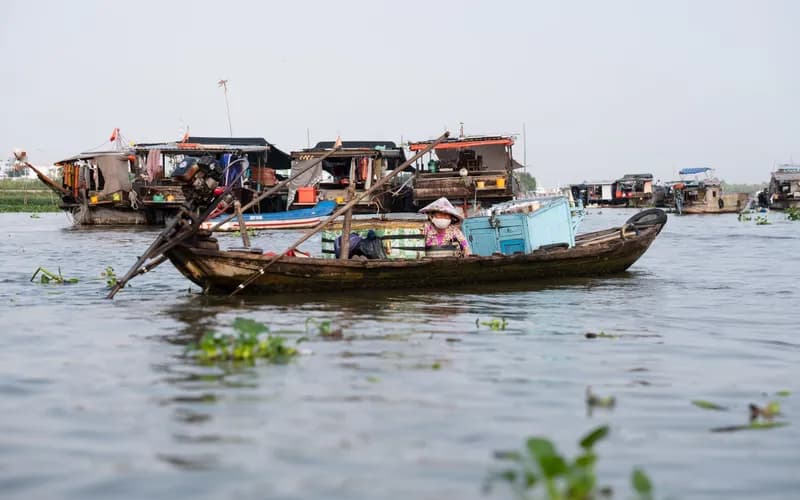
The government has leaned into this deliberately. The Visit Cambodia in the Green Season 2026 campaign, running May to October, is explicitly aimed at getting Cambodians to travel domestically during the rainy months, with a stated focus on lesser-known rural destinations and community ecotourism sites rather than the established circuit.
What Domestic Travellers Actually Want
This matters to visitors because Khmer travellers do not want the same things foreign travellers want, and businesses follow the money.
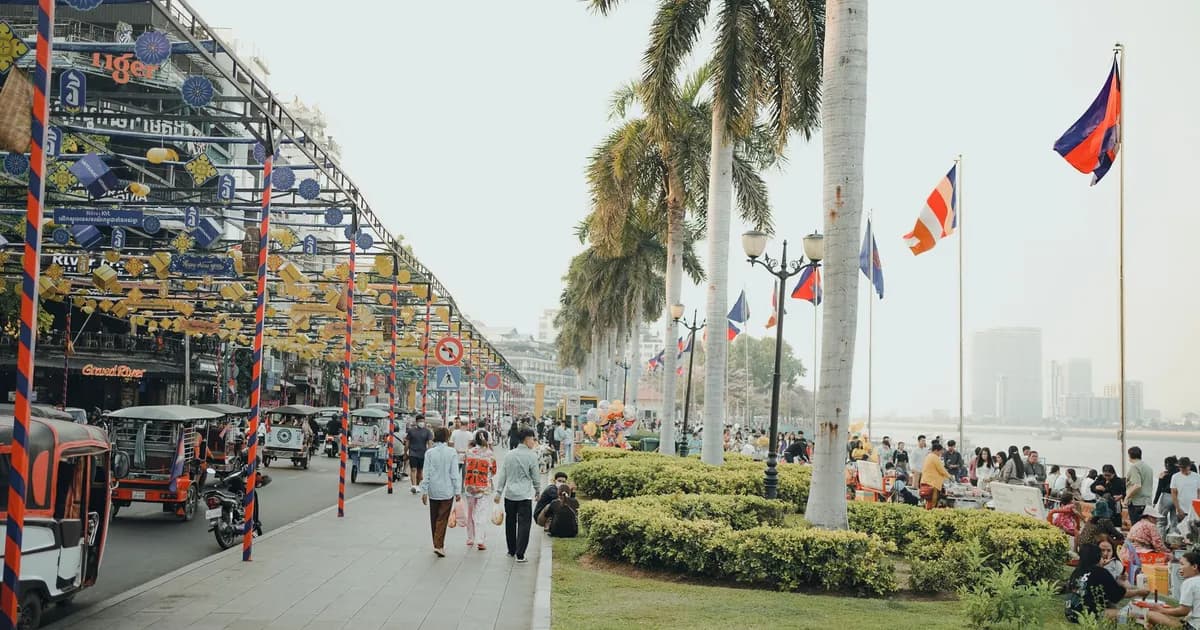
Cambodian domestic tourists travel in extended family groups, often three generations. They travel by car or minivan rather than by air. They favour water — riverside picnic platforms, waterfalls, the coast — over temples, which they have often seen and which carry religious rather than sightseeing weight. They eat at large, loud, open-sided restaurants that foreign guidebooks have never heard of. They travel heavily around public holidays and much less midweek. And they are extremely price-sensitive in a way that international visitors, converting from stronger currencies, are not.
The visible results are already showing up. Waterfall sites in Mondulkiri and Ratanakiri that once saw a handful of foreign visitors a day now have proper parking, food stalls and weekend crowds. Coastal towns are adding mid-range family rooms rather than boutique doubles. Kampot's riverfront and Kep's crab market operate on a Khmer weekend rhythm now, and both are covered in our piece on Kampot and Kep.
Get matched with up to 5 trusted Cambodia agencies
- Free
- No obligation
- Up to 5 agencies
The Upside for Slow Travellers
If you are the kind of traveller who came for depth rather than a checklist, 2026 is an unusually good year to be in Cambodia, and it is worth saying so without pretending the downturn is costless.
Angkor is quieter than it has been at any point since the pandemic. Sunrise at Angkor Wat is still busy, but the outer temples on a weekday afternoon can be close to empty. Guides who were fully booked two years ago have availability. Accommodation rates in Siem Reap have softened materially. Domestic flights and buses run with spare capacity.
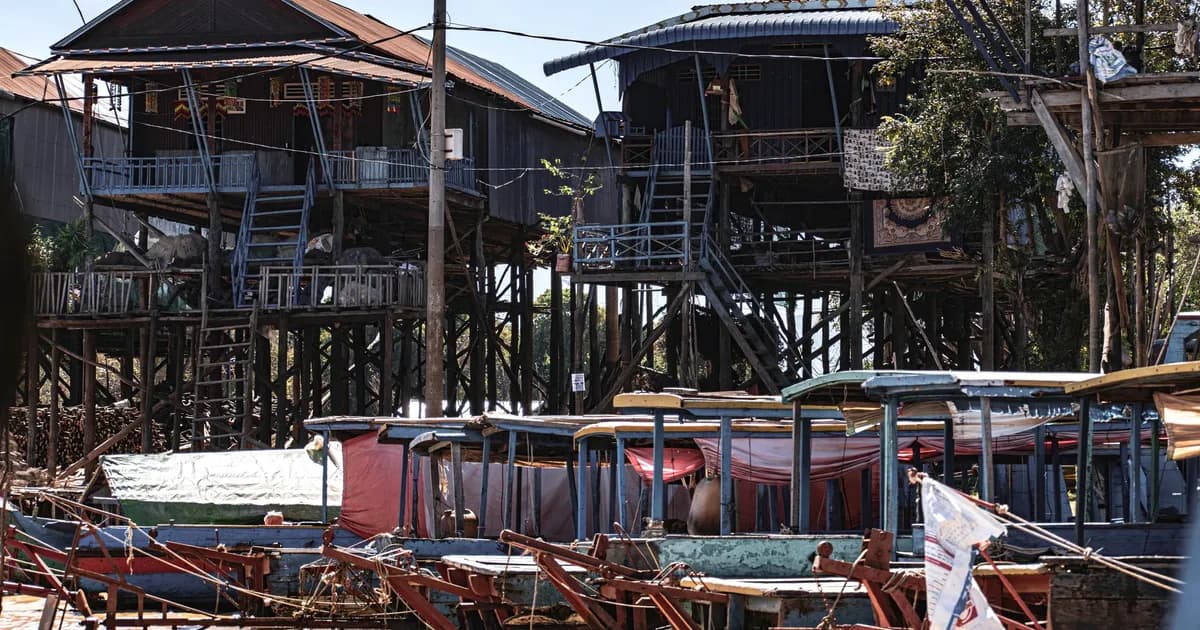
More interestingly, the infrastructure being built for Khmer travellers is infrastructure that suits slow travel too: better roads to secondary provinces, more homestays and community lodges in places that previously had nothing, food options in towns that used to offer one guesthouse restaurant. The community ecotourism sector documented in Cambodia's forest turn has been partly kept alive by domestic demand during a year when foreign bookings dried up.
The Downside, Stated Honestly
A 48 percent fall in foreign arrivals is not a good thing for the people who live there. Tour guides, drivers, hotel staff and craft producers who rebuilt their livelihoods after 2020 are being hit again. Domestic spending does not replace foreign spending one for one — average domestic spend per trip is a fraction of international spend, and day-trippers spend least of all.
Some businesses will not survive the year. In Siem Reap in particular you will find closed restaurants, shuttered boutiques and hotels running on skeleton staff. That is uncomfortable to walk past, and it should be.
There are practical consequences too. Reduced foreign demand means thinner flight schedules on some routes, fewer scheduled boat services, and English-language tour capacity that has contracted. Some community projects that depended on foreign group bookings are running at a loss. Booking ahead is less necessary than it was, but confirming that a service still operates is more necessary than it was.
The Road Network Is the Real Engine
It is worth pausing on why this shift happened now rather than a decade ago, because the answer is concrete rather than cultural. Cambodia's domestic travel boom rests on tarmac. The Phnom Penh to Sihanoukville expressway cut a journey that used to take five or six punishing hours down to roughly two, which converted the coast from a serious expedition into a plausible weekend. National Road upgrades toward Kampot, Battambang and the northeast did the same on a smaller scale. A second expressway toward the Vietnamese border is under construction.
That matters because Cambodian families travel by car, and car ownership among urban middle-income households has climbed steadily. When a destination moves inside a three-hour drive of Phnom Penh, its weekend visitor numbers change immediately and permanently. Every road project effectively creates a new domestic destination.
The same roads carry foreign travellers, of course, and the practical implications for overland routing are set out in our piece on Cambodia's expressways. What is new is that the primary user of that infrastructure is now Cambodian, and planners increasingly design for that user first.
What This Means for How You Travel
Three practical adjustments follow from all of this.
First, invert the calendar. Because domestic tourism is holiday-driven, the busiest days at Cambodian beaches, waterfalls and river sites are now Khmer public holidays and weekends, not the northern-hemisphere high season. Travel midweek and you will have places to yourself; arrive at Kep on a Sunday in April and you will not.
Second, spend where it lands. A guide costs the same whether the country is booming or not, and in a bad year that fee matters more. Choosing an operator with local staff and transparent pay is the single highest-leverage decision a visitor makes. Our directory of vetted Cambodian travel agencies exists for exactly this.
Third, go where the domestic market has built something and the foreign market has not caught up. The northeast, the Cardamoms, the Mekong river towns and the smaller coastal spots all now have workable infrastructure and very few international visitors. That combination does not last.
Will It Reverse?
Probably, partially, and not quickly. Authorities have implemented a package of remedial measures and were, as of early August 2026, actively reviewing visa-free entry for several priority source markets, alongside a pilot visa-free scheme for Chinese citizens. A resolution of the Thai border situation would restore a large chunk of the lost volume almost immediately, since much of it was overland day and short-stay traffic.
What will not reverse is the domestic market. Cambodian household travel is a structural shift driven by income and roads, not a cyclical blip, and it will keep growing whatever happens to foreign arrivals. Within a few years it is likely to be the dominant force shaping where hotels get built and which roads get paved. Travellers who understand that will read the country more accurately than those still using a 2019 map.
What to Do Next
- Consider 2026 and early 2027 an opportunity window for Angkor and Siem Reap specifically, where the quiet is most pronounced.
- Check the Khmer public holiday calendar before booking beaches, waterfalls or river towns, and deliberately avoid those dates.
- Confirm that boats, buses and community lodges are actually operating this season rather than assuming last year's schedule holds.
- Budget the same as you would have in a busy year and spend the difference on guides, homestays and locally owned kitchens.
- Add one province you had not planned on — Mondulkiri, Stung Treng, Koh Kong — while the road access is new and the visitor numbers are not.
- Read our budgeting guide for Cambodia to see where softer prices actually show up.
- Start shaping the route with plan your Cambodia journey.
Frequently Asked Questions
Is it insensitive to travel to Cambodia during a tourism downturn?
The opposite. A downturn caused by border politics and reputational damage is not a safety problem for visitors, and the people most affected are the ones who earn from visitors. Travelling thoughtfully, staying longer and spending with local operators is materially more useful than staying away.
Are prices actually lower in 2026?
In some places, yes. Siem Reap accommodation has softened noticeably, and guides and drivers have availability they did not have two years ago. Elsewhere the effect is muted, because domestic demand has picked up the slack in coastal and provincial destinations. Entrance fees, transport fares and food prices are largely unchanged.
Which parts of Cambodia are busiest now?
Coastal and provincial sites on Khmer weekends and public holidays, especially Kep, Kampot, the Sihanoukville-area beaches, and waterfall sites in the northeast. Angkor and Siem Reap, historically the busiest places in the country, are currently among the quietest relative to their capacity.
Is the Thailand land border still closed?
The land border situation has disrupted overland travel between the two countries throughout 2026 and remains the single biggest factor in the arrivals decline. Check the current position before planning any overland routing, and see our dedicated piece on the Thailand-Cambodia land border.
Does the scam-compound coverage affect ordinary travellers?
Not in any practical sense. The operations described in international reporting target victims online and recruit workers through fraudulent job offers; they have no interaction with tourists. The effect on travellers is indirect: harsher government travel notices, and a reputational hit that has kept some visitors away.
Will Angkor stay quiet?
Not indefinitely. If the border reopens and the visa-free proposals go ahead, volumes will recover on a timescale of months rather than years for regional markets. The current quiet at the outer temples is a real but temporary condition.
How do I travel in a way that helps most?
Stay longer in fewer places, use locally owned accommodation, hire local guides directly rather than through international intermediaries, eat at Cambodian-run kitchens, and buy craft from producers rather than resellers. None of that requires spending more. It changes where the money lands.